• About Me

Kevin M. Watson

Kevin M. Watson

Tag Archives: Band meeting

John Wesley’s Theology: A Great Question (and Better Answer) about Band Meetings

13 Tuesday May 2025

Posted by Kevin M. Watson in Accountability, Christian Living, Holiness, Methodist History, Teaching, Wesley

≈ Leave a comment

Tags

Band meeting, Bible, Christianity, faith, God, Jesus, John Wesley, Methodism, Methodist, New birth, sin, small groups, Wesley

I want to share one of my favorite memories from teaching this semester.

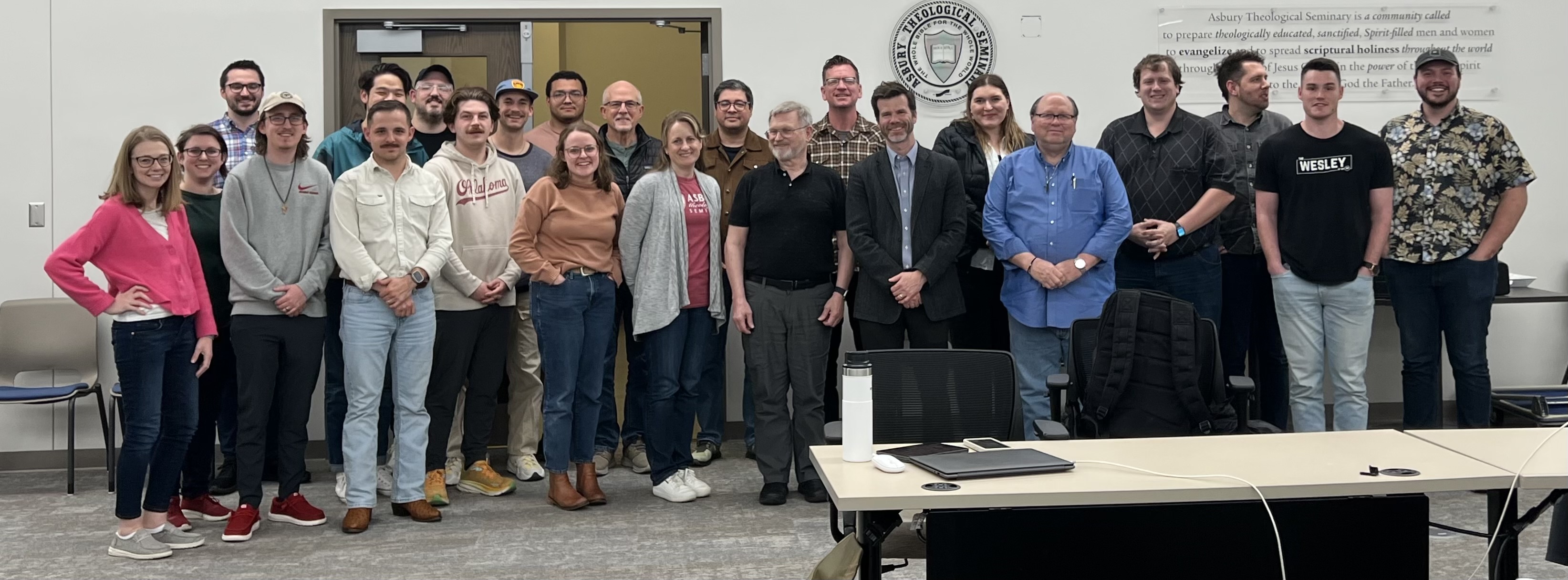
I had the privilege of teaching The Theology of John Wesley, which is one of the core classes at Asbury Theological Seminary this spring. Every student, regardless of degree, must take The Theology of John Wesley to graduate with a Master’s Degree. This is one of the ways Asbury anchors its identity and resists institutional drift. And I love it!

The class also gave me the opportunity to re-read core texts on John Wesley’s theology. First, we read sixty (yes, 60, not 6) of John Wesley’s sermons, including all of the original Standard Sermons. (Whether you want 44 or 52 in the list, they are all in the Collins and Vickers edited volume of Wesley’s sermons!) And we read my colleague Professor Kenneth J. Collins’s John Wesley: A Theological Journey and The Theology of John Wesley: Holy Love and the Shape of Grace. These are both masterful!

The class is a deep dive into Wesley’s theology. It is thorough and has been expertly crafted through decades of experience. I taught the class exactly the way it has been taught by those who have gone before me this semester. I had a blast because I was able to teach in an area I really enjoy teaching. And I was able to continue learning and growing as a follower of Jesus Christ and as a teacher.

Ok, so here is the memory I wanted to share:

One of the places there is always lively discussion, if students are tracking and understanding the material, is around John Wesley’s conviction that one who has experienced justification and the new birth does not commit outward sin. This is based on John Wesley’s reading of the canon of Scripture, particularly passages like 1 John 3:7-10:

Little children, let no one deceive you. Whoever practices righteousness is righteous, as he is righteous. Whoever makes a practice of sinning is of the devil, for the devil has been sinning from the beginning. The reason the Son of God appeared was to destroy the works of the devil. No one born of God makes a practice of sinning, for God’s seed abides in him; and he cannot keep on sinning, because he has been born of God. By this it is evident who are the children of God, and who are the children of the devil: whoever does not practice righteousness is not of God, nor is the one who does not love his brother. (ESV)

Collins brilliantly summarizes this in John Wesley: A Theological Journey:

Justification delivers from the guilt of sin, regeneration from its power or dominion, and entire sanctification from its being. Unfortunately, these distinctions are often neglected in contemporary Methodism where a decided “shift” has taken place; that is, freedom from the power of committing sin is attributed not to the new birth, as it should be, but to Christian Perfection, with the result that freedom from the being of sin is then relegated to the afterlife and glory. (190)

The conversation in class around freedom from the power of sin in regeneration led to a great question. I reached out to Professor Collins to get his perspective and his response was so good I asked for his permission to share it with my students and then to share it with all of you here. Here is how I framed the question:

How do I best talk to students about the correct definition and understanding of the new birth in connection with the band meeting, which both has a prerequisite of the new birth (and more), and weekly questions connected to sin.

I.e., if a students says, If someone does not commit outward sin after they receive justification and the new birth, why are the band meeting questions focused around sin? (I.e., “What known sins have you committed since we last met?”)

Here is Dr. Collins’s reply:

First of  all,  given the small numbers of people in the band meetings there may not be many responses to the weekly, sin-probing questions among the children of God, but there will likely be at least some responses over time.  Real Christians do at times break faith and commit sin of the high hand, so to speak.  The way forward then would be and must be one of repentance, of doing the first works afresh.  So then, when Wesley affirmed that a born again believer is free from the power and dominion of sin (“The Marks of the New Birth,” “The Great Privilege of Those that are Born of God”) he  was not teaching that real Christians would never sin again (a common misunderstanding among my students) but that Christian believers would have grace sufficient to remain faithful and to walk in a trusting and accountable way in the graces of regeneration.   How do we bring all of this together?  How can we summarize this basic and precious gospel truth which Jesus Christ, himself, affirmed (John 8:34-36)  and which John Wesley repeatedly taught?  I offer the following summary of the several elements here, though this language is not Wesley’s but my own.   However, I do believe that such language captures Wesley’s basic meaning.  And so here goes:    “Willful, intentional sin,  breaking faith with Christ,  should be the grave exception in the Christian life and not the rule.”  Our problem today, however, in American Christianity in general, and even at times in Methodism in particular,  is  that we have made sin the rule and grace the exception.  We need to turn this upside down.   Jesus Christ died for far more than to leave people in the bondages of which they are ashamed. 

Second, I think the very great value of  such questions for the saints that played out in the band meetings during Wesley’s lifetime is that they are a wonderful means of grace that ensure that responsibility and accountability will remain in place.   Think of  band members, for example, who are sorely tempted during the week but who in the midst of  that temptation are reminded by the Holy Spirit, the Spirit of Truth,  that they will have to confess such a sin (if it is committed) before several trusted and beloved others in just a few days.   At that  point the power of the temptation is broken (1 Cor. 10:13) by the light of the prospect of upcoming fellowship,  accountability and love.   That’s precisely the point!   In other words, the questions of the band meetings are themselves a wonderful means of grace, used by the Holy Spirit,  as a means by which faithful Christian discipleship is strengthened and lived out to the glory of God.  Put another way, evil and sin love the darkness; however, Wesley made sure that the infrastructure of Methodism in general, and the band meetings in particular would be flooded by an abundance of light in the form of relationship, accountability and the richest love.   In short, those questions are both precious and necessary  for serious Christian discipleship. 

So good!

Want to know more about the band meeting? Scott Kisker and I wrote a book that is designed to reclaim this practice. Check it out here.

Join My Seminary Course in Wesleyan Discipleship in Tulsa [January 2025]

24 Thursday Oct 2024

Posted by Kevin M. Watson in Accountability, Class Meetings, Holiness, Methodist History, Ministry

≈ Leave a comment

Tags

Band meeting, Christian formation, class meeting, discipleship, John Wesley, Methodism, Methodist, small groups, Wesley

I am teaching a course on Wesleyan Discipleship in Tulsa as a January-Term course at Asbury Theological Seminary this coming January (2025). You should join me! 

What is the course about?

Here is my description of the course:

Wesleyan Discipleship explores the history, theology, and practice of discipleship through a Wesleyan lens. Particular attention is given to the role of communal formation in eighteenth-century Methodism. John Wesley’s theology of discipleship is explored, along with a variety of aspects of Christian formation in community in early Methodism. Particular attention is given to the way Wesley’s theology of social holiness was expressed in early Methodist small groups, especially the class meeting and the band meeting. Students will apply the historical and theological understanding of Wesleyan discipleship to contemporary ministry contexts.

Why I am FIRED UP about this class:

This class will have an intensive on site here in Tulsa from the evening of January 16th through January 18th, 2025. I LOVE the time together with students at intensives! This class beautifully lends itself to teaching in this format. 

Hybrid classes have 20 hours of in-person instruction over 2.5 days. (The rest of the course requirements are met through online engagement and completion of online modules.) It is intense! But I have also found, perhaps surprisingly, that it is also an opportunity for a spiritual retreat for students. 

The in-person experience gives us the opportunity to worship together. We will start the class by attending worship at the Thursday evening service at Asbury Church, where Rev. Andrew Forrest will be preaching. Andrew is an exceptionally gifted preacher of the Scriptures and a brilliant communicator. I love being able to start class off by tangibly connecting the church and academy by walking across the parking lot to go to worship.

We will also have an Asbury Theological Seminary – Tulsa chapel service for the class and students in the area on Friday January 17.

I will get to spend hours talking about my scholarly passion – the importance of community and connection for the Christian life. I love getting to teach students and engage their questions around these topics!

And most important, we will spend time talking about and practicing ways to reintroduce these tried and tested methods that gave Methodism its name.

At the end of the course, students will have the kind of knowledge gain you would expect from a typical seminary course. But they will also have experience participating in class meetings, experiencing small group dynamics, and reflecting on various challenges and opportunities of leading small groups like class and band meetings.

I think of this course as like a laboratory. We will learn a lot about the concepts, but we will also engage them in a hands-on way. In a laboratory you can not only experience a class meeting, but you can also talk about your experience of a class meeting. In my view, this is essential for becoming an expert practitioner. You need not only a theoretical framework and some practical experience, but you also need a place to talk about your experience so you can acknowledge, address, and overcome obstacles and challenges.

I am more confident than I have ever been that groups like the Wesleyan class meeting and band meeting will be at the center of Christian discipleship in these new and strange times we are entering.

These intensives are aptly named. They are not easy. J-term is not a short cut. In fact, it is a three-week academic sprint. My goal is to maximize the 20 hours we get to spend together to suck the marrow out of the class and be as fully equipped to make disciples of Jesus Christ in the contemporary church as possible. 

I want students who come hungry and ready to learn and grow. And that is what we are seeing here in Tulsa. It is SO FUN!

How is the course being taught?

I am teaching this course as a hybrid course at Asbury Theological Seminary at our Tulsa, OK Extension Site (housed at Asbury Church).

What is a January-Term, or J-Term, course?

A J-Term course is a full three credit course that is offered entirely within the month of January. This coming J-Term will start on January 2, 2025 and conclude on January 24, 2025.

What is a hybrid course?

A hybrid course is a course that has parts that are online and parts that are in person. This specific course will have four online modules based on four main sets of reading, students will write a reflection paper that summarizes the content of the reading, critically engages it, and applies it to their own ministry context.

The in-person part is January 16-18, 2025 at Asbury Church’s Development Center in Tulsa, OK. The in-person meeting will be from 6:00pm-9:00pm January 16, 8:30am-5:30pm January 17, and 8:30-5:30pm January 18. The in-person meeting is required for completion of the course. It is also the highlight of the entire course!

Does this course meet the Wesleyan Discipleship and Spiritual Formation requirement for ordination in the Global Methodist Church?

The Convening General Conference of the Global Methodist Church, which met a few weeks back, updated the educational requirements for ordination. And one of the changes that was made was the addition of a course called “Wesleyan Discipleship and Spiritual Formation.” I don’t mean to brag, but I believe this course hits the bullseye for what the GMC is looking for here! So, yes, if you are seeking ordination in the GMC, this course meets the Wesleyan Discipleship and Spiritual Formation course requirement. You can take this course and meet all GMC ordination requirements with either an Asbury Theological Seminary M.Div. or our 60 credit (exactly 20 courses) Master’s in Christian Ministry (MACM).

Should I take this course if I am not in the Global Methodist Church?

Yes! 

If you want to help your church more effectively make discipleship of Jesus Christ, this course is for you. 

I am passionate about Wesleyan Discipleship, not because I am most passionate about John Wesley, but because I believe the Wesleyan theological tradition has a proven track record of excellence in intentional and effective disciple making. We do well to learn from experts who have gone before us. This course is not specifically for students from any one denominational tradition. I mentioned the GMC above only because there is obvious relevance for the GMC because they just made this exact course a required course to be ordained an elder in the GMC. (Your church or denomination should too. This topic really is that essential for succeeding in the 21st century church.)

Can I take this course if I am not an Asbury Theological Seminary student?

Yes! The easiest way to do this would be to apply now to become an Asbury Theological Seminary student. We have a variety of degree programs, and I would be thrilled to talk to you about any of them! There is time to apply now and start this January.

If you are interested in applying to Asbury Theological Seminary or for this course in particular, reach out to me here (scroll down to the bottom of the page) and I will get back to you soon. Be sure to include your email so I know how to reach you. 

Not ready to apply to one of our Master’s degree programs? You may be able to apply to take the course as a non-degree seeking student. You also may be able to audit the course. Both require an application and auditing requires permission from the instructor. For either of these, reach out to me at the link immediately above.

I am open to considering some auditors. Auditors do not receive any academic credit for the course and do not turn in any assignments. They are given permission to sit in on the in-person part of the class and participate in class discussions and activities. However, I will only open the class up to auditors if there are open seats after the registration period closes. (I would assume auditing the course would not satisfy denominational ordination requirements, but you should check with your own denominational leaders.)

What is the official title of the course?

The course is cross listed as a Spiritual Formation course and a Theology course. So you can sign up for either TH650 Wesleyan Discipleship or SF650 Wesleyan Discipleship.

What are the assigned readings in the course?

Students will read a few short essays from John Wesley. And they will read these three books (affiliate links):

The Class Meeting: Reclaiming a Forgotten (and Essential) Small Group Experience, Kevin M. Watson

The Band Meeting: Rediscovering Relational Discipleship in Transformational Community, Kevin M. Watson and Scott T. Kisker

Real-Life Discipleship: Building Churches that Make Disciples, Jim Putman

I cannot wait for this class! I hope to see you here in Tulsa January 16-18, 2025.

Secrets and the Wisdom of the Wesleyan Tradition

08 Wednesday May 2024

Posted by Kevin M. Watson in Book Review, Christian Living, Wesley

≈ Leave a comment

Tags

Band meeting, John Wesley, Methodism, secrets, Wesley

I don’t know about you, but I find it so encouraging when I read something outside of the church that highlights the value of what Christians do.

Here is an example I just came across:

One of the cornerstones of the Wesleyan movement throughout John Wesley’s lifetime was a small group called the band meeting. There were a list of prerequisites for joining a band meeting. But the basic activity of the band was pretty simple – confession of sin for the sake of growth in holiness.

At the weekly meeting, participants each answered five questions:

1. What known sins have you committed since our last meeting?

2. What temptations have you met with?

3. How were you delivered?

4. What have you thought, said, or done, of which you doubt whether it be sin or not?

5. Is there anything you desire to keep secret?

(You can read the entire “Rules of the Band Societies” here.) 

I first joined a band meeting when I was a seminary student. And joining that band meeting was, by far, the most important part of my seminary experience.

Not long after I graduated from seminary, I began to feel a more specific calling to pastor people who were preparing to become pastors. If I was going to pursue that calling, it would mean that I would need to complete a PhD. When I realized that no one had studied the band meeting in depth, I decided to write my PhD dissertation on the band meeting in John Wesley’s thought and in the popular experience of the first Methodists. I revised my dissertation and published it with Oxford University Press as Pursuing Social Holiness: The Band Meeting in Wesley’s Thought and Popular Methodist Experience.

During my work on the band meeting, I noticed that the fifth question was removed at one point by an editor of the original “Rules of the Band Societies” (the document where the five questions was published) sometime around the early nineteenth century.

As best I can remember, the fifth question was not used in the first band meeting I joined.

Is there anything you desire to keep secret?

It isn’t hard to come up with reasons why that question might be disappeared. It is intense! If you have a secret, kind of by definition you don’t want to share it. But the question is a game changer because it brings everything into the light of Christ and his healing grace in the appropriate place.

So back to the beginning of this post.

I just finished reading The Secret Life of Secrets by Michael Slepian. 

The book is an in-depth and interesting study of secrets and the role they play in our lives. 

The big takeaway at the end of the book could not have been much better aligned with the early Methodist band meeting and its simple question: Is there anything you desire to keep secret?

At the end of the book, Slepian shows that while everyone has had or has a secret, it is helpful to be able to share secrets with people you know and can trust.

All the way back in the 18th century, Methodists were creating band meetings in order to not only share secrets, but to seek the wholeness and healing described in James 5:16

Therefore confess your sins to one another, and pray for one antoher, so that you may be healed. The prayer of the righteous is powerful and effective.

Secular scientific study is confirming the instincts Christians have always had. How cool is that?

Want to know more about the band meeting?

For the academic and historic work, see Pursuing Social Holiness.

For an introduction to what a band meeting is and a guide to starting band meetings in our own day, check out the book I wrote with Dr. Scott T. Kisker, The Band Meeting.

Pursuing Social Holiness Now in Paperback

28 Monday Mar 2016

Posted by Kevin M. Watson in Accountability, Christian Living, Methodist History, Wesley

≈ 3 Comments

Tags

Band meeting, Early Methodism, small groups

Pursuing Social Holiness: The Band Meeting in Wesley’s Thought and Popular Methodist Practice is now available in paperback! This is good news because it means the book is much more reasonably priced. The book was initially published in a hardcover edition that was listed at $78. And many of you let me hear about it!

Because of the initial price of the book, I have tended not to promote it too much when I speak within the church. Now that it is available in a more economical format, I want to let you know about it. The retail price for the paperback edition is $35. I know this is still not cheap, but it is about as good as it gets for an academic book. Right now you can save 30% off the paperback edition. Click here and use the promotional code AAFLYG6.

This book is a revision of the work I did for my PhD dissertation and is the product of several years of research and writing on the band meeting in early British Methodism. The book is the only study of meaning and significance of the band meeting in Methodism that has been written.

I’ve been speaking quite a bit over the past few years on the role of Christian conferencing, social holiness, the class meeting, and the band meeting in a variety of contexts. I have focused on the class meeting in my recent writing for the church because the class meeting is the most appropriate entry point for transformation-driven small groups for people who don’t have much experience with them. My recent focus on the class meeting does not mean that I don’t think the band meeting was important too! The band meeting, which was focused on confession of sin for the sake of growth in holiness, was crucial for early Methodism and its mission to “spread scriptural holiness.” Methodists need to know this history and wrestle with its potential relevance for contemporary Christian formation.

Here’s a summary of the book from the back cover:

Kevin M. Watson offers the first in-depth examination of an essential early Methodist tradition: the band meeting, a small group of five to seven people who focused on the confession of sin in order to grow in holiness. Watson shows how the band meeting, which figured significantly in John Wesley’s theology of discipleship, united Wesley’s emphasis on the importance of holiness with his conviction that Christians are most likely to make progress in the Christian life together, rather than in isolation. Watson explores how Wesley synthesized important aspects of Anglican piety and Moravian piety in his own version of the band meeting. Pursuing Social Holiness is an essential contribution to understanding the critical role of the band meeting in the development of British Methodism and shifting concepts of community in eighteenth-century British society.

Here is what some noted scholars in Methodist Studies have said about Pursuing Social Holiness:

“This is a brilliant study of one of the foundational institutions of eighteenth-century Methodism…. Anyone who wants to understand the rise of Methodism should give this account careful consideration. This is a book we have long needed.”

– John Wigger, author of American Saint: Francis Asbury and the Methodists

“This groundbreaking study offers the most detailed account to date of band meetings in early Wesleyan Methodism…. Highly recommended.”

– Randy Maddox, William Kellon Quick Professor of Wesleyan and Methodist Studies, Divinity School

“Watson’s work on the band meeting is the definitive history of this practice of small-group confession within eighteenth-century English evangelicalism…. This is a must-have for scholars of Methodism and eighteenth-century religious history.”

– Scott Kisker, Associate Dean of Residential Programs and Professor of Church History, United Theological Seminary

I hope you will consider picking up a copy of this book in order to learn more about one of the core practices of early Methodists in their pursuit of social holiness.

Now Available: Pursuing Social Holiness

22 Wednesday Jan 2014

Posted by Kevin M. Watson in Accountability, Christian Living, Holiness, Methodist History, Wesley

≈ 2 Comments

Tags

Band meeting, Methodist History, social holiness, Wesley


Over the past several years, many of you have asked me when my dissertation would be available in print. I am pleased to announce that a revision of my dissertation, Pursuing Social Holiness: The Band Meeting in Wesley’s Thought and Popular Methodist Practice, has been published by Oxford University Press. Here is a summary of the book from the cover:

Kevin M. Watson offers the first in-depth examination of an essential early Methodist tradition: the band meeting, a small group of five to seven people who focused on the confession of sin in order to grow in holiness. Watson shows how the band meeting, which figured significantly in John Wesley’s theology of discipleship, united Wesley’s emphasis on the importance of holiness with his conviction that Christians are most likely to make progress in the Christian life together, rather than in isolation.

Demonstrating that neither John Wesley’s theology nor popular Methodism can be understood independent of each other, Watson explores how Wesley synthesized important aspects of Anglican piety (an emphasis on a disciplined practice of the means of grace) and Moravian piety (an emphasis on an experience of justification by faith and the witness of the Spirit) in his own version of the band meeting. Pursuing Social Holiness is an essential contribution to understanding the critical role of the band meeting in the development of British Methodism and shifting concepts of community in eighteenth-century British society.

OUP’s listing has more information about the book, including the Table of Contents. I think that readers of this blog will be particularly interested in the book’s description of Wesley’s understanding of holiness and how his emphasis on the importance of community is connected to sanctification. I also think readers will appreciate the extensive use of primary source materials from early Methodists, giving insight into the popular practice of communal formation in early Methodism.

OUP did a great job with this book. I am very please with the layout and production quality. The main factor that may keep many people from buying the book is the price. The book is listed at $74 (though it is currently available on amazon for $62.90), which will unfortunately price it out of many pastor’s personal libraries. For those not familiar with the world of academic publishing, I would note two things: 1) Authors do not determine the prices of their books. 2) Believe it or not, it could have been much worse. Hardcover academic monographs like this one often cost $150! All that to say, I completely understand if you are not interested in spending that much money on a book.

Here is what some reviewers have said about the book:

“This is a brilliant study of one of the foundational institutions of eighteenth-century Methodism. Early Methodism was at its heart a community event. The bands, along with the class meetings, were what bound Methodist societies together. Anyone who wants to understand the rise of Methodism should give this account careful consideration. This is a book we have long needed.”
– John Wigger, Professor, Department of History, University of Missouri

“Watson’s work on the band meeting is the definitive history of this practice of small-group confession within eighteenth-century English evangelicalism. Watson not only demonstrates the importance of this practice for the revival and the Wesleyan notion of ‘social holiness’ in the eighteenth century, but also outlines the reasons for its decline in the nineteenth century. This is a must-have for scholars of Methodism and eighteenth-century religious history.”
– Scott Kisker, Professor of Church History, United Theological Seminary

“This groundbreaking study offers the most detailed account to date of band meetings in early Wesleyan Methodism. Watson first demonstrates the distinctive synthesis of Anglican and Moravian precedents in John Wesley’s mature model for the bands. He then engages a range of primary sources to provide a richly textured account of the practice of bands through the eighteenth century. Highly recommended.”
–Randy L. Maddox, William Kellon Quick Professor of Wesleyan Methodist Studies, Duke Divinity School

Published in Methodist Review

06 Thursday Jan 2011

Posted by Kevin M. Watson in Article Review, Life, Methodist History, Wesley

≈ 2 Comments

Tags

Band meeting, Early Methodism, Methodist Review, Wesley

For those of you who may be interested in my research on the early Methodist band meeting, I have recently had an article published in Methodist Review an online, peer-reviewed academic journal. The title of my article is “Forerunners of the Early Methodist Band Meeting” and (as the title suggests) it explores the key antecedents that influenced the development of the Wesleyan Methodist bands.

If you want to read the article, you simply have to register with Methodist Review (which is free) and then download the PDF file. Once you register you have access to both vols. 1 and 2 of the journal and can download any or all of the articles that have been published.

Francis Asbury on Class Meetings

13 Monday Sep 2010

Posted by Kevin M. Watson in Christian Living, Methodist History

≈ 2 Comments

Tags

Band meeting, class meeting, Francis Asbury

In recent research, I came across the following quote in Francis Asbury’s Journal:

In meeting the society at night, I spoke plainly of some who neglected their bands and classes; and informed them that we took people into our societies that we might help them become entire Christians, and if they willfully neglected those meetings, they thereby withdrew themselves from our care and assistance. (June 12, 1774, vol. I Journal, p. 118)

This is an interesting quote because it is towards the beginning of Asbury’s ministry in America and is before he was the undisputed leader of American Methodism. It is also ten years before Asbury was ordained and Methodism in America became a Church in its own right.

Yet, from what I have read about Asbury, this was not an isolated sentiment that radically changed after 1784. Rather, it is pretty typical of his understanding both of the importance of the classes and bands for helping people “become entire Christians” as well as his understanding that this was the basic purpose of Methodism (helping people become entire Christians).

Rules of the Band Societies

21 Monday Jan 2008

Posted by Kevin M. Watson in Ministry

≈ 23 Comments

Tags

Accountability, Band meeting, Wesley

I had a conversation recently with a few people who expressed a desire to enter into a deeper level of accountability and intimacy with fellow Christians. We were talking about the power that can come from “watching over one another in love.” I shared that I had been a part of a Wesleyan band meeting in seminary and that this was one of the most powerful experiences of my life.

In light of that conversation, I thought I would post Wesley’s “Rules of the Band-Societies,” Drawn up December 25, 1738. (This is public domain.) So what follows are the rules:

The design of our meeting is, to obey that command of God, “Confess your faults one to another, and pray one for another, that ye may be healed.”

To this end, we intend –

  1. To meet once a week, at the least.
  2. To come punctually at the hour appointed, without some extraordinary reason.
  3. To begin (those of us who are present) exactly at the hour, with singing or prayer.
  4. To speak each of us in order, freely and plainly, the true state of our souls, with the faults we have committed in thought, word, or deed, the temptations we have felt, since our last meeting.
  5. To end every meeting with prayer, suited to the state of each person present.
  6. To desire some person among us to speak his own state first, and then to ask the rest, in order, as many and as searching questions as may be, concerning their state, sins, and temptations.

Some of the questions proposed to every one before he is admitted among us may be to this effect: —

  1. Have you the forgiveness of your sins?
  2. Have you peace with God, through our Lord Jesus Christ?
  3. Have you the witness of God’s Spirit with your spirit, that you are a child of God?
  4. Is the love of God shed abroad in your heart?
  5. Has no sin, inward or outward, dominion over you?
  6. Do you desire to be told of your faults?
  7. Do you desire to be told of all your faults, and that plain and home?
  8. Do you desire that every one of us should tell you, from time to time, whatsoever is in his heart concerning you?
  9. Consider! Do you desire we should tell you whatsoever we think, whatsoever we fear, whatsoever we hear, concerning you?
  10. Do you desire that, in doing this, we should come as close as possible, that we should cut to the quick, and search your heart to the bottom?
  11. Is it your desire and design to be on this, and all other occasions, entirely open, so as to speak everything that is in your heart without exception, without disguise, and without reserve?

Any of the preceding questions may be asked as often as occasion offers; the four following at every meeting: —

  1. What known sins have you committed since our last meeting?
  2. What temptations have you met with?
  3. How were you delivered?
  4. What have you thought, said, or done, of which you doubt whether it be sin or not?
  5. Is there anything you desire to keep secret?

Blog at WordPress.com.

  • Subscribe Subscribed
    • Kevin M. Watson
    • Join 369 other subscribers
    • Already have a WordPress.com account? Log in now.
    • Kevin M. Watson
    • Subscribe Subscribed
    • Sign up
    • Log in
    • Report this content
    • View site in Reader
    • Manage subscriptions
    • Collapse this bar
 

Loading Comments...