• About Me

Kevin M. Watson

Kevin M. Watson

Category Archives: Wesley

Generation Rising: A Future with Hope for The UMC

08 Monday Nov 2010

Posted by Kevin M. Watson in Accountability, Book Review, Christian Living, Methodist History, Ministry, Wesley

≈ 2 Comments

Tags

Christian accountability, Generation Rising, new book, small groups

Andrew Thompson has written a post about a book that Abingdon will be publishing in the Spring, Generation Rising: A Future with Hope for the United Methodist Church. Thompson is the editor of the book, which features chapters from twelve different younger leaders in the UMC about the future of the denomination. (Click on the link to Andrew’s post to see a list of the authors of the various chapters, the titles of each chapter, and the cover of the book.)

I was thrilled to be asked by Andrew to write a chapter on the role of small groups for the future of the UMC. My chapter gives a brief history of the role of “watching over one another in love” through a form of small group accountability in early Methodism. I then explore the relevance of the past for the present by addressing some of the challenges to embracing this Wesleyan communal practice in the 21st century. Ultimately, I argue that a return to such a practice will be essential for the renewal of United Methodism. I see the chapter I wrote for Generation Rising as a key part of what I have been doing here in my series on the relevance of the class meeting for the 21st century. If you have found that conversation to be beneficial, I hope you will read my chapter.

I am excited to be a part of this project, because I am thrilled to be part of a collaborative effort to give voice to what younger leaders in the UMC think is needed in order for United Methodism to have a future with hope. One of my frustrations about efforts to restore vitality to our denomination is that they typically fail to represent the vision or insights of the people who are the future of the church. This project is one attempt by younger folks in United Methodism to share what our sense is of where we are and what the most promising and hopeful way forward is. It is written by people who love the church and are committed to it.

I appreciate Andrew’s vision, initiative and leadership in conceiving this project, and his work to bring it to fruition. I also appreciate Abingdon Press’s recognition of the importance of giving voice to the experience and insights of younger generations within the church. Ultimately, I hope Generation Rising is only the beginning of a broader conversation about the way forward for the church.

Recommended Reading

27 Wednesday Oct 2010

Posted by Kevin M. Watson in Book Review, Christian Living, links, Methodist History, Wesley

≈ 4 Comments


I want to recommend three books that I have recently read (in one instance, re-read) and three books that I am really looking forward reading.


Almost Christian: What the Faith of Our Teenagers is Telling the American Church
by Kenda Dean.

If you are involved in ministry with youth and young adults, you should read this book. If you have children and care about them becoming mature Christians, you should read this book. Oh, and if you care about people in this demographic… you should read this book.

I just finished reading Almost Christian and (as you may be able to tell) I thought it was excellent. Almost Christian chews on the research and data that was released with Christian Smith and Melinda Lundquist Denton’s Soul Searching: The Religious and Spiritual Lives of American Teenagers, which has already made a big splash in conversations about the formation of youth and young adults. I plan on blogging about Dean’s book in the near future, so I won’t say more at this point.


Charles Wesley and the Struggle for Methodist Identity by Gareth Lloyd.

I re-read this book during my time working in the Methodist Archives in Manchester. Gareth Lloyd is also the archivist for the Methodist material in Manchester. Lloyd’s book does two things that are both major contributions to Wesleyan Studies and the history of Methodism. First, he argues that John Wesley’s perspective has dominated the history of Methodism in ways that have distorted the picture. Thus, Charles Wesley and the Struggle for Methodist Identity seeks to begin to restore some balance and bring the picture back into focus. The second contribution of Lloyd’s work is that the book acts as a kind of guide to the primary source material that has all too often been overlooked by Methodist historians. One of Lloyd’s key arguments is that scholarship relating to Charles Wesley is inadequate because it has tended to rely on nineteenth century secondary source material, rather than going back to the original materials. Because of his position at the Rylands, Lloyd is the ideal person to make this case and to provide suggestions as to where key materials are that have yet to be mined.

Warning: The main negative of this book is its price. It is currently only available in hardcover and is $99. (Oh, you can purchase a Kindle version, which is $20 cheaper.)


Wesleyan Beliefs: Formal and Popular Expressions of the Core Beliefs of Wesleyan Communities by Ted A. Campbell.

Finally, Ted A. Campbell’s latest contribution to Wesleyan Studies has just come off the presses. If nothing else, you should read this book because it is endorsed by both Richard P. Heitzenrater and Randy L. Maddox. Maddox’s endorsement suggests that “Campbell’s careful study should put to rest finally the frequent caricature of Methodism as unconcerned about doctrinal beliefs… This is a must-read for scholars of the Wesleyan/Methodist tradition and beyond!”

My brief summary of Campbell’s argument would be that studies of Methodist or Wesleyan doctrine or beliefs have tended to fall into one of two camps. They are either focused on a rigid study of official doctrinal statements or academic contributions from members of these traditions, or they are focused on the opposite extreme of the popular practices and expressions of faith of Wesleyan or Methodist faith communities at particular points in time. In Wesley Beliefs, Campbell aims to bring these two legitimate foci into conversation with one another. In so doing, he finds that the study of official statements of doctrine along with more popular expressions of lay spirituality (such as hymnals, catechisms, and the architectural design of churches) reveal significant harmony.

(Full disclosure: Ted Campbell is my Ph.D. advisor here at S.M.U., so I am perhaps predisposed to think highly of his work.)

Here are three books that I am chomping at the bit to get my hands on, in fact I hope to be able pick up a few this weekend at the American Academy of Religion. Since I have not read them, I will not comment on them any further at this point, except to say that I think they are worth checking out.

The Methodist Experience in America, Vol 1: A History
by Russell E. Richey, Kenneth E. Rowe, and Jean Miller Schmidt

From Aldersgate to Azusa Street: Wesleyan, Holiness, and Pentecostal Visions of the New Creation edited by Henry H. Knight III.

T&T Clark Companion to Methodism edited by Charles Yrigoyen, Jr.

Wesley Didn’t Say It: Set Myself on Fire… Watch Me Burn

06 Monday Sep 2010

Posted by Kevin M. Watson in Methodist History, Wesley

≈ 70 Comments

Tags

John Wesley

John Wesley, credit: Daniel X. O’Neil

Among the words put in John Wesley’s mouth that he did not actually say, perhaps the most common are the following:

I set myself on fire and people come to watch me burn.

or

Catch on fire with enthusiasm and people will come for miles to watch you burn.

Wesley did not say either of these.

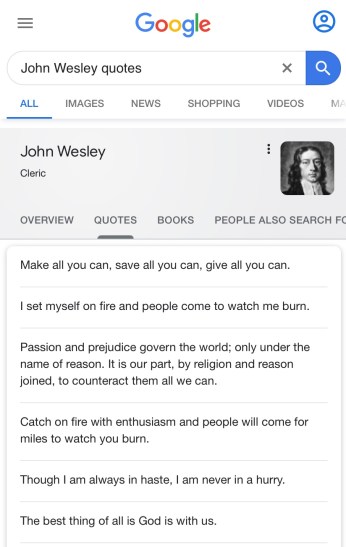
But this may be the most persistent quote that is incorrectly attributed to John Wesley.  I updated this post on April 25, 2020, and did a google search for “John Wesley quotes.” The first entry is an answer box that has a list of unattributed John Wesley quotes. Look at the second and fourth entires!

So, if you ask Google for John Wesley quotes, two of the first four it currently gives you are two quotes that he did not actually say.

It is easy to come up with numerous examples of this quote being attributed to Wesley. But what you will not find is a citation of the source where Wesley is supposed to have actually said it.

Inaccurate information spreads rapidly on the internet.

I have been surprised by the anger from some commenters on my series of “Wesley Didn’t Say It” posts. Several people have sarcastically said something like, “Oh, so you were there to hear every word that John Wesley ever said?”

Of course I wasn’t. But no historian thinks we can know what dead people said in conversations that were never recorded or written down. It is impossible to prove that someone never said something.

The standard for attributing words to someone is documentation showing they said it. For John Wesley, this would be published writings like sermons, treatises, and his published Journal or manuscript sources like letters.

I was a PhD student when I first wrote this post, so I checked in with an expert before I hit publish. I emailed noted historian of Wesley and early Methodism, Dr. Richard Heitzenrater. His response was along these lines: You can look for that quote in Wesley as long as you want, you won’t find it.

It troubles me that this quote is so frequently attributed to Wesley. It does not sound like something that Wesley would have said. In the email string that first made me aware of how often this is attributed to Wesley, someone commented that the quote was rather “braggadocious” and as a result did not sound like Wesley. I agree. It would not be characteristic of Wesley to say, “I do something awesome, and as a result people come to look at me.”

Wesley’s desire was not to attract people to himself, but to point them to the risen Lord who was their only hope of salvation.

Wesley didn’t say, “I set myself on fire and people come to watch me burn.” We should stop saying that he did.

You can add this quote to other quotes that are stubbornly connected to John Wesley despite the fact that there is no source that connects them to Wesley’s pen. I have written about several other quotes misattributed to John Wesley:

“Do all the good you can, by all the means you can, in all the ways you can, in all the places you can, at all the times you can, to all the people you can, as long as ever you can.”

“In essentials, unity; in non-essentials, liberty; and, in all things, charity.”

“Personal and social holiness“

“Holy conferencing“

“Be present at our table, Lord…“

Do you want to know if Wesley did actually say something that is attributed to him? Check out Did Wesley Really Say That? (Here’s How to Find Out).

Kevin M. Watson teaches, writes, and preaches to empower community, discipleship, and stewardship of our heritage. Connect with Kevin. Get future posts emailed to you. This post was updated on April 25, 2020.

Wesley Didn’t Say It: Unity, Liberty, Charity

02 Thursday Sep 2010

Posted by Kevin M. Watson in Wesley

≈ 29 Comments

Tags

John Wesley

John Wesley, credit: Daniel X. O’Neil

In essentials, unity; in non-essentials, liberty; and, in all things, charity.

Wesley did not say this.

I came across this frequently misattributed quote while reading Richard P. Heitzenrater’s chapter, “‘Unity, Liberty, Charity’ in the Wesleyan Heritage.” in the book Unity, Liberty, and Charity: Building Bridges under Icy Waters, edited by Donald E. Messer and William J. Abraham.

After a detailed search in Wesley’s writings for this quote, Heitzenrater found “the saying was not used by Wesley.” (29) Heitzenrater wrote the book on Wesley and the People Called Methodists, so this is good enough for me.

There is no record in Wesley’s published writings of him saying, “In essentials, unity; in non-essentials, liberty; and, in all things, charity.” We should stop saying that he did.

Check out the comments for helpful discussion of where the quote originated.

As with all of these quotes, my purpose here is not to contest the idea found in the quote. In other words, I am not arguing against the sentiment. I want to encourage historical accuracy and greater care in attributing sayings to historical figures.

This is the first post in a series of posts on quotes that are commonly attributed to Wesley that he did not actually say. Here are several other quotes misattributed to John Wesley:

“Do all the good you can, by all the means you can, in all the ways you can, in all the places you can, at all the times you can, to all the people you can, as long as ever you can.”

“I set myself on fire and people come to watch me burn.”

“Personal and social holiness“

“Holy conferencing“

“Be present at our table, Lord…“

Do you want to know if Wesley did actually say something that is attributed to him? Check out Did Wesley Really Say That? (Here’s How to Find Out).

Kevin M. Watson teaches, writes, and preaches to empower community, discipleship, and stewardship of our heritage. Connect with Kevin. Get future posts emailed to you. This post was updated on April 25, 2020. Affiliate links used in this post.

The Methodist Class Meeting for the 21st Century: The Role of the Class Leader

26 Thursday Aug 2010

Posted by Kevin M. Watson in Accountability, Christian Living, Methodist History, Ministry, Wesley

≈ 18 Comments

Tags

Accountability, class leader, class meeting, Methodism, small groups

This is the sixth post in a series on the contemporary relevance and practical application of the Methodist class meeting. Here is a brief outline of what has been discussed so far:

    1. A brief history of the origin and development of the class meeting in early Methodism.
    2. Discussion of the potential contributions the class meeting can make for 21st century Methodism and compared and contrasted the class meeting to Sunday school classes, small groups and accountability groups.
    3. Discussion of the target audience for the 21st century class meeting.
    4. Top Ten ways to guarantee that your class meeting will fail.
    5. Addressed the concern that classes would be judgmental and exclusive.

In early Methodism, the class leader was a crucial position. The class leader was seen as the spiritual leader of the people in his or her class meeting. They kept track of attendance and visited people who missed the weekly meeting. They also provided support and encouragement as needed. Because the focus of this series is on the contemporary relevance and application of the class meeting, I am going to skip an elaborate fleshing out of the details of the history of the early Methodist class leader, and move directly to a discussion of what this role might look like in contemporary practice. (The “General Rules” and other available sources can be consulted for more information on the function of the class leader in early Methodism. Of course, if you have specific questions, feel free to raise them and I will do my best to address them.)

I believe that the class leader and the ability of churches to identify gifted class leaders will be the single most important factor in the success or failure of a class meeting.

As I currently understand it, the imagery of the class leader as shepherd is helpful for fleshing out the function of the class leader for the contemporary church. The class leader is the shepherd of his or her flock, and as such there are two key things that a class leader should do: 1) go after lost sheep; 2) keep the rest of the sheep moving in the right direction. By lost sheep, I mean someone who stops coming to the class meeting. When this happens, the class leader should be the first person to go after them, expressing that they have been missed, asking if they are doing ok, and asking the person if they are willing to come back to the class meeting.

Second, by keeping the rest of the sheep moving in the right direction, I mean that the class leader is the person who is responsible for making sure everyone has a chance to answer the question, “How is your life in God?” They are also responsible for making sure that something else does not take over the class meeting. For example, that it does not become a curriculum driven group, rather than a place where people watch over one another in love and discuss the current state of their souls. And most boldly, as the shepherd of the flock, the class leader, by the grace of God, seeks to move the class away from sin and closer and closer to mature discipleship.

Finally, at a very practical level, the class leader is the one who runs the meeting. The most important part of this dynamic is that the class leader should begin and end the meeting with a prayer (or ask someone else, in advance, if they would be willing to pray) and then the class leader should begin the meeting by being the first one to answer the question, “How is your life in God?” This is important because it gives an example of how the question can be answered for any new visitors and it eases the anxiety and uncertainty in the group about who is going to go first. After the leader is done, she should ask the next person the question.

At this stage, several things come to mind that the class leader should not do:

The class leader is not a teacher. It is not the class leaders job to come with all of the answers. And it is absolutely not their job to come with a lesson to teach or a topic to study. Class leaders should see themselves as facilitators, not teachers.

The class leader should not allow the weekly meetings to last more than an hour and a half, and a successful class meeting can occur in one hour. Of course there should be freedom for the Spirit to move, and there will be weeks when it is obvious to everyone that the group is not done yet. However, this should be the exception and not the rule. People will stop coming to the class if it becomes a weekly marathon meeting.

The class leader should not allow the class to grow beyond twelve members. As the group grows, the class leader should seek to discern who God may be calling to lead a new class. The class leader should talk to that person outside of the class and express their feeling that they believe this person would be an excellent class leader, and then ask them to prayerfully consider leading a new class. Once a new leader has been identified, the group should divide.

The class leader should not feel the need to respond to every person at every meeting. Often there will be no need for any response to someone’s revelation of how things are going in their life with God. Other times someone besides the class leader will have exactly the right thing to say.

There is much more that could be said, but I am going to stop here (I need to get back to reading). What are your thoughts? What have I missed? What do you think would be crucial for a class leader to do? What would be essential for a class leader to avoid?

Wesley and Experience

23 Monday Aug 2010

Posted by Kevin M. Watson in Christian Living, Methodist History, Wesley

≈ 4 Comments

Tags

Experience, Quadrilateral, Wesley

The so-called “Wesleyan Quadrilateral” is often seen as the common thread that holds together Methodist theological discourse. The only problem is that it is rarely used as a tool that actually arbitrates theological disagreements amongst Methodists. That is to say, the people using the quadrilateral do not agree on what is meant by an appeal to the four sources of Scripture, tradition, reason, and experience.

One of the sources that is least understood, at least when connected with the thought of John Wesley is experience. In preparing for my most recent field-level exam, I reread this summary of Wesley’s understanding of experience in Gerald R. Cragg’s Reason and Authority in the Eighteenth Century, (1964):

Wesley never allowed experience to stand alone. It was always checked by the evidence of Scripture and by the judgment of his reason. Experience confirms authority, it does not establish it. It verifies the truth we have discovered, but it is not the source of that truth. Consequently we cannot authenticate our faith by appealing to our feelings. [Quoting Wesley] ‘That some consciousness of our being in favour with God is joined with the Christian faith I cannot doubt; but it is not the essence of it. A consciousness of pardon cannot be the condition of pardon.’ Wesley had too shrewd an understanding of human nature not to realise that emotions can be unpredictable and unreliable. Consequently he laid down the principle ‘you are not to judge by your feelings, but by the Word of God.’ (161)

Cragg’s summary identifies one of the most common misuses of “experience” as a source of authority within the quadrilateral. Experience does not stand alone. Experience confirms authority, it does not establish it. In particular, Wesley appealed to experience in order to confirm the doctrine of assurance. The truth of Romans 8:16 – “The Spirit witnesses with our spirit that we are God’s children” – is confirmed by our experience. For example, Wesley wrote:

The fact we know: namely, that the Spirit of God does give a believer such a testimony of his adoption that while it is present in the soul he can no more doubt the reality of his sonship than he can doubt of the shining of the sun, while he stands in the full blaze of his beams. (“The Witness of the Spirit”, I.12)

For Wesley, Scripture promises that the Holy Spirit will witness within the spirits of those who have become children of God that they are in fact children of God. The promise from Scripture is confirmed by the experience of the Spirit actually witnessing within our spirits of our adoption as God’s children.

What do you think?

(If you are interested in learning more about the quadrilateral, I would recommend Wesley and the Quadrilateral: Renewing the Conversation. William J. Abraham also provides a dissenting voice in Waking from Doctrinal Amnesia: The Healing of Doctrine in The United Methodist Church.)

Is the Class Meeting Judgmental and Exclusive?

11 Wednesday Aug 2010

Posted by Kevin M. Watson in Accountability, Christian Living, Methodist History, Ministry, Wesley

≈ 9 Comments

Tags

Accountability, Christian formation, Christian living, class meeting, exclusive, judgmental, Methodism, small groups

This is the fifth post in a series on the contemporary relevance and practical application of the Methodist class meeting. In the first post, I gave a brief history of the origin and development of the class meeting in early Methodism. In the second post I discussed the potential contributions I believe the class meeting can make for 21st century Methodism and compared and contrasted the class meeting to Sunday school classes, small groups and accountability groups. In the third post I discussed the target audience for the 21st century class meeting. In the fourth post I revealed (with tongue somewhat in cheek) ten ways to guarantee that your class meeting will fail. In this post I will discuss one of the main concerns that people have with any form of accountable discipleship – the fear that they will be judged.

One of the main fears or concerns that keeps people from joining a group like a class meeting is that they are afraid they will be judged. Part of the fear is that if I knew who you really were, I would never be able to accept you or continue to love you. And if I don’t meet your expectations, will you exclude me? Will I be told I am not good enough?

Judged. Excluded. Nobody likes to feel either judged or excluded. Most people will actively avoid placing themselves in situations where they know in advance they will feel judged or excluded. And The United Methodist Church has spent millions of dollars on an add campaign that, among other things, tries show that the UMC is neither judgmental nor exclusive.

So, how does this relate to the class meeting?

If we are honest, the class meeting is unavoidably a place where judgments are made. And it is a place of exclusion. But it makes all the difference in the world what judgments are made and what is excluded.

In contemporary Methodism, one of the quickest ways to dismiss something is to label it as judgmental or exclusive. Could it be that there is a place for both in the Church and in the Christian life?

Again, what we are excluding makes all the difference in the world. The first Methodists were obsessed with trying to figure out how best to exclude sin from peoples’ lives. They were clear that there are things that are not of God, that keep us from growing in our relationship with God. If we are to pursue growth in holiness, these things must be excluded. They are not neutral. It is not a matter of indifference if they are allowed to reign over our lives.

I doubt that many people would argue that Christians should not try to remove sin from their lives. The next part may be more contentious. One way of understanding early Methodism is that it excluded people who were not serious about following Christ. The Methodist movement was not designed to make people comfortable in listless apathetic discipleship. Rather, it was designed to help people experience the fullness of the abundant life that God offers every single person in Christ.

Hear me carefully: I believe that contemporary Methodism should welcome every single person, should reach out to every single person with the good news of what God has done for them in Jesus Christ. The gospel is not only for some, it is for everyone. In that sense the message of contemporary Methodism should be radically inclusive. But I do not believe that contemporary Methodism should pass out cheap grace. I do not believe we should tell people that it is ok if they profess faith in Christ, but do not allow it to impact the way that they live their lives.

I don’t have the implications of this fully worked out. I think that Methodism needs to wrestle a bit with whether excluding people who are not interested in following Christ may be necessary in order to help those who are to grow in their faith. Ultimately, the way I would see this working right now, it would not literally involve excluding people from the UMC, but it would involve intentionally not catering to people who are interested in the church only because it makes them feel comfortable, because it is their country club. The efforts and energies of the church should be fully focused on proclaiming the good news and inviting people into the new way of life that is available in the light of this news. This way of life excludes sin in order to more fully love God and serve others. In American culture today, I believe that something like the class meeting has enormous potential to help people live more fully into this new way of living.

What about judgment?

I want to say two things about judgment, as it relates to the class meeting for the 21st century. First, the fear of being judged, seems to me, to be related to a deeper issue – trust. Imagine having lunch with a perfect stranger, someone you have never met. How would you feel if they began to express concerns about the way that you were living your life? Probably not good.

Now imagine having lunch with the person you trust and respect more than anyone else in the world. How would your reaction be different if they expressed similar concerns? I hope your reaction would be very different. There are a handful of people in my life, who, if they sat me down and expressed concerns about the decisions I was making, I would listen very carefully. There are people whom I trust and respect so much that my instinct would be that they could see things about my life more clearly than I can. I would listen and likely take their advice because I know that they love me. I know that they care about me more than about whatever part of my life we are discussing.

My point is this: I am not sure it is healthy to avoid ever being in situations where you are judged. In my own life, I know that it would make me incredibly vulnerable to self-deception or to rationalization. When it comes to being judged, the identity of the person making the judgments makes all the difference in the world.

Having said that, I don’t think the contemporary class meeting is best conceived as a place where other people make judgments about your life. In the classes I have been a member of, it has been rare for someone to judge me or call me to account for something.

This leads to the second point about judgment, the primary person judging you in a class meeting is yourself. The class meeting is a place where you take a weekly inventory of your own life. You make judgments about how things are going in your life with God. Some weeks you will judge that things are going very well, that you have been particularly aware of God’s grace and have cooperated with this grace. Other weeks, for whatever reason, you will judge that things are not going very well. On other occasions, you may be doing everything right, and yet, God seems strangely distant. The point is that in a class meeting, it is not the group’s job to tell you about your relationship with God, or evaluate it. Rather, you are telling the group about your experience from the past week.

Sometimes judgment and exclusion are the bogey men of the Church. Our fear of them can cause us to forget that they are descriptive terms, that can describe harmful events in some contexts and healthy, even necessary, events in other situations. The class meeting has the potential to be a place that is judgmental and exclusive in a negative sense. However, if this happens it is a malfunction of the class meeting, and not its best use. On the other hand, the class meeting has the potential to create a place where we can gather together to make judgments about our own lives with God, with the goal of removing (or excluding) the things that are hindering our growth in grace and nurturing the things that are an asset to our discipleship.

What do you think?

The Methodist Class Meeting for the 21st Century: Who Is This For?

04 Wednesday Aug 2010

Posted by Kevin M. Watson in Accountability, Christian Living, Methodist History, Ministry, Wesley

≈ 11 Comments

Tags

Accountability, Christian living, class meeting, Methodism, small groups

This is the third post in a series on the contemporary relevance and practical application of the Methodist class meeting. In the first post, I gave a brief history of the origin and development of the class meeting in early Methodism. In the second post I discussed the potential contributions I believe the class meeting can make for 21st century Methodism and compared and contrasted the class meeting to Sunday school classes, small groups and accountability groups. In this post I will discuss the target audience for the 21st century class meeting.

Simply put, class meetings are designed for anyone who wants to grow closer to God. As I mentioned in the last post, they can help ensure that people do not fall through the cracks in a church. Classes also help people be self-aware of what is happening in their lives as Christians. What difference is their faith making in their life? And they provide a place for people to talk with other people who want to grow closer to God about what is happening in their life with God.

In the last post, John Meunier raised an important issue. John wrote: “Didn’t the class leader have a role that included giving advice and/or reproof as needed? It seems like that would be felt as more intense to most people today. Not as intense as the bands, but more intense than many folks want.”

As far as I can tell, John is right. I think there would be resistance to joining something like a class meeting among many people for two reasons: 1) Generally speaking, Methodists have not been in the habit of talking about their lives with God for a long time. 2) Contemporary Methodism’s desire to avoid being judgmental or condemning has led to an almost total abandonment of any real standards or expectations for its members. This was illustrated recently by, of all people, Jon Stewart who said that Methodism was like the University of Phoenix of religions, you pay $50 check “I agree” and you are saved. Stewart has perhaps given Methodism too much credit for having membership standards – because there is no cost currently associated with being a Methodist.

So, at one level people might be uncomfortable because they are being asked to talk about something they aren’t used to talking about with other people. At another level they might be uncomfortable because they are being asked to make a meaningful commitment to join together with a small group of people with the purpose of growing in their lives with God.

My response is that comfort is not the best indicator of whether or not something is good for you, or whether you need to do something.

For my first two years as a Ph.D. student, I did not take good care of my body. I did not exercise and I ate whatever sounded good. This approach was, generally speaking, very comfortable. Recently, I committed to exercise 20 minutes or more at least 3 times a week. The first time I ran (using that word very loosely!) was not comfortable, in fact it was painful. I thought I might throw up at the end of those first 20 minutes and the next day my legs were sore. I am slowly getting in better shape, but running (using that word just a bit less loosely now) is never comfortable for me.

This may not be the best example, but we could easily come up with many other examples of how comfort is not necessarily a good or accurate indicator of right or wrong, or of what is best for us.

More directly to John’s concern, in my experience people who are gifted at leading groups like class meetings are quick to listen and both cautious and sensitive about offering advice or correction. At this point, I am going to set this aside, because I plan on writing more extensively about the role of the class leader in future posts – which is what I think is primarily at issue here.

So far I have argued that the class meeting is for everyone who wants to grow closer to God, but I have also admitted that it will likely intimidate many people who sincerely desire to grow closer to God. What is the best way to address this tension?

This is a key place where pastors and lay leaders have an opportunity to challenge people to move outside of their comfort zone. An effective way to address this tension would be for the person who has the vision for starting groups like this to acknowledge that the thought of joining something like this might be a little bit scary, but that is actually a very normal reaction. One thing I have done to ease this tension is to make the first meeting more of an information session, where people will have the chance to learn more about the group, what its goals are, and why someone would benefit from being a part of it. I always stress that people who are interested, but not sure if this is for them should come, that coming to the first meeting is part of discerning whether this is for them. It is NOT a commitment to join the group. In other words, you can give people the freedom to come and learn more, without feeling like showing up means they are going to be forced to permanently join.

More importantly, anyone who is trying to start these type of groups needs to be able to make the case for why facing the fears or discomfort that will result from getting involved will more than offset the initial discomfort. If someone has been part of a group like this before, it would be very appropriate for them to share the hesitation they may have initially had to joining and then to share the ways that the group was a blessing and actually did help them grow closer to God.

Ultimately, I believe there are a significant number of Methodists who want to grow closer to God so much so that they are willing to move outside of their comfort zone and take a risk if they are convinced that the risk is likely to help them actually grow in their faith. The key, then, will be to make a persuasive case that this type of group is a key tool to that end. It might not hurt to remind them that for our spiritual ancestors, it was believed to be an indispensable tool.

What do you think? Have you been in a group like this? Did it help you grow closer to God?

If you are just joining this conversation, welcome! Please continue to feel free to ask any questions that this post may have raised for you. You can email me directly at deeplycommitted at gmail dot com or leave a comment on this post.

The Methodist Class Meeting for the 21st Century: Why Classes?

02 Monday Aug 2010

Posted by Kevin M. Watson in Accountability, Christian Living, Methodist History, Ministry, Wesley

≈ 22 Comments

Tags

Accountability, class meeting, Methodism, small groups, Sunday School

This is the second post in a series on the contemporary relevance and practical application of the Methodist class meeting. In the previous post, I tried to make sure we were all on the same page by giving a brief history of the origin and development of the class meeting in early Methodism. In this post I will discuss the potential contributions I believe the class meeting can make for 21st century Methodism (or any Christians who are seeking to grow together in their faith). This post also will answer some of the questions I have received from you about the difference between the class meeting, small groups, and accountability groups.

The key contribution that the class meeting can make to contemporary Christianity is that it provides an entry point for every Christian to be in connection with one another in a way that is focused on the dynamic process of the Christian life. In general, the Christian life is a fluid process, people tend to either grow and mature in their faith or they tend to decrease in their commitment to their faith.

The class meeting is a helpful tool for increasing the likelihood that people will move forward in their faith for at least two key reasons. 1) The class meeting joins people together in small groups so that people are not lost in church. While this may seem most common or most likely in large churches, people can be “lost” in the smallest churches. In churches of almost any size, I suspect there are people who are connected with the church in some way, but who are not really known by other people in the church. This is largely unintentional, but when a church does not plan for ways to try to connect every person who is involved in the life of the church, someone is inevitably going to be left on the sidelines. The class meeting provides a structure that can connect everyone to a small group of people within the community of faith.

2) The format of the class meeting draws attention every week to the reality that the Christian life is not static. Every week each person in the class meeting is asked the simple question: “How is it with your soul?” Or, “How is your life in God?” In the classes that I have been a part of, simply getting into the rhythm of anticipating answering that question each week helps people to be more aware of how God is at work in their lives and how they are cooperating with God, or failing to cooperate with God. The content of the class meeting, then, is the lives of the people who are present. The goal of the class meeting is growth in holiness of the members of the class.

At this point, the difference between the class meeting and most Sunday school classes can be seen. To put it rather starkly, in the typical Sunday school class the content of the class is the Bible or a book of some sort. The goal is to learn new information. In my experience, people feel that a Sunday school class has been successful if at the end of the class they have learned something new, or have come to think about something in a new way.

In theory, and perhaps all too often in reality, someone could attend a Sunday school class for years, learning all kinds of information about the Bible or about Christian beliefs without growing in their faith one bit. Someone could be in a Sunday school class for years and their life with God could be worse at the end of the period of time than it was at the beginning – and it would be possible that nobody else would even know!

In the class meeting, there is no guarantee that the same person would be doing better spiritually. But they would have the opportunity to give voice to their struggles every week and the rest of the people in the group would have some idea of what was going on with them. They would be able to walk with them and pray for them.

The basic difference between the class meeting and Sunday school is that the class meeting focuses on transformation, on us becoming more and more like Christ. The Sunday school class focuses on information, on us learning information about Christ. To be fair, the intent of Sunday school is that this information will help us to live better lives as Christians. However, this is a second step, and one that often does not receive focus. I wonder if many Methodists have become so addicted to informational approaches to discipleship that they no longer think about how what they are learning is impacting the way they are living their lives.

It is difficult to provide a neat distinction between the class meeting and small groups or accountability groups, in part because the class meeting is a type of small group or accountability group. First, a class meeting is a small group, because it is a group that is small. However, a class meeting is a specific type of small group. The point here is that you can talk about a class meeting as a type of small group, but you cannot talk about all small groups as a type of class meeting. The key distinction is that in a class meeting the focus of the group must be on every person having the chance to talk about their life with God every week. If a small group gathers to read and study a book (no matter how amazing the book might be), it is not a class meeting.

Accountability groups are perhaps more similar to class meetings, in that it is generally assumed that an accountability group involves giving an account to the other people in the group. In other words, accountability groups are usually not dependent on curriculum or group study. Rather, accountability groups are oriented toward a voluntary decision to be accountable to a specific group of people for living a certain kind of life, the specifics of which are usually agreed upon by the group.

At one level, the class meeting is an accountability group. In our brief look at the class meeting in early Methodism, we saw that the class meeting was a place where people were held accountable for keeping the General Rules. And yet, at another level, the class meeting is actually a bit less intense than what most people have in mind when they think of being in an accountability group. In the early Methodist structure, the band meeting (a group of about 5 people that involved confessing specific sins) was more similar to the generally understood meaning of an accountability group.

The fact that the class meeting is a less intense form of accountability is a crucial point for understanding its potential contribution to contemporary Christianity. In most conceptions of discipleship or Christian formation, it seems to me that a combination of tools are used. There are usually classes offered that will teach people the basics of the Bible, Christian beliefs, or the particularities of the denomination of which the specific church is a part. However, what is often missing is a basic structure that will bring Christians of all levels of maturity together with the basic goal of living out their convictions.

To put it differently, most people who go to church are not willing to join an accountability group where they meet in order to tell each other the sins they have committed of which they are the most ashamed. The early Methodist approach to Christian formation recognized this and created something that was less intense so that every person could have a place where they did come together to talk at a more general and less invasive level about their life as a Christian. Methodism did not force every one of its members to confess their sins to their peers (or to anyone). However, they did require that every Methodist weekly give an account of how things were going in their walk with God.

In our context, I believe a structure similar to the class meeting would help people connect to one another. It also would help people to get into the habit of being aware of what difference the faith that they profess with their mouths is making in how they actually live their lives.

What do you think? Again, please feel free to continue asking questions about the contemporary relevance of the class meeting, or about this post in particular. You are welcomed to leave your questions as a comment, or email me directly at deeplycommitted at gmail dot com.

The Methodist Class Meeting for the 21st Century: The Foundation

30 Friday Jul 2010

Posted by Kevin M. Watson in Accountability, Christian Living, Methodist History, Ministry, Wesley

≈ 26 Comments

Tags

Accountability, Christian formation, class meeting, discipleship, Methodism

I want to start this series of posts on the contemporary relevance of the Methodist class meeting by covering the basics of the early Methodist class meeting. For those of you who already know about the early Methodist class meeting, please bear with me. After this post, the remainder of the conversation will be focused on practical application. I do want to take the time to give a brief introduction to the origins of the class meeting in case people find this series who want to know how to start small groups that are focused on growing as disciples, but aren’t familiar with the Methodist jargon of “societies,” “classes,” and “bands.”

The class meeting was started in 1742 when a group of Methodists were trying to figure out how to pay off a building debt in Bristol (pictured above). Captain Foy suggested that the Bristol society be divided up into groups of 12 people. One person in each group would be designated the leader and would be responsible for visiting each person in their group every week in order to collect one penny from them. By this means, Foy believed the building debt could be retired. Someone raised a concern that this would prevent the poorest Methodists from being involved. Captain Foy responded by volunteering to take the 11 poorest members of the Bristol Society into his group. He said that he would visit them each week and ask them if they could contribute. If they were unable, he would pay their penny on their behalf. Then, he challenged the other people at the meeting to do the same thing.

As this plan was put into practice, it became apparent that many Methodists were not keeping the “General Rules,” which were: do no harm, do good, and practice the means of grace (i.e., prayer, searching the Scriptures, receiving Communion, etc.). Almost immediately, Wesley realized that the class leaders (who were the ones that had originally committed to make the weekly collection) were ideally suited to address the lack of discipline in keeping the General Rules amongst Methodists.

In the General Rules Wesley described the duty of the class leader:

That it may the more easily be discerned, whether they are indeed working out their own salvation, each society is divided into small companies, called classes, according to their respective places of abode. There are about twelve persons in every class; one of whom is styled the Leader. It is his business, (1.) To see each person in his class once a week at least, in order to inquire how their souls prosper; to advise, reprove, comfort, or exhort, as occasion may require; to receive what they are willing to give toward the relief of the poor. (2.) To meet the Minister and the Stewards of the society once a week; in order to inform the Minister of any that are sick, or of any that walk disorderly, and will not be reproved; to pay to the Stewards what they have received of their several classes in the week preceding; and to show their account of what each person has contributed. (3)

Initially, the class leader met each person at his or her own house. However, it was quickly decided that it would be more practical for the entire class to meet together once a week. Wesley reported in A Plain Account of the People Called Methodists that at the class meeting “Advice or reproof was given as need required, quarrels made up, misunderstandings removed: And after an hour or two spent in this labour of love, they concluded with prayer and thanksgiving.” (II.6)*

Wesley further reported on what he believed were the fruits of the class meeting:

It can scarce be conceived what advantages have been reaped from this little prudential regulation. Many now happily experienced that Christian fellowship of which they had not so much as an idea before. They began to ‘bear one another’s burderns,’ and naturally to ‘care for each other.’ As they had daily a more intimate acquaintance with, so they had a more endeared affection for, each other. And ‘speaking the truth in love, they grew up into Him in all things, who is the Head, even Christ; from whom the whole body, fitly joined together, and compacted by that which every joint supplied, according to the effectual working in the measure of every part, increased unto the edifying itself in love.’ (Plain Account, II.7)

The class meeting, then, quickly developed into much more than a capital campaign. It became a crucial tool for enabling Methodists to “watch over one another in love,” to support and encourage one another in their lives with God. In fact, John Wesley thought the oversight and support that the class meeting provided was so important that it became a requirement for membership in a Methodist society. To be a Methodist meant that you were involved in a weekly class meeting.

So what happened in these weekly meetings?

Classes were intended to have between 7 to 12 members in them. They had both women and men in the classes and class leaders were both women and men. Classes were divided primarily by geographical location. In other words, you would have attended a class meeting with the Methodists in your neighborhood. From what we have seen above, the class meeting seems to have focused on three things. First, it held people accountable to keeping the “General Rules.” Second, the class meeting was a place where every Methodist weekly answered the question, “How is it with you soul?” (Methodist historian Scott Kisker has recently rephrased this question as “How is your life in God?”) Third, it was a place where Methodists were encouraged to give weekly to the relief of the poor.

The phrase that I believe best captures what the Methodists believed was so important about the class meeting was “watching over one another in love.” Early Methodists were asked to invite others into their lives and to be willing to enter deeply into the lives of other people so that together they would grow in grace. They were committed to the idea that the Christian life is a journey of growth in grace, or sanctification. And they believed that they needed one another in order to persevere on this journey.

The remainder of this series will be focused on what it might look like to “watch over one another in love” in the twenty-first century. I continue to welcome your questions about the relevance or application of the class meeting for the twenty-first century. You can leave your questions as a comment on the first post in this series, or you can email me at deeplycommitted at gmail dot com. I am looking forward to the conversation!

*(Note: All quotations in this post are from John Wesley, The Works of John Wesley, vol. 8., ed. Thomas Jackson, first published 1872. I have used this edition because it is in the public domain, and I am not sure what the copyright implications are for quoting as extensively as I have from “A Plain Account” and “The General Rules.” Having said that, I would highly recommend The Bicentennial Edition of the Works of John Wesley, as it is the recent scholarly edition of Wesley’s works. Vol. 9 of this edition contains the documents I have cited here.)

Kevin M. Watson teaches, writes, and preaches to empower community, discipleship, and stewardship of our heritage. Connect with Kevin. Get future posts emailed to you.

← Older posts
Newer posts →

Blog at WordPress.com.

  • Subscribe Subscribed
    • Kevin M. Watson
    • Join 366 other subscribers
    • Already have a WordPress.com account? Log in now.
    • Kevin M. Watson
    • Subscribe Subscribed
    • Sign up
    • Log in
    • Report this content
    • View site in Reader
    • Manage subscriptions
    • Collapse this bar

Loading Comments...