• About Me

Kevin M. Watson

Kevin M. Watson

Category Archives: Wesley

John Wesley’s Theology: A Great Question (and Better Answer) about Band Meetings

13 Tuesday May 2025

Posted by Kevin M. Watson in Accountability, Christian Living, Holiness, Methodist History, Teaching, Wesley

≈ Leave a comment

Tags

Band meeting, Bible, Christianity, faith, God, Jesus, John Wesley, Methodism, Methodist, New birth, sin, small groups, Wesley

I want to share one of my favorite memories from teaching this semester.

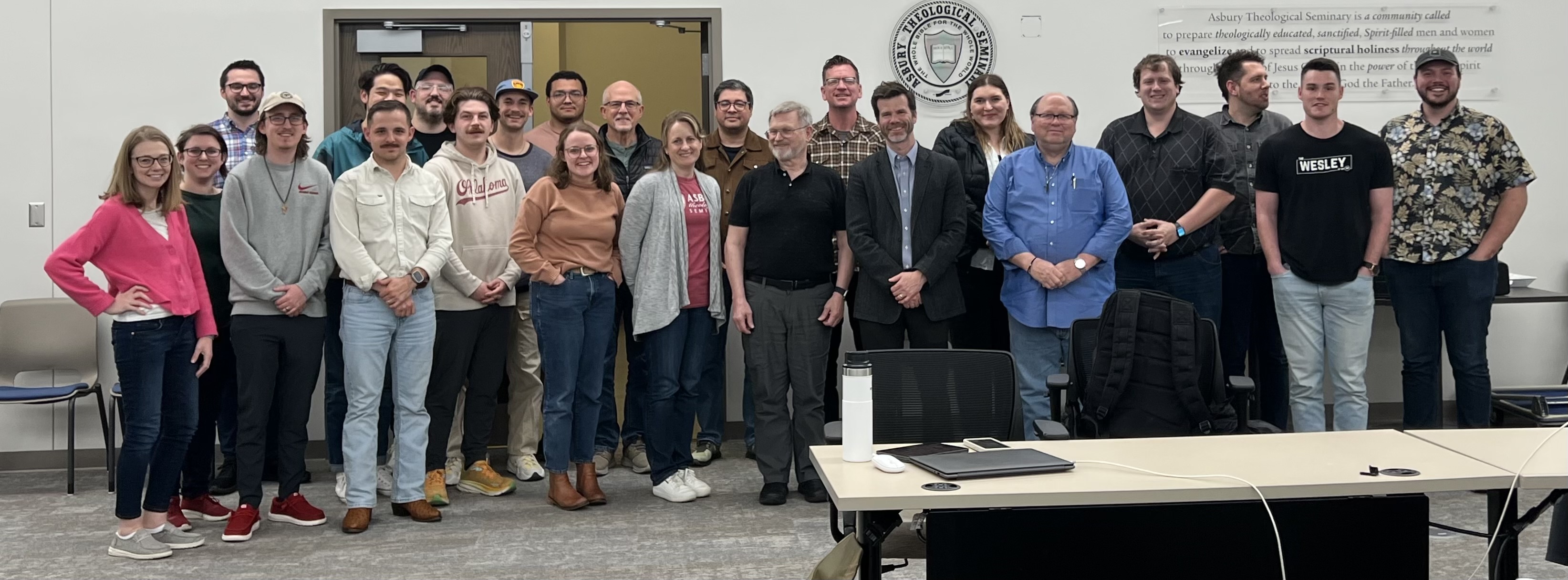
I had the privilege of teaching The Theology of John Wesley, which is one of the core classes at Asbury Theological Seminary this spring. Every student, regardless of degree, must take The Theology of John Wesley to graduate with a Master’s Degree. This is one of the ways Asbury anchors its identity and resists institutional drift. And I love it!

The class also gave me the opportunity to re-read core texts on John Wesley’s theology. First, we read sixty (yes, 60, not 6) of John Wesley’s sermons, including all of the original Standard Sermons. (Whether you want 44 or 52 in the list, they are all in the Collins and Vickers edited volume of Wesley’s sermons!) And we read my colleague Professor Kenneth J. Collins’s John Wesley: A Theological Journey and The Theology of John Wesley: Holy Love and the Shape of Grace. These are both masterful!

The class is a deep dive into Wesley’s theology. It is thorough and has been expertly crafted through decades of experience. I taught the class exactly the way it has been taught by those who have gone before me this semester. I had a blast because I was able to teach in an area I really enjoy teaching. And I was able to continue learning and growing as a follower of Jesus Christ and as a teacher.

Ok, so here is the memory I wanted to share:

One of the places there is always lively discussion, if students are tracking and understanding the material, is around John Wesley’s conviction that one who has experienced justification and the new birth does not commit outward sin. This is based on John Wesley’s reading of the canon of Scripture, particularly passages like 1 John 3:7-10:

Little children, let no one deceive you. Whoever practices righteousness is righteous, as he is righteous. Whoever makes a practice of sinning is of the devil, for the devil has been sinning from the beginning. The reason the Son of God appeared was to destroy the works of the devil. No one born of God makes a practice of sinning, for God’s seed abides in him; and he cannot keep on sinning, because he has been born of God. By this it is evident who are the children of God, and who are the children of the devil: whoever does not practice righteousness is not of God, nor is the one who does not love his brother. (ESV)

Collins brilliantly summarizes this in John Wesley: A Theological Journey:

Justification delivers from the guilt of sin, regeneration from its power or dominion, and entire sanctification from its being. Unfortunately, these distinctions are often neglected in contemporary Methodism where a decided “shift” has taken place; that is, freedom from the power of committing sin is attributed not to the new birth, as it should be, but to Christian Perfection, with the result that freedom from the being of sin is then relegated to the afterlife and glory. (190)

The conversation in class around freedom from the power of sin in regeneration led to a great question. I reached out to Professor Collins to get his perspective and his response was so good I asked for his permission to share it with my students and then to share it with all of you here. Here is how I framed the question:

How do I best talk to students about the correct definition and understanding of the new birth in connection with the band meeting, which both has a prerequisite of the new birth (and more), and weekly questions connected to sin.

I.e., if a students says, If someone does not commit outward sin after they receive justification and the new birth, why are the band meeting questions focused around sin? (I.e., “What known sins have you committed since we last met?”)

Here is Dr. Collins’s reply:

First of  all,  given the small numbers of people in the band meetings there may not be many responses to the weekly, sin-probing questions among the children of God, but there will likely be at least some responses over time.  Real Christians do at times break faith and commit sin of the high hand, so to speak.  The way forward then would be and must be one of repentance, of doing the first works afresh.  So then, when Wesley affirmed that a born again believer is free from the power and dominion of sin (“The Marks of the New Birth,” “The Great Privilege of Those that are Born of God”) he  was not teaching that real Christians would never sin again (a common misunderstanding among my students) but that Christian believers would have grace sufficient to remain faithful and to walk in a trusting and accountable way in the graces of regeneration.   How do we bring all of this together?  How can we summarize this basic and precious gospel truth which Jesus Christ, himself, affirmed (John 8:34-36)  and which John Wesley repeatedly taught?  I offer the following summary of the several elements here, though this language is not Wesley’s but my own.   However, I do believe that such language captures Wesley’s basic meaning.  And so here goes:    “Willful, intentional sin,  breaking faith with Christ,  should be the grave exception in the Christian life and not the rule.”  Our problem today, however, in American Christianity in general, and even at times in Methodism in particular,  is  that we have made sin the rule and grace the exception.  We need to turn this upside down.   Jesus Christ died for far more than to leave people in the bondages of which they are ashamed. 

Second, I think the very great value of  such questions for the saints that played out in the band meetings during Wesley’s lifetime is that they are a wonderful means of grace that ensure that responsibility and accountability will remain in place.   Think of  band members, for example, who are sorely tempted during the week but who in the midst of  that temptation are reminded by the Holy Spirit, the Spirit of Truth,  that they will have to confess such a sin (if it is committed) before several trusted and beloved others in just a few days.   At that  point the power of the temptation is broken (1 Cor. 10:13) by the light of the prospect of upcoming fellowship,  accountability and love.   That’s precisely the point!   In other words, the questions of the band meetings are themselves a wonderful means of grace, used by the Holy Spirit,  as a means by which faithful Christian discipleship is strengthened and lived out to the glory of God.  Put another way, evil and sin love the darkness; however, Wesley made sure that the infrastructure of Methodism in general, and the band meetings in particular would be flooded by an abundance of light in the form of relationship, accountability and the richest love.   In short, those questions are both precious and necessary  for serious Christian discipleship. 

So good!

Want to know more about the band meeting? Scott Kisker and I wrote a book that is designed to reclaim this practice. Check it out here.

Understanding the Wesleyan Tradition in the United States: Interview at Asbury Church

16 Friday Aug 2024

Posted by Kevin M. Watson in Christian Living, Life, Methodist History, Sermons, Wesley

≈ 2 Comments

Tags

John Wesley, Methodism, Wesley

The Rev. Andrew Forrest, the senior pastor at Asbury Church in Tulsa, OK, interviewed me about my new book this past weekend in all of our services. It was so fun!

Andrew is not only a gifted communicator, he also has the ability to help other people refine and clarify their own ideas. It was really fun to see his mind work in terms of distilling what was most important from the book for people at Asbury Church.

Here is a screenshot of the interview. Click the link below to view it.

https://asburytulsa.org/sermon/why-and-how-churches-lose-their-way/

Doctrine, Spirit, and Discipline: A History of the Wesleyan Tradition in the United States has already sold out of the first print run! (It continues to be available as an e-book and an audio book.) I am thrilled by the interest the book has received and look forward to seeing it continue to build.

As I’ve talked with people about the book, I’ve only become more convinced of its importance for such a time as this. As we move into new futures, it is essential that we be able to recognize real Methodism from cheap imitations. In order to do so, we have to know where we have come from and be regrounded in our identity. I believe John Wesley was right to lay out the following as the litmus test for Methodist vitality:

“I am not afraid that the people called Methodists should ever cease to exist either in Europe or America. But I am afraid lest they should only exist as a dead sect, having the form of religion without the power. And this undoubtedly will be the case unless they hold fast both the doctrine, spirit, and discipline with which they first set out.” – John Wesley “Thoughts upon Methodism” (1786)

My book describes the doctrine, spirit, and discipline with which Methodists first set out and traces adherence to them across the history of the Wesleyan family in the United States.

Methodists were at the center of the First Great Awakening and the Second Great Awakening. I am convinced that one way or another, the DNA of real Methodism will be at the center of the Third Great Awakening.

May it begin with us!

Doctrine, Spirit, and Discipline: A History of the Wesleyan Tradition in the United States – Book Release

25 Tuesday Jun 2024

Posted by Kevin M. Watson in Book Review, Holiness, Methodist History, Wesley

≈ Leave a comment

Tags

Book Review, John Wesley, Methodism, Methodist, Wesley

After working on this book for seven years, my new book Doctrine, Spirit, and Discipline: A History of the Wesleyan Tradition in the United States is officially released.

I am so thankful to the Lord that this day has arrived!

If you haven’t picked up a copy of the book, I hope you will today!

Here is the summary of the book from the dust jacket:

An expansive, substantive history of the Wesleyan tradition in the United States, Doctrine, Spirit, and Discipline offers a broad survey of the Methodist movement as it developed and spread throughout America, from the colonial era to the present day. It also provides a theological appraisal of these developments in light of John Wesley’s foundational vision. Beginning with Wesley himself, Watson describes the distinctiveness of the tradition at the outset. Then, as history unfolds, he identifies the common set of beliefs and practices that have unified a diverse group of people across the centuries, providing them a common identity through a number of divisions and mergers. At a time when sweeping changes continue to transform Methodism and the pan-Wesleyan movement, Watson shows that the heart of the Wesleyan theological tradition is both more expansive and substantive than any singular denominational identity.

For more information check out the post I wrote here.

Zondervan has created a fantastic page for the book here.

Buy the book at Amazon here (affiliate link) or through Zondervan directly here.

I have been interviewed on several podcasts about the book. I will update interviews as they go live.

I was on Art of Holiness with Rev. Dr. Carolyn Moore. Check it out here.

I was on Spirit & Truth with Rev. Dr. Matt Reynolds. Check it out here.

The interest in this book has been so encouraging to me. Thank you so much to each of you who have bought the book. I am grateful! 

New Book Announcement: Doctrine, Spirit, and Discipline

11 Tuesday Jun 2024

Posted by Kevin M. Watson in Book Review, Holiness, Life, Methodist History, Wesley

≈ 2 Comments

Tags

Book Review, John Wesley, Methodism, Wesley

On June 25, 2024 Doctrine, Spirit, and Discipline: A History of the Wesleyan Tradition in the United States will be released. And I need your help!

In some ways, I have been working on this book my entire scholarly career. I started this project in earnest seven years ago. This is the most ambitious writing project I’ve undertaken. I believe it is also the most important book I’ve written.

Why?

One of the main problems I have been trying to solve throughout my work in the church and the academy is identifying the core content of the Wesleyan/Methodist theological tradition. What does it mean to be Wesleyan or Methodist?

My sense has been that many different parts of the Wesleyan tradition have been undergoing a crisis of identity for various reasons. Some have pursued cultural respectability at the expense of coherence and clarity. Others have moved away from the riches of their heritage in the Holiness Movement to generic evangelicalism. Much more could be said on this.

In Doctrine, Spirit, and Discipline, I argue that there is an identifiable theological tradition running through the Wesleyan/Methodist theological tradition in the United States. It was clearly articulated by John Wesley in the beginnings of Methodism in Britain. And this theological vision, along with the method that gave it its name, was embraced explicitly by the founders of the first denominations founded in the United States. 

My sense is that the Wesleyan theological tradition is in a time of both fragmenting and realigning. I don’t think we can know yet how things are going to sort out. There are even very good reasons to think that denominational identity will not have the purchase in the future that it has had in the past.

With all this change and uncertainty, there is one thing of which I am confident: I am convinced the founding vision of John Wesley and the first Methodists is as relevant for our day as it was for theirs, if not more so. 

Before we can do anything else, we need to know who we are. Getting clear of our identity requires knowing our history. We need to know where we’ve come from.

Doctrine, Spirit, and Discipline is my attempt to tell the story of the Wesleyan tradition in the United States in a way that intentionally, though I am sure imperfectly and incompletely, tells the story through a broader lens than it has been typically told.

I also do the best that I can to wrestle with the issues and challenges facing the church today. I do this because I am convinced that our past is an essential guide for a better future.

I have been humbled by the endorsements this book has received. This book has been described as “the definitive history of the Wesleyan movement in the United States.” Here are a few endorsements, you can read more at the landing page Zondervan has created for the book.

“Kevin Watson’s newest book, Doctrine, Spirit, and Discipline, is not just the latest history of Methodism in America. Rather, it’s a tour de force. Previous historical accounts have viewed the institutions that resulted in the United Methodist Church as the truly legitimate Methodist trajectory, while offering just a fleeting look at other Wesleyan denominations. But rather than seeing African American, Holiness, and Pentecostal church bodies as schismatic and somewhat peripheral to the Methodist story, Watson treats them as central. Why? Because these groups, though smaller in size than better-known, larger institutions (Methodist Episcopal/Methodist/United Methodist), often maintained Wesley’s theological foundation more consistently. Watson sees Wesley’s formulation of “doctrine, spirit, and discipline” as the “common foundation for a broad tradition”—not broad theologically, but broad geographically, ethnically, and denominationally. This book, then, is not only necessary reading for all American Wesleyans but also an essential corrective to the overall narrative of the Methodist legacy in the United States.”
—DOUGLAS M. STRONG, Paul T. Walls Professor of Wesleyan Studies, professor of the history of Christianity, Seattle Pacific University

“I was captivated on the first page of Doctrine, Spirit, and Discipline. Immediately the reader is taken into the early life of John Wesley with this theme developed through his own personal life and expanded as he leads this great awakening throughout England and then more thoroughly developed in the US. However, Kevin Watson does not shy away from the power struggles, the issues of slavery, and the divisions even to this present day. He gives very generous history of the Black church, the Pentecostal movement, the Holiness movement, and various denominations which comprise what is known as the pan-Wesleyan movement today. In all this it is obvious the themes that continue to hold this diverse group together from the beginnings of John Wesley. It is written in such a way that is inspirational and at the same time with a strong researched theological and historical foundation. This book is a treasure for the classroom, leaders in the pan-Wesleyan movement both lay and clergy, and those outside the movement to discover the strength of the doctrine, spirit, and discipline initiated by John Wesley that has been effective for some 250 years. Yes, a book for now and future generations.”
—JO ANNE LYON, general superintendent emerita, the Wesleyan Church

“A faithful witness to the people called Methodists in England and in America, this colossal volume expeditiously moves from Wesley to American Methodism and its extended branches to the current state of Wesleyanism today. Watson masterfully retells a well-chronicled narrative in terse, accessible, lucid prose, covering not just the contours of Wesleyan history with its highs and lows but also its various doctrinal developments and disputes and ecclesial divisions. The moral of the story, as indicated by the quote from which the title is taken, is that Methodism at its best is a blazing, fiery force of renewal and at its worst an inert, acculturated institution. Although coming in at nearly 500 pages, this volume is concise and highly accessible. Well-illustrated, highly detailed, and informative, Doctrine, Spirit, and Discipline is suitable for the classroom and will make a fine addition to any shelf of classic volumes on Methodist history.”
—PETER J. BELLINI, professor of church renewal and evangelization in the Heisel Chair, United Theological Seminary

“This book is destined to become the standard reference work for everyone who wants a better understanding of the Wesleyan tradition. More important, however, is that anyone who seeks the blessing of holiness in his or her own life will find inspiration and encouragement on every page. Churches that preach the life-giving message of sanctification, including the Salvation Army, owe a tremendous debt of gratitude to Dr. Watson for this outstanding work.”
—KENNETH G. HODDER, USA national commander, the Salvation Army

I need your help.

Please pre-order my book. There is much about the publishing world I don’t understand. One thing I do know is that pre-orders are crucial to a book’s success. You can pre-order the book on Amazon here (affiliate link) or directly through Zondervan here. Amazon has a pre-order price guarantee and books like this are typically discounted as they get closer to the release date. Zondervan is currently offering a 30% sale!

I don’t think I’ve ever made a direct request like this before. It would be a big help to me if you would place a pre-order for this book now. If you do, you can also get immediate access to chapters 1 & 2 by entering your email and book order number at the bottom of the page here: https://zondervanacademic.com/doctrine-spirit-and-discipline

I am so excited to see something I’ve been working on for so long finally be released. Thank you so much for your support!

Kevin M. Watson is Director of Academic Growth and Formation at Asbury Theological Seminary. He is anchored at the Seminary’s Tulsa Extension Site. He is also the Scholar in Residence at Asbury Church in Tulsa, OK.

Secrets and the Wisdom of the Wesleyan Tradition

08 Wednesday May 2024

Posted by Kevin M. Watson in Book Review, Christian Living, Wesley

≈ Leave a comment

Tags

Band meeting, John Wesley, Methodism, secrets, Wesley

I don’t know about you, but I find it so encouraging when I read something outside of the church that highlights the value of what Christians do.

Here is an example I just came across:

One of the cornerstones of the Wesleyan movement throughout John Wesley’s lifetime was a small group called the band meeting. There were a list of prerequisites for joining a band meeting. But the basic activity of the band was pretty simple – confession of sin for the sake of growth in holiness.

At the weekly meeting, participants each answered five questions:

1. What known sins have you committed since our last meeting?

2. What temptations have you met with?

3. How were you delivered?

4. What have you thought, said, or done, of which you doubt whether it be sin or not?

5. Is there anything you desire to keep secret?

(You can read the entire “Rules of the Band Societies” here.) 

I first joined a band meeting when I was a seminary student. And joining that band meeting was, by far, the most important part of my seminary experience.

Not long after I graduated from seminary, I began to feel a more specific calling to pastor people who were preparing to become pastors. If I was going to pursue that calling, it would mean that I would need to complete a PhD. When I realized that no one had studied the band meeting in depth, I decided to write my PhD dissertation on the band meeting in John Wesley’s thought and in the popular experience of the first Methodists. I revised my dissertation and published it with Oxford University Press as Pursuing Social Holiness: The Band Meeting in Wesley’s Thought and Popular Methodist Experience.

During my work on the band meeting, I noticed that the fifth question was removed at one point by an editor of the original “Rules of the Band Societies” (the document where the five questions was published) sometime around the early nineteenth century.

As best I can remember, the fifth question was not used in the first band meeting I joined.

Is there anything you desire to keep secret?

It isn’t hard to come up with reasons why that question might be disappeared. It is intense! If you have a secret, kind of by definition you don’t want to share it. But the question is a game changer because it brings everything into the light of Christ and his healing grace in the appropriate place.

So back to the beginning of this post.

I just finished reading The Secret Life of Secrets by Michael Slepian. 

The book is an in-depth and interesting study of secrets and the role they play in our lives. 

The big takeaway at the end of the book could not have been much better aligned with the early Methodist band meeting and its simple question: Is there anything you desire to keep secret?

At the end of the book, Slepian shows that while everyone has had or has a secret, it is helpful to be able to share secrets with people you know and can trust.

All the way back in the 18th century, Methodists were creating band meetings in order to not only share secrets, but to seek the wholeness and healing described in James 5:16

Therefore confess your sins to one another, and pray for one antoher, so that you may be healed. The prayer of the righteous is powerful and effective.

Secular scientific study is confirming the instincts Christians have always had. How cool is that?

Want to know more about the band meeting?

For the academic and historic work, see Pursuing Social Holiness.

For an introduction to what a band meeting is and a guide to starting band meetings in our own day, check out the book I wrote with Dr. Scott T. Kisker, The Band Meeting.

John Wesley’s Sermon “The Law Established through Faith, II”: A Brief Summary

23 Tuesday Mar 2021

Posted by Kevin M. Watson in Christian Living, Sermons, Wesley

≈ 4 Comments

Tags

faith, holiness, John Wesley, John Wesley Sermons, Law

John Wesley, Justification by Faith

This is the 31st sermon in this series. It is very encouraging to see how many people are reading these posts and clicking through to read the sermon itself. Just joining the growing number of people reading these sermons? Feel free to start at the beginning by reading the first sermon by John Wesley in this series, “Salvation by Faith,” or jump right in with us!


Background:

Did you know that many of John Wesley’s sermons are part of the formal doctrinal teaching of multiple Wesleyan/Methodist denominations? Wesley’s sermons have particular authority because these were the main way he taught Methodist doctrine and belief.

“The Law Established through Faith, II” is the 31st sermon of the Wesleyan Standard Sermons. This sermon builds on the previous sermon, “The Law Established through Faith, I” and outlines a more positive vision for how the law is established in the lives of followers of Jesus Christ.

In hopes of sparking interest in Wesley’s sermons and Methodism’s doctrinal heritage, here is my very short summary of “The Law Established through Faith, II.” I hope it will inspire you to read the sermon in its entirety yourself. Links to the sermon and other resources are included at the end of this post.


Key quote: 

Can you say, ‘Thou art merciful to my unrighteousness; my sins thou rememberest no more’? Then for the time to come see that you fly from sin, as from the face of a serpent. For how exceeding sinful does it appear to you now! How heinous above all expression! On the other hand, in how amiable a light do you now see the holy and perfect will of God! Now, therefore, labour that it may be fulfilled, both in you, by you, and upon you. Now watch and pray that you may sin no more, that you may see and shun the least transgression of his law. You see the motes which you could not see before when the sun shines into a dark place. In like manner you see the sins which you could not see before, now the sun of righteousness shines in your heart. Now, then, do all diligence to walk in every respect according to the light you have received. Now be zealous to receive more light daily, more of the knowledge and love of God, more of the Spirit of Christ, more of his life, and of the power of his resurrection. Now use all the knowledge and love and life and power you have already attained. So shall you continually go on from faith to faith. So shall you daily increase in holy love, till faith is swallowed up in sight, and the law of love established to all eternity. [III.6]


One sentence summary:  

The moral law of God is established in our lives through sound doctrine, faith in Christ, love of God and neighbor, and holiness of heart and life.


Scripture passage for the sermon:

“Do we then make void the law through faith? God forbid! Yea, we establish the law.”

– Romans 3: 31


Concise outline of “The Law Established through Faith, II”

1. A summary of the previous sermon. This sermon asks, positively, “How do we establish the law through faith?”
2. Establishing the moral law is not the condition of our justification. And yet, “we still, in the Aposle’s sense, ‘establish the law.'”

I. We Establish the Law by Our Doctrine
1. We establish the law by offering “the whole counsel of God” with “great plainness of speech.”
2. The law is established by our doctrine when “we declare every part of it, every commandment contained therein, not only in its full, literal sense, but likewise in its spiritual meaning; not only with regard to the outward actions which it either forbids or enjoins, but also with respect to the inward principle, to the thoughts, desires, and intents of the heart.”
3. The law must be established through doctrine because “as important as these things are, they are little considered or understood.
4. “The law of God, as to its inward spiritual meaning, is not hid from the Jews or heathens only, but even from what is called the Christian world.”
5. Even though it is offensive to many who hear it, “All that is written in the Book of God we are to declare, not as pleasing men, but the Lord. We are to declare not only all the promises but all the threatenings, too, which we find therein. At the same time that we proclaim all the blessings and privileges which God had prepared for his children, we are likewise to ‘teach all the things whatsoever he hath commanded.'”
6. “It is our part thus to ‘preach Christ’ by preaching all things whatsoever he hath revealed… We are not ourselves clear before God unless we proclaim him in all his offices.”

II. We Establish the Law by Preaching Faith in Christ in a Way that Leads to Holiness of Heart and Life
1. Even faith in Christ is not the end result God aims at. “God hath given this honor to love alone. Love is the end of all the commandments of God.”
2. Faith “is the great temporary means which God has ordained to promote that eternal end [love].”
3. Faith cannot be preached so as to “swallow up all things” and become more important than love.
4. “Nor is it certain… that faith, even in the general sense of the word, had any place in paradise.”
5. Faith was necessary before the fall. “It was only when love was lost by sin that faith was added, not for its own sake, nor with any design that it should exist any longer than until it had answered the end for which it was ordained – namely, to restore man to the love from which he was fallen.”
6. “Faith then was originally designed of God to re-establish the law of love.”

III. The Most Important Way of Establishing the Law Is by Establishing It in Our Own Hearts and Lives
1. It would serve no purpose to preach the law through our doctrine and preach Christ in all of his offices if it “were not established in our hearts.”
2. “How may we establish the law in our own hearts so that it may have its full influence on our lives?… This can only be done by faith… Faith in general is the most direct and effectual means of promoting all righteousness and true holiness; of establishing the holy and spiritual law in the hearts of them that believe.”
3. “There is no motive which so powerfully inclines us to love God as the sense of the love of God in Christ.”
4. “Nor does faith fulfill either the negative or positive law as to the external part only; but it works inwardly by love to the purifying of the heart, the cleansing it from all vile affections.”
5. “Let us thus endeavor to establish the law in ourselves; not sinning ‘because we are under grace’, but rather using all the power we receive thereby ‘to fulfill all righteousness.'”
6. Can you say, ‘Thou art merciful to my unrighteousness; my sins thou remeberest no more’? Then for the time to come see that you fly from sin, as from the face of a serpent…. Now use all the knowledge and love and life and power you have already attained. So shall you continually go on from faith to faith. So shall you daily increase in holy love, till faith is swallowed up in sight, and the law of love established to all eternity.”


Resources:

Read “The Law Established through Faith, II” in its entirety.

Check out my brief summaries of the first thirty Standard Sermons:

“Salvation by Faith”

“The Almost Christian”

“Awake, Thou That Sleepest”

“Scriptural Christianity“

“Justification by Faith“

“The Righteousness of Faith“

“The Way to the Kingdom“

“The First-Fruits of the Spirit“

“The Spirit of Bondage and of Adoption“

“The Witness of the Spirit, I“

“The Witness of Our Own Spirit“

“The Means of Grace“

“The Circumcision of the Heart“

“The Marks of the New Birth“

“The Great Privilege of those that are Born of God“

“Upon our Lord’s Sermon on the Mount, Discourse the First“

“Upon our Lord’s Sermon on the Mount, Discourse the Second“

“Upon our Lord’s Sermon on the Mount, Discourse the Third“

“Upon our Lord’s Sermon on the Mount, Discourse the Fourth“

“Upon our Lord’s Sermon on the Mount, Discourse the Fifth“

“Upon our Lord’s Sermon on the Mount, Discourse the Sixth“

“Upon our Lord’s Sermon on the Mount, Discourse the Seventh“

“Upon our Lord’s Sermon on the Mount, Discourse the Eighth“

“Upon our Lord’s Sermon on the Mount, Discourse the Ninth“

“Upon our Lord’s Sermon on the Mount, Discourse the Tenth“

“Upon our Lord’s Sermon on the Mount, Discourse the Eleventh“

“Upon our Lord’s Sermon on the Mount, Discourse the Twelfth“

“Upon our Lord’s Sermon on the Mount, Discourse the Thirteenth“

“The Original, Nature, Properties, and Use of the Law“

“The Law Established through Faith, I“

I highly recommend the critical edition of Wesley’s sermons, which has excellent references that show his reliance on Scripture throughout his preaching. There are four volumes if you want every known Wesley sermon. The sermon outlined in this post is in volume II. These books aren’t cheap, but this is the most important publication by Abingdon since its release. And they are designed to last. Highly recommended!

There is also a three volume edition of Wesley’s sermons in modern English, which is easier to read if you find the 18th century English frustrating. Here is the first volume.


Kevin M. Watson is a professor at Candler School of Theology, Emory University. He teaches, writes, and preaches to empower community, discipleship, and stewardship of our heritage. Click here to get future posts emailed to you. Affiliate links used in this post.

John Wesley’s “Upon Our Lord’s Sermon on the Mount, Discourse the Thirteenth”: A Brief Summary

01 Tuesday Dec 2020

Posted by Kevin M. Watson in Christian Living, Sermons, Wesley

≈ 8 Comments

Tags

John Wesley, John Wesley Sermons, Sermon on the Mount

John Wesley, Justification by Faith

This is the 28th sermon in this series. I have been publishing one sermon each Tuesday. Just joining the growing number of people reading these sermons? Feel free to start at the beginning by reading the first sermon by John Wesley in this series, “Salvation by Faith,” or jump right in with us!


Background:

Did you know that many of John Wesley’s sermons are part of the formal doctrinal teaching of multiple Wesleyan/Methodist denominations? Wesley’s sermons have particular authority because these were the main way he taught Methodist doctrine and belief.

“Upon Our Lord’s Sermon on the Mount, Discourse the Thirteenth” is the 28th sermon of the Wesleyan Standard Sermons. It is also the 13th of 13 sermons on the Sermon on the Mount. The fact that 13 of the 44 original Standard Sermons focused on the Sermon on the Mount gives an idea of the importance John Wesley placed on Matthew 5-7. Wesley spends so much time on these three chapters of the Bible because he believed they provide essential teaching from Jesus on “the true way to life everlasting, the royal way which leads to the kingdom.”

In hopes of sparking interest in Wesley’s sermons and Methodism’s doctrinal heritage, here is my very short summary of “Upon Our Lord’s Sermon on the Mount, Discourse the Thirteenth.” I hope it will inspire you to read the sermon in its entirety yourself. Links to the sermon and other resources are included at the end of this post.


Key quote: 

I am, secondly, to show the wisdom of him that doth them, that ‘buildeth his house upon a rock.’ He indeed is wise who ‘doeth the will of my Father which is in heaven.’ He is truly wise whose ‘righteousness exceeds the righteousness of the scribes and Pharisees.’ He is poor in spirit; knowing himself even as also he is known. He sees and feels all his sin, and all his guilt, till it is washed away by the atoning blood. He is conscious of his lost estate, of the wrath of God abiding on him, and of his utter inability to help himself till he is filled with peace and joy in the Holy Ghost. He is meek and gentle, patient toward all men, never ‘returning evil for evil, or railing for railing, but contrariwise blessing’; till he overcomes evil with good. His soul is athirst for nothing on earth, but only for God, the living God. He has bowels of love for all mankind, and is ready to lay down his life for his enemies. He loves the Lord his God with all his heart, and with all his mind and soul and strength. He alone shall enter into the kingdom of heaven who in this spirit doth good unto all men; and who, being for this cause despised and rejected of men, being hated, reproached, and persecuted, ‘rejoices and is exceeding glad,’ knowing in whom he hath believed; and being assured these light, momentary afflictions will ‘work out for him an eternal weight of glory.’ [II.1]


One sentence summary:  

This sermon outlines the difference between building a house on sand or on rock in following Jesus.


Scripture passage for the sermon:

“Not everyone that saith unto me, Lord, Lord, shall enter into the kingdom of heaven; but he that doeth the will of my Father which is in heaven.

Many will say to me in that day, Lord, Lord, have we not prophesied in thy name? And in thy name have cast out devils? And in thy name done many wonderful works?

And then will I profess unto them, I never knew you: depart from me, ye that work iniquity.

Therefore whosoever heareth these sayings of mine, and doeth them, I will liken him unto a wise man, which built his house upon a rock;

And the rain descended, and the floods came, and the winds blew, and beat upon that house; and it fell not; for it was founded upon a rock.

And everyone that heareth these sayings of mine, and doeth them not, shall be likened unto a foolish man, which built his house upon the sand;

And the rain descended, and the floods came, and the winds blew, and beat upon that house; and it fell: and great was the fall of it.”

– Matthew 7:21-27


Concise outline of “Upon our Lord’s Sermon on the Mount, Discourse the Thirteenth”

1. Jesus closes the Sermon on the Mount with these words, “setting his seal to his prophecy, and impressing his whole authority on what he had delivered, that it might stand firm to all generations.”
2. There is no other way than the way outlined by Jesus.
3. This sermon will, first, “consider the case of him who builds his house upon the sand; secondly, to show the wisdom of him who builds upon a rock; and thirdly, to conclude with a practical application.”

I.The case of the one who builds a house upon the sand.
1. Wesley emphasizes the serious consequences of building upon sand, regardless of good intentions or good works.
2. Doing no harm also does not guarantee that you will enter the kingdom of heaven.
3. Doing good works does not guarantee that you will enter the kingdom of heaven.
4. “If any man marvels at this, let him acknowledge he is a stranger to the whole religion of Jesus Christ; and in particular to the perfect portraiture thereof which he has set before us in this discourse.”
5. None will enter the kingdom of God unless they have this kingdom within them. Jesus reemphasizes this in this passage.
6. Those who “rest in anything short of that religion” which Jesus describes in the Sermon on the Mount built their house on sand.

II. The wisdom of the one who builds a house upon rock.
1. “He alone shall enter into the kingdom of heaven who in this spirit doth good unto all men; and who, being for this cause despised and rejected of men, being hated, reproached, and persecuted, ‘rejoices and is exceeding glad,’ knowing in whom he hath believed; and being assured these light, momentary afflictions will ‘work out for him an eternal weight of glory.'”
2. The wise person knows her true state before God and she knows the way to the kingdom of heaven: “even now to know, to love, to imitate God, and to believe in Jesus Christ whom he hath sent.”
3. It is wise to build upon the rock, which is Jesus Christ himself.
4. This does not mean the Christian is done with trials or temptation. “It still remains for God to prove the grace he hath given: he shall be tried as gold in the fire.”

III. Practical Application
1. Do not mistake things that help one grow in holiness (such as right doctrine or an excellent church) with holiness itself.
2. Avoiding harm is necessary but not sufficient. “When all this harmlessness flows from a right principles it is the least part of the religion of Christ. But in you it does not flow from a right principle, and therefore is no part at all of religion.”
3. Attending all the ordinances of God is important, but still not sufficient. “Faith, mercy, and love of God; holiness of heart; heaven opened in the soul” are essential.
4. Do not rely on your good works. “Learn to hang naked upon the cross of Christ, counting all thou hast done but dung and dross.”
5. Real faith produces inward and outward holiness. “That faith which hath not works, which doth not produce both inward and outward holiness, which does not stamp the whole image of God on the heart, and purify us as he is pure; that faith which does not produce the whole of the religion described in the foregoing chapters, is not the faith of the gospel, not the Christian faith, not the faith which leads to glory.”
6. “Now, therefore, build thou upon a rock. By the grace of God, know thyself.”
7. “Now weep for your sins, and mourn after God till he turns your heaviness into joy.”
8. “Learn in every state wherein you are, therewith to be content… Be angry at sin, as an affront offered to the majesty of heaven; but love the sinner still.”
9. Hunger and thirst for eternal things, not things that perish.
10. “Now, seeing thou canst do all things through Christ strengthening thee, be merciful as thy Father in heaven is merciful. Love thy neighbour as thyself. Love friends and enemies as thy own soul. And let thy love be long-suffering, and patient towards all men.”
11. “Now be thou ‘pure in heart’; purified through faith from every unholy affection, ‘cleansing thyself from all filthiness of flesh and spirit, and perfecting holiness in the fear of God.'”
12. “In a word: let thy religion be the religion of the heart… And as sure as thou now walkest with God on earth, thou shalt also reign with him in glory.”


Resources:

Read “Upon Our Lord’s Sermon on the Mount, Discourse the Thirteenth” in its entirety.

Check out my brief summaries of the first twenty-seven Standard Sermons:

“Salvation by Faith”

“The Almost Christian”

“Awake, Thou That Sleepest”

“Scriptural Christianity“

“Justification by Faith“

“The Righteousness of Faith“

“The Way to the Kingdom“

“The First-Fruits of the Spirit“

“The Spirit of Bondage and of Adoption“

“The Witness of the Spirit, I“

“The Witness of Our Own Spirit“

“The Means of Grace“

“The Circumcision of the Heart“

“The Marks of the New Birth“

“The Great Privilege of those that are Born of God“

“Upon our Lord’s Sermon on the Mount, Discourse the First“

“Upon our Lord’s Sermon on the Mount, Discourse the Second“

“Upon our Lord’s Sermon on the Mount, Discourse the Third“

“Upon our Lord’s Sermon on the Mount, Discourse the Fourth“

“Upon our Lord’s Sermon on the Mount, Discourse the Fifth“

“Upon our Lord’s Sermon on the Mount, Discourse the Sixth“

“Upon our Lord’s Sermon on the Mount, Discourse the Seventh“

“Upon our Lord’s Sermon on the Mount, Discourse the Eighth“

“Upon our Lord’s Sermon on the Mount, Discourse the Ninth“

“Upon our Lord’s Sermon on the Mount, Discourse the Tenth“

“Upon our Lord’s Sermon on the Mount, Discourse the Eleventh“

“Upon our Lord’s Sermon on the Mount, Discourse the Twelfth“

I highly recommend the critical edition of Wesley’s sermons, which has excellent references that show his reliance on Scripture throughout his preaching. There are four volumes if you want every known Wesley sermon. They aren’t cheap, but this is the most important publication by Abingdon since its release. Highly recommended!

There is also a three volume edition of Wesley’s sermons in modern English, which is easier to read if you find the 18th century English frustrating. Here is the first volume.


Kevin M. Watson is a professor at Candler School of Theology, Emory University. He teaches, writes, and preaches to empower community, discipleship, and stewardship of our heritage. Click here to get future posts emailed to you. Affiliate links used in this post.

John Wesley’s Sermon “Upon Our Lord’s Sermon on the Mount, Discourse the Tenth”: A Brief Summary

03 Tuesday Nov 2020

Posted by Kevin M. Watson in Christian Living, Methodist History, Sermons, United Methodism, Wesley

≈ 11 Comments

Tags

John Wesley, John Wesley Sermons, Sermon on the Mount

John Wesley, Justification by Faith

This is the 25th sermon in this series. You can expect to see a new post in this series by 10am EST on Tuesday mornings (sorry I’m a bit late today). Just joining the growing number of people reading these sermons? Feel free to start at the beginning by reading the first sermon by John Wesley in this series, “Salvation by Faith,” or jump right in with us!


Background:

Did you know that many of John Wesley’s sermons are part of the formal doctrinal teaching of multiple Wesleyan/Methodist denominations? Wesley’s sermons have particular authority because these were the main way he taught Methodist doctrine and belief.

“Upon Our Lord’s Sermon on the Mount, Discourse the Tenth” is the 25th sermon of the Wesleyan Standard Sermons. It is also the 10th of 13 sermons on the Sermon on the Mount. The fact that 13 of the 44 original Standard Sermons focused on the Sermon on the Mount gives an idea of the importance John Wesley placed on Matthew 5-7. Wesley spends so much time on these three chapters of the Bible because he believed they provide essential teaching from Jesus on “the true way to life everlasting, the royal way which leads to the kingdom.”

In hopes of sparking interest in Wesley’s sermons and Methodism’s doctrinal heritage, here is my very short summary of “Upon Our Lord’s Sermon on the Mount, Discourse the Tenth.” I hope it will inspire you to read the sermon in its entirety yourself. Links to the sermon and other resources are included at the end of this post.


Key quote: 

‘This is the law and the prophets.’ Whatsoever is written in that law which God of old revealed to mankind, and whatsoever precepts God has given by ‘his holy prophets which have been since the world began’, they are all summed up in these few words, they are all contained in this short direction. And this, rightly understood, comprises the whole of that religion which our Lord came to establish upon earth. [23]


One sentence summary:  

Jesus warns against several of the main hindrances of Christianity (such as judging others and casting pearls before swine) and concludes with the Golden Rule.


Scripture passage for the sermon:

“Judge not, that ye be not judged.

For with what judgment ye judge, ye shall be judged; and with what measure ye mete, it shall be measured to you again.

And why beholdest thou the mote that is in thy brother’s eye, but considerest not the beam that is in thine own eye?

Or how wilt thou say to thy brother, Let me pull out the mote out of thine eye; and, behold, a beam is in thine own eye?

Thou hypocrite, first cast out the beam out of thine own eye; and then thou shalt see clearly to cast out the mote out of thy brother’s eye.

Give not that which is holy unto dogs, neither cast your pearls before swine; lest they trample them under their feet, and turn again and rend you.

Ask, and it shall be given you; seek, and ye shall find; knock, and it shall be opened unto you.

For everyone that asketh, receiveth; and he that seeketh, findeth; and to him that knocketh, it shall be opened.

Or what man is there of you, who, if his son ask bread, will give him a stone? Or if he ask a fish, will give him a serpent?

If ye, then, being evil, know how to give good gifts unto your children, how much more shall your Father which is in heaven give good things to them that ask him!

Therefore all things whatsoever ye would that men should do to you, do ye even so to them; for this is the law and the prophets.

– Matthew 7:1-12


Concise outline of “Upon our Lord’s Sermon on the Mount, Discourse the Tenth”

1. In Matthew 7:1-12 Jesus identifies the main hindrances to Christianity and ends with application.
2. In Matthew 5, Jesus described inward religion, “the dispositions of the soul which constitute real Christianity.” In Matthew 6, Jesus shows “how all our actions… may be made holy… by a pure and holy intention.”
3. In the beginnings of Matthew 7, Jesus identifies “the most common and most fatal hindrances of this holiness.”
4. The first hindrance is judging.
5. This caution is needed at every stage of the Christian life.
6. This caution is for non-Christians as well as Christians.
7. Jesus especially cautions non-Christians against judging hypocrisy in Christians.
8. Judging is not only speaking evil of someone, it is also thinking evil of another.
9. “The thinking of another in a manner that is contrary to love is that judging which is here condemned.”
10. “We may not only fall into the sin of judging by condemning the innocent, but also… by condemning the guilty in a higher degree than he deserves.”
11. Judging shows a lack of love “which never draws an unjust or unkind conclusion from any premises.”
12. Another snare to be avoided is condemning a person where there is insufficient evidence.
13. Christians should hesitate to immediately believe a person’s self-accusation.
14. The problem of judging others would be largely solved if we consistently applied Matthew 18:15-17.
15. Once you have addressed the problem of judging others, still be careful you are not too quick to help that you “cast your pearls before swine.”
16. “Give not that which is holy unto the dogs.”
17. Be “very unwilling” to make this determination, but once it is clear someone is proud of their shame and separation from the will of God, do not cast your pearls before them.
18. And yet even if all your attempts to persuade someone fail, there is still prayer.
19. “It is in compassion to the hardness of our hearts, so unready to believe the goodness of God, that our Lord is pleased to enlarge upon this head, and to repeat and confirm what he hath spoken.”
20. God is ready and willing to give good gifts to all who ask.
21. “But that your prayer may have its full weight with God, see that ye be in charity with all men.”
22. The golden rule is recognized well beyond Christianity.
23. This summarizes “the whole of that religion which our Lord came to establish upon earth.”
24. This can be understood positively (do to others what you would want them to do to you) or negatively (do not do to others what you would not want them to do to you).
25. “It is clear to every man’s own conscience, we would not that others should judge us, should causelessly or lightly think evil of us.”
26. “Let us love and honor all men. Let justice, mercy, and truth govern all our minds and actions.”
27. “This is pure and genuine morality.”


Resources:

Read “Upon Our Lord’s Sermon on the Mount, Discourse the Tenth” in its entirety.

Check out my brief summaries of the first twenty-four Standard Sermons:

“Salvation by Faith”

“The Almost Christian”

“Awake, Thou That Sleepest”

“Scriptural Christianity“

“Justification by Faith“

“The Righteousness of Faith“

“The Way to the Kingdom“

“The First-Fruits of the Spirit“

“The Spirit of Bondage and of Adoption“

“The Witness of the Spirit, I“

“The Witness of Our Own Spirit“

“The Means of Grace“

“The Circumcision of the Heart“

“The Marks of the New Birth“

“The Great Privilege of those that are Born of God“

“Upon our Lord’s Sermon on the Mount, Discourse the First“

“Upon our Lord’s Sermon on the Mount, Discourse the Second“

“Upon our Lord’s Sermon on the Mount, Discourse the Third“

“Upon our Lord’s Sermon on the Mount, Discourse the Fourth“

“Upon our Lord’s Sermon on the Mount, Discourse the Fifth“

“Upon our Lord’s Sermon on the Mount, Discourse the Sixth“

“Upon our Lord’s Sermon on the Mount, Discourse the Seventh“

“Upon our Lord’s Sermon on the Mount, Discourse the Eighth“

“Upon our Lord’s Sermon on the Mount, Discourse the Ninth“

I highly recommend the critical edition of Wesley’s sermons, which has excellent references that show his reliance on Scripture throughout his preaching. There are four volumes if you want every known Wesley sermon. They aren’t cheap, but this is the most important publication by Abingdon since its release. Highly recommended!

There is also a three volume edition of Wesley’s sermons in modern English, which is easier to read if you find the 18th century English frustrating. Here is the first volume.


Kevin M. Watson is a professor at Candler School of Theology, Emory University. He teaches, writes, and preaches to empower community, discipleship, and stewardship of our heritage. Click here to get future posts emailed to you. Affiliate links used in this post.

Pursuing Social Holiness Now in Paperback

28 Monday Mar 2016

Posted by Kevin M. Watson in Accountability, Christian Living, Methodist History, Wesley

≈ 3 Comments

Tags

Band meeting, Early Methodism, small groups

Pursuing Social Holiness: The Band Meeting in Wesley’s Thought and Popular Methodist Practice is now available in paperback! This is good news because it means the book is much more reasonably priced. The book was initially published in a hardcover edition that was listed at $78. And many of you let me hear about it!

Because of the initial price of the book, I have tended not to promote it too much when I speak within the church. Now that it is available in a more economical format, I want to let you know about it. The retail price for the paperback edition is $35. I know this is still not cheap, but it is about as good as it gets for an academic book. Right now you can save 30% off the paperback edition. Click here and use the promotional code AAFLYG6.

This book is a revision of the work I did for my PhD dissertation and is the product of several years of research and writing on the band meeting in early British Methodism. The book is the only study of meaning and significance of the band meeting in Methodism that has been written.

I’ve been speaking quite a bit over the past few years on the role of Christian conferencing, social holiness, the class meeting, and the band meeting in a variety of contexts. I have focused on the class meeting in my recent writing for the church because the class meeting is the most appropriate entry point for transformation-driven small groups for people who don’t have much experience with them. My recent focus on the class meeting does not mean that I don’t think the band meeting was important too! The band meeting, which was focused on confession of sin for the sake of growth in holiness, was crucial for early Methodism and its mission to “spread scriptural holiness.” Methodists need to know this history and wrestle with its potential relevance for contemporary Christian formation.

Here’s a summary of the book from the back cover:

Kevin M. Watson offers the first in-depth examination of an essential early Methodist tradition: the band meeting, a small group of five to seven people who focused on the confession of sin in order to grow in holiness. Watson shows how the band meeting, which figured significantly in John Wesley’s theology of discipleship, united Wesley’s emphasis on the importance of holiness with his conviction that Christians are most likely to make progress in the Christian life together, rather than in isolation. Watson explores how Wesley synthesized important aspects of Anglican piety and Moravian piety in his own version of the band meeting. Pursuing Social Holiness is an essential contribution to understanding the critical role of the band meeting in the development of British Methodism and shifting concepts of community in eighteenth-century British society.

Here is what some noted scholars in Methodist Studies have said about Pursuing Social Holiness:

“This is a brilliant study of one of the foundational institutions of eighteenth-century Methodism…. Anyone who wants to understand the rise of Methodism should give this account careful consideration. This is a book we have long needed.”

– John Wigger, author of American Saint: Francis Asbury and the Methodists

“This groundbreaking study offers the most detailed account to date of band meetings in early Wesleyan Methodism…. Highly recommended.”

– Randy Maddox, William Kellon Quick Professor of Wesleyan and Methodist Studies, Divinity School

“Watson’s work on the band meeting is the definitive history of this practice of small-group confession within eighteenth-century English evangelicalism…. This is a must-have for scholars of Methodism and eighteenth-century religious history.”

– Scott Kisker, Associate Dean of Residential Programs and Professor of Church History, United Theological Seminary

I hope you will consider picking up a copy of this book in order to learn more about one of the core practices of early Methodists in their pursuit of social holiness.

Thoughts on #UMCGC and Christian Conferencing (Part 2)

16 Tuesday Feb 2016

Posted by Kevin M. Watson in Uncategorized, Wesley

≈ 11 Comments

Tags

Christian conferencing, Methodism

In my previous post, I discussed my concern with the imprecise use of Christian conferencing in the Advance Daily Christian Advocate and the push to reclaim Christian conferencing at the General Conference level. Recent reporting on Christian conferencing leaves me with the impression that the discussion around Christian conferencing has taken a significant step back over the past year. These two UMNS articles [1] [2] have very different understandings of Christian conferencing. Curiously, there is no indication of an awareness of tension between the two or commentary on the shift.

More broadly, I’m not sure United Methodism is currently operating with a collective understanding of either grace or the means of grace that is sufficiently robust. If we aren’t clear about either of these, we cannot hope to be clear about what concrete expressions of means of grace like Christian conferencing ought to look like. Richard P. Heitzenrater’s “The Exercise of the Presence of God: Holy Conferencing as a Means of Grace” is a helpful starting point for a Wesleyan understanding of grace, means of grace, as well as parsing “holy conferencing” and “Christian conferencing.”

While I am discouraged by the recent direction that the discussion of Christian conferencing seems to have taken, particularly as seen in the Advance DCA, I continue to be eager to see The United Methodist Church return to an authentic retrieval of Christian conferencing. So, how can we do a better job of articulating what Christian conferencing is? And where are the best places to work toward a return to this practice?

Andrew C. Thompson’s recent book The Means of Grace offers a substantive and accessible introduction to the means of grace in general, as well as to Christian conferencing more specifically. In his chapter on Christian conferencing, Thompson points out that “fellowship” and “Christian conferencing” are synonyms in Wesley’s writing. For Thompson, “There’s a deeply spiritual component to fellowship, in Wesley’s mind, that makes it centrally about the work of transformation…. Christian believers were gathered together with their hearts open to the work of the Holy Spirit and with a desire to receive God’s grace” (90). Considering the way that conferencing is used in Wesley’s writing, Thompson writes, “Christian conference… is about believers coming together to focus on their faith: to pray, to share their experience of God, to seek advice and to offer counsel, and even to confess their sins and ask for forgiveness” (90).

The recent work of Methodist historians like Heitzenrater and Thompson provides a good foundation for working toward a coherent collective understanding of Christian conferencing at the General Conference and Annual Conference level. Again, because of the current lack of clarity and precision in defining Christian conferencing, the best approach is to focus on teaching on this practice at General Conference and Annual Conference, not implementation. In our current moment, attempting to go straight into practice at General Conference is premature, will most likely waste time, and comes across as trying to manage or control the conversation to people from nearly every perspective.

The best place to begin working toward reclaiming Christian conferencing would be at the district level where you could offer workshops and training. The key place of implementation is the local church, where ongoing relationships are present. Among Methodist historians, there has been a general consensus that the class meeting is one of the best concrete examples of what Wesley had in mind by Christian conferencing being an instituted means of grace.

I have been encouraged by the momentum I have seen building for a retrieval of a contemporary expression of the class meeting. This past Sunday, it was announced at the church I attend that 150 people had signed up to join a new small group ministry that is an intentional reclaiming of the class meeting (and 85 people have already been actively involved in similar groups). This is only one example of the broader interest I am seeing in not just talking about transformation-driven small groups, but in experiencing them. A return to something like the class meeting is something laity are ready for and are responding to in contemporary Methodism. The time seems to be ripe for a deeper engagement with not only Christian conferencing as an instituted means of grace, but also the class meeting and the band meeting as prudential means of grace for “the people called Methodists.”

The specificity of the class meeting as an example of Christian conferencing is helpful for a host of reasons. First, Christian conferencing is a means of grace for everyone, not just General Conference delegates. The primary emphasis for reclaiming this practice needs to be at the local church level and not the General Conference to be sure that all are invited into a practice that is at the core of what it means to be a Methodist.

Second, the class meeting’s focus was answering the question: “How does your soul prosper?” This question reminds us that the key focus of Christian conferencing in early Methodism was on God and peoples’ experience with God, or their search for a deeper experience with God’s presence and power in their lives.

Third, the class meeting was a small group that was intended to meet together for the long haul, not a few times over a couple of weeks. Christian conferencing can occur in isolated meetings, but I do not think that should be seen as the normal experience of Christian conferencing. Christian conferencing is most likely to occur in the context of ongoing community.

One of the reasons I find this to be a difficult topic is because Christian conferencing can occur in a variety of contexts. In thinking about Christian conferencing more over the past few weeks, I’ve realized that I have to say that it is theoretically possible for Christian conferencing to happen at General Conference. It cannot be defined restrictively as a particular type of small group meeting. And yet, I am as convinced as ever that it is foolish to have General Conference be the primary point of emphasis, or the starting point for reclaiming Christian conferencing, in our current moment. Based on the past several General Conferences, we simply do not have good reason to think that genuine Christian conferencing is likely to happen in Portland.

Christian conferencing is a precious part of our heritage as Methodists. It is too important to trivialize or gut of its power as a means of God’s transforming grace. It is not everything that happens at General Conference, as has been suggested by conversations around the pre-General Conference meetings in January. In a time when United Methodism is desperate for renewal, we should absolutely look to our past for guidance. We should struggle to discern where God has been at work in the past in hopes of being renewed in the present. I am all for retrieving Christian conferencing. In fact, my recent book The Class Meeting is an attempt to provide a practical resource for retrieving the most basic aspect of this practice within the local church.

My worry is that we are currently on a course that will disillusion the key leaders of our church with the value of one of our most basic practices. Recent appeals to this practice have not resulted in what I would consider to be Christian conferencing. Instead, there seems to be a persistent tendency to (mis)use Christian conferencing as a way of sanctifying decisions after they have been made that is self-justifying.

To be clear on where I come down on Rule 44: I do not think Rule 44 represents a faithful expression of Christian conferencing. I do not believe Rule 44 would facilitate Christian conferencing.

If we continue in the directions suggested by the Advance DCA, I fear that those who would be most poised to advocate for churches to return to the authentic practice of Christian conferencing will come to have a very negative connotation associated with the phrase. Many already do. The consequence could well be that our key leaders become apathetic to Christian conferencing entirely. Even worse, they might actively oppose attempts to reclaim Christian conferencing based on negative experiences at General Conference that were not actual experiences of the practice.

Much is at stake for the ongoing vitality and coherence of Methodism. May God grant us wisdom and discernment as we continue to work towards reclaiming a practice that is essential for authentic Methodist identity and practice.

Kevin M. Watson is Assistant Professor of Wesleyan and Methodist Studies at Candler School of Theology, Emory University. You can keep up with this blog on twitter @kevinwatson or on facebook at Vital Piety.

← Older posts

Blog at WordPress.com.

  • Subscribe Subscribed
    • Kevin M. Watson
    • Join 369 other subscribers
    • Already have a WordPress.com account? Log in now.
    • Kevin M. Watson
    • Subscribe Subscribed
    • Sign up
    • Log in
    • Report this content
    • View site in Reader
    • Manage subscriptions
    • Collapse this bar
 

Loading Comments...