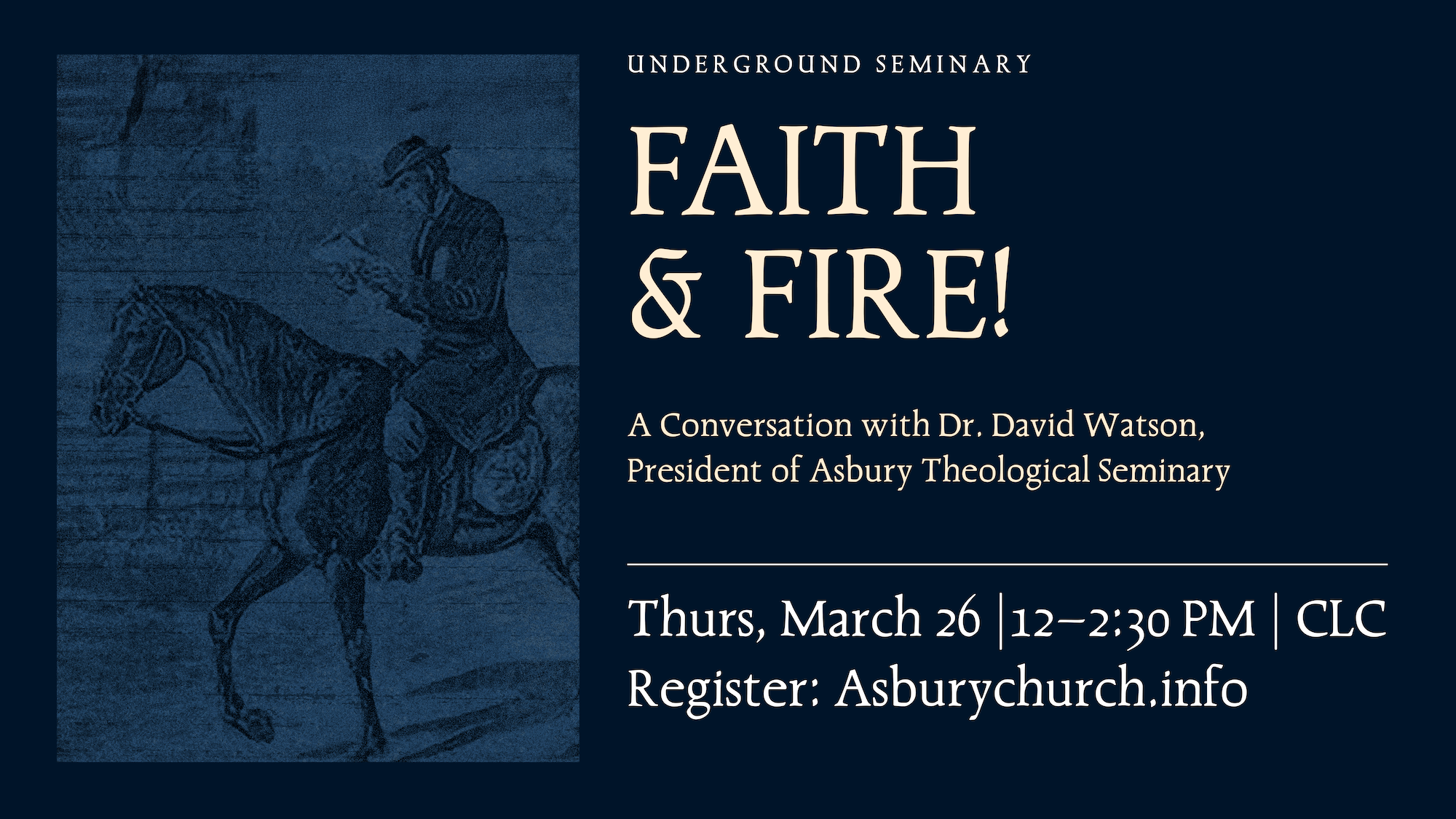
Our next Underground Seminary is going to be our biggest yet! This is the first time that we will have a guest who travels in from out of state to be with us. And I am so pumped to introduce him to you.
This Underground Seminary is called Faith & Fire.
And it will feature Dr. David Watson, the President of Asbury Theological Seminary.
Asbury Theological Seminary is one of the largest seminaries in the world and is the largest Wesleyan evangelical seminary in the United States. Asbury Seminary’s headquarters are in Wilmore, KY which is where the outpouring of the Holy Spirit happened on campus in February 2023. I love getting to be on the faculty and teach at Asbury!
Who this is for:
Underground Seminary is for people who are in ministry, interested in ministry, or considering ministry. It is for people who are hungry for more of God. It is for people who want to learn how to be more effective in work in the church. It is for people who want to grow in faith and holiness.
Underground Seminary is a place for candid and off the record discussion of ideas that matter, particularly for the church in the 21st century and might not fit in a typical seminary curriculum. Underground Seminary is non-academic, not for credit, and only in person.
And my favorite part: Underground Seminary gives people considering or getting started in ministry access to great leaders. This is one of my favorite parts of doing this. I have two decades of ministry experience in the church and academy, and I know firsthand that great leaders are also in demand and have full schedules. It excites me to be able to give people access to my favorite leaders.
Underground Seminary is serious and fun.
It is inspiring and practical.
What this Underground Seminary is about:
Faith & Fire
You will get to have a conversation with Dr. David Watson, President of Asbury Theological Seminary. He and I have written a book together called Faith & Fire: Methodism as a Move of God. This will be the first time I get to talk about this book. And it is going to be so much fun!
I am going to invite Dr. Watson to start by sharing what people in ministry need to not just survive, but to thrive in their work. How should people prepare for ministry and what maintenance should they do to continue to grow in their work? What do you need to do to bring faith & fire to your seminary education, maintain it throughout seminary and your entire ministry?
Then, Dr. Watson and I will talk about our new book. For more than a century, from John Wesley’s “heart warming experience” at Aldersgate Street through the dramatic growth of the Methodist Episcopal Church through the 1850s, Methodism was a powerful move of God. In our book, David and I share the keys for a Spirit-filled movement of God in our day. David will unpack this in ways that will be relevant and insightful for your ministry.
When is this?
March 26, 2026 from 12:00-2:30 pm.
Where is this?
This Underground Seminary will meet at Asbury Church in the CLC. Asbury Church is located at 6767 S. Mingo Road, Tulsa, OK 74133. The CLC is just to left when you come in the West Foyer. We will have hosts ready to greet you and point you in the right direction from any of the main entrances.
The cost for this Underground Seminary is $10. You will receive a copy of Faith & Fire and lunch is included. In case it isn’t obvious: We are not making any money here. The church will cover the additional cost for every person who attends. (If you have dietary restrictions, please email amiller@asburytulsa.org after you register.)
You need Faith & Fire!
So does the church.
Are you ready for more? Come join us!
Kevin M. Watson is a Pastor and the Senior Director of Christian Formation at Asbury Church in Tulsa, OK. He is also on the faculty at Asbury Theological Seminary, anchoring the Seminary’s Tulsa, OK Extension Site. His most recent book, Doctrine, Spirit, and Discipline describes the purpose of the Wesleyan tradition and the struggle to maintain its identity in the United States. Affiliate links, which help support my work, used in this post.
This is a question that is good and healthy for people and institutions to ask periodically.
This question became acute for churches that left their denominations of many years, often due to the presenting issue of same sex marriage. This has happened across mainline denominations. Perhaps the most public recent separation was within the UMC.
I am now on staff at Asbury Church in Tulsa, OK. Asbury was for years the largest United Methodist Church in its Annual Conference.
Since leaving the UMC, Asbury has been in a season of discernment about the future after leaving the United Methodist Church.
Where do we go from here?
The presenting issue for the era of disaffiliation from the UMC was the decades long denominational infighting over sexual ethics, particularly same sex marriage. The breaking point, however, was when it became clear that the bureaucracy of the UMC was willing to nullify the decisions of General Conference when it disagreed with them by simply ignoring them or refusing to enforce them. The decision of bishops and other UMC leaders to impose their judgment over that of General Conference shattered the polity of the UMC, which was the very mechanism that was designed to protect unity in the midst of deep disagreement.
Some orthodox United Methodists could live with the official teaching of the church being one thing on paper and another thing “in real life” happening with no consequence.
I was not one of them.
On the other side of disaffiliation, United Methodism swiftly changed its position on sexual ethics so that its actions are now consistent with its practice. This brought the advantage of consistency and coherence. But it came at the expense of faithfulness to the clear teaching of Scripture at the main pressure point of the present cultural moment.
Some orthodox United Methodist could live with this. I don’t understand how.
If you believe that same sex marriage is not a thing that the Triune God can bless, then I do not understand how you can be “in connection” with a denomination where clergy say that God does bless them and where they regularly occur. The idea that one can be United Methodist and unimpacted by this because it does not happen in your church is either foolish or intellectually dishonest. It is at best incoherent with the basic meaning and purpose of a denomination.
Where do we go from here?
I want to talk about a recent post from Ryan Burge that brings urgency to this question. In fact, it suggests that we don’t have much time left to decide where we are going. And though I will highlight data that relates to the United Methodist Church, the UMC is not the point of this post. I would guess that the Global Methodist Church, the denomination born out of the disaffiliations from the UMC earlier this decade, is probably in a similar position as the UMC is. (Burge does not include date for the GMC in his piece.)
Most importantly, for my focus, Burge’s data is relevant to my own church. We generally fit the picture he shows.
If you are not already familiar with Ryan Burge’s work, you should be. Burge is professor of practice at the Danforth Center on Religion and Politics at Washington University.
He is one of the very few positive examples I can think of where a person has gained a significant platform on social media by delivering consistently thoughtful and nuanced content, particularly regarding the contemporary church. Burge’s work is focused on demographic data, analyzing trends, and pointing to implications for the church.
Are we presuming we have a future, despite all evidence to the contrary?
The heart of Burge’s post is showing how top heavy in terms of age most Protestant denominations are.
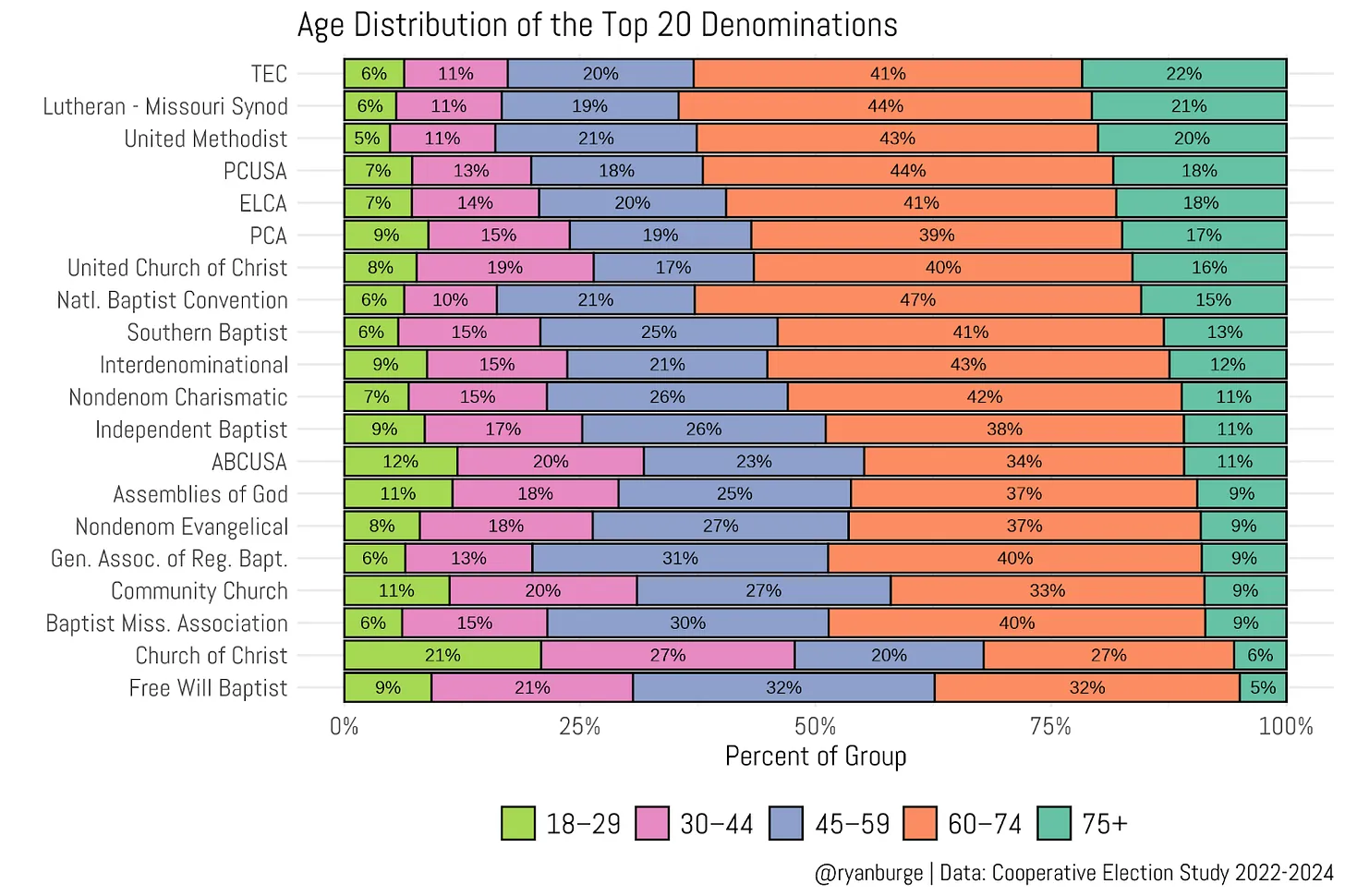
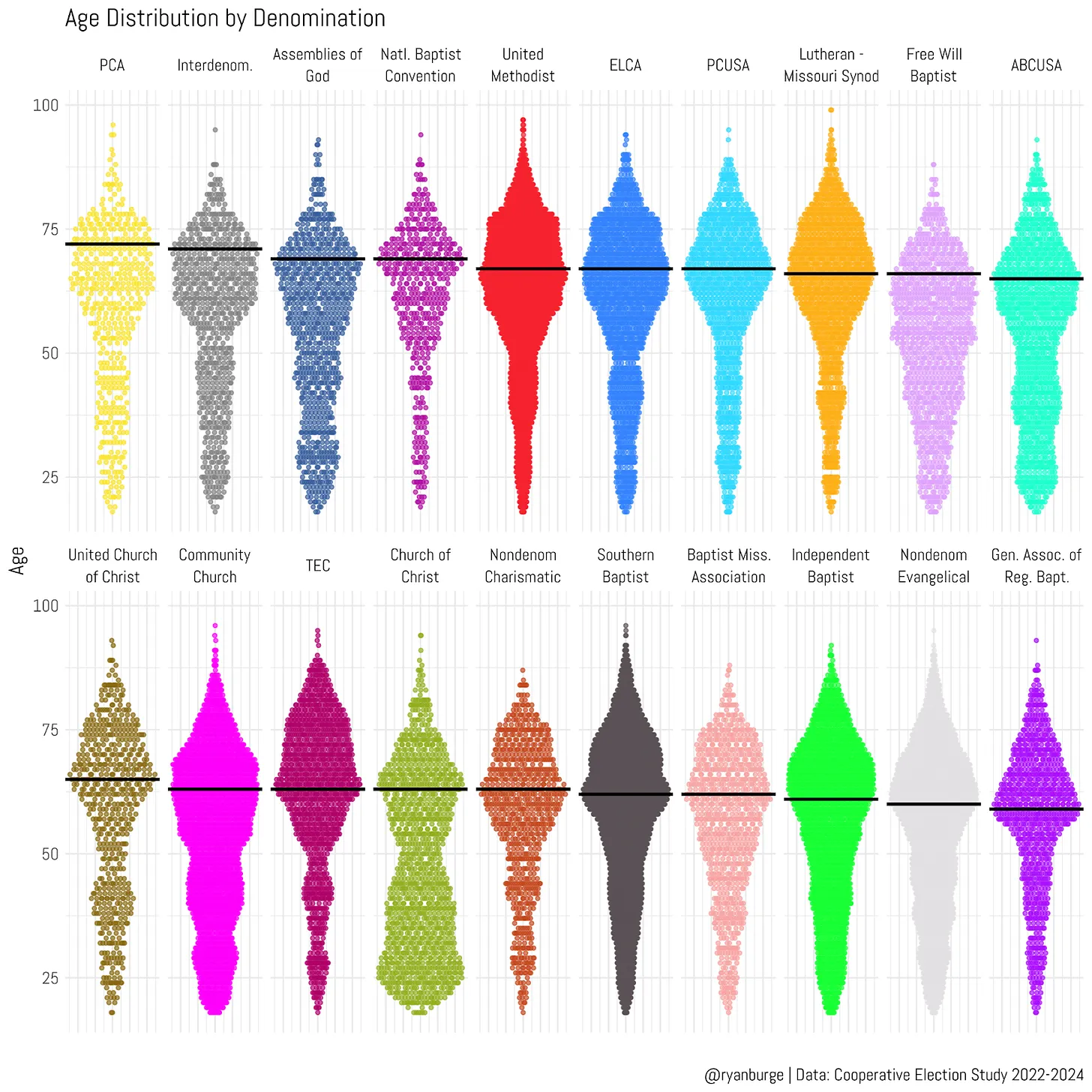
I’ll use the UMC to illustrate, but you can see the details of other denominations in the two images I’ve included.
Look how few members in any of these denominations are young. Not one of the 20 denominations listed has more than 50% of its members under 44 years old. In the UMC, only 16% are 18-44.
Burge emphasizes this age range in his article because this is the age range of fertility, broadly speaking. That is, the rest of the folks in the group are not going to be adding to membership by giving birth to children.
He does not unpack this in his post, but another angle of this is the theology, views and values around life itself, and starting families (how soon and how big). The more progressive the denomination, the more likely it is that the fertility rate will be lower even within the age range of fertility.
21% of the membership of the UMC is between 45-59, which is more than 18-44 combined. And, at 43%, there are more than double the number of people who are 60-74 than 45-59. (And there are 8x as many 60-74 year olds as 18-29 year olds.) 63% of the UMC is 60 years and up.
This represents a demographic crisis.
I want to pause here. I doubt very many United Methodists read my work anymore. I suspect there are a lot of people who read this who are not fond of the UMC. And I think this kind of data brings a tremendous temptation to self-congratulation.
“See, this is why we left?”
And I suspect for most people reading this, you would be completely missing the point.
Is your tribe different?
Self-congratulations, posturing, or denial won’t accomplish anything positive.
I am thinking about this because this has been a topic of conversation among the staff at Asbury Church, where I serve.
So, to be as clear as I can be about the point of this post: This is not a post to celebrate the seeming demise of others.
The point is to be in touch with reality so we can ask the question I started with:
Where do we go from here?
Let’s start by stating the obvious:
If the denominations Burge lists do not figure out how to grow younger, they don’t have a future.
That is a descriptive statement, not a moral argument.
We are all mortal. I will die someday. And if no one comes behind me, the thing that I am part of will not exist anymore.
I am worried that older people will be offended by what I write. Please understand me. Age is not a moral issue. It is not immoral to grow old. It is just what happens.
But if an institution consists of primarily senior citizens and is no longer able to reach young people, then it is dying.
This is all the more difficult to talk about in a healthy way because our culture idolizes youth in ways that are damaging to young people and can invalidate the worth and value of older people. The older we are, the more likely we are to experience acutely the limitations of our bodies.
As we age, moving our bodies becomes more painful.
To young people who do not experience significant pain:
Take time to notice the literal physical pain some of the older members at your church endure to simply come to church. There are people who show heroic courage, strength, and grit by showing up. This will humble you and help you not take your own body for granted. Perhaps it will even encourage you to not take gathering with the faithful for worship for granted.
To older people:
I say to you with love, I know that talking about this can be uncomfortable. It is not at all my intent to signal that you are unimportant or lacking in value. Not at all! You are the reason we are here! My hope for you is that if you turn your hearts towards reaching the next generation (and many of you already have!), you will gain peace and joy knowing that reinforcements are coming and the mission you have given your life to will continue after your death.
This applies to me.
We are all moving towards the grave. We all ought to humble ourselves and learn from those who have gone before us. And we should all do all that we can to build up, strengthen, encourage, and bless those who are coming after us.
One of the reasons work like what Ryan Burge is doing is helpful and interesting is because it provides a more neutral way to talk about the future. It is hard to ignore or deny that a problem is coming when you look at the second image from Burge’s article.
There is, however, at least one obvious sign of hope for the future. Did you notice that there is one major exception? Look at the Church of Christ.
21% of the Church is 18-29. 27% are 30-44. This means that 48% of the Church of Christ is in the peak fertility range! It also means that the largest percentage in any one of the five age ranges is a tie for 30-44 and 60-74. So, there is a significant generational balance. It gets better. The third largest group is the youngest. Look at the Church of Christ in the second graph. You don’t want a long thin tail, as so many of the denominations included have.
You want, at a minimum, the people coming behind to be able to replace the people and resources of those who are ahead.
It took a lot of spadework to get to this point. Now, I want to share a few thoughts about this information. Fair warning, it may feel more discouraging before there is hope. But I am writing this post because I do feel hope for the future. I believe the Lord has already given us the way forward, if we would have the courage to take it.
My first thought comes from reading Aaron Renn’s Life in the Negative World and Christian Smith’s Why Religion Went Obsolete. These books are both crucial for thinking about evangelism and discipleship in the contemporary church.
I’ve mentioned Renn’s work here before. Renn argues that we live in “Negative World,” where elite culture is opposed to the core claims and commitments of the gospel. I think he is right. (I wrote a review of Life in the Negative World here.)
Rev. Andrew Forrest, the Senior Pastor at Asbury Church where I work, has written a book that show how to avoid being passive and victims in Negative World and move forward. Hint: Forrest gives away the core concept in his book’s brilliant title: Love Goes First. (I wrote a review of Love Goes First here.)
You should read all three of these books. The church desperately needs leaders who are doing the deep work to think about the times in which we live and who refuse to settle for running plays that worked in the 1950s but simply do not work today.
Here is how reading and thinking about these things came through in reading Ryan Burge’s post:
The work before the church is going to be extremely, nearly impossibly, difficult.
There is so much that could be said here. I’ll say three quick things to illustrate how hard this is going to be.
First, the Baby Boomer Generation is literally a one-of-a-kind event. The really wide parts of the second image represent this generation. There are just less people at each age behind the Baby Boomers. So that is the first demographic reality that makes this extremely difficult.
Second, over the past thirty years the dominant culture has shifted dramatically. In the years immediately following World War II, there was cultural pressure to be a member of a Christian church in the United States. Sometime in the 1990s that shifted to neutral, neither positive nor negative. And in the mid-2010s that shifted further to negative cultural pressure. So, when the Baby Boomer Generation was around my age, there were cultural incentives, or social pressures on people to go to church. Today, with this major loss of members coming in the next 10-15 years, there are negative incentives, negative social pressure on people becoming followers of Jesus.
Put simply: It is harder to “make” a convert today than it was fifty years ago.
Third, the institutions that represent these groups are sick and dying. In other words, they are not in a place to lead a resurgence or a renewal. They might have been able to do that back when I was in seminary when professors at the mainline liberal seminary I attended talked about the coming “death tsunami” that was headed for the UMC.
One of the things we talk about all the time at Asbury Church is how hard it is going to be going forward. We are looking for others who share a sense of urgency about figuring out how to lead and move forward “for such a time as this.” Figuring out how to reach people my age and younger is urgent and has to be the top priority for every church or they will not have a future.
As I was looking at Burge’s charts in a staff meeting at Asbury, someone brought the focus back to the Church of Christ: “Why are they different?”
I don’t know much about the Church of Christ. But I do know that sociologists have found that there is something of a law of church growth in the United States. I first came across this in the fantastic book The Churching of America, 1776-2005by Roger Finke and Rodney Stark.
Here is the law of church growth in the United States:
High expectation, high demand churches grow. Low expectation, low demand churches decline.
I am sure that the Church of Christ, especially compared to the other denominations Burge includes, is a high expectation and high demand church.
I spent a decade trying to get United Methodists to move away from sloppy nonsense like “open hearts, open minds, open doors.”
Methodism has grown when it has had clear expectations of its members and enforced them. It has declined when it has not.
The Methodist Episcopal Church grew from the smallest Protestant denomination in the U.S. to the largest by far from 1776 to 1850. (See The Churching of America for details.) And during this time, you were required to attend a weekly small group meeting to remain a member. If you missed more than three times in a quarter, you were removed from membership. There was a document that outlined the lifestyle expectations for members in terms of sins to be avoided, concrete actions that expressed love of neighbor, and insisted on a disciplined practice of the means of grace (practices like Bible reading, prayer, worship, holy communion, and fasting).
Today, in many churches you can join a church by standing up for a few moments during a worship service and making a few vows. And you won’t be removed from membership even if you don’t keep any of the vows you made.
As I’ve thought about where we are and where we are going, it is just so obvious: This is going to be really difficult.
In Negative World, there are no longer any incentives for people to come to a church that is more a social club than a place that is focused on Jesus Christ and helping people meet him and give their lives to him as not only savior, but Lord of their lives.
There are a variety of ways you can miss the mark in terms of high expectation and high demand. Cults, for example, are high expectation and high demand. They provide a clear sense of belonging and identity. But they do not make disciples of Jesus Christ.
You can also miss the mark by jettisoning any attempt to be Christian and simply be an activist organization. Many college students and young adults are finding meaning and identity in protest and advocacy that is cult-like in terms of the demands it makes and the all-encompassing sense of belonging and identity it gives (or demands).
When Methodism was at its best, it was a high expectation and high demand church. It was focused on the gospel and was built to ensure that no one lost sight of growing in concrete practical discipleship to Jesus Christ.
You did not have to be a member of Methodism.
But you could not be a member of Methodism in name only.
John Wesley and those who carried on his work from one generation to the next into at least the mid-nineteenth century were marked by a commitment to basic doctrine, spirit, and discipline.
Here is how John Wesley put it in the last years of his life:
I am not afraid that the people called Methodists should ever cease to exist either in Europe or America. But I am afraid lest they should only exist as a dead sect, having the form of religion without the power. And this undoubtedly will be the case unless they hold fast both the doctrine, spirit, and discipline with which they first set out. (J. Wesley, “Thoughts Upon Methodism”)
I wrote a 400-page book about what this meant and how true it has been in the history of the Wesleyan tradition in the United States.
And I have never been more convinced that this is true than I am today.
One of the things that consistently amazes me about people at my church is their desire to grow. They want to be faithful. And they are eager to be led. It is so encouraging.
In Negative World, this will only become truer.
People who come to our churches will want to know if Jesus is real and if he can make a difference in their lives. When they come to faith, they will want to learn how to follow Jesus. Nominal Christianity doesn’t make sense anymore, especially to younger people.
So, where do we go from here?
We must become churches that are serious about discipleship and formation.
The bad news is: This will not be easy. In part because the truth is that many of our churches have not been most concerned about discipleship and formation. This means that in addition to the work of building, we also have work to reform, redirect, and change.
The good news is Jesus is real. Everyone knows the Great Commission from Matthew 28. We may need to especially remember the very last sentence of Matthew’s Gospel: “And behold, I am with you always, to the end of the age.”
We are not alone. We have never been alone.
Church leaders, we’ve got our work cut out for us.
I want to share one of my favorite memories from teaching this semester.
I had the privilege of teaching The Theology of John Wesley, which is one of the core classes at Asbury Theological Seminary this spring. Every student, regardless of degree, must take The Theology of John Wesley to graduate with a Master’s Degree. This is one of the ways Asbury anchors its identity and resists institutional drift. And I love it!
The class is a deep dive into Wesley’s theology. It is thorough and has been expertly crafted through decades of experience. I taught the class exactly the way it has been taught by those who have gone before me this semester. I had a blast because I was able to teach in an area I really enjoy teaching. And I was able to continue learning and growing as a follower of Jesus Christ and as a teacher.
Ok, so here is the memory I wanted to share:
One of the places there is always lively discussion, if students are tracking and understanding the material, is around John Wesley’s conviction that one who has experienced justification and the new birth does not commit outward sin. This is based on John Wesley’s reading of the canon of Scripture, particularly passages like 1 John 3:7-10:
Little children, let no one deceive you. Whoever practices righteousness is righteous, as he is righteous. Whoever makes a practice of sinning is of the devil, for the devil has been sinning from the beginning. The reason the Son of God appeared was to destroy the works of the devil. No one born of God makes a practice of sinning, for God’s seed abides in him; and he cannot keep on sinning, because he has been born of God. By this it is evident who are the children of God, and who are the children of the devil: whoever does not practice righteousness is not of God, nor is the one who does not love his brother. (ESV)
Collins brilliantly summarizes this in John Wesley: A Theological Journey:
Justification delivers from the guilt of sin, regeneration from its power or dominion, and entire sanctification from its being. Unfortunately, these distinctions are often neglected in contemporary Methodism where a decided “shift” has taken place; that is, freedom from the power of committing sin is attributed not to the new birth, as it should be, but to Christian Perfection, with the result that freedom from the being of sin is then relegated to the afterlife and glory. (190)
The conversation in class around freedom from the power of sin in regeneration led to a great question. I reached out to Professor Collins to get his perspective and his response was so good I asked for his permission to share it with my students and then to share it with all of you here. Here is how I framed the question:
How do I best talk to students about the correct definition and understanding of the new birth in connection with the band meeting, which both has a prerequisite of the new birth (and more), and weekly questions connected to sin.
I.e., if a students says, If someone does not commit outward sin after they receive justification and the new birth, why are the band meeting questions focused around sin? (I.e., “What known sins have you committed since we last met?”)
Here is Dr. Collins’s reply:
First of all, given the small numbers of people in the band meetings there may not be many responses to the weekly, sin-probing questions among the children of God, but there will likely be at least some responses over time. Real Christians do at times break faith and commit sin of the high hand, so to speak. The way forward then would be and must be one of repentance, of doing the first works afresh. So then, when Wesley affirmed that a born again believer is free from the power and dominion of sin (“The Marks of the New Birth,” “The Great Privilege of Those that are Born of God”) he was not teaching that real Christians would never sin again (a common misunderstanding among my students) but that Christian believers would have grace sufficient to remain faithful and to walk in a trusting and accountable way in the graces of regeneration. How do we bring all of this together? How can we summarize this basic and precious gospel truth which Jesus Christ, himself, affirmed (John 8:34-36) and which John Wesley repeatedly taught? I offer the following summary of the several elements here, though this language is not Wesley’s but my own. However, I do believe that such language captures Wesley’s basic meaning. And so here goes: “Willful, intentional sin, breaking faith with Christ, should be the grave exception in the Christian life and not the rule.” Our problem today, however, in American Christianity in general, and even at times in Methodism in particular, is that we have made sin the rule and grace the exception. We need to turn this upside down. Jesus Christ died for far more than to leave people in the bondages of which they are ashamed.
Second, I think the very great value of such questions for the saints that played out in the band meetings during Wesley’s lifetime is that they are a wonderful means of grace that ensure that responsibility and accountability will remain in place. Think of band members, for example, who are sorely tempted during the week but who in the midst of that temptation are reminded by the Holy Spirit, the Spirit of Truth, that they will have to confess such a sin (if it is committed) before several trusted and beloved others in just a few days. At that point the power of the temptation is broken (1 Cor. 10:13) by the light of the prospect of upcoming fellowship, accountability and love. That’s precisely the point! In other words, the questions of the band meetings are themselves a wonderful means of grace, used by the Holy Spirit, as a means by which faithful Christian discipleship is strengthened and lived out to the glory of God. Put another way, evil and sin love the darkness; however, Wesley made sure that the infrastructure of Methodism in general, and the band meetings in particular would be flooded by an abundance of light in the form of relationship, accountability and the richest love. In short, those questions are both precious and necessary for serious Christian discipleship.
So good!
Want to know more about the band meeting? Scott Kisker and I wrote a book that is designed to reclaim this practice. Check it out here.
I have previously shared here about my conviction that the culture or atmosphere of the classes I teach is more important than being sure I say all the words I want to say or get all the content in before the class ends.
I am not sure I always get this right. Actually, I’m sure I don’t always get this right.
However, I am increasingly confident that students are most impacted by the things that happen in my classes because I intentionally create an atmosphere that is open to the Holy Spirit than they are by the lectures that I give. And maybe even more than that, I find that students are more willing to listen to what I have to say when they are convinced that I care about them. So, I think that prioritizing the culture or atmosphere of classes I teach enhances student learning and engagement with the content of the course.
And I don’t think this goes the other direction.
This week, I’ve found myself reminiscing on the things I saw the Lord do over the past month. I wanted to share a few highlights here.
I taught back-to-back intensives a few weeks ago. And they were such a blessing!
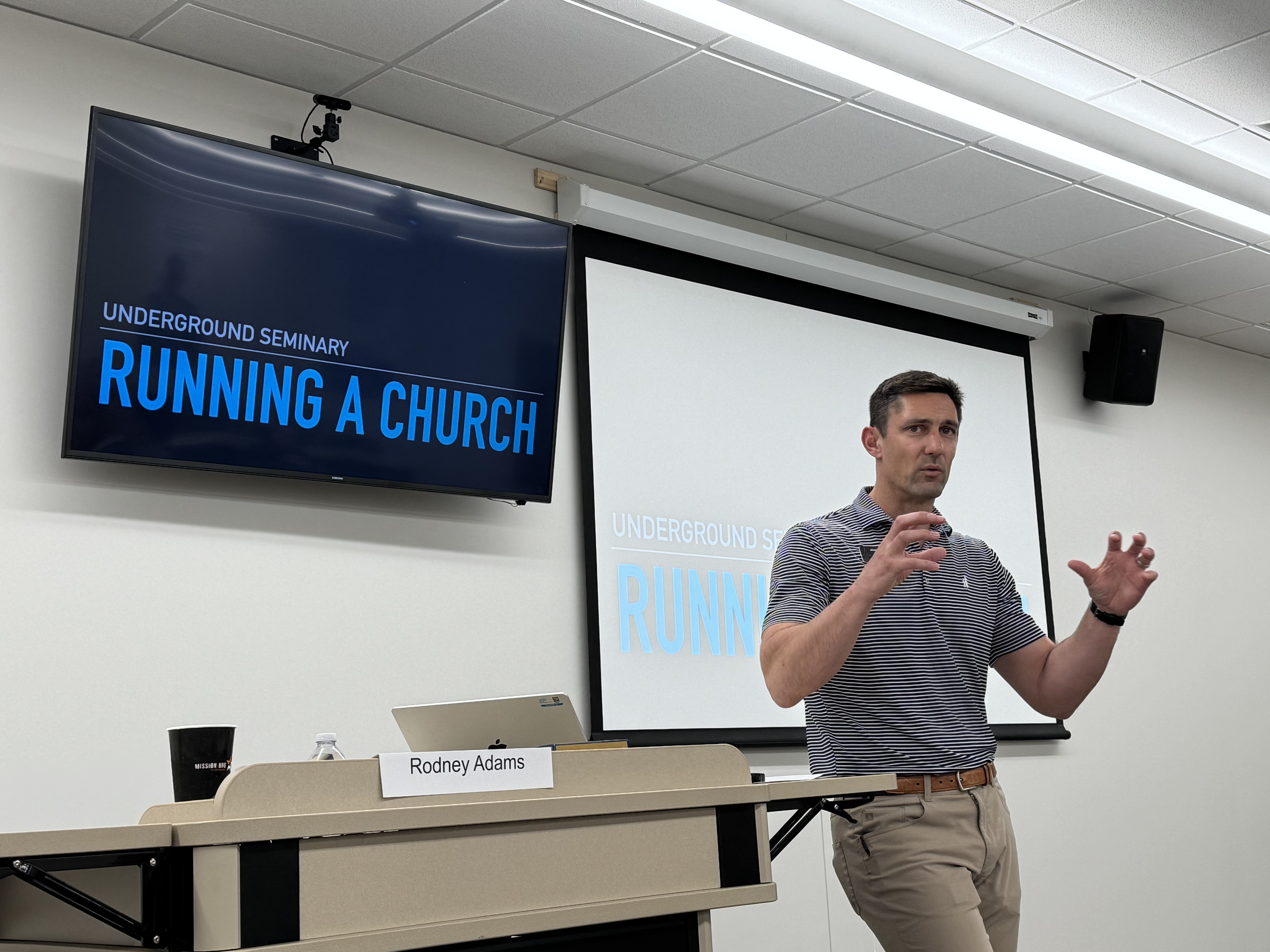
Before my Basic Christian Doctrine class, I put together the second Underground Seminary event. We called it “What They Don’t Teach You in Seminary.” It was led by Rodney Adams, the Executive Director of Asbury Church. Rodney gave a detailed behind the scenes look at how a large church like Asbury is run, the strategic decisions he makes as Executive Director, and the challenges of leading that are particular to a church. (You can read about the original announcement here.)
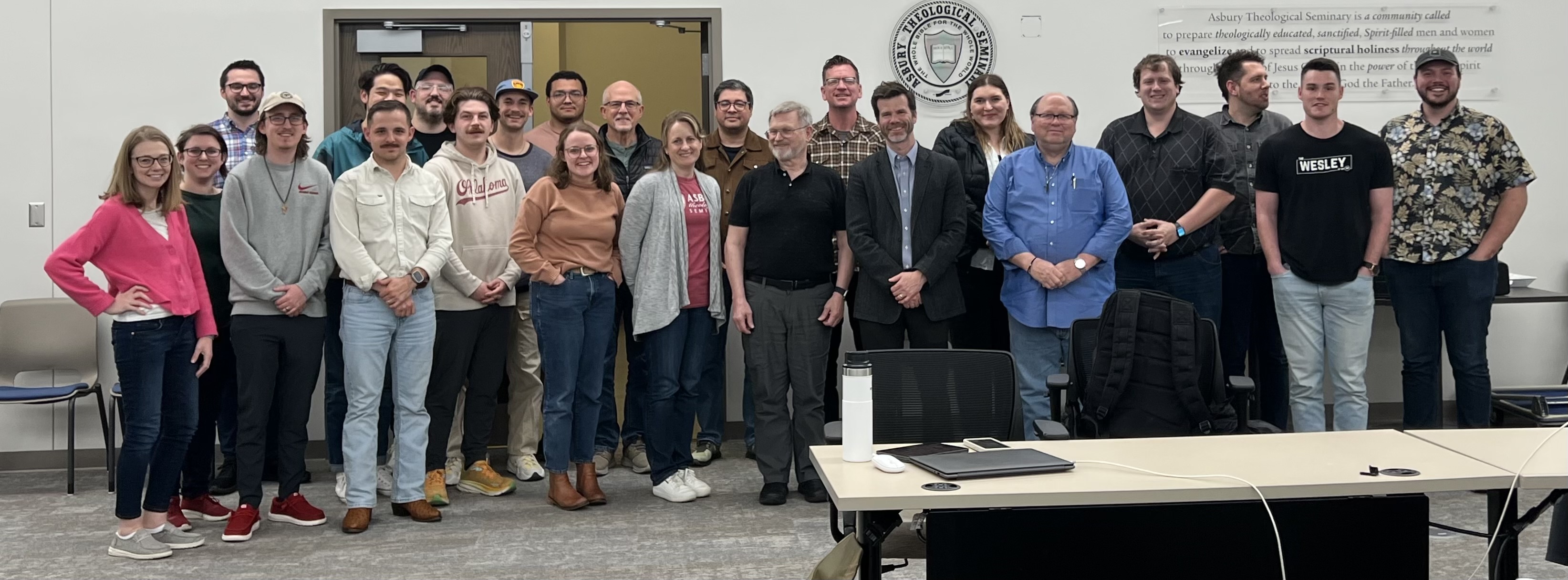
From my perspective, it was a fantastic success. There were 23 people who came to this meeting, which was immediately before a class that had 16 students. I am encouraged both by such a strong turnout and that the Underground Seminary idea is building energy for what is happening at Asbury-Tulsa. It is energizing to me to have people in the building talking to each other about ministry. I am best at inviting people to things I passionately believe in. Asbury Church is one of those things for me.
During the class itself, I had a sense that the Lord wanted to minister in some ways to the specific people in the room. I am still learning and growing in how to lead and take risks appropriately in this space. These students were so gracious and hungry for Jesus. It was wonderful. The highlight of the weekend for me was checking in with someone at the end of class that I had particularly felt a burden to pray for and they said, “I feel like myself again for the first time in a year.”
Thank you, Jesus!
Several students stayed with members of Asbury Church. On Sunday morning, one of the students ran into the family that had hosted them, and they were so excited to see each other. The hosts sat with the group of students and my family in worship. I was so blessed by such a tangible connection of my church loving my students well and seeing church and academy connected in such a lovely way.
The next week I had another hybrid. First Methodist Church in Tulsa hosted a Holy Spirit Conference that was amazing. I was invited to lead a breakout on spiritual parenting. This is something I have thought a lot about and am passionate about but had not had a chance to teach on to a group of people. I learned a lot in preparing and was challenged and blessed in thinking it through in order to lead the workshop. I drove straight from First Methodist to Asbury to prepare to teach my second intensive in two weeks, The Theology of John Wesley (with 23 students).
I love getting to teach this material. It has been a blessing to systematically read through Wesley’s sermon corpus in a short window of time. (I highly recommend this if you are a leader in a Wesleyan context and have not done this.) The biggest gift for me personally was rereading two great books by one of the academics I most respect, Dr. Kenneth J. Collins. The two books are core texts for The Theology of John Wesley (which is a required class for every major at Asbury Theological Seminary) and I highly recommend them both. Read Collins’s John Wesley: A Theological Journeyfirst to get a sense of Wesley’s life. It is a great book because it unpacks Wesley’s own life and legacy, but from a rich theological lens.
After you read this, you should read The Theology of John Wesley: Holy Love and the Shape of Grace. In my opinion, this is Collins’s masterpiece. Reading this book in preparation to teach helped me teach with greater clarity than the last time I taught this material. Collins does a masterful job explaining core concepts like justification, the new birth, and entire sanctification. He is fearless in his fidelity to the witness of Scripture and Wesley’s understanding of it.
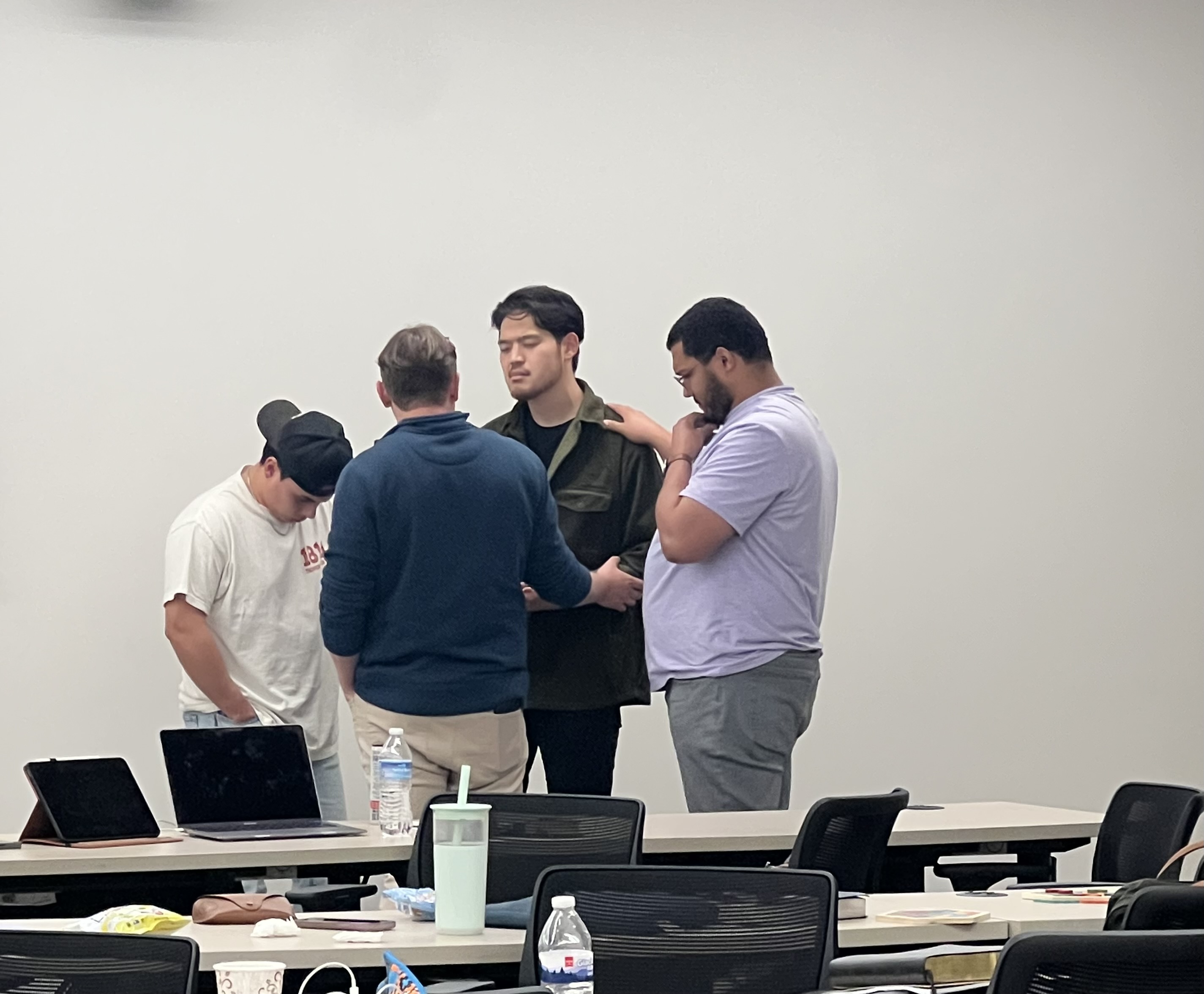
In addition to this class just being a delight, there were some powerful moments where the Spirit met us. Rev. Graeme Collett, one of the associate pastors at Asbury Church, preached for the Asbury Seminary chapel service on Friday. Graeme has become a good friend and one of the best surprises in our move here to Tulsa. And unlike any sermon I’ve experienced here yet, the Lord gave Graeme a clear word for this specific class at this specific time. (And this is saying something, because we’ve had an embarrassment of riches in terms of the quality of preaching we’ve had in our chapels here!) The highlight was Graeme’s burden to anoint students to remind them of their callings and to seal the work of the Holy Spirit in them. I believe every single person in the room came forward for prayer at some point. Lots of beautiful Holy Spirit tears and ugly crying. It was one of those times you are just aware the Lord is doing deep work in people right before your eyes. I am so thankful for Pastor Graeme’s leadership and for the Spirit’s presence with us in chapel.
We lost track of time and went more than thirty minutes over, but that is one of the special things about these intensives. It didn’t matter! Sometimes people will say in ministry that “the trains have to run on time.” The great thing about the intensives I teach is that there is one train and we’re all on it! So, we got where we were supposed to go when we were supposed to get there.
The second highlight of the Theology of John Wesley hybrid was a word I felt like I got from the Lord on Saturday morning, before the last day of the intensive. As I was praying that morning, I had the impression that the Lord wanted me to start the day by inviting people to share testimonies to what they had seen the Lord do so far in our time together.
I need to admit that this is often hard for me. Sometimes I’m afraid nobody is going to say anything, and it will bomb. I’ve gotten more comfortable holding space as time has gone on, but it is still an area I’m growing in. And I felt that Saturday morning.
Goodness was I wrong to be concerned. There were so many wonderful testimonies people were ready to share about how the Lord had met them. God is so good!
That part went so well, the Lord nudged me to notice the second thing I had written down as I had been praying that morning:
“Deliverance?”
In part, I think this came from witnessing a powerful deliverance at the Holy Spirit Conference the Wednesday night before my class started. I also think it came from reflecting on how important deliverance ministry was in John Wesley’s own ministry. (For more on this, see Dr. Peter J. Bellini, Thunderstruck! The Deliverance Ministry of John Wesley Today )
I gave what felt like a pretty timid invitation to receive prayer for deliverance if someone felt like they needed it. I am not going to go into details here for a variety of reasons, except just to say that the Father, again, showed me His desire to communicate with His children. I also experienced the power and authority of Jesus Christ in a deeper way that I don’t think I can adequately express. It was just a blessing.
I have so much to learn. One thing that I have found really helpful is thinking about my classes as laboratories. Here is what that image means to me: in a lab, you do something real but you also reflect on it and can interrogate the experiment itself. So we can meet in a small group in my Wesleyan discipleship class and talk authentically about the state of our souls. And we can also then ask how the conversation felt, what could we do differently? Was there something that felt unhelpful or could have been more helpful? Lowering the stakes and explicitly thinking of the time together in class as a learning environment gives permission to make mistakes and raises the expectation for pursuing excellence. I love that combination.
I’ve seen this with prayer for healing in my classes. I’ve seen this with seeking to hear the Lord’s voice and be guided by the Holy Spirit. And I’ve seen it in lively classroom conversations about deep matters of theology. It is challenging. And it is fun.
I can’t wait to see what the Holy Spirit does next!
P.S. Did you know that I am launching a Fellowship Program at Asbury Church? We are hiring two Fellows that will be paid full-time positions, with benefits. Starting this August. More details about the Fellowship Program and how to apply here.
This is a short post to share two podcasts appearances from this week.
The prompt for both invitations was the release of my new book Doctrine, Spirit, and Discipline: A History of the Wesleyan Tradition in the United States. #affiliate I did quite a few interviews in the weeks the book was released in late June. The first print run sold out in a few weeks. The timing of these conversations is great because Doctrine, Spirit, and Discipline is back in stock!
If you enjoy these kinds of conversations, I think you’ll enjoy both episodes as they went in significantly different directions.
I was interviewed by Dr. Brian Russell on his podcast Deep Dive Spirituality. This was my second time on Dr. Russell’s podcast. I really enjoyed the conversation with him about my new book. My favorite part of the conversation, however, was when he asked me what I am most hopeful about the future. He set it up with a great image. Audio only is available here.
I was also interviewed by Rev. Jeffrey Rickman on his podcast Plain Spoken. We also talked about the book and spent time talking about implications of the book’s argument for theological education and developments in the Global Methodist Church. Check out my conversation with Rev. Rickman here: https://plainspokenpod.substack.com/p/american-methodist-history-and-its
Thanks to Brian and Jeffrey for having me on their podcasts! I hope you’ll check them both out.
I am teaching a course on Wesleyan Discipleship in Tulsa as a January-Term course at Asbury Theological Seminary this coming January (2025). You should join me!
What is the course about?
Here is my description of the course:
Wesleyan Discipleship explores the history, theology, and practice of discipleship through a Wesleyan lens. Particular attention is given to the role of communal formation in eighteenth-century Methodism. John Wesley’s theology of discipleship is explored, along with a variety of aspects of Christian formation in community in early Methodism. Particular attention is given to the way Wesley’s theology of social holiness was expressed in early Methodist small groups, especially the class meeting and the band meeting. Students will apply the historical and theological understanding of Wesleyan discipleship to contemporary ministry contexts.
Why I am FIRED UP about this class:
This class will have an intensive on site here in Tulsa from the evening of January 16th through January 18th, 2025. I LOVE the time together with students at intensives! This class beautifully lends itself to teaching in this format.
Hybrid classes have 20 hours of in-person instruction over 2.5 days. (The rest of the course requirements are met through online engagement and completion of online modules.) It is intense! But I have also found, perhaps surprisingly, that it is also an opportunity for a spiritual retreat for students.
The in-person experience gives us the opportunity to worship together. We will start the class by attending worship at the Thursday evening service at Asbury Church, where Rev. Andrew Forrest will be preaching. Andrew is an exceptionally gifted preacher of the Scriptures and a brilliant communicator. I love being able to start class off by tangibly connecting the church and academy by walking across the parking lot to go to worship.
We will also have an Asbury Theological Seminary – Tulsa chapel service for the class and students in the area on Friday January 17.
I will get to spend hours talking about my scholarly passion – the importance of community and connection for the Christian life. I love getting to teach students and engage their questions around these topics!
And most important, we will spend time talking about and practicing ways to reintroduce these tried and tested methods that gave Methodism its name.
At the end of the course, students will have the kind of knowledge gain you would expect from a typical seminary course. But they will also have experience participating in class meetings, experiencing small group dynamics, and reflecting on various challenges and opportunities of leading small groups like class and band meetings.
I think of this course as like a laboratory. We will learn a lot about the concepts, but we will also engage them in a hands-on way. In a laboratory you can not only experience a class meeting, but you can also talk about your experience of a class meeting. In my view, this is essential for becoming an expert practitioner. You need not only a theoretical framework and some practical experience, but you also need a place to talk about your experience so you can acknowledge, address, and overcome obstacles and challenges.
I am more confident than I have ever been that groups like the Wesleyan class meeting and band meeting will be at the center of Christian discipleship in these new and strange times we are entering.
These intensives are aptly named. They are not easy. J-term is not a short cut. In fact, it is a three-week academic sprint. My goal is to maximize the 20 hours we get to spend together to suck the marrow out of the class and be as fully equipped to make disciples of Jesus Christ in the contemporary church as possible.
I want students who come hungry and ready to learn and grow. And that is what we are seeing here in Tulsa. It is SO FUN!
How is the course being taught?
I am teaching this course as a hybrid course at Asbury Theological Seminary at our Tulsa, OK Extension Site (housed at Asbury Church).
What is a January-Term, or J-Term, course?
A J-Term course is a full three credit course that is offered entirely within the month of January. This coming J-Term will start on January 2, 2025 and conclude on January 24, 2025.
What is a hybrid course?
A hybrid course is a course that has parts that are online and parts that are in person. This specific course will have four online modules based on four main sets of reading, students will write a reflection paper that summarizes the content of the reading, critically engages it, and applies it to their own ministry context.
The in-person part is January 16-18, 2025 at Asbury Church’s Development Center in Tulsa, OK. The in-person meeting will be from 6:00pm-9:00pm January 16, 8:30am-5:30pm January 17, and 8:30-5:30pm January 18. The in-person meeting is required for completion of the course. It is also the highlight of the entire course!
Does this course meet the Wesleyan Discipleship and Spiritual Formation requirement for ordination in the Global Methodist Church?
The Convening General Conference of the Global Methodist Church, which met a few weeks back, updated the educational requirements for ordination. And one of the changes that was made was the addition of a course called “Wesleyan Discipleship and Spiritual Formation.” I don’t mean to brag, but I believe this course hits the bullseye for what the GMC is looking for here! So, yes, if you are seeking ordination in the GMC, this course meets the Wesleyan Discipleship and Spiritual Formation course requirement. You can take this course and meet all GMC ordination requirements with either an Asbury Theological Seminary M.Div. or our 60 credit (exactly 20 courses) Master’s in Christian Ministry (MACM).
Should I take this course if I am not in the Global Methodist Church?
Yes!
If you want to help your church more effectively make discipleship of Jesus Christ, this course is for you.
I am passionate about Wesleyan Discipleship, not because I am most passionate about John Wesley, but because I believe the Wesleyan theological tradition has a proven track record of excellence in intentional and effective disciple making. We do well to learn from experts who have gone before us. This course is not specifically for students from any one denominational tradition. I mentioned the GMC above only because there is obvious relevance for the GMC because they just made this exact course a required course to be ordained an elder in the GMC. (Your church or denomination should too. This topic really is that essential for succeeding in the 21st century church.)
Can I take this course if I am not an Asbury Theological Seminary student?
Yes! The easiest way to do this would be to apply now to become an Asbury Theological Seminary student. We have a variety of degree programs, and I would be thrilled to talk to you about any of them! There is time to apply now and start this January.
If you are interested in applying to Asbury Theological Seminary or for this course in particular, reach out to me here (scroll down to the bottom of the page) and I will get back to you soon. Be sure to include your email so I know how to reach you.
Not ready to apply to one of our Master’s degree programs? You may be able to apply to take the course as a non-degree seeking student. You also may be able to audit the course. Both require an application and auditing requires permission from the instructor. For either of these, reach out to me at the link immediately above.
I am open to considering some auditors. Auditors do not receive any academic credit for the course and do not turn in any assignments. They are given permission to sit in on the in-person part of the class and participate in class discussions and activities. However, I will only open the class up to auditors if there are open seats after the registration period closes. (I would assume auditing the course would not satisfy denominational ordination requirements, but you should check with your own denominational leaders.)
What is the official title of the course?
The course is cross listed as a Spiritual Formation course and a Theology course. So you can sign up for either TH650 Wesleyan Discipleship or SF650 Wesleyan Discipleship.
What are the assigned readings in the course?
Students will read a few short essays from John Wesley. And they will read these three books (affiliate links):
The Rev. Andrew Forrest, the senior pastor at Asbury Church in Tulsa, OK, interviewed me about my new book this past weekend in all of our services. It was so fun!
Andrew is not only a gifted communicator, he also has the ability to help other people refine and clarify their own ideas. It was really fun to see his mind work in terms of distilling what was most important from the book for people at Asbury Church.
Here is a screenshot of the interview. Click the link below to view it.
Doctrine, Spirit, and Discipline: A History of the Wesleyan Tradition in the United States has already sold out of the first print run! (It continues to be available as an e-book and an audio book.) I am thrilled by the interest the book has received and look forward to seeing it continue to build.
As I’ve talked with people about the book, I’ve only become more convinced of its importance for such a time as this. As we move into new futures, it is essential that we be able to recognize real Methodism from cheap imitations. In order to do so, we have to know where we have come from and be regrounded in our identity. I believe John Wesley was right to lay out the following as the litmus test for Methodist vitality:
“I am not afraid that the people called Methodists should ever cease to exist either in Europe or America. But I am afraid lest they should only exist as a dead sect, having the form of religion without the power. And this undoubtedly will be the case unless they hold fast both the doctrine, spirit, and discipline with which they first set out.” – John Wesley “Thoughts upon Methodism” (1786)
My book describes the doctrine, spirit, and discipline with which Methodists first set out and traces adherence to them across the history of the Wesleyan family in the United States.
Methodists were at the center of the First Great Awakening and the Second Great Awakening. I am convinced that one way or another, the DNA of real Methodism will be at the center of the Third Great Awakening.
I am so thankful to the Lord that this day has arrived!
If you haven’t picked up a copy of the book, I hope you will today!
Here is the summary of the book from the dust jacket:
An expansive, substantive history of the Wesleyan tradition in the United States, Doctrine, Spirit, and Discipline offers a broad survey of the Methodist movement as it developed and spread throughout America, from the colonial era to the present day. It also provides a theological appraisal of these developments in light of John Wesley’s foundational vision. Beginning with Wesley himself, Watson describes the distinctiveness of the tradition at the outset. Then, as history unfolds, he identifies the common set of beliefs and practices that have unified a diverse group of people across the centuries, providing them a common identity through a number of divisions and mergers. At a time when sweeping changes continue to transform Methodism and the pan-Wesleyan movement, Watson shows that the heart of the Wesleyan theological tradition is both more expansive and substantive than any singular denominational identity.
For more information check out the post I wrote here.
Zondervan has created a fantastic page for the book here.
Buy the book at Amazon here (affiliate link) or through Zondervan directly here.
I have been interviewed on several podcasts about the book. I will update interviews as they go live.
I was on Art of Holiness with Rev. Dr. Carolyn Moore. Check it out here.
I was on Spirit & Truth with Rev. Dr. Matt Reynolds. Check it out here.
The interest in this book has been so encouraging to me. Thank you so much to each of you who have bought the book. I am grateful!
In some ways, I have been working on this book my entire scholarly career. I started this project in earnest seven years ago. This is the most ambitious writing project I’ve undertaken. I believe it is also the most important book I’ve written.
Why?
One of the main problems I have been trying to solve throughout my work in the church and the academy is identifying the core content of the Wesleyan/Methodist theological tradition. What does it mean to be Wesleyan or Methodist?
My sense has been that many different parts of the Wesleyan tradition have been undergoing a crisis of identity for various reasons. Some have pursued cultural respectability at the expense of coherence and clarity. Others have moved away from the riches of their heritage in the Holiness Movement to generic evangelicalism. Much more could be said on this.
In Doctrine, Spirit, and Discipline, I argue that there is an identifiable theological tradition running through the Wesleyan/Methodist theological tradition in the United States. It was clearly articulated by John Wesley in the beginnings of Methodism in Britain. And this theological vision, along with the method that gave it its name, was embraced explicitly by the founders of the first denominations founded in the United States.
My sense is that the Wesleyan theological tradition is in a time of both fragmenting and realigning. I don’t think we can know yet how things are going to sort out. There are even very good reasons to think that denominational identity will not have the purchase in the future that it has had in the past.
With all this change and uncertainty, there is one thing of which I am confident: I am convinced the founding vision of John Wesley and the first Methodists is as relevant for our day as it was for theirs, if not more so.
Before we can do anything else, we need to know who we are. Getting clear of our identity requires knowing our history. We need to know where we’ve come from.
Doctrine, Spirit, and Discipline is my attempt to tell the story of the Wesleyan tradition in the United States in a way that intentionally, though I am sure imperfectly and incompletely, tells the story through a broader lens than it has been typically told.
I also do the best that I can to wrestle with the issues and challenges facing the church today. I do this because I am convinced that our past is an essential guide for a better future.
I have been humbled by the endorsements this book has received. This book has been described as “the definitive history of the Wesleyan movement in the United States.” Here are a few endorsements, you can read more at the landing page Zondervan has created for the book.
“Kevin Watson’s newest book, Doctrine, Spirit, and Discipline, is not just the latest history of Methodism in America. Rather, it’s a tour de force. Previous historical accounts have viewed the institutions that resulted in the United Methodist Church as the truly legitimate Methodist trajectory, while offering just a fleeting look at other Wesleyan denominations. But rather than seeing African American, Holiness, and Pentecostal church bodies as schismatic and somewhat peripheral to the Methodist story, Watson treats them as central. Why? Because these groups, though smaller in size than better-known, larger institutions (Methodist Episcopal/Methodist/United Methodist), often maintained Wesley’s theological foundation more consistently. Watson sees Wesley’s formulation of “doctrine, spirit, and discipline” as the “common foundation for a broad tradition”—not broad theologically, but broad geographically, ethnically, and denominationally. This book, then, is not only necessary reading for all American Wesleyans but also an essential corrective to the overall narrative of the Methodist legacy in the United States.” —DOUGLAS M. STRONG, Paul T. Walls Professor of Wesleyan Studies, professor of the history of Christianity, Seattle Pacific University
“I was captivated on the first page of Doctrine, Spirit, and Discipline. Immediately the reader is taken into the early life of John Wesley with this theme developed through his own personal life and expanded as he leads this great awakening throughout England and then more thoroughly developed in the US. However, Kevin Watson does not shy away from the power struggles, the issues of slavery, and the divisions even to this present day. He gives very generous history of the Black church, the Pentecostal movement, the Holiness movement, and various denominations which comprise what is known as the pan-Wesleyan movement today. In all this it is obvious the themes that continue to hold this diverse group together from the beginnings of John Wesley. It is written in such a way that is inspirational and at the same time with a strong researched theological and historical foundation. This book is a treasure for the classroom, leaders in the pan-Wesleyan movement both lay and clergy, and those outside the movement to discover the strength of the doctrine, spirit, and discipline initiated by John Wesley that has been effective for some 250 years. Yes, a book for now and future generations.” —JO ANNE LYON, general superintendent emerita, the Wesleyan Church
“A faithful witness to the people called Methodists in England and in America, this colossal volume expeditiously moves from Wesley to American Methodism and its extended branches to the current state of Wesleyanism today. Watson masterfully retells a well-chronicled narrative in terse, accessible, lucid prose, covering not just the contours of Wesleyan history with its highs and lows but also its various doctrinal developments and disputes and ecclesial divisions. The moral of the story, as indicated by the quote from which the title is taken, is that Methodism at its best is a blazing, fiery force of renewal and at its worst an inert, acculturated institution. Although coming in at nearly 500 pages, this volume is concise and highly accessible. Well-illustrated, highly detailed, and informative, Doctrine, Spirit, and Discipline is suitable for the classroom and will make a fine addition to any shelf of classic volumes on Methodist history.” —PETER J. BELLINI, professor of church renewal and evangelization in the Heisel Chair, United Theological Seminary
“This book is destined to become the standard reference work for everyone who wants a better understanding of the Wesleyan tradition. More important, however, is that anyone who seeks the blessing of holiness in his or her own life will find inspiration and encouragement on every page. Churches that preach the life-giving message of sanctification, including the Salvation Army, owe a tremendous debt of gratitude to Dr. Watson for this outstanding work.” —KENNETH G. HODDER, USA national commander, the Salvation Army
I need your help.
Please pre-order my book. There is much about the publishing world I don’t understand. One thing I do know is that pre-orders are crucial to a book’s success. You can pre-order the book on Amazon here (affiliate link) or directly through Zondervan here. Amazon has a pre-order price guarantee and books like this are typically discounted as they get closer to the release date. Zondervan is currently offering a 30% sale!
I don’t think I’ve ever made a direct request like this before. It would be a big help to me if you would place a pre-order for this book now. If you do, you can also get immediate access to chapters 1 & 2 by entering your email and book order number at the bottom of the page here: https://zondervanacademic.com/doctrine-spirit-and-discipline
I am so excited to see something I’ve been working on for so long finally be released. Thank you so much for your support!
Kevin M. Watson is Director of Academic Growth and Formation at Asbury Theological Seminary. He is anchored at the Seminary’s Tulsa Extension Site. He is also the Scholar in Residence at Asbury Church in Tulsa, OK.
This is the 25th sermon in this series. You can expect to see a new post in this series by 10am EST on Tuesday mornings (sorry I’m a bit late today). Just joining the growing number of people reading these sermons? Feel free to start at the beginning by reading the first sermon by John Wesley in this series, “Salvation by Faith,” or jump right in with us!
Background:
Did you know that many of John Wesley’s sermons are part of the formal doctrinal teaching of multiple Wesleyan/Methodist denominations? Wesley’s sermons have particular authority because these were the main way he taught Methodist doctrine and belief.
“Upon Our Lord’s Sermon on the Mount, Discourse the Tenth” is the 25th sermon of the Wesleyan Standard Sermons. It is also the 10th of 13 sermons on the Sermon on the Mount. The fact that 13 of the 44 original Standard Sermons focused on the Sermon on the Mount gives an idea of the importance John Wesley placed on Matthew 5-7. Wesley spends so much time on these three chapters of the Bible because he believed they provide essential teaching from Jesus on “the true way to life everlasting, the royal way which leads to the kingdom.”
In hopes of sparking interest in Wesley’s sermons and Methodism’s doctrinal heritage, here is my very short summary of “Upon Our Lord’s Sermon on the Mount, Discourse the Tenth.” I hope it will inspire you to read the sermon in its entirety yourself. Links to the sermon and other resources are included at the end of this post.
Key quote:
‘This is the law and the prophets.’ Whatsoever is written in that law which God of old revealed to mankind, and whatsoever precepts God has given by ‘his holy prophets which have been since the world began’, they are all summed up in these few words, they are all contained in this short direction. And this, rightly understood, comprises the whole of that religion which our Lord came to establish upon earth. [23]
One sentence summary:
Jesus warns against several of the main hindrances of Christianity (such as judging others and casting pearls before swine) and concludes with the Golden Rule.
Scripture passage for the sermon:
“Judge not, that ye be not judged.
For with what judgment ye judge, ye shall be judged; and with what measure ye mete, it shall be measured to you again.
And why beholdest thou the mote that is in thy brother’s eye, but considerest not the beam that is in thine own eye?
Or how wilt thou say to thy brother, Let me pull out the mote out of thine eye; and, behold, a beam is in thine own eye?
Thou hypocrite, first cast out the beam out of thine own eye; and then thou shalt see clearly to cast out the mote out of thy brother’s eye.
Give not that which is holy unto dogs, neither cast your pearls before swine; lest they trample them under their feet, and turn again and rend you.
Ask, and it shall be given you; seek, and ye shall find; knock, and it shall be opened unto you.
For everyone that asketh, receiveth; and he that seeketh, findeth; and to him that knocketh, it shall be opened.
Or what man is there of you, who, if his son ask bread, will give him a stone? Or if he ask a fish, will give him a serpent?
If ye, then, being evil, know how to give good gifts unto your children, how much more shall your Father which is in heaven give good things to them that ask him!
Therefore all things whatsoever ye would that men should do to you, do ye even so to them; for this is the law and the prophets.
– Matthew 7:1-12
Concise outline of “Upon our Lord’s Sermon on the Mount, Discourse the Tenth”
1. In Matthew 7:1-12 Jesus identifies the main hindrances to Christianity and ends with application.
2. In Matthew 5, Jesus described inward religion, “the dispositions of the soul which constitute real Christianity.” In Matthew 6, Jesus shows “how all our actions… may be made holy… by a pure and holy intention.”
3. In the beginnings of Matthew 7, Jesus identifies “the most common and most fatal hindrances of this holiness.”
4. The first hindrance is judging.
5. This caution is needed at every stage of the Christian life.
6. This caution is for non-Christians as well as Christians.
7. Jesus especially cautions non-Christians against judging hypocrisy in Christians.
8. Judging is not only speaking evil of someone, it is also thinking evil of another.
9. “The thinking of another in a manner that is contrary to love is that judging which is here condemned.”
10. “We may not only fall into the sin of judging by condemning the innocent, but also… by condemning the guilty in a higher degree than he deserves.”
11. Judging shows a lack of love “which never draws an unjust or unkind conclusion from any premises.”
12. Another snare to be avoided is condemning a person where there is insufficient evidence.
13. Christians should hesitate to immediately believe a person’s self-accusation.
14. The problem of judging others would be largely solved if we consistently applied Matthew 18:15-17.
15. Once you have addressed the problem of judging others, still be careful you are not too quick to help that you “cast your pearls before swine.”
16. “Give not that which is holy unto the dogs.”
17. Be “very unwilling” to make this determination, but once it is clear someone is proud of their shame and separation from the will of God, do not cast your pearls before them.
18. And yet even if all your attempts to persuade someone fail, there is still prayer.
19. “It is in compassion to the hardness of our hearts, so unready to believe the goodness of God, that our Lord is pleased to enlarge upon this head, and to repeat and confirm what he hath spoken.”
20. God is ready and willing to give good gifts to all who ask.
21. “But that your prayer may have its full weight with God, see that ye be in charity with all men.”
22. The golden rule is recognized well beyond Christianity.
23. This summarizes “the whole of that religion which our Lord came to establish upon earth.”
24. This can be understood positively (do to others what you would want them to do to you) or negatively (do not do to others what you would not want them to do to you).
25. “It is clear to every man’s own conscience, we would not that others should judge us, should causelessly or lightly think evil of us.”
26. “Let us love and honor all men. Let justice, mercy, and truth govern all our minds and actions.”
27. “This is pure and genuine morality.”
I highly recommend the critical edition of Wesley’s sermons, which has excellent references that show his reliance on Scripture throughout his preaching. There are four volumes if you want every known Wesley sermon. They aren’t cheap, but this is the most important publication by Abingdon since its release. Highly recommended!
There is also a three volume edition of Wesley’s sermons in modern English, which is easier to read if you find the 18th century English frustrating. Here is the first volume.
Kevin M. Watson is a professor at Candler School of Theology, Emory University. He teaches, writes, and preaches to empower community, discipleship, and stewardship of our heritage. Click here to get future posts emailed to you. Affiliate links used in this post.





 Kevin M. Watson