• About Me

Kevin M. Watson

Kevin M. Watson

Category Archives: Accountability

John Wesley’s Theology: A Great Question (and Better Answer) about Band Meetings

13 Tuesday May 2025

Posted by Kevin M. Watson in Accountability, Christian Living, Holiness, Methodist History, Teaching, Wesley

≈ Leave a comment

Tags

Band meeting, Bible, Christianity, faith, God, Jesus, John Wesley, Methodism, Methodist, New birth, sin, small groups, Wesley

I want to share one of my favorite memories from teaching this semester.

I had the privilege of teaching The Theology of John Wesley, which is one of the core classes at Asbury Theological Seminary this spring. Every student, regardless of degree, must take The Theology of John Wesley to graduate with a Master’s Degree. This is one of the ways Asbury anchors its identity and resists institutional drift. And I love it!
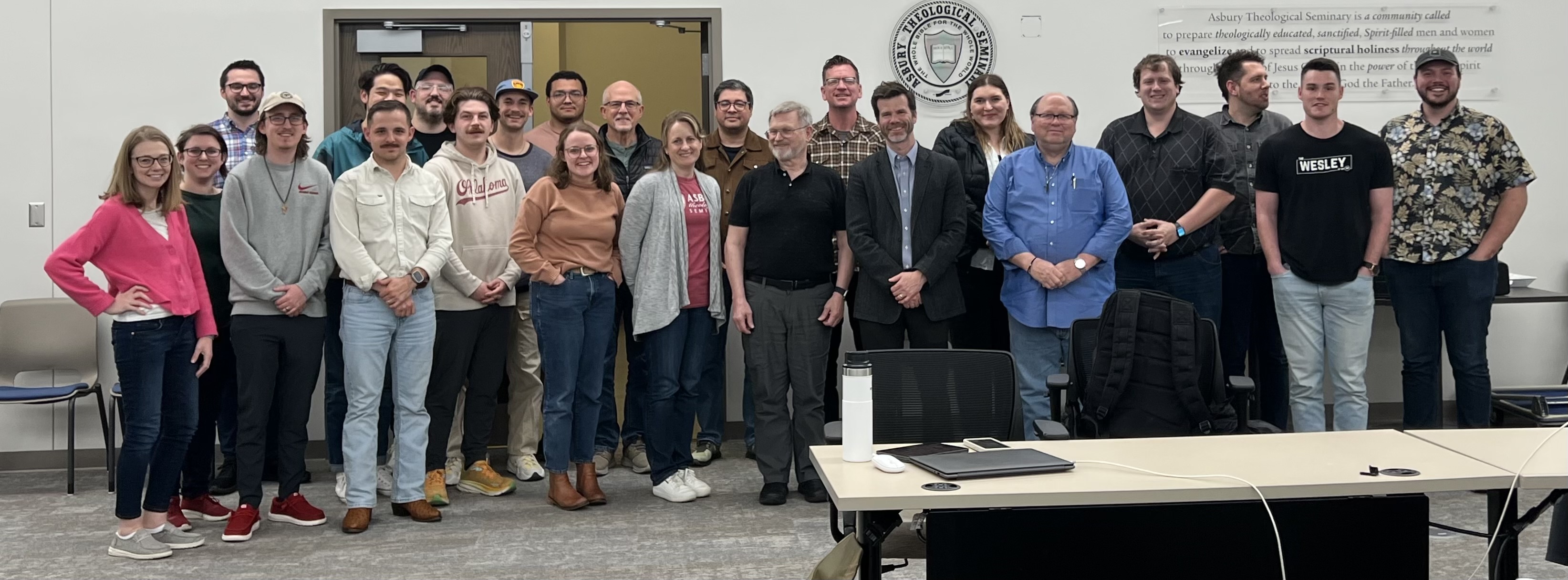
The class also gave me the opportunity to re-read core texts on John Wesley’s theology. First, we read sixty (yes, 60, not 6) of John Wesley’s sermons, including all of the original Standard Sermons. (Whether you want 44 or 52 in the list, they are all in the Collins and Vickers edited volume of Wesley’s sermons!) And we read my colleague Professor Kenneth J. Collins’s John Wesley: A Theological Journey and The Theology of John Wesley: Holy Love and the Shape of Grace. These are both masterful!

The class is a deep dive into Wesley’s theology. It is thorough and has been expertly crafted through decades of experience. I taught the class exactly the way it has been taught by those who have gone before me this semester. I had a blast because I was able to teach in an area I really enjoy teaching. And I was able to continue learning and growing as a follower of Jesus Christ and as a teacher.

Ok, so here is the memory I wanted to share:

One of the places there is always lively discussion, if students are tracking and understanding the material, is around John Wesley’s conviction that one who has experienced justification and the new birth does not commit outward sin. This is based on John Wesley’s reading of the canon of Scripture, particularly passages like 1 John 3:7-10:

Little children, let no one deceive you. Whoever practices righteousness is righteous, as he is righteous. Whoever makes a practice of sinning is of the devil, for the devil has been sinning from the beginning. The reason the Son of God appeared was to destroy the works of the devil. No one born of God makes a practice of sinning, for God’s seed abides in him; and he cannot keep on sinning, because he has been born of God. By this it is evident who are the children of God, and who are the children of the devil: whoever does not practice righteousness is not of God, nor is the one who does not love his brother. (ESV)

Collins brilliantly summarizes this in John Wesley: A Theological Journey:

Justification delivers from the guilt of sin, regeneration from its power or dominion, and entire sanctification from its being. Unfortunately, these distinctions are often neglected in contemporary Methodism where a decided “shift” has taken place; that is, freedom from the power of committing sin is attributed not to the new birth, as it should be, but to Christian Perfection, with the result that freedom from the being of sin is then relegated to the afterlife and glory. (190)

The conversation in class around freedom from the power of sin in regeneration led to a great question. I reached out to Professor Collins to get his perspective and his response was so good I asked for his permission to share it with my students and then to share it with all of you here. Here is how I framed the question:

How do I best talk to students about the correct definition and understanding of the new birth in connection with the band meeting, which both has a prerequisite of the new birth (and more), and weekly questions connected to sin.

I.e., if a students says, If someone does not commit outward sin after they receive justification and the new birth, why are the band meeting questions focused around sin? (I.e., “What known sins have you committed since we last met?”)

Here is Dr. Collins’s reply:

First of  all,  given the small numbers of people in the band meetings there may not be many responses to the weekly, sin-probing questions among the children of God, but there will likely be at least some responses over time.  Real Christians do at times break faith and commit sin of the high hand, so to speak.  The way forward then would be and must be one of repentance, of doing the first works afresh.  So then, when Wesley affirmed that a born again believer is free from the power and dominion of sin (“The Marks of the New Birth,” “The Great Privilege of Those that are Born of God”) he  was not teaching that real Christians would never sin again (a common misunderstanding among my students) but that Christian believers would have grace sufficient to remain faithful and to walk in a trusting and accountable way in the graces of regeneration.   How do we bring all of this together?  How can we summarize this basic and precious gospel truth which Jesus Christ, himself, affirmed (John 8:34-36)  and which John Wesley repeatedly taught?  I offer the following summary of the several elements here, though this language is not Wesley’s but my own.   However, I do believe that such language captures Wesley’s basic meaning.  And so here goes:    “Willful, intentional sin,  breaking faith with Christ,  should be the grave exception in the Christian life and not the rule.”  Our problem today, however, in American Christianity in general, and even at times in Methodism in particular,  is  that we have made sin the rule and grace the exception.  We need to turn this upside down.   Jesus Christ died for far more than to leave people in the bondages of which they are ashamed. 

Second, I think the very great value of  such questions for the saints that played out in the band meetings during Wesley’s lifetime is that they are a wonderful means of grace that ensure that responsibility and accountability will remain in place.   Think of  band members, for example, who are sorely tempted during the week but who in the midst of  that temptation are reminded by the Holy Spirit, the Spirit of Truth,  that they will have to confess such a sin (if it is committed) before several trusted and beloved others in just a few days.   At that  point the power of the temptation is broken (1 Cor. 10:13) by the light of the prospect of upcoming fellowship,  accountability and love.   That’s precisely the point!   In other words, the questions of the band meetings are themselves a wonderful means of grace, used by the Holy Spirit,  as a means by which faithful Christian discipleship is strengthened and lived out to the glory of God.  Put another way, evil and sin love the darkness; however, Wesley made sure that the infrastructure of Methodism in general, and the band meetings in particular would be flooded by an abundance of light in the form of relationship, accountability and the richest love.   In short, those questions are both precious and necessary  for serious Christian discipleship. 

So good!

Want to know more about the band meeting? Scott Kisker and I wrote a book that is designed to reclaim this practice. Check it out here.

Join My Seminary Course in Wesleyan Discipleship in Tulsa [January 2025]

24 Thursday Oct 2024

Posted by Kevin M. Watson in Accountability, Class Meetings, Holiness, Methodist History, Ministry

≈ Leave a comment

Tags

Band meeting, Christian formation, class meeting, discipleship, John Wesley, Methodism, Methodist, small groups, Wesley

I am teaching a course on Wesleyan Discipleship in Tulsa as a January-Term course at Asbury Theological Seminary this coming January (2025). You should join me! 

What is the course about?

Here is my description of the course:

Wesleyan Discipleship explores the history, theology, and practice of discipleship through a Wesleyan lens. Particular attention is given to the role of communal formation in eighteenth-century Methodism. John Wesley’s theology of discipleship is explored, along with a variety of aspects of Christian formation in community in early Methodism. Particular attention is given to the way Wesley’s theology of social holiness was expressed in early Methodist small groups, especially the class meeting and the band meeting. Students will apply the historical and theological understanding of Wesleyan discipleship to contemporary ministry contexts.

Why I am FIRED UP about this class:

This class will have an intensive on site here in Tulsa from the evening of January 16th through January 18th, 2025. I LOVE the time together with students at intensives! This class beautifully lends itself to teaching in this format. 

Hybrid classes have 20 hours of in-person instruction over 2.5 days. (The rest of the course requirements are met through online engagement and completion of online modules.) It is intense! But I have also found, perhaps surprisingly, that it is also an opportunity for a spiritual retreat for students. 

The in-person experience gives us the opportunity to worship together. We will start the class by attending worship at the Thursday evening service at Asbury Church, where Rev. Andrew Forrest will be preaching. Andrew is an exceptionally gifted preacher of the Scriptures and a brilliant communicator. I love being able to start class off by tangibly connecting the church and academy by walking across the parking lot to go to worship.

We will also have an Asbury Theological Seminary – Tulsa chapel service for the class and students in the area on Friday January 17.

I will get to spend hours talking about my scholarly passion – the importance of community and connection for the Christian life. I love getting to teach students and engage their questions around these topics!

And most important, we will spend time talking about and practicing ways to reintroduce these tried and tested methods that gave Methodism its name.

At the end of the course, students will have the kind of knowledge gain you would expect from a typical seminary course. But they will also have experience participating in class meetings, experiencing small group dynamics, and reflecting on various challenges and opportunities of leading small groups like class and band meetings.

I think of this course as like a laboratory. We will learn a lot about the concepts, but we will also engage them in a hands-on way. In a laboratory you can not only experience a class meeting, but you can also talk about your experience of a class meeting. In my view, this is essential for becoming an expert practitioner. You need not only a theoretical framework and some practical experience, but you also need a place to talk about your experience so you can acknowledge, address, and overcome obstacles and challenges.

I am more confident than I have ever been that groups like the Wesleyan class meeting and band meeting will be at the center of Christian discipleship in these new and strange times we are entering.

These intensives are aptly named. They are not easy. J-term is not a short cut. In fact, it is a three-week academic sprint. My goal is to maximize the 20 hours we get to spend together to suck the marrow out of the class and be as fully equipped to make disciples of Jesus Christ in the contemporary church as possible. 

I want students who come hungry and ready to learn and grow. And that is what we are seeing here in Tulsa. It is SO FUN!

How is the course being taught?

I am teaching this course as a hybrid course at Asbury Theological Seminary at our Tulsa, OK Extension Site (housed at Asbury Church).

What is a January-Term, or J-Term, course?

A J-Term course is a full three credit course that is offered entirely within the month of January. This coming J-Term will start on January 2, 2025 and conclude on January 24, 2025.

What is a hybrid course?

A hybrid course is a course that has parts that are online and parts that are in person. This specific course will have four online modules based on four main sets of reading, students will write a reflection paper that summarizes the content of the reading, critically engages it, and applies it to their own ministry context.

The in-person part is January 16-18, 2025 at Asbury Church’s Development Center in Tulsa, OK. The in-person meeting will be from 6:00pm-9:00pm January 16, 8:30am-5:30pm January 17, and 8:30-5:30pm January 18. The in-person meeting is required for completion of the course. It is also the highlight of the entire course!

Does this course meet the Wesleyan Discipleship and Spiritual Formation requirement for ordination in the Global Methodist Church?

The Convening General Conference of the Global Methodist Church, which met a few weeks back, updated the educational requirements for ordination. And one of the changes that was made was the addition of a course called “Wesleyan Discipleship and Spiritual Formation.” I don’t mean to brag, but I believe this course hits the bullseye for what the GMC is looking for here! So, yes, if you are seeking ordination in the GMC, this course meets the Wesleyan Discipleship and Spiritual Formation course requirement. You can take this course and meet all GMC ordination requirements with either an Asbury Theological Seminary M.Div. or our 60 credit (exactly 20 courses) Master’s in Christian Ministry (MACM).

Should I take this course if I am not in the Global Methodist Church?

Yes! 

If you want to help your church more effectively make discipleship of Jesus Christ, this course is for you. 

I am passionate about Wesleyan Discipleship, not because I am most passionate about John Wesley, but because I believe the Wesleyan theological tradition has a proven track record of excellence in intentional and effective disciple making. We do well to learn from experts who have gone before us. This course is not specifically for students from any one denominational tradition. I mentioned the GMC above only because there is obvious relevance for the GMC because they just made this exact course a required course to be ordained an elder in the GMC. (Your church or denomination should too. This topic really is that essential for succeeding in the 21st century church.)

Can I take this course if I am not an Asbury Theological Seminary student?

Yes! The easiest way to do this would be to apply now to become an Asbury Theological Seminary student. We have a variety of degree programs, and I would be thrilled to talk to you about any of them! There is time to apply now and start this January.

If you are interested in applying to Asbury Theological Seminary or for this course in particular, reach out to me here (scroll down to the bottom of the page) and I will get back to you soon. Be sure to include your email so I know how to reach you. 

Not ready to apply to one of our Master’s degree programs? You may be able to apply to take the course as a non-degree seeking student. You also may be able to audit the course. Both require an application and auditing requires permission from the instructor. For either of these, reach out to me at the link immediately above.

I am open to considering some auditors. Auditors do not receive any academic credit for the course and do not turn in any assignments. They are given permission to sit in on the in-person part of the class and participate in class discussions and activities. However, I will only open the class up to auditors if there are open seats after the registration period closes. (I would assume auditing the course would not satisfy denominational ordination requirements, but you should check with your own denominational leaders.)

What is the official title of the course?

The course is cross listed as a Spiritual Formation course and a Theology course. So you can sign up for either TH650 Wesleyan Discipleship or SF650 Wesleyan Discipleship.

What are the assigned readings in the course?

Students will read a few short essays from John Wesley. And they will read these three books (affiliate links):

The Class Meeting: Reclaiming a Forgotten (and Essential) Small Group Experience, Kevin M. Watson

The Band Meeting: Rediscovering Relational Discipleship in Transformational Community, Kevin M. Watson and Scott T. Kisker

Real-Life Discipleship: Building Churches that Make Disciples, Jim Putman

I cannot wait for this class! I hope to see you here in Tulsa January 16-18, 2025.

Pursuing Social Holiness Now in Paperback

28 Monday Mar 2016

Posted by Kevin M. Watson in Accountability, Christian Living, Methodist History, Wesley

≈ 3 Comments

Tags

Band meeting, Early Methodism, small groups

Pursuing Social Holiness: The Band Meeting in Wesley’s Thought and Popular Methodist Practice is now available in paperback! This is good news because it means the book is much more reasonably priced. The book was initially published in a hardcover edition that was listed at $78. And many of you let me hear about it!

Because of the initial price of the book, I have tended not to promote it too much when I speak within the church. Now that it is available in a more economical format, I want to let you know about it. The retail price for the paperback edition is $35. I know this is still not cheap, but it is about as good as it gets for an academic book. Right now you can save 30% off the paperback edition. Click here and use the promotional code AAFLYG6.

This book is a revision of the work I did for my PhD dissertation and is the product of several years of research and writing on the band meeting in early British Methodism. The book is the only study of meaning and significance of the band meeting in Methodism that has been written.

I’ve been speaking quite a bit over the past few years on the role of Christian conferencing, social holiness, the class meeting, and the band meeting in a variety of contexts. I have focused on the class meeting in my recent writing for the church because the class meeting is the most appropriate entry point for transformation-driven small groups for people who don’t have much experience with them. My recent focus on the class meeting does not mean that I don’t think the band meeting was important too! The band meeting, which was focused on confession of sin for the sake of growth in holiness, was crucial for early Methodism and its mission to “spread scriptural holiness.” Methodists need to know this history and wrestle with its potential relevance for contemporary Christian formation.

Here’s a summary of the book from the back cover:

Kevin M. Watson offers the first in-depth examination of an essential early Methodist tradition: the band meeting, a small group of five to seven people who focused on the confession of sin in order to grow in holiness. Watson shows how the band meeting, which figured significantly in John Wesley’s theology of discipleship, united Wesley’s emphasis on the importance of holiness with his conviction that Christians are most likely to make progress in the Christian life together, rather than in isolation. Watson explores how Wesley synthesized important aspects of Anglican piety and Moravian piety in his own version of the band meeting. Pursuing Social Holiness is an essential contribution to understanding the critical role of the band meeting in the development of British Methodism and shifting concepts of community in eighteenth-century British society.

Here is what some noted scholars in Methodist Studies have said about Pursuing Social Holiness:

“This is a brilliant study of one of the foundational institutions of eighteenth-century Methodism…. Anyone who wants to understand the rise of Methodism should give this account careful consideration. This is a book we have long needed.”

– John Wigger, author of American Saint: Francis Asbury and the Methodists

“This groundbreaking study offers the most detailed account to date of band meetings in early Wesleyan Methodism…. Highly recommended.”

– Randy Maddox, William Kellon Quick Professor of Wesleyan and Methodist Studies, Divinity School

“Watson’s work on the band meeting is the definitive history of this practice of small-group confession within eighteenth-century English evangelicalism…. This is a must-have for scholars of Methodism and eighteenth-century religious history.”

– Scott Kisker, Associate Dean of Residential Programs and Professor of Church History, United Theological Seminary

I hope you will consider picking up a copy of this book in order to learn more about one of the core practices of early Methodists in their pursuit of social holiness.

Now Available: Pursuing Social Holiness

22 Wednesday Jan 2014

Posted by Kevin M. Watson in Accountability, Christian Living, Holiness, Methodist History, Wesley

≈ 2 Comments

Tags

Band meeting, Methodist History, social holiness, Wesley


Over the past several years, many of you have asked me when my dissertation would be available in print. I am pleased to announce that a revision of my dissertation, Pursuing Social Holiness: The Band Meeting in Wesley’s Thought and Popular Methodist Practice, has been published by Oxford University Press. Here is a summary of the book from the cover:

Kevin M. Watson offers the first in-depth examination of an essential early Methodist tradition: the band meeting, a small group of five to seven people who focused on the confession of sin in order to grow in holiness. Watson shows how the band meeting, which figured significantly in John Wesley’s theology of discipleship, united Wesley’s emphasis on the importance of holiness with his conviction that Christians are most likely to make progress in the Christian life together, rather than in isolation.

Demonstrating that neither John Wesley’s theology nor popular Methodism can be understood independent of each other, Watson explores how Wesley synthesized important aspects of Anglican piety (an emphasis on a disciplined practice of the means of grace) and Moravian piety (an emphasis on an experience of justification by faith and the witness of the Spirit) in his own version of the band meeting. Pursuing Social Holiness is an essential contribution to understanding the critical role of the band meeting in the development of British Methodism and shifting concepts of community in eighteenth-century British society.

OUP’s listing has more information about the book, including the Table of Contents. I think that readers of this blog will be particularly interested in the book’s description of Wesley’s understanding of holiness and how his emphasis on the importance of community is connected to sanctification. I also think readers will appreciate the extensive use of primary source materials from early Methodists, giving insight into the popular practice of communal formation in early Methodism.

OUP did a great job with this book. I am very please with the layout and production quality. The main factor that may keep many people from buying the book is the price. The book is listed at $74 (though it is currently available on amazon for $62.90), which will unfortunately price it out of many pastor’s personal libraries. For those not familiar with the world of academic publishing, I would note two things: 1) Authors do not determine the prices of their books. 2) Believe it or not, it could have been much worse. Hardcover academic monographs like this one often cost $150! All that to say, I completely understand if you are not interested in spending that much money on a book.

Here is what some reviewers have said about the book:

“This is a brilliant study of one of the foundational institutions of eighteenth-century Methodism. Early Methodism was at its heart a community event. The bands, along with the class meetings, were what bound Methodist societies together. Anyone who wants to understand the rise of Methodism should give this account careful consideration. This is a book we have long needed.”
– John Wigger, Professor, Department of History, University of Missouri

“Watson’s work on the band meeting is the definitive history of this practice of small-group confession within eighteenth-century English evangelicalism. Watson not only demonstrates the importance of this practice for the revival and the Wesleyan notion of ‘social holiness’ in the eighteenth century, but also outlines the reasons for its decline in the nineteenth century. This is a must-have for scholars of Methodism and eighteenth-century religious history.”
– Scott Kisker, Professor of Church History, United Theological Seminary

“This groundbreaking study offers the most detailed account to date of band meetings in early Wesleyan Methodism. Watson first demonstrates the distinctive synthesis of Anglican and Moravian precedents in John Wesley’s mature model for the bands. He then engages a range of primary sources to provide a richly textured account of the practice of bands through the eighteenth century. Highly recommended.”
–Randy L. Maddox, William Kellon Quick Professor of Wesleyan Methodist Studies, Duke Divinity School

Now Available: The Class Meeting

17 Tuesday Dec 2013

Posted by Kevin M. Watson in Accountability, Christian Living, Class Meetings, Methodist History, Ministry, Wesley

≈ 1 Comment

Tags

21st Century Class Meeting, books, class meeting, Methodism, small groups, Wesley

Life has been hectic the last month and a half! My thoughts recently turned to this blog and I realized that I had not announced here that The Class Meeting: Reclaiming a Forgotten (and Essential) Small Group Experience is now available. The book can be purchased in print directly from Seedbed at the previous link. (It is only available in print directly from Seedbed.) It can also be purchased electronically through a variety of e-formats, including Amazon Kindle. This link will take you directly to Amazon’s Kindle listing for the book.

Seedbed has created a page for the book that has much more information: http://classmeeting.seedbed.com/

Seedbed has also included a page that contains links to reviews written online: http://classmeeting.seedbed.com/reviews/

My previous post included several of the advanced reviews that the book received.

Finally, I wrote a post for Seedbed.com that was published on the day the book was released. I also did a video interview that they published. You can view the post here and the interview here.

I am encouraged and grateful for the enthusiasm I am seeing for reclaiming the Wesleyan class meeting. Thank you for your support!

Almost Here: New Book on the Methodist Class Meeting

30 Wednesday Oct 2013

Posted by Kevin M. Watson in Accountability, Christian Living, Class Meetings, Life, Methodist History, Wesley

≈ 6 Comments

Tags

The Class Meeting

Over the last few months, many of you have asked for updates on the progress of my book, The Class Meeting: Reclaiming a Forgotten (and Essential) Small Group Experience. The book is an introduction to the central role that the Wesleyan class meeting played in early Methodism, as well as a guide to reclaiming this kind of small group today.

I wrote this book because I have personally experienced the blessing of being in a class meeting and I believe that the Holy Spirit will continue to use this small group practice to help women and men grow in faith in Christ if we would only return to it. I believe the Wesleyan approach to small groups is one of great gifts that God has given to the “people called Methodists.” In many ways, writing this book is an attempt to test whether I am correct in my discernment that God wants to bring renewal to the Methodist/Wesleyan family through a return to this practice.

Here are a few practical details about the release of the book: The Class Meeting has gone to the printer and will be released on November 15 of this year. The list price for the book is $16.95. There is a 20% discount for all preorders of the book before November 15.

Seedbed has created a page that has quite a bit more information about the book, classmeeting.seedbed.com. If you want to read the first chapter of the book now, they will send you the first chapter if you enter your email address. If you are considering using the book in a group (which is my hope for the book), you can find out information about discounts on bulk orders here as well.

I am grateful for the support the book has received from people I admire and respect. Here are some of the things people have said about the book:

Kevin Watson has given us a wonderful gift. He has resurrected an historic Wesleyan practice—the class meeting—and given it fresh meaning, showing its relevance for the church today. Kevin shows us how the class meeting may be a perfect means for church renewal, a gift of God, through the Wesleyan movement, for such a time as this.
Will Willimon, Bishop UMC (retired)
Professor of the Practice of Christian Ministry
Duke Divinity School

Kevin Watson has written a fresh new guide to the theory and practice of the Wesley Class meeting, an essential element of truly Wesleyan spirituality. As an experienced participant and initiator of class meetings in academic and congregational settings, Watson is a faithful guide. I highly recommend this book to clergy and congregations who are looking for ways to develop deeper discipleship and reconnect with our own, rich Wesleyan heritage.
Elaine A. Heath, Ph.D.
Southern Methodist University
Co-Founder, The Missional Wisdom Foundation
Director, The Academy for Missional Wisdom

Kevin Watson’s new book is a clarion call to recover the Methodist class meeting as a vital means of grace with an eye on the renewal of the church in the twenty-first century. Rightly balancing the
historical and the practical, Watson invites readers to embrace not only the generous value of the class meeting in the past but also to participate in what promise it holds for the present and beyond in raising up disciples of Jesus Christ.

Dr. Kenneth J. Collins
Professor of Historical Theology and Wesley Studies
Asbury Theological Seminary

As the United Methodist Church struggles to redefine itself and its mission for the next generation of disciples, Kevin Watson has managed to reconnect us to a timeless practice that has the potential of “revitalizing” our denomination—the Class Meeting!
With so much emphasis on declining membership and loss of relevancy, we are invited to rediscover what made Methodism and the Wesleyan movement so vibrant for over a century. Could it be that we’ve been looking in all the wrong places for the right answers? Watson reminds us that the class meeting is not an end in itself, but it has the ability to bring together and transform core groups of people who “are willing to invest in each other’s lives and who are desperate to grow in their relationship with Jesus.”
What I treasure most about this book is the way Watson traces the history of the class meeting, shares the basics of what should/should not take place within the group, and defines for us the role and qualities of the class leader. In other words, this is not a history book that simply tells us what happen then. Instead, it is a modern day road map that points us in the direction of what can happen now! If you are one of those Christians seeking to experience the height, depth, length, width and breath of God’s purpose and meaning for your life, you need to know you can discover it in a
place we’ve yet to look—the class meeting!

Robert Hayes, Bishop UMC

Like other key aspects of Christian living, the Wesleyan class meeting is often talked about today but seldom really practiced. For Wesley the class meeting included, but was much more than,
“small-group fellowship.”
Kevin Watson understands this, and he writes out of both research and personal experience. The strength of authentic Wesleyanism is that it denies the sharp distinction between head knowledge and heart experience. Rather, it unites them. We find that strength here in this practical book.
To be effective today, the class meeting must be re-contextualized (that is, made workable) without losing its essential dynamic as gospel-based accountable community. I commend this book as a useful tool that, if put into practice, can achieve that goal.

Howard A. Snyder, Ph.D.
Author, The Radical Wesley and Patterns for Church Renewal

We want to know and be known. We need to hear each other’s stories. Watson’s compelling case for reinventing the Methodist class meeting recognizes that holy living must be rooted in confession, accountable community, testimony, and gentle shepherding.
Stan Ingersol
Denominational Archivist, Church of the Nazarene

Dr Kevin Watson has given every church and pastor a gift! The gift is the reclaiming of the Wesley Class Meeting as the primary disciple growing tool. Any church willing to use this book as a guide will experience what I experienced at Christ Church United Methodist in Ft Lauderdale, Fl. I was there when
Wesley Fellowship Groups began and I had the honor to watch an outpouring of the Holy Spirit. If this is a hunger in your heart, then this book by Dr. Watson will be a “must read” for you.

Richard J. Wills, Jr., Bishop UMC (retired)

Dr. Kevin Watson’s emphasis upon renewing the Methodist movement takes a pragmatic approach. The intent of this book is to be practiced, not merely read.
Tom Harrison, Senior Pastor
Asbury United Methodist Church
Tulsa, Oklahoma

This powerful practice must be reclaimed, but not just for adults, for all ages. Do your youth pastor a favor and give him/her a copy of this deeply-rooted and thoroughly-practical book!
Jeremy W. Steele, Next Generation Minister
Christ United Methodist Church
Mobile, Alabama

The Class Meeting: Reclaiming a Forgotten (and Essential) Small Group Experience (Coming Soon)

24 Monday Jun 2013

Posted by Kevin M. Watson in Accountability, Class Meetings, Wesley

≈ 5 Comments

Tags

Class Meetings, Seedbed, small groups

Seedbed has just posted a press release to their website about the book I will be publishing with them on the class meeting. You can read the entire release here. The working title of the book is: The Class Meeting: Reclaiming a Forgotten (and Essential) Small Group Experience. The purpose of the book is to help people form class meetings. In order to accomplish this purpose, the book provides an introduction to the class meeting and its central role for the early Methodist movement, as well as a practical guide to reclaiming this distinct kind of small group. The book is designed to be an eight week small group resource that helps a group to actually become a class meeting. The hope is that after the book is over, the group will continue meeting as a class meeting. To further facilitate this, the book includes questions for discussion and a transformation question that progressively guides the group to the heart of the class meeting: Discussing the state of each person’s relationship with God.

In the speaking I have done on the class meeting in various contexts, people have consistently asked me to recommend a resource that would help them guide a group toward becoming a class meeting. These requests, and the lack of a resource that is focused on a return to the class meeting, led me to write this book. My hope is that The Class Meeting will help people to actually start life-changing class meetings, not just learn about the small groups that were at the heart of early Methodism.

I am very excited about this book! I believe the class meeting continues to have enormous potential for Christian discipleship in this time and place. And from many of the conversations that have occurred here, I know that many of you do too. I am praying for the Holy Spirit to raise up a network of class meetings.

I will provide further updates on the release of the book here. As the press release states, Seedbed anticipates that the book will be in print this fall.

Kevin M. Watson is Assistant Professor of Historical Theology & Wesleyan Studies at Seattle Pacific University. You can keep up with this blog on twitter @kevinwatson or on facebook at Vital Piety.

Ordination: Communal Rite or Individual Right?

06 Monday May 2013

Posted by Kevin M. Watson in Accountability, Ministry

≈ 9 Comments

Tags

community, D. Stephen Long, individualism, ordination

“Ordination is a communal rite, not an individual right.”

After reading this quote from D. Stephen Long’s Keeping Faith, I began mentally reviewing many of the conversations I have had with candidates for ordination. In my admittedly far from perfect mental scan of tweets, blog posts, and personal conversations, most (but not all) of the comments I could remember fit in the ordination as “individual right” camp. Viewing ordination as an individual right, and not a communal rite, can lead to a sense of entitlement and defensiveness, particularly if the person pursuing ordination feels like the church owes it to them.

But ordination is a communal rite and is not understood as an individual right.

And just in case the understanding of ordination as an individual right is more appealing to you than the approach of ordination as a communal rite, it may be helpful to point out that no denomination understands ordination as an individual right. Even in churches that have a congregational polity, it is the local church community that votes on whether to ordain the person. The individual is not the sole judge who claims their right, which the community is required to give.

So, what is going on? Why do so many people seem to feel entitled to be ordained, rather than viewing it as a process of communal discernment?

While I have two initial thoughts, my broader purpose with this post is to stimulate a larger conversation. I hope you will comment here. You can also connect with me and respond to this post on twitter @kevinwatson. Either way, I hope you will share your thoughts.

At this stage I will offer two thoughts. The first one is much more extended than the second. 1) People view ordination as an individual right more than a communal rite because the church has formed them to think about ordination in this way. 2) Ordination as an individual right may be a litmus test for a broader unwillingness of individuals to submit to the authority and wisdom of a broader community.

First, as I have been thinking about this quote and processing it with others, I have found myself seeing this as a basic issue of formation. Thinking back to my initial engagement with the ordination process, I don’t remember having hardly any expectations of the process beyond an initial desire to serve God and feeling that the local church was the best place to begin to work this out. I was almost completely ignorant of what the process entailed. In fact, in my first conversation with my pastor, I don’t think I knew there was a process. I was formed into a particular understanding of what ordination is and how it works.

One of the main things I initially learned was that I should expect that not only would I discern whether I felt that God was calling me to ordained ministry, but that my denomination would likewise discern whether God was calling me to ordained ministry in their midst. Where ordination is a communal rite, discernment is a two-way street.

I am concerned that many are being taught to expect that the ordination process will be, and for various reasons must be, one where the gifts one already feels one has are simply affirmed and celebrated by others. I wonder if an unintended consequence of the emphasis on being inclusive and accepting has led some people to view ordination as an entitlement. The thought process could go like this: If I feel like I want to be ordained, you must accept my sense of calling and include me in the order of ordained clergy, otherwise you are being exclusive. When this is seen in its most extreme form, even to examine someone’s calling is seen as invasive, unnecessary, and a problematic use of power by the church.

There are at least two problems with an understanding of ordination that demands that it be given as an individual right. First, people who should be ordained have room to grow and improve in the gifts and grace that have been given to them, no matter how gifted they are. Candidates for ordained ministry should be prepared to accept constructive criticism. They should expect to learn more about themselves and to grow in their sense of calling as a result of the process. Everyone, even experienced pastors, has room to grow. And discerning that one is not called to ordained ministry should actually be viewed as a successful outcome, not as a failure. Second, some people should not be ordained. And they may not always agree with the decision of the church. If ordination is the culmination of a discernment process by both the individual considering ordained ministry and the church that will ordain them, both parties must continue to affirm that they are headed in the right direction.

Before moving on to the second thought, I feel compelled to acknowledge that Boards of Ordained Ministry are not infallible. They make mistakes. And sometimes the criticism they give is not constructive, or honest. Making distinctions about when Boards of Ordained Ministry get it right and when they get it wrong gets messy quickly. And yet, as long as our polity understands ordination as a communal rite and not an individual right, we ought to try to correct mistakes and improve the process, rather than resist the authority that is rightly invested in the community.

My second main thought is that ordination as an individual right may be a litmus test for a broader unwillingness of individuals to submit to the authority and wisdom of a broader community. A few pages after the quote from D. Stephen Long that prompted this post, he wrote something that is an even more aggressive challenge to the contemporary idolatry of the individual:

We Methodists find the rites and ceremonies of our church to be so important that openly breaking them should issue in a rebuke, even if that rebuke must be given to a pastor, superintendent, or bishop. The rites and ceremonies belong to the whole church. When a pastor, superintendent, or bishop changes those rites and ceremonies because of her or his individual conscience, she or he violates the trust that the church places in her or him to guard and preserve the faith. (59)

My guess is that Long’s call for individuals to submit to the whole church, (including even their conscience!) would be contested by many. A key question, though, would be whether the disagreement is precisely an assertion of individual rights over that of the community.

What do you think? How do you think ordination is perceived by most people discerning a calling to ordained ministry? Is Long right that ordination should be understood as a communal rite and not as an individual right?

Coming Soon: Reclaiming the Class Meeting

18 Thursday Apr 2013

Posted by Kevin M. Watson in Accountability, Christian Living, Class Meetings, Methodist History, Ministry, Wesley

≈ 5 Comments

Tags

catechesis, Christian formation, Class Meetings, life in god, methodist class, relationship with god

photo (8)If I had to pick one thing that I believe would be most likely to be used by the Holy Spirit to bring renewal to the church, it would be a return to the early Methodist class meeting.

And that is why I have finally gotten around to writing a book that is designed to introduce people to what a class meeting is and to help create and sustain these groups. I have just submitted my manuscript and am excited to see this book in print.

Class meetings were groups of seven to twelve people who gathered together to discuss the state of their relationship with God. The question used in the eighteenth-century was, “How does your soul prosper?” Today it might be translated, “How is your life in God?” Regardless of how the question is phrased, the most important thing is that the group is focused on each person’s relationship with God.

In my experience, when people want to grow in their faith, they typically assume that they need to know more. The problem of a lack of formation is often perceived to be a lack of information. I agree that all of us could stand to learn more about our faith and there is a key role for catechesis.

However, following Jesus is ultimately a way of life, not a body of knowledge about him. Too often, Christians do not practice what they do know.

The key contribution that the early Methodist class meeting would make for contemporary Christianity is that it would help people learn to look for encounters with God in every part of their life. They have the potential to help Christians learn to interpret every part of their lives through the lens of the gospel.

Above all else, contemporary Christianity needs Christians who are Christian not in name only, but women and men who are passionate and confident in their faith in Christ and who can speak to the ways that they have seen and experienced God’s work in their lives and in the lives of others.

I believe that the Holy Spirit wants to use this form of communal Christian formation once again to help people have an active faith in Christ, not merely a passive intellectual faith. And I believe that if this practice were to be reclaimed, it would be used by the Spirit to bring renewal.

If you are interested in reclaiming the class meeting in your faith community, stay tuned! I will update the progress and availability of the book here and on twitter (@kevinwatson).

If you’d like to read more about the class meeting, check out the series of posts I wrote here.

Online Class Meetings

25 Wednesday Jul 2012

Posted by Kevin M. Watson in Accountability, Christian Living, Methodist History, Ministry, Wesley

≈ 7 Comments

Tags

class meeting, online class meeting

In my writing and teaching about reclaiming the Wesleyan class meeting, I am sometimes asked about the potential for online class meetings. The class meeting was a small group of seven to twelve people that was centered on each person answering the question “How does your soul prosper?” (For more on the class meeting, click here for a previous series I wrote.)

The more I have thought about the class meeting, the more I have become convinced that the class meeting is more of an archaeological relic from when early Methodism’s days as a movement focused on justification by faith, the new birth, and growth in holiness. Today, most United Methodists do not have the vocabulary to talk about their personal experience of God. I’ve been in class meetings where we revised the original question so it was either “how is it with your soul?” or “how is your life in God?” People who do not have previous experience with a group like this often struggle to find the words to answer the question.

I mention this because I am often asked by people who want to be in a class meeting, but are struggling to find the critical mass to start a class, about the potential for an online class meeting.

Here are my initial thoughts (with the caveat that these are very much still in process for me):

I think there is some potential for online class meetings, but I would have a strong preference for class meetings that meet in real life. Here is my guess: Groups that meet in person in someone’s home have a much better chance of being successful in the long run than do those that are started by people who have met online and cannot meet in person because of geographical distance.

There are two scenarios where I think online class meetings would be most likely to succeed. 1) Technology could be used to sustain community that would otherwise be interrupted by a move. Imagine, for example, an amazing seminary that requires its students to participate in weekly class meetings during their time in seminary, the seminary I teach at does have this requirement! 😉 Here, many of our students have formed close friendships and want to stay accountable to one another, even as they are sent out from SPU. Given a context where people have met together for years and have built deep relationships, I think an online version of the class meeting could be used to help people continue the community that has been built.

2) Technology could be used to help pastors participate in a class meeting themselves, especially if they have never participated in one previously. There are a host of issues here that could be explored further. There is disagreement, for example, about whether pastors should or should not be involved in something like a class meeting with their parishioners. I think it would be better for the church if the pastor is in a group like this within their congregation; however, I am more of a pragmatist than a purist on this. I would rather a pastor be in a group than not, so if it helps a pastor enter into a class meeting by joining a group of other pastors, then by all means they should do it! And if it is not feasible to meet in person because of geographical proximity and scheduling issues, then an online meeting could work really well.

Before I sketch what I think would be the ideal way to organize an online class meeting, I want to make one qualification. One of the values of the class meeting is that it was a way to ensure that every person who was associated with “the people called Methodists” was connected to a community of people who were seeking to be saved from their sins and would watch over one another in love. A concern I always have when discussing online class meetings is that it will be a way for people to play it safe and join together with those they are already comfortable with, rather than risking inviting people around you to try something new. In early Methodism, the class meeting was one of the major pieces of the early Methodist movement. Better to start a class meeting in any form than not start one. But in my mind, it is even better to start one with people in your local church, to invite and encourage them to grow in their love and knowledge of God. I believe that a return to a form of small group practice like the class meeting is one of the best hopes for Wesleyan faith communities, but can only bring renewal to local churches to the extent that they are connected to local churches.

Conducting an online class meeting:

Here’s how I would organize an online class meeting. First, contact the people you would like to be in the group. Agree on a consistent time to meet weekly (remember to take time zone differences into account, if applicable). The best news about trying an online class meeting today is that technology makes it possible to meet as close to in person as possible. I would use skype, facetime, or some other online chat forum to meet. It is ideal if participants can see each other, but not essential. I do think it is nearly essential that the group be able to hear each other’s voices. Instead of sitting together in a circle, or around a table, you will be sitting in front of your computer. But you will still be able to answer the weekly question, pray for each other, and even sing (as long as I don’t have to lead the singing)!

Ultimately, I think online class meetings offer both potential and peril. The potential is that the virtual format may help some folks stay connected to Christian community that God has used to help them grow in holiness. It could also help people find a class meeting to participate in if they are in a culture that is not willing to try a class meeting. And best of all, everything that is essential about the class meeting can be preserved (i.e., people talking to each other about their relationship with God and their pursuit of growth in grace). The peril is that virtual classes could discourage vulnerability and intimacy. They could also encourage people to avoid their literal neighbors and inviting new people into the group.

A good rule of thumb is that you are doing something right if the class meeting is both a means of grace to you personally and it is also used to invite people into a deeper relationship with the Father, Son, and Holy Spirit.

← Older posts

Blog at WordPress.com.

  • Subscribe Subscribed
    • Kevin M. Watson
    • Join 369 other subscribers
    • Already have a WordPress.com account? Log in now.
    • Kevin M. Watson
    • Subscribe Subscribed
    • Sign up
    • Log in
    • Report this content
    • View site in Reader
    • Manage subscriptions
    • Collapse this bar
 

Loading Comments...