Some of my favorite people to do ministry with are the folks at Spirit & Truth. If you have not heard of this ministry, you should check them out right now. For several years now, they have hosted a yearly conference in Dayton, OH at Stillwater Church. This year, they were led to shift to regional gatherings in Alabama, Texas, and Ohio. Maybe even more than these conferences, Spirit & Truth’s sweet spot is going to specific local churches and offering training on evangelism and discipleship empowered by the Holy Spirit.
Spirit & Truth is gifted at introducing people to the presence and power of the Holy Spirit as a person they can partner with to share the gospel. If you invite Spirit & Truth to minister at your church, they will offer excellent teaching on evangelism and discipleship that is practical and immediately applicable. More importantly, they will partner with the Spirit to activate the laity in your church and send them out into your community to talk and pray with real people in your community.
For decades the church in the United States, at least the parts I have been connected to, has been engaged in a sophisticated program of procrastination. We have programmed evangelism, reading books, meeting in classrooms, even forming committees, but we have not engaged with people outside the walls of our church. We have planned and strategized, but not acted. We have talked to each other about these things more than we have spent time with the Lord and sought his direction. We have talked about people who do not know Jesus more than we have talked with them.
Matt, Maggie, and Emma know God the Father intimately. They have been changed by Jesus Christ and the power of the gospel. And they have each been filled with and empowered by the Holy Spirit. They are also exceptionally gifted at helping churches experience the presence of the Holy Spirit in their midst. They are willing to be used by the Lord to break up ground in local churches and make room for real Christianity. They don’t have techniques or gimmicks. But they also don’t flinch or lose their nerve when the Spirit of God comes in power in answer to their prayers.
Ok, so that is my pitch to you to reach out to Spirit & Truth!
I started writing this post to share my experience at the recent Spirit & Truth regional conference in Conroe, TX and First Methodist Conroe, where John Wayne McMann is the lead pastor. (For more on what the Lord did, check out Spirit & Truth’s podcast episode with John Wayne McMann.)
Matt asked me to be part of the gathering in Conroe several months ago, I’m not quite sure how far back. But I had really been looking forward to this conference. Matt and I had touched base a few times about what the direction he was sensing from the Lord for the conference, and I had a pretty good idea of the direction I thought I was supposed to take with my message.
I felt like the Lord was asking me to share more vulnerably than I have in this kind of space about my own experience with the Holy Spirit. I felt like I was supposed to share how I, sometimes by fits and starts, have grown in my ability to hear God’s voice and have grown in a hunger to see God heal people inwardly and physically. I also felt like I was supposed to be more unscripted than normal.
This is vulnerable for me for a variety of reasons. First, I know there have been many excesses throughout the history of the church. (I’ve seen many of them in teaching Church History.) Second, pretty much every part of my own formation in the church (and even more so in the academy) taught me to trust what I could know objectively, particularly facts, dates, and ideas I could read in books and master enough to do well on tests. Third, for much of my life, more than I realized, I really wanted to be in control. (Ok, God is still working here.) There is probably more, but that gives you an idea.
But.
I have seen God do things that are powerful, immediate, and life changing and I don’t want to miss the opportunity to be part of what God is doing now in his church because I am unsure of what will happen next, or I’m worried I’ll fall on my face.
So, I did the best I could to share about my experience with the prophetic and how I’ve seen the Lord heal. I tried to share in humility about the times I’ve missed it, gotten it wrong, or at least not gotten to see the full picture. My sense is that at least some of the excesses in the Pentecostal/charismatic world come from the same need to be in control as are found on the anti-supernatural side of the street.
And so, any time I have an impression or a sense that the Lord is speaking, I try to offer it gently and with open hands. I don’t always get it right. But, again, I’ve seen the Lord open doors to ministry I didn’t even know were there, sometimes simply by being willing to ask a question that was persistent in my head all day and seemed completely random.
I’m sharing this here because I want you to know that the Holy Spirit is alive and active. And he is so good!
I am also sharing this here because I want you to know that if I can grow in my faith, willingness to take risks to see the Lord move, and openness to receiving gifts from the Spirit, so can you!
Finally, I’m sharing this here because I don’t think we were meant to go it alone in any part of the Christian life. We need to learn from those who have gone before us. Spirit & Truth has been a place where the Lord has met me and ministered to me in powerful ways. It has also been a place where I have learned and grown in my confidence to minister in the power and authority of the Holy Spirit.
I preached 1 Corinthians 1:18 – 2:5 at the Spirit & Truth Conference in Conroe. I want this to be true of my life and ministry:
My message and my preaching were not with wise and persuasive words, but with a demonstration of the Spirit’s power, so that your faith might not rest on human wisdom, but on God’s power.
In February 2022, Aaron Renn published a piece in First Things Magazine titled “The Three Worlds of Evangelicalism.” The article laid out a metanarrative for thinking about the changes evangelicalism in the United States has experienced over the past fifty years or so. (Renn actually first developed this argument in 2014, but the First Things piece brought a significant increase in attention to his argument.)
This article received a lot of attention, both positive and negative. I have found Renn’s way of framing the moment we are in to be very helpful. I was thrilled to see that he was publishing a book on this topic, Life in the Negative World, which was released just a few weeks ago.
Here is the heart of the argument:
Since that bygone midcentury era, the status of Christianity in America has passed through multiple thresholds as it declined, dividing that post-1963 period into three major eras, or worlds, characterized by three ways society at large has viewed and related to Christianity. These are the positive world, the neutral world, and the negative world (dates are approximate).
Positive World (1964-1994). Society at large retains a mostly positive view of Christianity. To be known as a good, churchgoing man or woman remains part of being an upstanding citizen of society. Publicly being a Christian enhances social status. Christian moral norms are still the basic moral norms of society, and violating them can lead to negative consequences.
Neutral World (1994-2014). Society takes a neutral stance toward Christianity. Christianity no longer has privileged status, but nor is it disfavored. Being publicly known as a Christian has neither a positive nor a negative impact on social status. Christianity is one valid option among many within a pluralistic, multicultural public square. Christian moral norms retain some residual effect.
Negative World (2014-present). In this era, society has an overall negative view of Christianity. Being known as a Christian is a social negative, particularly in the higher status domains of society. Christian morality is expressly repudiated and now seen as a threat to the public good and new public moral order. Holding to Christian moral views, particularly affirming the teachings of the Bible, or violating the new secular moral order can lead to negative consequences. (6-7)
The phrase that has kept coming to mind as I have thought about Renn’s thesis and as the church seeks to respond faithfully to our present cultural moment is this:
Everything depends on knowing what time it is.
If we are in negative world and we respond with neutral world strategies, we will fail. Every. Single. Time.
And my sense is that most of the people in my tribe are living as if the last page of the calendar in 2014 had never turned.
One of the biggest indicators that you are attempting to live in the past is any attempt to woo the world on its own terms.
And I see this all over the place. If we could just explain ourselves in the right way, people would realize that we are reasonable, good, and likeable people. Let me put my understanding of Renn’s argument sharply:
If you are an evangelical Christian, they will never like you.
My sense has been that for quite a while, the church in America has tried to do evangelism by winsomeness. But if you are a traditional Christian, they are never going to like you. Instead of seeking to avoid giving any offense and trying to explain why our convictions are reasonable on the anti-Christian culture’s own terms, we need to evangelize. We need to seek conversion to Jesus and submission to him as Lord of all creation. Winsomeness is a losing strategy in negative world. (Please note that this is not the same thing as recommending the opposite of winsomeness as the right strategy. I am also not advocating for anger or bitterness or anything else contrary to the fruit of the Spirit.)
If you think all of this is dead wrong, I would encourage you to read Renn’s book. If you read it and are entirely unconvinced, then there will at least be clarity that we are working on very different problems. May God bless you in your work. I hope you will ask the Lord to bless my work as I work according to the truth as I best see it.
I am convinced those of us in the American church do live in negative world. This is true of our context. And it is independent of denominational affiliation across that context.
I suspect that most of the engagement with Renn’s book will consist of two responses:
Evaluation of the framework itself. Does he get the details of positive, neutral, and negative world right? And most importantly, are we in negative world?
Engagement with the prescriptions for life in negative world. What does Renn get right? Where is he off?
I think these are important and I will read these kinds of engagement with interest.
However, I want to respond to Renn’s book in a different way.
As I read Life in the Negative World, I often just felt sad. I felt sad because I know so few people who are doing this kind of work. I felt sad because even after having left the United Methodist Church, I still often feel like making progress on the issues facing the church is an uphill battle.
Having left the UMC, some seem to think the first order of business is showing the world we are not the crazy, bigoted fundies our enemies have said we are. But this posture is still reacting on the terms set by those who fundamentally disagree with us and will never like us.
Rather, I think the first order of business for those leaving the UMC is to get our own house in order as soon as it is properly our house and not the United Methodist Church’s house.
For many of us, a ruthless inventory is needed before we seek to enter the Promised Land of whether we are still carrying Egypt around with us.
Life in Negative World is, in my view, an important book simply because it is paying attention to the big picture and it is willing to risk speaking the truth as clearly and accurately as possible, even when it is uncomfortable, seems like bad news, or might offend.
On the one hand, we need to do our own work to develop moral courage, boldness, clarity, and a willingness to suffer for the core claims of the gospel, if necessary. And on the other hand, I believe that those who find themselves in leadership positions must use their power and influence to make it easier and not more difficult for people to “live not by lies.”
It is past time for those in the United States who claim to be followers of Jesus Christ to lay down their reputations and fear of man in obedience to the Lord.
If we live in negative world, and I believe we do, there are major adjustments that need to be made, and yesterday, in almost every single way we approach the Christian faith. Evangelistic strategies that worked in the 1990s and 2000s will not work in negative world. (And at least in my world, we never really had evangelistic strategies in these decades anyway.) The same is true for discipleship.
I have been reading Daniel 3 over and over again for years now. Daniel 3 is a beautiful story of cultural differentiation. Shadrach, Meshach, and Abednego are so grounded in their faith that they can respond under immense pressure to the claims of the world and the demands of empire on their lives. They are differentiated from their cultural moment. They don’t pick fights to be nasty or pursue conflict. But they are willing to stand and put their entire trust in the Lord, even under very real threat of death.
This passage gets me every time:
If we are thrown into the blazing furnace, the God whom we serve is able to save us. He will rescue us from your power, Your Majesty. But even if he doesn’t, we want to make it clear to you, Your Majesty, that we will never serve your gods or worship the gold statue you have set up. (Daniel 3:17-18 NLT)
I long to see a church in the United States with his kind of clarity, conviction, and courage.
I am thankful for Aaron Renn’s willingness to step forward and offer new ideas and prod evangelicals in the United States to think more carefully about the times we live in that we might be faithful. This is not easy to do. I suspect it has come at a cost for him personally, though I do not know this.
If we are wrong, we can change our minds. But if we are too afraid to think or take any risks to ask questions or challenge the dominant culture and its brokenness, we are blind guides.
One more thing:
I was excited to see that the senior pastor of my church, Asbury Church in Tulsa, OK wrote an endorsement for Life in the Negative World. Here is why Rev. Andrew Forrest thinks you should read the book:
The most important distinction in the American church today is not the one between liberal and conservative, or high church and low church, or mainline and evangelical; no, the most important distinction in the American church today is between those who recognize that we live in the negative world and those who haven’t yet accepted that fact. I am in the former camp, and Aaron Renn has given me the vocabulary I need to help others see the world as it is. Every now and then a writer and thinker comes along who helps us see the world more clearly, and Aaron Renn has been that guide for me. In Life in the Negative World he does two important things: (1) He helps us see the world as it actually is and not as we wish it to be. (2) He gives us a way forward. I’d recommend this book to every pastor I know, and I’d like everyone in my church to read it.
(Links to the book in this post are Affiliate links, which means if you use them, it helps to support this blog.)
Last week, I had the privilege of speaking to the Salvation Army Officers of the Arkansas-Oklahoma Division on the theme of “Holiness unto the Lord.”
If you are not familiar with the Salvation Army’s structure, officers in the Army are the equivalent of clergy in most churches. So, this was like a retreat for all of the active clergy in the Salvation Army serving in Arkansas and Oklahoma. I love the schedule at Officer’s Councils (at least at the Divisions in the Southern Territory where I’ve been a guest). There are typically two sessions of worship and teaching in the morning and then the rest of the day is unscheduled.
It is a blessing for pastors to have time away where they have time and space in the schedule to truly rest, relax, and reconnect with each other. This is a rare gift and I’ve not experienced that kind of intentionality given to actual rest, rather than busyness and business at this kind of gathering.
The Salvation Army also does hospitality exceptionally well. My goodness! Unpacking this would be an entire post of its own. I’ll just give one example: one time the Army not only flew my entire family to be with me because it was my daughter’s 10th birthday, they also ordered a special cake and balloons that were waiting for her when we arrived. They have loved us so well!
I want to share a bit about my connection to the Salvation Army and what I have learned, so far. This is a bit vulnerable for me to share. I am not intending to boast in Kevin here. I am intending to give glory to God. I also hope it may help some of you recognize when the Lord provides similar places of blessing in your lives.
The Lord has blessed me with a special connection to the Salvation Army. It started at a moment when I did not expect it all. And it has truly been a sheer gift from the Lord.
The first invitation I received to speak at an Army event was as the Commencement speaker for Evangeline Booth College, in Atlanta, GA at the beginning of the summer in 2021. I went to that event very naïve. I knew a little bit about the Salvation Army. I knew, for example, that they were founded by Generals William and Catherine Booth in England. I also knew that they had strong connections to the Wesleyan-Holiness tradition and that their impressive social work came out of this heritage.
I also knew that Ezekiel Elliott sometimes jumped into a giant red Salvation Army kettle after he scored a touchdown on Thanksgiving back when he played for the Cowboys.
I didn’t know much more than that, however, when I spoke to the Cadets (students) who were graduating from Evangeline Booth College.
This first Salvation Army event came at a strange time in my life. I had just resigned a tenured faculty position at Candler School of Theology at Emory University. After stepping away from this position, I didn’t think I was going to be doing much of this kind of speaking anymore. Something about that moment brought focus, freedom, and courage to speak very candidly about the need for the Army to remember that its identity is first and foremost an army of salvation through Christ. They are also a people committed to holiness and full salvation. I pressed them to remember that they were raised up to be an intentionally strange people and that they should not lay aside the things that set them apart from the world to hope to receive the world’s approval.
For me personally, it felt like one of the most bold and true talks I had ever given. I think a piece of this was that I kind of assumed this was a one-off opportunity just before we moved away from Atlanta.
It can be easier to be bolder with strangers than with friends.
In ways I could not have known, however, the Lord blessed me by giving me favor with the leaders of the Southern Territory who were there that day. I did not have the opportunity to visit with them at length at Commencement. But, that event led to further opportunities to minister within the Salvation Army and get to know its leadership.
Since speaking at Evangeline Booth College, I have spoken at Bible Conference in the summer of 2022, Officer’s Councils in three different divisions (Kentucky-Tennessee, the Carolinas, and Arkansas-Oklahoma) and at a Holiness week at the College for Officer Training in the Eastern Territory in Suffern, NY.
Every single one of these experiences has been a tremendous blessing to me.
Last week brought some things together for me that I want to share:
First, I want to publicly thank the leadership of the Salvation Army for loving me and my family so well during a challenging time for us. Lt. Colonels Tom and Julie Louden, currently serving as Divisional Commanders for Kentucky and Tennessee, first invited me to speak at Evangeline Booth College’s Commencement. They also prayed for us many times throughout this season and even sent a care package to my kids at Christmas in 2022.
Just as encouraging to me, I have been surprised in the best way by the wisdom and moral courage I have found among many of the leaders of the Salvation Army, especially in the Southern Territory, where I have had the most engagement. I have often been looking for wisdom, moral courage, and leaders who provide godly spiritual covering for the people under their car. I have seen that in the leadership of the Southern Territory in ways that have strengthened and encouraged me.
Finally, I want to share what I think could most easily be misunderstood as boastful. But I am going to risk it in hopes of giving glory to Jesus Christ and his work in my life. I also want to share it here in case it helps you recognize the places of abundance in your life.
The Salvation Army has been for me what a dear friend of mine calls a “land of my anointing.” I did not see this coming or expect it at all. But again and again I have come back from Salvation Army events and said to my wife, “I feel like the Lord prepared this particular people for exactly what he has put in me.” I am learning to simply trust and receive this as a gift from the Lord.
When I minister in Salvation Army contexts, I consistently receive feedback that things I’ve sensed or said have landed, often beyond what I could have expected. I think every time I’ve spoken at an Army event I have received testimony that I have spoken prophetically in ways I didn’t anticipate. This has been humbling to me because it has not come from my own wisdom or hard work. It has simply been the Holy Spirit’s work moving to bless his people.
These experiences have helped me learn to pay attention and intentionally listen for the Spirit’s guidance and direction anytime I preach or teach. It has been so much more fun working with the Spirit than trying to do it on my own!
I have seen the Lord move in powerful ways renewing the strength of officers to recommit to the fight for souls, press into deeper relational connectedness particularly through reclaiming Wesleyan class and band meetings, and even blessing officers with the gift of entire sanctification. I’ve also seen God’s heart for officer families.
I have been able to invite people to receive the gift of entire sanctification in multiple contexts. And the Lord has moved in miraculous and transforming ways. At the last Salvation Army event, I heard a powerful testimony to entire sanctification just before I preached on 1 Thessalonians 4:1-6 and 5:23-24. I then invited people to receive the gift of entire sanctification in faith that Jesus has already done everything that is needed to break the power of canceled sin in their lives.
I used a specific image that was given to me by the Spirit in the moment and multiple people testified that the Holy Spirit fell on them in a powerful way through that image. This was especially humbling for me because when the image was brought to mind, I did not like it. It seemed corny to me. But I offered it because I felt the weight of the Spirit on it.
What a great reminder that the Lord knows so much better than I do!
Two people have testified to me that they received entire sanctification through the Spirit’s work at that session.
God is so good!
I am learning to gratefully accept that the Lord in his wisdom has made the Salvation Army a place of particular anointing in this season of my life. It has been fun and a joy.
I don’t know how long this season will last. I am aware that I am not in control of any of it. I just know it has been a blessing to me in a rough stretch. I am thankful for what I have seen the Spirit do over these last few years. I have learned so much and am grateful for all of it.
Is there a place for you that consistently seems to be synced up with the Holy Spirit? Where there always seems to be fruit beyond your expectations in a way that is clearly separated from your performance or achievement? Look for your land of anointing. Is there a place, a people, or a topic, where the Lord consistently brings his blessing to your work?
When you see it, receive it in humble and joyful submission to the Lord.
I know for me it has been a gift to see such a concrete sign of how God has intended to use the things he has put in me for his purposes even before I could have anticipated any of it.
On January 19-20, 2024, a group of more than 70 scholars met in Alexandria, VA to discuss the doctrine of holiness and its ongoing relevance for the contemporary church. The gathering was remarkable to me because of its size, the focus on holiness itself, and the prerequisites for participation in the gathering:
affirm the historic creedal faith of the church
hold to traditional moral standards
embrace a Wesleyan theological vision
The purpose of the Summit was:
To craft a document designed for the faithful by leading scholars that clearly describes a Wesleyan view of holiness of heart and life. The teachings of John and Charles Wesley will provide the foundation for this document and serve as a uniting principle to guide our work. Of course, following the Wesley brothers’ direction, we will always look to scripture and the faithful interpretation of scripture within the Church’s tradition. This uniting principle will enable a large Wesleyan tent to find a common voice. Or to put it differently, the Wesley brothers make it possible for us – in all of our diversity – to write a document that can be endorsed by everyone from a high church Methodist to a Pentecostal and everyone in-between.
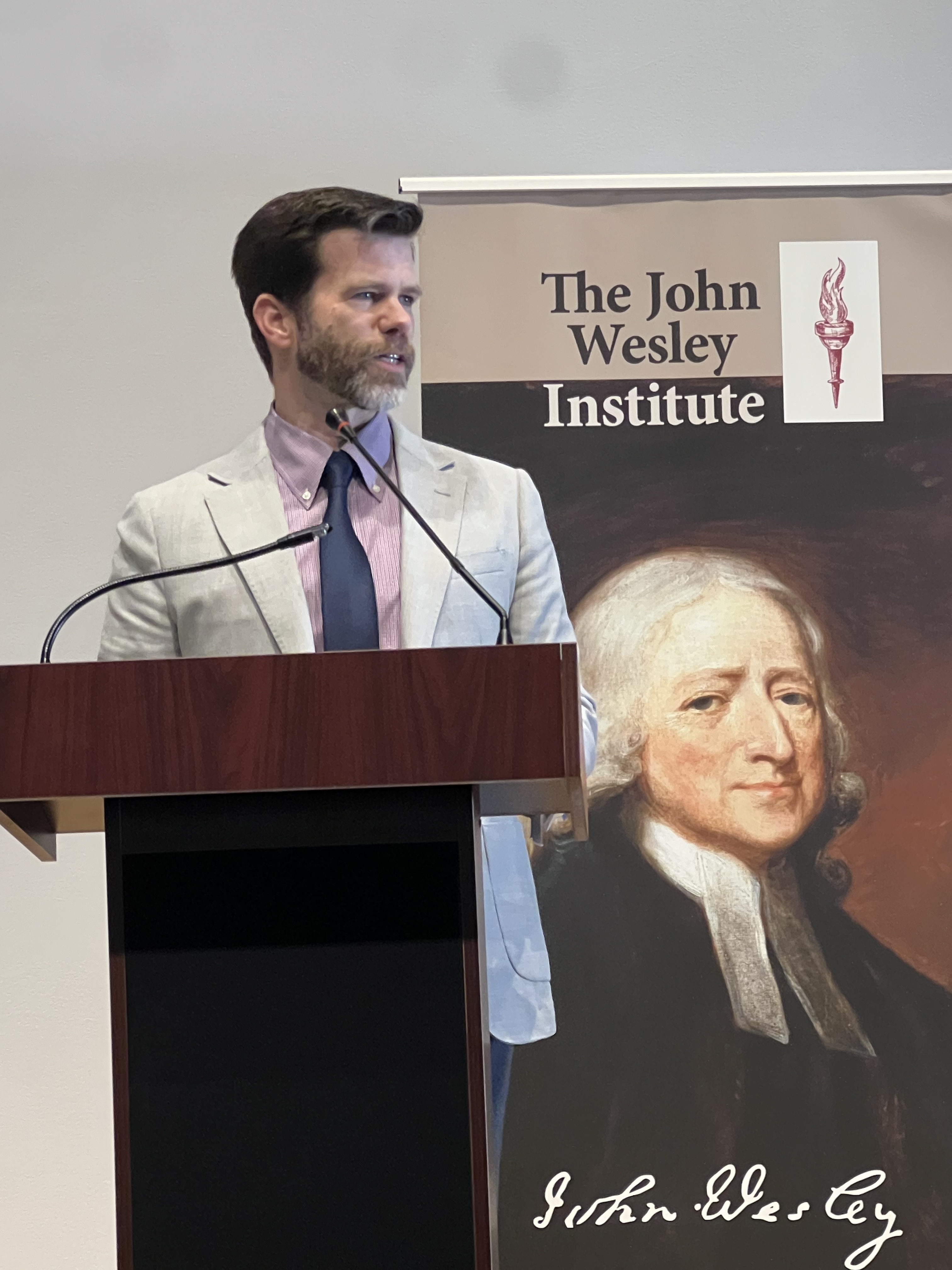
I was asked to give one of two keynote addresses at this gathering, Dr. Warren Smith of Duke Divinity School gave the other.
Here I am, mid-pontification.
Here are a few reflections from my time at this gathering:
First, the Lord has raised up a surprising number of conservative Wesleyan scholars who are willing to publicly be seen as such. This is surprising because most of us have come from institutions that were not trying to produce us. In fact, several come serve in contexts where there is pressure not to be associated with these kinds of gatherings.
I see this as a hopeful sign of God’s provision for the church.
Second, I was reminded of what I already know: Spiritual warfare is real and the Holy Spirit is alive and active. When I was initially asked to give a keynote at this gathering, I was excited and happy to accept. But as the day drew nearer and I began to work on my address, my preparation was difficult and unenjoyable in a way that was abnormal for me. To be candid, I was really dreading speaking at this gathering. This is probably because the last few years in the academy have been particularly challenging for me. More than that, I believe I was experiencing interference from the enemy. Added to that is the feeling that we aren’t supposed to talk about spiritual warfare or anything supernatural in academic contexts.
Let me say that I while I am sure there were those who disagreed with parts of what I said in my presentation, I did not experience any hostility from anyone at the Summit. On the contrary, I received words of affirmation and encouragement that were humbling and beyond anything I deserved. I was blessed to be surrounded by people who love well.
Third, there were a couple of interactions that felt healing and redemptive connected to some of the most painful times of my life in the academy. This was a completely unexpected and surprising gift to receive. I share it here because it reminded me of something I want to offer as an encouragement:
Suffering in the moment often feels even more painful because it seems pointless. There have been times I did the best I could to be faithful that increased suffering. This was the hardest for me to take when it led to suffering not only for me, but for my family. The Lord showed me at this gathering that God has used my witness in the past to strengthen other people. I had no idea. I don’t think we usually get to see these kinds of things, but it is such a blessing when we do! (And, of course, my suffering could also be because of bad decisions or mistakes I have made.)
Fourth, I think part of my dread going into the gathering was that I did not want to go to a dry academic conference where we could not be openly hungry for the presence of the Holy Spirit. The greatest blessing to me of the weekend was getting to see how many colleagues in the academy are hungry for more of the Spirit. On Saturday night, a Church of God in Christ bishop preached, Bishop John Mark Richardson, and he gave an invitation. Then, Dr. Cheryl Bridges-Johns gave a word of knowledge with a specific call to prayer. And in a room full of academics, there was a wonderful response to the move of the Spirit. People came forward to receive prayer. It was awesome!
Finally, this gathering pressed me to think more deeply about the distrust that exists between the church and the academy. I shared my conviction that I think this is understandable and largely rational by the church. During my time as a United Methodist, I think most seminaries did a better job saying that their purpose was to serve the local church for marketing purposes than they actually served the church.
I have a lot of thoughts on this, some of which I am still working through. I may write more on this down the road. For now, I’ll just offer two questions that I think can help church leaders think through these things:
First: Does the institution tend to produce people who are more effective pastors than they were before they attended that institution? I don’t think you can overstate the importance of an established track record here in terms of thinking about what is most likely to lead to the best outcome for the church.
Second, has the institution taken stands that hurt them politically with any constituency that are in alignment with your values and commitments? If they have shown their hand, so to speak, at a cost to themselves, you can trust that this represents their true commitments, values, and priorities.
I am encouraged by the number of individuals the Lord has raised up who affirm basic Christian orthodoxy, are Wesleyan, and affirm traditional moral standards. I hope these men and women will guide the institutions where they serve to more faithfully serve the local church. Raising up the next generation of leaders for Christ’s church is the key reason seminaries exist. If they lose this first love, the church is right to cease supporting them.
My mom died one year ago today. I have spent part of the day reflecting on my favorite memories with her. My immediate family was also able to have dinner tonight with my dad and share stories as a family about my mom.
I shared this story about my mom’s memorial service. It is the best example I have come up with of my mother’s unconditional and self-sacrificial love for me.
It is important that you know that I did not and could not have fully appreciated at the time, how hard this was for my mom. This was largely because she did not show me that my decision was hurting her because of her love for me.
High school was a tough time for me. I went to three high schools in three years. I kind of ran out of steam in the third high school and just didn’t have the energy after a few false starts to keep trying to find my people.
I remember driving to school on the first day of my junior year of high school, which was also the first day I ever drove myself to school, aware that nobody knew or cared that this was my first day to drive to school.
It was a hard year.
I remember going to lunch with my parents one day at the end of a long and discouraging week and one of my parents, I can’t remember who, suggested the possibility of applying to college as a junior. I had no idea that was a possibility, but fairly immediately became interested in it.
I applied to a small liberal arts school in the Midwest, Knox College (most famous for being the site of one of the Lincoln Douglas Debates).
With my parents blessing, I traveled to Knox College to visit the school and see what I thought. Having been to college, my parents knew better than I did that I would love it.
And I did.
A mother sacrificially loving her son, who has no idea his mom’s sacrifice.
So, I went to college after my junior year of high school. The truth is that the details of this story don’t really matter, except one thing:
I had no idea what my mom was giving up in order to support me going to college after my junior year of high school. It not only meant that I would be leaving the nest a year early. It also meant that both of my mom’s children would be leaving the same year.
My mom thought she had a year to recover from one son going off to college before both were gone. Instead, because of my decision, she became an empty nester overnight. She lost a year of parenting and a year she’d expected to have with just me living at home.
I had no idea at the time how selfless and generous it was for my mom to do that. And I had no idea how hard that must have been. The truth is I don’t think I thought about it at all.
And I want you to see what a blessing it was for me that I didn’t know. My mom could easily have let me know how much this was all hurting her. She could have let is passive aggressively slip how painful this was for her, or would be if I chose to do it.
But there was never any guilt trip at all. She had tremendous self-control. And a fierce determination to support my well-being as best she could.
I got a small glimpse of how hard this decision was for my mom a few years later when I heard the story of what happened when my mom took me back to the airport after Winter Break my freshman year.
My grandmother had to accompany my mom because she didn’t know if she’d be able to hold it together. She later told me she just fell to pieces once I was out of sight and gone again. I think that was the moment when she most felt the grief of losing that whole year with me.
From my mom’s perspective, my leaving a year early for college hurt. It was gut-wrenching.
It was bad for her.
But she saw the spark had come back into my eyes.
She saw the excitement of a new challenge and the joy that brought me.
She was not going to deny me any of that. She willingly and whole-heartedly supported me in doing something that was good for me that would cause her true grief. She sacrificed what was best for her because it was good for me.
That’s what my mom did.
Now that I have a kid in high school I have some idea of how hard this was for my mom.
I am forever marked by her love. I am so grateful.
As I mentioned in my last post, my appointment to Director of Academic Growth & Formation at Asbury Theological Seminary in Tulsa, OK has also provide the blessing of joining the staff at Asbury Church as Scholar-in-Residence. Reverend Andrew Forrest, the senior pastor at Asbury Church, wrote about my work at the church in a post published a few weeks ago. Read it here.
The first thing I get to do in my role as Scholar-in-Residence for Asbury Church is help Andrew by writing some of the commentaries for Asbury Church’s daily Bible reading. I’d love for you to join me in reading one psalm a day. We are on Psalm 94 today (July 12th). You can read today’s commentary here.
It has been a lot of fun to spend time reading commentaries and praying through these psalms. It has also deepened my appreciation for how much work it has taken for Andrew to write daily commentaries for Asbury Church’s reading plans since his arrival.
As Andrew often says, Asbury is a Bible reading church. I’m so grateful to be joining this faith community.
I’ve decided against republishing these commentaries on my own blog but wanted to share part of what I’m up to with you. It is easy to signup at Andrew’s blog here. Be sure to check the second box “Daily Bible posts” towards the bottom.
Asbury Theological Seminary recently announced my hire as Director of Academic Growth & Formation. I am delighted to share this news with you. I am one of many new hires Asbury has made as they continue to strengthen what was already an outstanding faculty. You can read more about some of the new faculty that will be joining Asbury here.
I have felt drawn to Asbury’s Tulsa, OK Extension Site since I first heard about it several years ago. I will continue to teach in my new role. I will also get to work on Asbury’s commitment to introducing students to Wesleyan band meetings. Because of Asbury’s deep Wesleyan roots, the seminary has had a commitment to small group formation as a part of the student experience. These groups give students the opportunity to “watch over one another in love,” as Wesley put it. They also give students experience in leading small groups so they will be equipped to lead dynamic small group ministries where they serve. I am thrilled to get to partner with colleagues in Formation at Asbury to equip students to build community and connection in their ministry contexts and make disciples through these tried and tested small groups.
I have already been energized by the conversations I’ve had with people at Asbury Seminary and Seedbed around band meetings. The resurgence of Wesleyan small group formation in the contemporary church is one of the most encouraging things I’ve seen in the church over the past decade. Asbury has been the key leader in reclaiming this practice, particularly through their vision for Seedbed and New Room.
I will also have the opportunity to work to build Asbury’s Tulsa Extension Site. I think this is what I am most excited about. When I lived in Georgia, people would occasionally press me to transfer my conference membership. Wherever we have lived, I have always had a sense of calling to stay connected to Oklahoma. Tulsa, in particular, has felt like home throughout my life. I am excited to be able to invite students I care about and want to work with to spend some time in a place I love.
As someone who has primarily worked in the academy, but whose heart beats for the local church, experience has shown me how important healthy local churches are to theological education.
Tulsa is the home to not just one but two of the strongest Methodist Churches in the United States (Asbury Church and First Methodist). Each church has a strong and unique heritage. Both churches have also added new senior pastors in the past year. And they are dear friends who are both people I have long said I would love to have pastor my family. Andrew Forrest is just finishing his first year at Asbury Church. And Andrew Thompson has been in place for six months at First Methodist. And these are just two of many churches in the region I believe are on the verge of revival.
I also believe Tulsa provides a model where people who are already serving in local church contexts can be further equipped and strengthened for the work God has called them to without having to leave their ministry context. One of the best ways to learn and grow is by doing. Students at Asbury Seminary – Tulsa will only come to Tulsa for 2.5-day hybrid courses a few times a year. The on campus meetings will be both academically rigorous and spiritually invigorating. The rest of the student’s academic work will be done where they live. This is a model for theological education that puts the needs of the church first without sacrificing academic quality.
I thrive when I am in a context I genuinely believe in and passionately support. I believe in Asbury Theological Seminary and the opportunities at the Tulsa Extension Site. I am eager to work with the students there that God is raising up to lead in the church.
I am also grateful to God for opening a door for me to join the team at Asbury Theological Seminary because tectonic plates are shifting in the culture, the academy, and the church.
During times of significant change and upheaval, the historian in me looks to places that are already tried and tested. Asbury Theological Seminary has demonstrated its commitment to basic Christian orthodoxy, the authority of Scripture, and its value in raising up evangelical Wesleyan pastors for the church for a century. Asbury did this in an environment where it would have benefitted from compromising its values and theological commitments. More than any institution I know of over the past one hundred years, Asbury Theological Seminary has resisted the tendency that besets nearly every institution to drift from its founding commitments.
I experienced how seriously the faculty take stewarding Asbury’s identity and commitments during my candidacy for this position. It was clear to me that this was not a mere formality. Rather, the faculty take ownership of the institution’s identity and commitments with integrity.
Asbury Seminary is a community called to prepare theologically educated, sanctified, Spirit-filled men and women to evangelize and to spread scriptural holiness throughout the world through the love of Jesus Christ, in the power of the Holy Spirit and to the glory of God the Father.
Let’s go!
Oh, one more thing: Remember how I said that I would love for Andrew Forrest or Andrew Thompson to be my family’s pastor? Andrew Forrest is now my family’s pastor! In God’s goodness to us, I am not only the Director of Academic Growth & Formation at Asbury Seminary, I am also the Scholar in Residence at Asbury Church. Asbury Church, through Tom Harrison’s leadership (who was long-time senior pastor of Asbury Church before Andrew), has always had a strong partnership with Asbury Theological Seminary. The Seminary’s Tulsa Extension Site is located on Asbury Church’s property in the Development Center. I cannot imagine a church more invested than Asbury Church in the future of theological education. I believe it will be essential for many churches to stand up and be counted in the coming years. The church must insist academic institutions entrusted with training women and men for Christian ministry maintain an unwavering commitment to biblical orthodoxy and an unabashed commitment to the ongoing formation of those students in the likeness of Jesus Christ as they are learning, growing, and leading in the church.
If you or someone you know is considering seminary, please reach out! I would love to talk with you about Asbury’s many degree options and how they can help you grow in your calling.
Kevin M. Watson is Director of Academic Growth & Formation at Asbury Theological Seminary. He is anchored at the Seminary’s Tulsa, OK Extension Site.
Tellia Ann Watson died on January 24, 2023 in Tulsa, Oklahoma. She was sixty-nine years old. Tellia is survived by her husband, Matt; sons Brad (and wife Heidi) and Kevin (and wife Melissa); grandchildren Bethany, James, Eden, Henry, George, and Thomas; and siblings Susan Cherry and Roger Hennington.
Born in Wichita, KS, in the Wesley Hospital, Tellia moved many times throughout her childhood. Tellia graduated from Memorial High School (Tulsa, OK) in 1971. She graduated summa cum laude from Monmouth College in 1977. Tellia Watson was a devoted wife and mother. She was married to Matt for 51 years. She regularly said that being a mother was her most important job, which was evident in the ways she prioritized her family throughout her sons’ childhoods. She was also a constant and steadfast source of support and strength for Brad and Kevin and their families.
Tellia was a committed disciple of Jesus Christ. She was a member of Asbury Church in Tulsa. An avid reader in general, she spent time reading the Bible and other devotional material daily. Tellia also enjoyed playing board games and card games, particularly with her grandchildren. Named “Nani” by her grandkids, she was most comfortable in the role of gracious loser and delighted in seeing them win. She beamed doing anything with her grandkids and smiled when hearing about them even in her last days.
Tellia Watson is preceded in death by Willard Mack Hennington (father), Lanora Frances Miner Hennington (mother), and David Hennington (brother). A celebration of Tellia’s life will be held at 10am on February 3 at Asbury Church, 6767 S. Mingo Road, Tulsa, OK 74133.
In lieu of flowers, the family requests any charitable donations be given to Asbury Church: http://www.asburytulsa.org.
This is the 34th sermon in this series. It is very encouraging to see how many people are reading these posts and clicking through to read the sermon itself. Just joining the growing number of people reading these sermons? Feel free to start at the beginning by reading the first sermon by John Wesley in this series, “Salvation by Faith,” or jump right in with us!
Background:
Did you know that many of John Wesley’s sermons are part of the formal doctrinal teaching of multiple Wesleyan/Methodist denominations? Wesley’s sermons have particular authority because these were the main way he taught Methodist doctrine and belief.
“Catholic Spirit” is the 34th sermon of the Wesleyan Standard Sermons. Of all of Wesley’s sermons, “Catholic Spirit” may be the most frequently cited today by contemporary Methodists. In my view, the sermon is often misused to justify a big-tent vision for Methodism. But the sermon is intentionally titled “Catholic Spirit” and not “Methodist Spirit.” In other words, the sermon provides a vision for how Christians can extend love and goodwill towards one another when they disagree on matters of belief and practice that prevent them from being in the same denomination. Click here and here to read posts I’ve written that unpack how this sermon is often misused or misunderstood. This is a powerful and convicting sermon when Wesley’s words are read carefully and on their own terms.
In hopes of sparking interest in Wesley’s sermons and Methodism’s doctrinal heritage, here is my very short summary of “Catholic Spirit.” I hope it will inspire you to read the sermon in its entirety yourself. Links to the sermon and other resources are included at the end of this post.
Key quote:
“But while he is steadily fixed in his religious principles in what he believes to be the truth as it is in Jesus; while he firmly adheres to that worship of God which he judges to be most acceptable in his sight; and while he is united by the most tender and close ties to one particular congregation, his heart is enlarged toward all mankind, those he knows and those he does not; he embraces with strong and cordial affection both neighbours and strangers, friends and enemies. This is catholic or universal love. And he that has this is of a catholic spirit. For love alone gives the title to this character: catholic love is a catholic spirit. [III.4]
One sentence summary:
This sermon describes the love and good-will that Christians ought to have towards one another across denominational or confessional lines; they can be united in love though they cannot be united in one body.
Scripture passage for the sermon:
“And when he was departed thence, he lighted on Jehonadab the son of Rehab coming to meet him. And he saluted him and said, Is thine heart right, as my heart is with thy heart? And Jehonadab answered, It is. If it be, give me thine hand.”
– 2 Kings 10:15
Outline of “Catholic Spirit”
1. The royal law of love is due to all mankind. 2. We have a special obligation to love God. 3. Daily experience shows that people do not love one another as God has commanded. This is because “they cannot all think alike” and “they cannot all walk alike.” 4. “But although a difference in opinions or modes of worship may prevent an entire external union, yet need it prevent our union in affection? Though we cannot think alike, may we not love alike?” 5. Wesley introduces the Scripture he chose for the sermon as a way into his “Catholic spirit”
I. First, “Is your heart right, as my heart is with your heart?” 1. There is no questioning at the outset of Jehonadab’s opinions, though there were certainly points of difference. 2. Jehu “lets Jehonadab abound in his own sense.” 3. “It is an unavoidable consequence of the present weakness and shortness of human understanding that several men will be of several minds, in religion as well as in common life.” 4. Everyone believes that their opinions are true. But we cannot be certain that all of our opinions are true. Indeed, some of them are almost certainly false. But we don’t know which ones, or we would change our minds. 5. “Who can tell how far invincible ignorance… may extend.” 6. “Every wise man, therefore, will allow others the same liberty of thinking which he desires they should allow him; and will no more insist on their embracing his opinions than he would have them to insist on his embracing theirs.” 7. Secondly, Jehu did not question Jehonadab’s way of worshipping. 8. “As long as there are various opinions, there we be various ways of worshiping God; since a variety of opinion necessarily implies a variety of practice.” 9. How do we choose among so much variety of belief and practice? “No man can choose for, or prescribe to, another. But everyone must follow the dictates of his own conscience, in simplicity and godly sincerity.” 10. “Although every follower of Christ is obliged… to be a member of some particular congregation… none can be obliged by any power on earth but that of his own conscience to prefer this or that congregation to another, this or that particular manner of worship.” 11. “I dare not, therefore, presume to impose my mode of worship on any other.” Wesley also includes form of church government, liturgy or form of prayer, posture and manner of receiving the Lord’s Supper, and administration of baptism in this category. 12. What is, then, implied in the question: “Is your heart right, as my heart is with your heart?” First: “Is your heart right with God?” Wesley here includes a variety of doctrines as required: “Do you believe his being and his perfections? HIs eternity, immensity, wisdom, power?” 13. “Do you believe in the Lord Jesus Christ?” Wesley again includes here a litany of questions that require affirmative assent, such as “Having absolutely relinquished all your own works, your own righteousness, have you ‘submitted yourself to the righteousness of God which is by faith in Christ Jesus?'” 14. “Do you love God… ‘with all your heart, and with all your mind, and with all your soul, and with all your strength’? … Has the love of God cast the love of the world out of your soul?” 15. “Are you employed in doing not your own will, but the will of him that sent you?” 16. “Are you more afraid of displeasing God than of either death or hell?” 17. “Is your heart right toward your neighbor? Do you love as yourself, all mankind, without exception?” 18. “Do you show your love by your works? While you have time, as you have opportunity, do you in fact ‘do good to all men?'”
II. “If it be, give me your hand.” 1. “I do not mean, ‘Be of my opinion.'” 2. “I do not mean, ‘Embrace my modes of worship,’ or, ‘I will embrace yours.’… We must both act as each is fully persuaded in his own mind. He includes form or government or church polity, infant baptism, and communion in the category where differences do not prevent “catholic spirit.”[This is a key paragraph that shows that Wesley could not have intended this paragraph to apply for relationships within one denomination, but was intended to be applied across denominations.] 3. “I mean, first, love me.” 4. “Love me… with the love that is long-suffering and kind; that is patient.” 5. “I mean, secondly, commend me to God in all your prayers.” 6. “I mean, thirdly, provoke me to love and to good works.” 7. “I mean, lastly, love me not in word only, but in deed and truth.” 8. “Two things should be observed with regard to what has been spoken under this last head: One, that whatever love, whatever offices of love, whatever spiritual or temporal assistance, I claim from him whose heart is right, as my heart is with his, the same I am ready, by the grace of God, according to my measure, to give him: Two, that I have not made this claim on behalf of myself alone, but of all who heart is right toward God and man, that we may all love one another as Christ has loved us.”
III. From the previous, we can learn what a “catholic spirit” is. 1. “There is scarcely any expression which has been more grossly misunderstood, and more dangerously misapplied, than this: but it will be easy for any who calmly considered the preceding observations to correct any such misapprehensions of it, and to prevent any such misapplication. … First, a catholic spirit is not speculative latitudinarianism. It is not an indifference to all opinions: this is the spawn of hell, not the offspring of heaven. This unsettledness of thought, this being ‘driven to and fro, and tossed about with every wind of doctrine,’ is a great curse, not a blessing; an irreconcilable enemy, not a friend, to true catholicism. 2. Second, “a catholic spirit is not any kind of practical latitudinarianism. It is not indifference as to public worship, or as to the outward manner of performing it. 3. Third, “a catholic spirit is not indifference to all congregations. 4. “But while he is steadily fixed in his religious principles in what he believes to be the truth as it is in Jesus; while he firmly adheres to that worship of God which he judges to be most acceptable in his sight; and while he is united by the most tender and close ties to one particular congregation, his heart is enlarged toward all mankind, those he knows and those he does not; he embraces with strong and cordial affection both neighbours and strangers, friends and enemies. This is catholic or universal love. And he that has this is of a catholic spirit. For love alone gives the title to this character: catholic love is a catholic spirit. 5. “A mean of a catholic spirit is one who… gives his hand to all whose hearts are right with his heart.” 6. “You, O man of God, think on these things! If you are already in this way, go on. If you have until now mistaken the path, thank God who has brought you back! And now run the race which is set before you, in the royal way of universal love. Take heed, lest you be either wavering in your judgment or hardened in your sympathies: but keep an even pace, rooted in the faith once delivered to the saints, and grounded in love, in true catholic love, till you are swallowed up in love for ever and ever!”
I highly recommend the critical edition of Wesley’s sermons, which has excellent references that show his reliance on Scripture throughout his preaching. There are four volumes if you want every known Wesley sermon. The sermon outlined in this post is in volume II. These books aren’t cheap, but this is the most important publication by Abingdon since its release. And they are designed to last. Highly recommended!
There is also a three volume edition of Wesley’s sermons in modern English, which is easier to read if you find the 18th century English frustrating. Here is the first volume.
William J. Abraham has just published a three volume edition of the 44 Standard Sermons, with his own commentary. I just received my copy and am very excited to get into them! Check them out here. We are now in the third volume of Abraham’s edition.
Kevin M. Watson is a professor at Candler School of Theology, Emory University. He teaches, writes, and preaches to empower community, discipleship, and stewardship of our heritage. Click here to get future posts emailed to you. Affiliate links used in this post.
Seedbed has just published my newest book, Perfect Love: Recovering Entire Sanctification – The Lost Power of the Methodist Movement. I have more excitement and nervous energy about this book than any other book I have written. I wrote two books from a sense of direct calling from God to write on a particular topic at a particular time. The first one was The Class Meeting. This book is the second. After a conversation with Andy Miller at Seedbed, I sensed it was time to invite John Wesley’s spiritual heirs to boldly claim the doctrine he believed was the reason God breathed life into Methodism in the first place.
Since I started writing the book, I have seen people experience powerful and dramatic growth in holiness. And I know of at least one recent testimony to entire sanctification. And I am confident there are others! God is up to something in our tribe.
It is time to recover entire sanctification, the lost power of the Methodist movement.
Seedbed is hosting a Summer Book Club and you are invited to join! This group will be unlike other book clubs. We will not merely read a book and discuss interesting ideas together. We are joining together to press in after God and ask him to give us the indescribably precious gift of perfect love. We are going to read, yes. But, more importantly, we are going to pray. And we are going to seek all that God has for us. After all, as my friend and Seedbed Sower in Chief J. D. Walt says, “The best of the gospel is the rest of the gospel.”
I hope you will join me. You need this. And Methodism needs this.
Kevin M. Watson teaches, writes, and preaches to empower community, discipleship, and stewardship of our heritage. Click here to get future posts emailed to you.




 Kevin M. Watson