Bridwell Library is Awesome!

Bridwell Library, the library for the Perkins School of Theology at Southern Methodist University, is amazing! Every four months or so Bridwell has a different exhibit which highlights some of the great items that are contained in Bridwell’s special collections. The current exhibit is called “Welcome Additions” and it shows some of the wonderful items that Bridwell has acquired in the last year or so.

I needed a study break last week, so I wandered into the exhibit. I was delighted to see an original letter that written by John Wesley on one side, and written by Thomas Coke on the other.
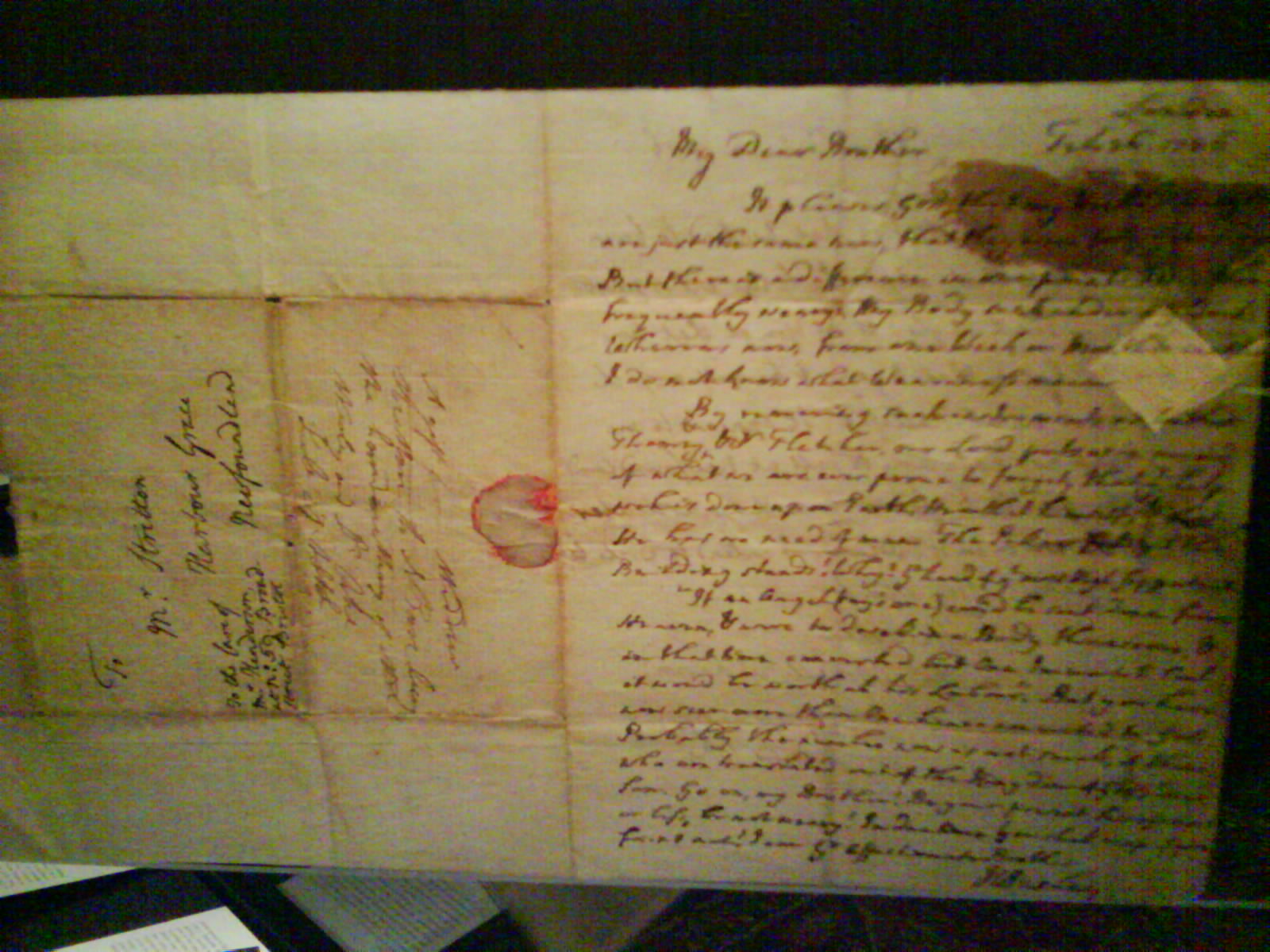
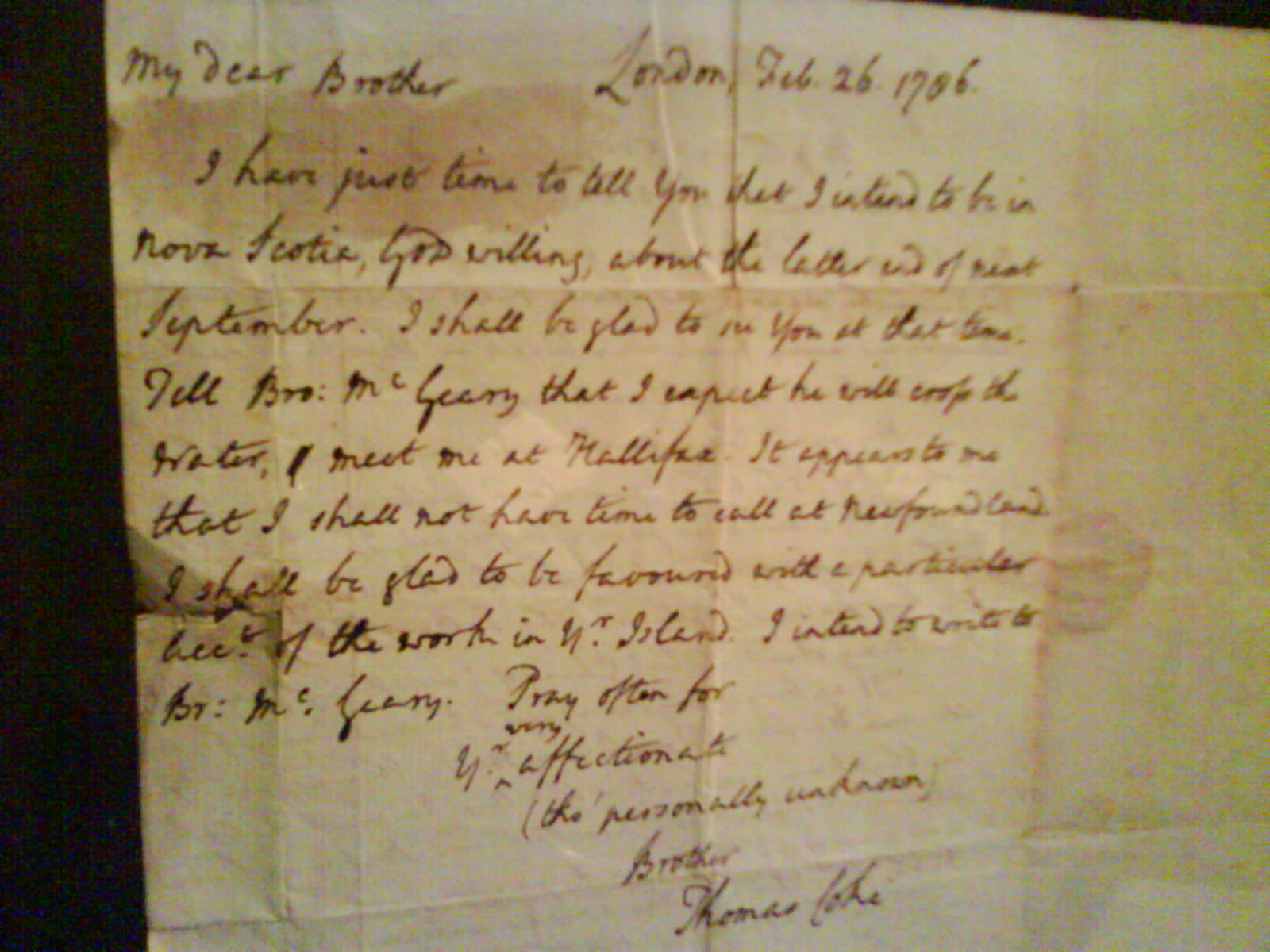
The first picture is the one by Wesley and the second is the one written by Coke.

Bridwell also has a copy of the Minutes that was given to a “fellow laborer” which was, I believe, the practice for itinerant preachers, they were given a copy of the minutes with an inscription like the one pictured, signed by John Wesley. This one is dated 1789, so Wesley would have been about 86. Here is a picture of the Minutes signed by Wesley:
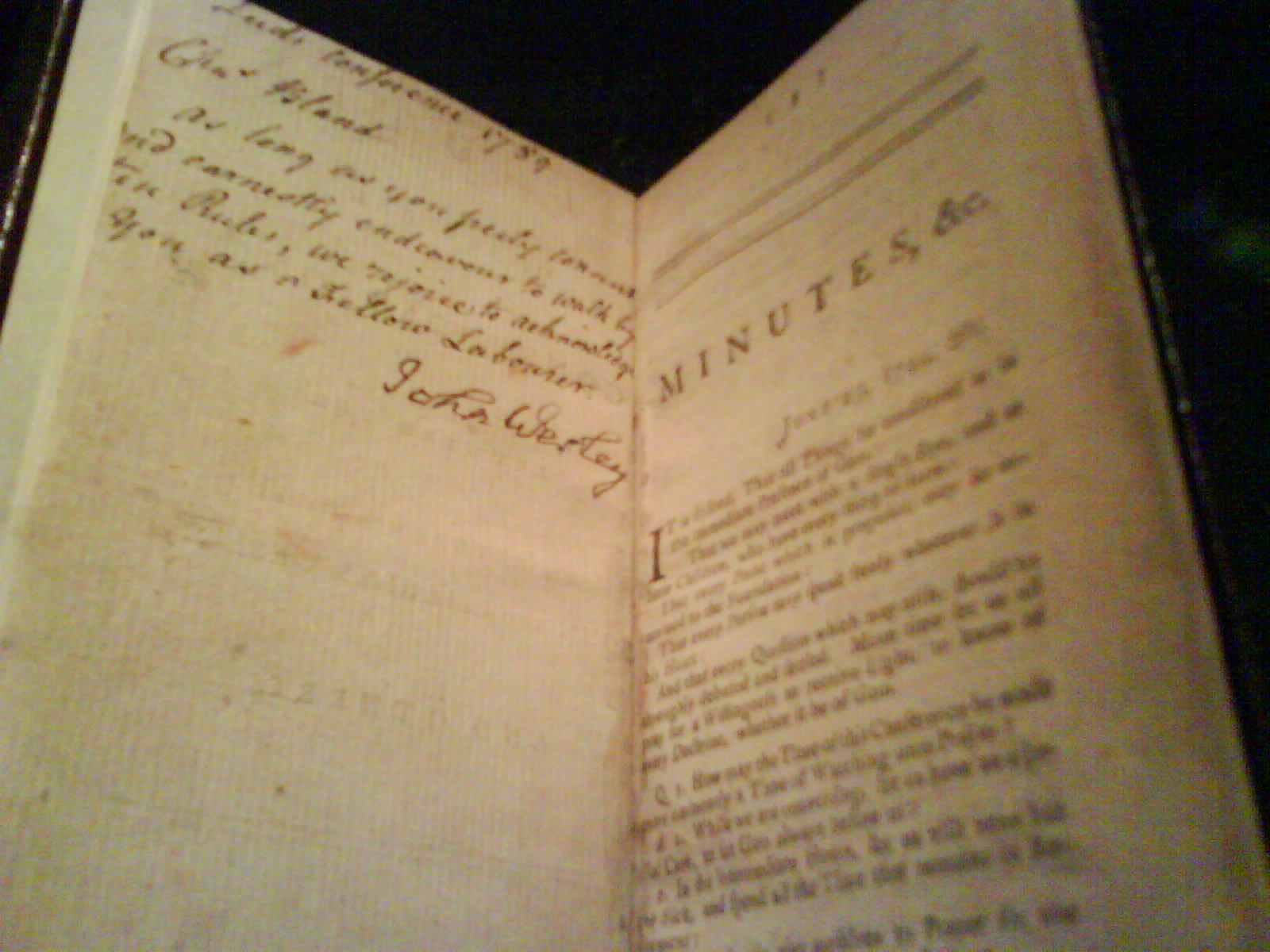
Now isn’t history fun and exciting?!? (Note: You should be able to click on each picture to see a larger version.)

Evangelical Enchantment and Disenchantment – Hempton Lectures Part I

Dr. David Hempton gave two excellent lectures the beginning of this week here at SMU. Both of his lectures offered glimpses into his forthcoming book, Evangelical Disenchantment: Nine Portraits of Faith and Doubt. Intereestingly, his lecture series was titled: Evangelical Enchantment and Disenchantment, so I was somewhat surprised to notice that the title of the book so clearly draws your attention to one side of what he focused on in his lectures.

Dr. Hempton’s first lecture was titled “Culture Wars: George Eliot and Fundamentalism.” In this lecture Hempton look at the author Mary Ann Evans, whose pen name was George Eliot, and her relationship with evangelicalism. Hempton discussed three aspects of evangelical enchantment that initially appealed to Eliot: the offer of a fresh start (the new birth), disciplined spirituality, and mobilization and transformation by lay agency and an emphasis on hymn singing. Hempton’s discussion of Methodist hymnody, in particular, caught my attention. He argued that the 1737 Hymnbook that Wesley published in Georgia was probably the first hymnbook published in America. He also discussed at length the importance of the 1780 edition.

The symbol of Eliot’s disenchantment was Rev. Cumming who Hempton compared to a modern day Hal Lindsey or Tim LaHaye. Eliot despised the lack of love that she saw in Cummings ministry and his rather gleeful proclamation that others were going to hell.

One of the primary themes I gleaned from this lecture was that the closer evangelicalism came to dogmatism and exclusivism, the more disenchanting it was to the folks in Hempton’s study.

Hempton’s Second lecture was titled “Artists in Revolt: Vincent Van Gogh and James Baldwin.” I will try to post a brief summary of that lecture and some further thoughts in the next few days.

Crazy Day

Here is what my day has looked liked so far today:

9:00 A.M. to 11:20 A.M. Seminar Presenter for Philosophy of Religion

11:30 – 12:50 Attended Lecture by Dr. David Hempton on Evangelical Enchantment and Disenchantment

1:00-4:10 History of Doctrine Class

So, from 9:00 – 4:10 I went outside for about 5 minutes to eat a peanut butter and jelly sandwich.

And to top it off we have our first Graduate Student Colloquy with Dr. David Hempton at 7:00.

These are all great things that I am enjoying, but I am tired! I am guessing I will sleep well tonight.

(I will try to post take home points from Hempton’s lectures in the next few days.)

Kimball Reviews Religulous

Tags

,

Dan Kimball has a thoughtful review about Bill Maher’s new movie “Religulous” on his blog. I often enjoy Kimball’s posts and wanted to pass this one on to you. I don’t watch a whole lot of movies, so I don’t know that I will get around to watching this one, but Kimball raises some very important questions. And I really appreciate that for him the result is being energized for ministry. You can read his post here.

Acts 2 Young Adult Sunday School Class

Tags

, ,

I began teaching a new Sunday School class at Highland Park United Methodist Church in Dallas, TX called Acts 2. The class was created to try to reach out to folks in their 20s and 30s. We welcome singles and couples. The class met for the first time yesterday morning with about 25 people showing up. About half of the folks were graduate students and the other half were young professionals. It also seemed like it worked out that about half were married and half were single.

In the class we hope to practice the kind of community that the early Church created as seen in Acts 2:42-47. So, we hope to devote ourselves to studying Scripture, fellowship, breaking bread, and prayer. We are especially focused on connecting head knowledge with heart knowledge during our time in class. We hope that we will learn not just information, but how to put our beliefs into practice. We are also focused on having an active fellowship outside of our time on Sunday morning. Some of the leaders in the class are already planning several activities. We hope this will be a place where young professionals and graduate students will be able to find a community that will help them become deeply committed Christians.

If you live in the Dallas area and are a young adult looking for this kind of community, we would love to have you join us. We meet at 9:30 am in room 256 in Highland Park UMC.

David Hempton Coming to SMU Perkins

Tags

,

David Hempton, who is the Harvard Divinity School Professor of Evangelical Theological Studies, will be on campus here at Perkins School of Theology next week. Dr. Hempton will be giving two lectures on the them of “Evangelical Enchantment and Disenchantment” on Monday October 6th at 7:00 P.M. and on Tuesday October 7th at 11:30 A.M. The title for his Monday lecture is “Culture Wars: George Eliot and Fundamentalism” and his Tuesday lecture is titled “Artists in Revolt: Vincent van Gogh and James Baldwin.” Both lectures will be given in room 120 of Highland Park United Methodist Church and are open to the public.

Dr. Hempton’s most recent book is Methodism: Empire of the Spirit, which I highly recommend.

If you are in the area, you should be sure to check out Dr. Hempton’s lectures.

Q: Are Ye Able? A: No!

Tags

I was recently a part of a wonderful worship service. Unfortunately, it was interrupted by the hymn “Are Ye Able” (#530 in the United Methodist Hymnal). The hymn was sung in a setting where people should have been more aware of the theology that is being expressed by the hymn, but people seemed to be unaware of what they were singing.

Here is the first verse:

Are ye able, said the Master, to be
crucified with me? Yea, the sturdy dreamers
answered, to the death we follow thee.
Lord, we are able. Our spirits are thine. (etc.)

It gets worse in verse three:
Are ye able, when the shadows close
around you with the sod, to believe that spirit
triumphs, to commend your soul to God?
Lord, we are able…

As one of my seminary professors succinctly put it, this is heresy. Christians have long understood a basic part of the gospel message to be that we are not able to save ourselves, we are saved by God’s astonishing, undeserved grace. Jesus came to seek and to save the lost. So, the basic problem with this hymn is that every time the hymn asks “Are ye able?” the answer the hymns gives is “yes,” but it should be “No!” We are not able. But the good news is that God is able.

Frankly, the idea that when we die, we are able to commend our souls to God is nearly as far as we can get away from the Christian understanding of salvation by grace through faith. “It is the gift of God and not by works, so that no one can boast.”

The next time the United Methodist Church revises the Hymnal, I would be delighted to discover that this hymn was no longer included in our hymnal.

We are not able, it is not about us or our ability. May we quit singing songs that help us feel more comfortable in our own sufficiency.

Great Post, Definitely Read This

Tony Steward has a great post that is prompted by the realization that guys often miss opportunities to hold one another accountable for growing in their faith. In hopes of rectifying this, or at least providing a way forward, he offers a list of questions that guys should ask each other. I commend this post to you, but more importantly, I commend the practice of having real conversations with others about your relationship with God and your relationships with others.

Death Is Dead

Tags

, ,

Yesterday, I turned in my first paper for my History of Doctrine class. The PhD students in the class have to write five preceptorial papers and one major research paper. The readings for the paper were Athanasius’ On the Incarnation and Gregory of Nyssa’s An Address on Religious Instruction. In my paper I focused on Athanasius and Gregory’s discussion of the resurrection and how Christ’s resurrection impacts the meaning and significance of death for Christians. During my time as a local pastor, I was often frustrated by the discrepancy between what I believe Scripture says about life after death and what many people in my congregation believed about life after death. This was one of the main areas where I tried to graciously communicate the good news of the gospel, in hopes that we would allow the gospel to transform our understanding of life, death, and life after death. In any case, the paper itself follows if you are interested in reading it… Continue reading