• About Me

Kevin M. Watson

Kevin M. Watson

Category Archives: Holiness

John Wesley’s Theology: A Great Question (and Better Answer) about Band Meetings

13 Tuesday May 2025

Posted by Kevin M. Watson in Accountability, Christian Living, Holiness, Methodist History, Teaching, Wesley

≈ Leave a comment

Tags

Band meeting, Bible, Christianity, faith, God, Jesus, John Wesley, Methodism, Methodist, New birth, sin, small groups, Wesley

I want to share one of my favorite memories from teaching this semester.

I had the privilege of teaching The Theology of John Wesley, which is one of the core classes at Asbury Theological Seminary this spring. Every student, regardless of degree, must take The Theology of John Wesley to graduate with a Master’s Degree. This is one of the ways Asbury anchors its identity and resists institutional drift. And I love it!
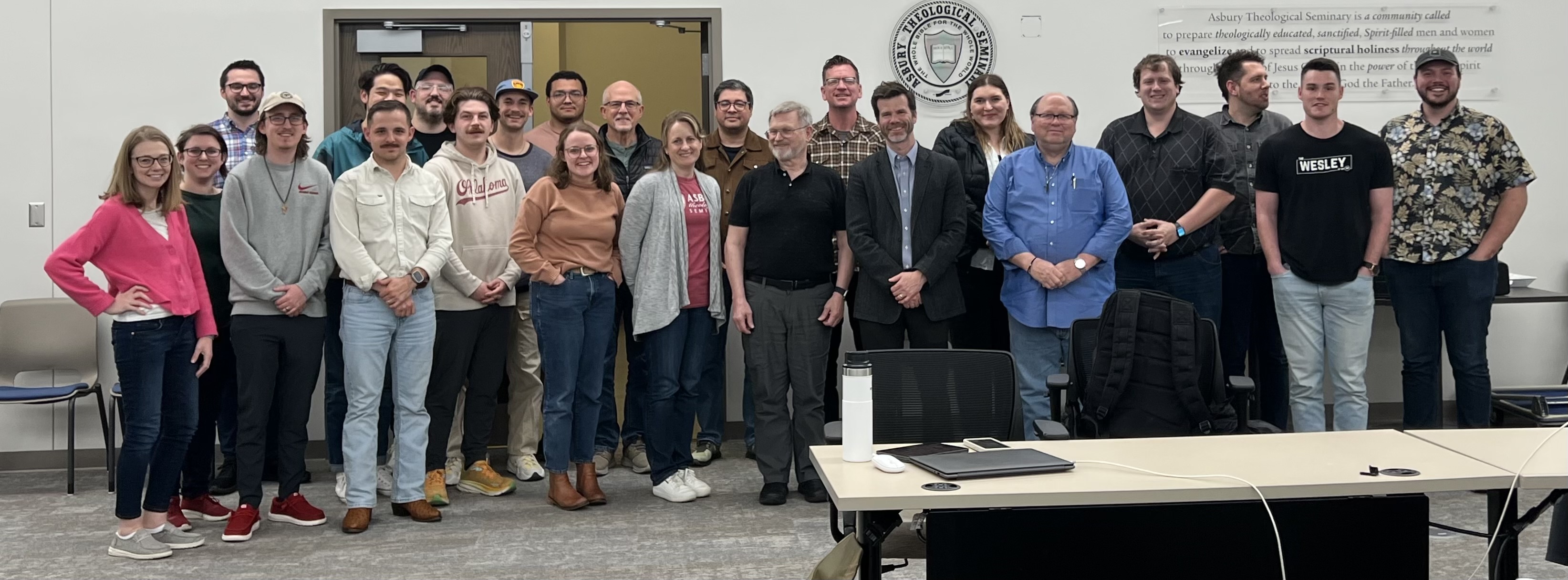
The class also gave me the opportunity to re-read core texts on John Wesley’s theology. First, we read sixty (yes, 60, not 6) of John Wesley’s sermons, including all of the original Standard Sermons. (Whether you want 44 or 52 in the list, they are all in the Collins and Vickers edited volume of Wesley’s sermons!) And we read my colleague Professor Kenneth J. Collins’s John Wesley: A Theological Journey and The Theology of John Wesley: Holy Love and the Shape of Grace. These are both masterful!

The class is a deep dive into Wesley’s theology. It is thorough and has been expertly crafted through decades of experience. I taught the class exactly the way it has been taught by those who have gone before me this semester. I had a blast because I was able to teach in an area I really enjoy teaching. And I was able to continue learning and growing as a follower of Jesus Christ and as a teacher.

Ok, so here is the memory I wanted to share:

One of the places there is always lively discussion, if students are tracking and understanding the material, is around John Wesley’s conviction that one who has experienced justification and the new birth does not commit outward sin. This is based on John Wesley’s reading of the canon of Scripture, particularly passages like 1 John 3:7-10:

Little children, let no one deceive you. Whoever practices righteousness is righteous, as he is righteous. Whoever makes a practice of sinning is of the devil, for the devil has been sinning from the beginning. The reason the Son of God appeared was to destroy the works of the devil. No one born of God makes a practice of sinning, for God’s seed abides in him; and he cannot keep on sinning, because he has been born of God. By this it is evident who are the children of God, and who are the children of the devil: whoever does not practice righteousness is not of God, nor is the one who does not love his brother. (ESV)

Collins brilliantly summarizes this in John Wesley: A Theological Journey:

Justification delivers from the guilt of sin, regeneration from its power or dominion, and entire sanctification from its being. Unfortunately, these distinctions are often neglected in contemporary Methodism where a decided “shift” has taken place; that is, freedom from the power of committing sin is attributed not to the new birth, as it should be, but to Christian Perfection, with the result that freedom from the being of sin is then relegated to the afterlife and glory. (190)

The conversation in class around freedom from the power of sin in regeneration led to a great question. I reached out to Professor Collins to get his perspective and his response was so good I asked for his permission to share it with my students and then to share it with all of you here. Here is how I framed the question:

How do I best talk to students about the correct definition and understanding of the new birth in connection with the band meeting, which both has a prerequisite of the new birth (and more), and weekly questions connected to sin.

I.e., if a students says, If someone does not commit outward sin after they receive justification and the new birth, why are the band meeting questions focused around sin? (I.e., “What known sins have you committed since we last met?”)

Here is Dr. Collins’s reply:

First of  all,  given the small numbers of people in the band meetings there may not be many responses to the weekly, sin-probing questions among the children of God, but there will likely be at least some responses over time.  Real Christians do at times break faith and commit sin of the high hand, so to speak.  The way forward then would be and must be one of repentance, of doing the first works afresh.  So then, when Wesley affirmed that a born again believer is free from the power and dominion of sin (“The Marks of the New Birth,” “The Great Privilege of Those that are Born of God”) he  was not teaching that real Christians would never sin again (a common misunderstanding among my students) but that Christian believers would have grace sufficient to remain faithful and to walk in a trusting and accountable way in the graces of regeneration.   How do we bring all of this together?  How can we summarize this basic and precious gospel truth which Jesus Christ, himself, affirmed (John 8:34-36)  and which John Wesley repeatedly taught?  I offer the following summary of the several elements here, though this language is not Wesley’s but my own.   However, I do believe that such language captures Wesley’s basic meaning.  And so here goes:    “Willful, intentional sin,  breaking faith with Christ,  should be the grave exception in the Christian life and not the rule.”  Our problem today, however, in American Christianity in general, and even at times in Methodism in particular,  is  that we have made sin the rule and grace the exception.  We need to turn this upside down.   Jesus Christ died for far more than to leave people in the bondages of which they are ashamed. 

Second, I think the very great value of  such questions for the saints that played out in the band meetings during Wesley’s lifetime is that they are a wonderful means of grace that ensure that responsibility and accountability will remain in place.   Think of  band members, for example, who are sorely tempted during the week but who in the midst of  that temptation are reminded by the Holy Spirit, the Spirit of Truth,  that they will have to confess such a sin (if it is committed) before several trusted and beloved others in just a few days.   At that  point the power of the temptation is broken (1 Cor. 10:13) by the light of the prospect of upcoming fellowship,  accountability and love.   That’s precisely the point!   In other words, the questions of the band meetings are themselves a wonderful means of grace, used by the Holy Spirit,  as a means by which faithful Christian discipleship is strengthened and lived out to the glory of God.  Put another way, evil and sin love the darkness; however, Wesley made sure that the infrastructure of Methodism in general, and the band meetings in particular would be flooded by an abundance of light in the form of relationship, accountability and the richest love.   In short, those questions are both precious and necessary  for serious Christian discipleship. 

So good!

Want to know more about the band meeting? Scott Kisker and I wrote a book that is designed to reclaim this practice. Check it out here.

Join My Seminary Course in Wesleyan Discipleship in Tulsa [January 2025]

24 Thursday Oct 2024

Posted by Kevin M. Watson in Accountability, Class Meetings, Holiness, Methodist History, Ministry

≈ Leave a comment

Tags

Band meeting, Christian formation, class meeting, discipleship, John Wesley, Methodism, Methodist, small groups, Wesley

I am teaching a course on Wesleyan Discipleship in Tulsa as a January-Term course at Asbury Theological Seminary this coming January (2025). You should join me! 

What is the course about?

Here is my description of the course:

Wesleyan Discipleship explores the history, theology, and practice of discipleship through a Wesleyan lens. Particular attention is given to the role of communal formation in eighteenth-century Methodism. John Wesley’s theology of discipleship is explored, along with a variety of aspects of Christian formation in community in early Methodism. Particular attention is given to the way Wesley’s theology of social holiness was expressed in early Methodist small groups, especially the class meeting and the band meeting. Students will apply the historical and theological understanding of Wesleyan discipleship to contemporary ministry contexts.

Why I am FIRED UP about this class:

This class will have an intensive on site here in Tulsa from the evening of January 16th through January 18th, 2025. I LOVE the time together with students at intensives! This class beautifully lends itself to teaching in this format. 

Hybrid classes have 20 hours of in-person instruction over 2.5 days. (The rest of the course requirements are met through online engagement and completion of online modules.) It is intense! But I have also found, perhaps surprisingly, that it is also an opportunity for a spiritual retreat for students. 

The in-person experience gives us the opportunity to worship together. We will start the class by attending worship at the Thursday evening service at Asbury Church, where Rev. Andrew Forrest will be preaching. Andrew is an exceptionally gifted preacher of the Scriptures and a brilliant communicator. I love being able to start class off by tangibly connecting the church and academy by walking across the parking lot to go to worship.

We will also have an Asbury Theological Seminary – Tulsa chapel service for the class and students in the area on Friday January 17.

I will get to spend hours talking about my scholarly passion – the importance of community and connection for the Christian life. I love getting to teach students and engage their questions around these topics!

And most important, we will spend time talking about and practicing ways to reintroduce these tried and tested methods that gave Methodism its name.

At the end of the course, students will have the kind of knowledge gain you would expect from a typical seminary course. But they will also have experience participating in class meetings, experiencing small group dynamics, and reflecting on various challenges and opportunities of leading small groups like class and band meetings.

I think of this course as like a laboratory. We will learn a lot about the concepts, but we will also engage them in a hands-on way. In a laboratory you can not only experience a class meeting, but you can also talk about your experience of a class meeting. In my view, this is essential for becoming an expert practitioner. You need not only a theoretical framework and some practical experience, but you also need a place to talk about your experience so you can acknowledge, address, and overcome obstacles and challenges.

I am more confident than I have ever been that groups like the Wesleyan class meeting and band meeting will be at the center of Christian discipleship in these new and strange times we are entering.

These intensives are aptly named. They are not easy. J-term is not a short cut. In fact, it is a three-week academic sprint. My goal is to maximize the 20 hours we get to spend together to suck the marrow out of the class and be as fully equipped to make disciples of Jesus Christ in the contemporary church as possible. 

I want students who come hungry and ready to learn and grow. And that is what we are seeing here in Tulsa. It is SO FUN!

How is the course being taught?

I am teaching this course as a hybrid course at Asbury Theological Seminary at our Tulsa, OK Extension Site (housed at Asbury Church).

What is a January-Term, or J-Term, course?

A J-Term course is a full three credit course that is offered entirely within the month of January. This coming J-Term will start on January 2, 2025 and conclude on January 24, 2025.

What is a hybrid course?

A hybrid course is a course that has parts that are online and parts that are in person. This specific course will have four online modules based on four main sets of reading, students will write a reflection paper that summarizes the content of the reading, critically engages it, and applies it to their own ministry context.

The in-person part is January 16-18, 2025 at Asbury Church’s Development Center in Tulsa, OK. The in-person meeting will be from 6:00pm-9:00pm January 16, 8:30am-5:30pm January 17, and 8:30-5:30pm January 18. The in-person meeting is required for completion of the course. It is also the highlight of the entire course!

Does this course meet the Wesleyan Discipleship and Spiritual Formation requirement for ordination in the Global Methodist Church?

The Convening General Conference of the Global Methodist Church, which met a few weeks back, updated the educational requirements for ordination. And one of the changes that was made was the addition of a course called “Wesleyan Discipleship and Spiritual Formation.” I don’t mean to brag, but I believe this course hits the bullseye for what the GMC is looking for here! So, yes, if you are seeking ordination in the GMC, this course meets the Wesleyan Discipleship and Spiritual Formation course requirement. You can take this course and meet all GMC ordination requirements with either an Asbury Theological Seminary M.Div. or our 60 credit (exactly 20 courses) Master’s in Christian Ministry (MACM).

Should I take this course if I am not in the Global Methodist Church?

Yes! 

If you want to help your church more effectively make discipleship of Jesus Christ, this course is for you. 

I am passionate about Wesleyan Discipleship, not because I am most passionate about John Wesley, but because I believe the Wesleyan theological tradition has a proven track record of excellence in intentional and effective disciple making. We do well to learn from experts who have gone before us. This course is not specifically for students from any one denominational tradition. I mentioned the GMC above only because there is obvious relevance for the GMC because they just made this exact course a required course to be ordained an elder in the GMC. (Your church or denomination should too. This topic really is that essential for succeeding in the 21st century church.)

Can I take this course if I am not an Asbury Theological Seminary student?

Yes! The easiest way to do this would be to apply now to become an Asbury Theological Seminary student. We have a variety of degree programs, and I would be thrilled to talk to you about any of them! There is time to apply now and start this January.

If you are interested in applying to Asbury Theological Seminary or for this course in particular, reach out to me here (scroll down to the bottom of the page) and I will get back to you soon. Be sure to include your email so I know how to reach you. 

Not ready to apply to one of our Master’s degree programs? You may be able to apply to take the course as a non-degree seeking student. You also may be able to audit the course. Both require an application and auditing requires permission from the instructor. For either of these, reach out to me at the link immediately above.

I am open to considering some auditors. Auditors do not receive any academic credit for the course and do not turn in any assignments. They are given permission to sit in on the in-person part of the class and participate in class discussions and activities. However, I will only open the class up to auditors if there are open seats after the registration period closes. (I would assume auditing the course would not satisfy denominational ordination requirements, but you should check with your own denominational leaders.)

What is the official title of the course?

The course is cross listed as a Spiritual Formation course and a Theology course. So you can sign up for either TH650 Wesleyan Discipleship or SF650 Wesleyan Discipleship.

What are the assigned readings in the course?

Students will read a few short essays from John Wesley. And they will read these three books (affiliate links):

The Class Meeting: Reclaiming a Forgotten (and Essential) Small Group Experience, Kevin M. Watson

The Band Meeting: Rediscovering Relational Discipleship in Transformational Community, Kevin M. Watson and Scott T. Kisker

Real-Life Discipleship: Building Churches that Make Disciples, Jim Putman

I cannot wait for this class! I hope to see you here in Tulsa January 16-18, 2025.

Doctrine, Spirit, and Discipline: A History of the Wesleyan Tradition in the United States – Book Release

25 Tuesday Jun 2024

Posted by Kevin M. Watson in Book Review, Holiness, Methodist History, Wesley

≈ Leave a comment

Tags

Book Review, John Wesley, Methodism, Methodist, Wesley

After working on this book for seven years, my new book Doctrine, Spirit, and Discipline: A History of the Wesleyan Tradition in the United States is officially released.

I am so thankful to the Lord that this day has arrived!

If you haven’t picked up a copy of the book, I hope you will today!

Here is the summary of the book from the dust jacket:

An expansive, substantive history of the Wesleyan tradition in the United States, Doctrine, Spirit, and Discipline offers a broad survey of the Methodist movement as it developed and spread throughout America, from the colonial era to the present day. It also provides a theological appraisal of these developments in light of John Wesley’s foundational vision. Beginning with Wesley himself, Watson describes the distinctiveness of the tradition at the outset. Then, as history unfolds, he identifies the common set of beliefs and practices that have unified a diverse group of people across the centuries, providing them a common identity through a number of divisions and mergers. At a time when sweeping changes continue to transform Methodism and the pan-Wesleyan movement, Watson shows that the heart of the Wesleyan theological tradition is both more expansive and substantive than any singular denominational identity.

For more information check out the post I wrote here.

Zondervan has created a fantastic page for the book here.

Buy the book at Amazon here (affiliate link) or through Zondervan directly here.

I have been interviewed on several podcasts about the book. I will update interviews as they go live.

I was on Art of Holiness with Rev. Dr. Carolyn Moore. Check it out here.

I was on Spirit & Truth with Rev. Dr. Matt Reynolds. Check it out here.

The interest in this book has been so encouraging to me. Thank you so much to each of you who have bought the book. I am grateful! 

New Book Announcement: Doctrine, Spirit, and Discipline

11 Tuesday Jun 2024

Posted by Kevin M. Watson in Book Review, Holiness, Life, Methodist History, Wesley

≈ 2 Comments

Tags

Book Review, John Wesley, Methodism, Wesley

On June 25, 2024 Doctrine, Spirit, and Discipline: A History of the Wesleyan Tradition in the United States will be released. And I need your help!

In some ways, I have been working on this book my entire scholarly career. I started this project in earnest seven years ago. This is the most ambitious writing project I’ve undertaken. I believe it is also the most important book I’ve written.

Why?

One of the main problems I have been trying to solve throughout my work in the church and the academy is identifying the core content of the Wesleyan/Methodist theological tradition. What does it mean to be Wesleyan or Methodist?

My sense has been that many different parts of the Wesleyan tradition have been undergoing a crisis of identity for various reasons. Some have pursued cultural respectability at the expense of coherence and clarity. Others have moved away from the riches of their heritage in the Holiness Movement to generic evangelicalism. Much more could be said on this.

In Doctrine, Spirit, and Discipline, I argue that there is an identifiable theological tradition running through the Wesleyan/Methodist theological tradition in the United States. It was clearly articulated by John Wesley in the beginnings of Methodism in Britain. And this theological vision, along with the method that gave it its name, was embraced explicitly by the founders of the first denominations founded in the United States. 

My sense is that the Wesleyan theological tradition is in a time of both fragmenting and realigning. I don’t think we can know yet how things are going to sort out. There are even very good reasons to think that denominational identity will not have the purchase in the future that it has had in the past.

With all this change and uncertainty, there is one thing of which I am confident: I am convinced the founding vision of John Wesley and the first Methodists is as relevant for our day as it was for theirs, if not more so. 

Before we can do anything else, we need to know who we are. Getting clear of our identity requires knowing our history. We need to know where we’ve come from.

Doctrine, Spirit, and Discipline is my attempt to tell the story of the Wesleyan tradition in the United States in a way that intentionally, though I am sure imperfectly and incompletely, tells the story through a broader lens than it has been typically told.

I also do the best that I can to wrestle with the issues and challenges facing the church today. I do this because I am convinced that our past is an essential guide for a better future.

I have been humbled by the endorsements this book has received. This book has been described as “the definitive history of the Wesleyan movement in the United States.” Here are a few endorsements, you can read more at the landing page Zondervan has created for the book.

“Kevin Watson’s newest book, Doctrine, Spirit, and Discipline, is not just the latest history of Methodism in America. Rather, it’s a tour de force. Previous historical accounts have viewed the institutions that resulted in the United Methodist Church as the truly legitimate Methodist trajectory, while offering just a fleeting look at other Wesleyan denominations. But rather than seeing African American, Holiness, and Pentecostal church bodies as schismatic and somewhat peripheral to the Methodist story, Watson treats them as central. Why? Because these groups, though smaller in size than better-known, larger institutions (Methodist Episcopal/Methodist/United Methodist), often maintained Wesley’s theological foundation more consistently. Watson sees Wesley’s formulation of “doctrine, spirit, and discipline” as the “common foundation for a broad tradition”—not broad theologically, but broad geographically, ethnically, and denominationally. This book, then, is not only necessary reading for all American Wesleyans but also an essential corrective to the overall narrative of the Methodist legacy in the United States.”
—DOUGLAS M. STRONG, Paul T. Walls Professor of Wesleyan Studies, professor of the history of Christianity, Seattle Pacific University

“I was captivated on the first page of Doctrine, Spirit, and Discipline. Immediately the reader is taken into the early life of John Wesley with this theme developed through his own personal life and expanded as he leads this great awakening throughout England and then more thoroughly developed in the US. However, Kevin Watson does not shy away from the power struggles, the issues of slavery, and the divisions even to this present day. He gives very generous history of the Black church, the Pentecostal movement, the Holiness movement, and various denominations which comprise what is known as the pan-Wesleyan movement today. In all this it is obvious the themes that continue to hold this diverse group together from the beginnings of John Wesley. It is written in such a way that is inspirational and at the same time with a strong researched theological and historical foundation. This book is a treasure for the classroom, leaders in the pan-Wesleyan movement both lay and clergy, and those outside the movement to discover the strength of the doctrine, spirit, and discipline initiated by John Wesley that has been effective for some 250 years. Yes, a book for now and future generations.”
—JO ANNE LYON, general superintendent emerita, the Wesleyan Church

“A faithful witness to the people called Methodists in England and in America, this colossal volume expeditiously moves from Wesley to American Methodism and its extended branches to the current state of Wesleyanism today. Watson masterfully retells a well-chronicled narrative in terse, accessible, lucid prose, covering not just the contours of Wesleyan history with its highs and lows but also its various doctrinal developments and disputes and ecclesial divisions. The moral of the story, as indicated by the quote from which the title is taken, is that Methodism at its best is a blazing, fiery force of renewal and at its worst an inert, acculturated institution. Although coming in at nearly 500 pages, this volume is concise and highly accessible. Well-illustrated, highly detailed, and informative, Doctrine, Spirit, and Discipline is suitable for the classroom and will make a fine addition to any shelf of classic volumes on Methodist history.”
—PETER J. BELLINI, professor of church renewal and evangelization in the Heisel Chair, United Theological Seminary

“This book is destined to become the standard reference work for everyone who wants a better understanding of the Wesleyan tradition. More important, however, is that anyone who seeks the blessing of holiness in his or her own life will find inspiration and encouragement on every page. Churches that preach the life-giving message of sanctification, including the Salvation Army, owe a tremendous debt of gratitude to Dr. Watson for this outstanding work.”
—KENNETH G. HODDER, USA national commander, the Salvation Army

I need your help.

Please pre-order my book. There is much about the publishing world I don’t understand. One thing I do know is that pre-orders are crucial to a book’s success. You can pre-order the book on Amazon here (affiliate link) or directly through Zondervan here. Amazon has a pre-order price guarantee and books like this are typically discounted as they get closer to the release date. Zondervan is currently offering a 30% sale!

I don’t think I’ve ever made a direct request like this before. It would be a big help to me if you would place a pre-order for this book now. If you do, you can also get immediate access to chapters 1 & 2 by entering your email and book order number at the bottom of the page here: https://zondervanacademic.com/doctrine-spirit-and-discipline

I am so excited to see something I’ve been working on for so long finally be released. Thank you so much for your support!

Kevin M. Watson is Director of Academic Growth and Formation at Asbury Theological Seminary. He is anchored at the Seminary’s Tulsa Extension Site. He is also the Scholar in Residence at Asbury Church in Tulsa, OK.

What I Have Learned from the Salvation Army

08 Thursday Feb 2024

Posted by Kevin M. Watson in Holiness, Life

≈ 2 Comments

Tags

anointing, Christianity, Holy Spirit, Salvation Army, Sanctification

Last week, I had the privilege of speaking to the Salvation Army Officers of the Arkansas-Oklahoma Division on the theme of “Holiness unto the Lord.”

If you are not familiar with the Salvation Army’s structure, officers in the Army are the equivalent of clergy in most churches. So, this was like a retreat for all of the active clergy in the Salvation Army serving in Arkansas and Oklahoma. I love the schedule at Officer’s Councils (at least at the Divisions in the Southern Territory where I’ve been a guest). There are typically two sessions of worship and teaching in the morning and then the rest of the day is unscheduled. 

It is a blessing for pastors to have time away where they have time and space in the schedule to truly rest, relax, and reconnect with each other. This is a rare gift and I’ve not experienced that kind of intentionality given to actual rest, rather than busyness and business at this kind of gathering.

The Salvation Army also does hospitality exceptionally well. My goodness! Unpacking this would be an entire post of its own. I’ll just give one example: one time the Army not only flew my entire family to be with me because it was my daughter’s 10th birthday, they also ordered a special cake and balloons that were waiting for her when we arrived. They have loved us so well!

I want to share a bit about my connection to the Salvation Army and what I have learned, so far. This is a bit vulnerable for me to share. I am not intending to boast in Kevin here. I am intending to give glory to God. I also hope it may help some of you recognize when the Lord provides similar places of blessing in your lives.

The Lord has blessed me with a special connection to the Salvation Army. It started at a moment when I did not expect it all. And it has truly been a sheer gift from the Lord.

The first invitation I received to speak at an Army event was as the Commencement speaker for Evangeline Booth College, in Atlanta, GA at the beginning of the summer in 2021. I went to that event very naïve. I knew a little bit about the Salvation Army. I knew, for example, that they were founded by Generals William and Catherine Booth in England. I also knew that they had strong connections to the Wesleyan-Holiness tradition and that their impressive social work came out of this heritage.

I also knew that Ezekiel Elliott sometimes jumped into a giant red Salvation Army kettle after he scored a touchdown on Thanksgiving back when he played for the Cowboys.

I didn’t know much more than that, however, when I spoke to the Cadets (students) who were graduating from Evangeline Booth College.

This first Salvation Army event came at a strange time in my life. I had just resigned a tenured faculty position at Candler School of Theology at Emory University. After stepping away from this position, I didn’t think I was going to be doing much of this kind of speaking anymore. Something about that moment brought focus, freedom, and courage to speak very candidly about the need for the Army to remember that its identity is first and foremost an army of salvation through Christ. They are also a people committed to holiness and full salvation. I pressed them to remember that they were raised up to be an intentionally strange people and that they should not lay aside the things that set them apart from the world to hope to receive the world’s approval.

For me personally, it felt like one of the most bold and true talks I had ever given. I think a piece of this was that I kind of assumed this was a one-off opportunity just before we moved away from Atlanta. 

It can be easier to be bolder with strangers than with friends.

In ways I could not have known, however, the Lord blessed me by giving me favor with the leaders of the Southern Territory who were there that day. I did not have the opportunity to visit with them at length at Commencement. But, that event led to further opportunities to minister within the Salvation Army and get to know its leadership.  

Since speaking at Evangeline Booth College, I have spoken at Bible Conference in the summer of 2022, Officer’s Councils in three different divisions (Kentucky-Tennessee, the Carolinas, and Arkansas-Oklahoma) and at a Holiness week at the College for Officer Training in the Eastern Territory in Suffern, NY.

Every single one of these experiences has been a tremendous blessing to me.

Last week brought some things together for me that I want to share:

First, I want to publicly thank the leadership of the Salvation Army for loving me and my family so well during a challenging time for us. Lt. Colonels Tom and Julie Louden, currently serving as Divisional Commanders for Kentucky and Tennessee, first invited me to speak at Evangeline Booth College’s Commencement. They also prayed for us many times throughout this season and even sent a care package to my kids at Christmas in 2022.

Just as encouraging to me, I have been surprised in the best way by the wisdom and moral courage I have found among many of the leaders of the Salvation Army, especially in the Southern Territory, where I have had the most engagement. I have often been looking for wisdom, moral courage, and leaders who provide godly spiritual covering for the people under their car. I have seen that in the leadership of the Southern Territory in ways that have strengthened and encouraged me.

Finally, I want to share what I think could most easily be misunderstood as boastful. But I am going to risk it in hopes of giving glory to Jesus Christ and his work in my life. I also want to share it here in case it helps you recognize the places of abundance in your life.

The Salvation Army has been for me what a dear friend of mine calls a “land of my anointing.” I did not see this coming or expect it at all. But again and again I have come back from Salvation Army events and said to my wife, “I feel like the Lord prepared this particular people for exactly what he has put in me.” I am learning to simply trust and receive this as a gift from the Lord. 

When I minister in Salvation Army contexts, I consistently receive feedback that things I’ve sensed or said have landed, often beyond what I could have expected. I think every time I’ve spoken at an Army event I have received testimony that I have spoken prophetically in ways I didn’t anticipate. This has been humbling to me because it has not come from my own wisdom or hard work. It has simply been the Holy Spirit’s work moving to bless his people.

These experiences have helped me learn to pay attention and intentionally listen for the Spirit’s guidance and direction anytime I preach or teach. It has been so much more fun working with the Spirit than trying to do it on my own!

I have seen the Lord move in powerful ways renewing the strength of officers to recommit to the fight for souls, press into deeper relational connectedness particularly through reclaiming Wesleyan class and band meetings, and even blessing officers with the gift of entire sanctification. I’ve also seen God’s heart for officer families.

I have been able to invite people to receive the gift of entire sanctification in multiple contexts. And the Lord has moved in miraculous and transforming ways. At the last Salvation Army event, I heard a powerful testimony to entire sanctification just before I preached on 1 Thessalonians 4:1-6 and 5:23-24. I then invited people to receive the gift of entire sanctification in faith that Jesus has already done everything that is needed to break the power of canceled sin in their lives. 

I used a specific image that was given to me by the Spirit in the moment and multiple people testified that the Holy Spirit fell on them in a powerful way through that image. This was especially humbling for me because when the image was brought to mind, I did not like it. It seemed corny to me. But I offered it because I felt the weight of the Spirit on it. 

What a great reminder that the Lord knows so much better than I do!

Two people have testified to me that they received entire sanctification through the Spirit’s work at that session.

God is so good!

I am learning to gratefully accept that the Lord in his wisdom has made the Salvation Army a place of particular anointing in this season of my life. It has been fun and a joy.

I don’t know how long this season will last. I am aware that I am not in control of any of it. I just know it has been a blessing to me in a rough stretch. I am thankful for what I have seen the Spirit do over these last few years. I have learned so much and am grateful for all of it.

Is there a place for you that consistently seems to be synced up with the Holy Spirit? Where there always seems to be fruit beyond your expectations in a way that is clearly separated from your performance or achievement? Look for your land of anointing. Is there a place, a people, or a topic, where the Lord consistently brings his blessing to your work?

When you see it, receive it in humble and joyful submission to the Lord.

I know for me it has been a gift to see such a concrete sign of how God has intended to use the things he has put in me for his purposes even before I could have anticipated any of it.

To God be the glory!

The Next Methodism Summit II: Holiness – Reflections

01 Thursday Feb 2024

Posted by Kevin M. Watson in Holiness, Life

≈ 6 Comments

Tags

holy-spirit, Methodism

On January 19-20, 2024, a group of more than 70 scholars met in Alexandria, VA to discuss the doctrine of holiness and its ongoing relevance for the contemporary church. The gathering was remarkable to me because of its size, the focus on holiness itself, and the prerequisites for participation in the gathering:

  • affirm the historic creedal faith of the church
  • hold to traditional moral standards
  • embrace a Wesleyan theological vision

The purpose of the Summit was:

To craft a document designed for the faithful by leading scholars that clearly describes a Wesleyan view of holiness of heart and life. The teachings of John and Charles Wesley will provide the foundation for this document and serve as a uniting principle to guide our work. Of course, following the Wesley brothers’ direction, we will always look to scripture and the faithful interpretation of scripture within the Church’s tradition. This uniting principle will enable a large Wesleyan tent to find a common voice. Or to put it differently, the Wesley brothers make it possible for us – in all of our diversity – to write a document that can be endorsed by everyone from a high church Methodist to a Pentecostal and everyone in-between.

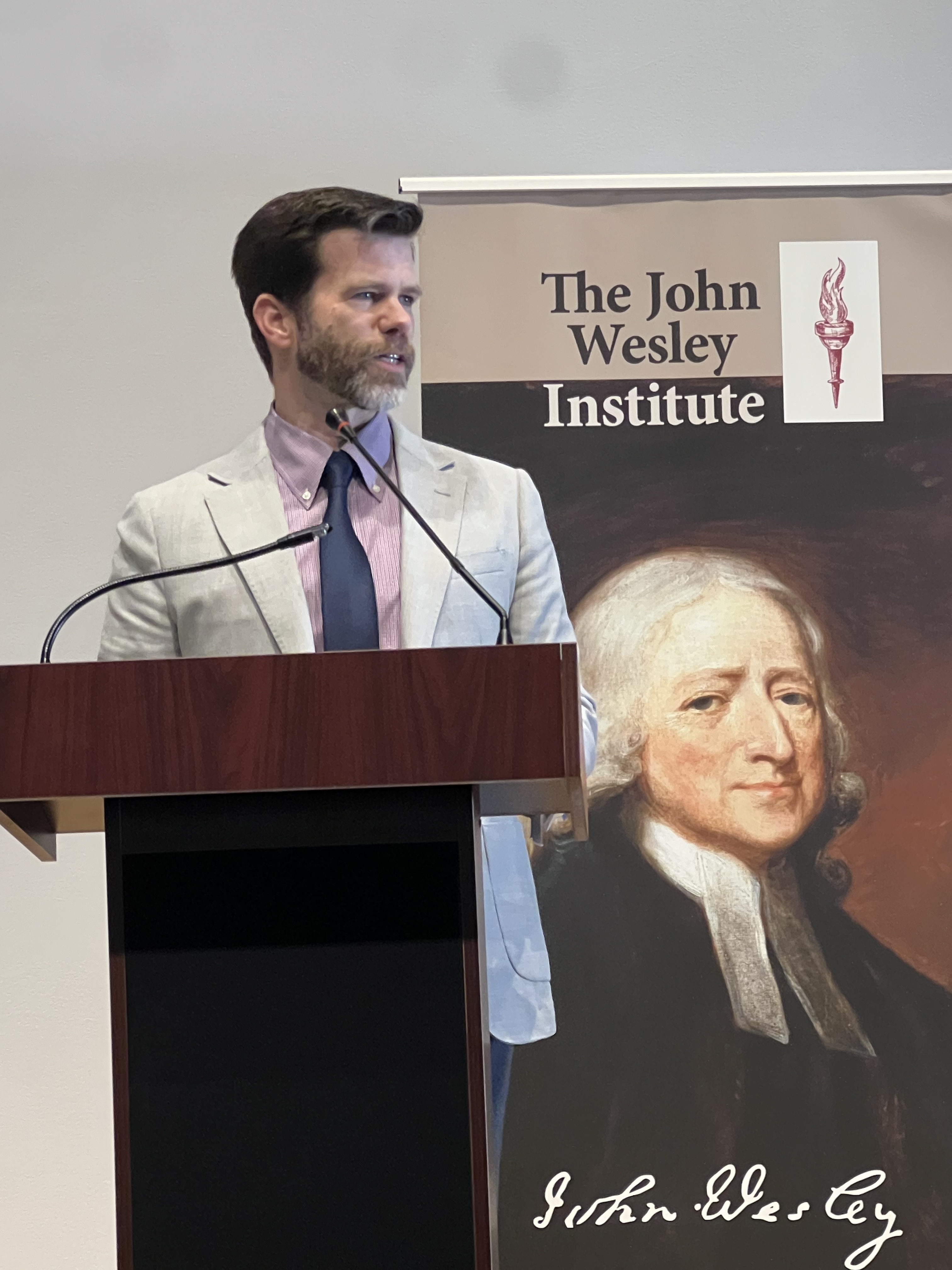
I was asked to give one of two keynote addresses at this gathering, Dr. Warren Smith of Duke Divinity School gave the other.

Here I am, mid-pontification.

Here are a few reflections from my time at this gathering:

First, the Lord has raised up a surprising number of conservative Wesleyan scholars who are willing to publicly be seen as such. This is surprising because most of us have come from institutions that were not trying to produce us. In fact, several come serve in contexts where there is pressure not to be associated with these kinds of gatherings.

I see this as a hopeful sign of God’s provision for the church.

Second, I was reminded of what I already know: Spiritual warfare is real and the Holy Spirit is alive and active. When I was initially asked to give a keynote at this gathering, I was excited and happy to accept. But as the day drew nearer and I began to work on my address, my preparation was difficult and unenjoyable in a way that was abnormal for me. To be candid, I was really dreading speaking at this gathering. This is probably because the last few years in the academy have been particularly challenging for me. More than that, I believe I was experiencing interference from the enemy. Added to that is the feeling that we aren’t supposed to talk about spiritual warfare or anything supernatural in academic contexts.

Let me say that I while I am sure there were those who disagreed with parts of what I said in my presentation, I did not experience any hostility from anyone at the Summit. On the contrary, I received words of affirmation and encouragement that were humbling and beyond anything I deserved. I was blessed to be surrounded by people who love well.

Third, there were a couple of interactions that felt healing and redemptive connected to some of the most painful times of my life in the academy. This was a completely unexpected and surprising gift to receive. I share it here because it reminded me of something I want to offer as an encouragement:

Suffering in the moment often feels even more painful because it seems pointless. There have been times I did the best I could to be faithful that increased suffering. This was the hardest for me to take when it led to suffering not only for me, but for my family. The Lord showed me at this gathering that God has used my witness in the past to strengthen other people. I had no idea. I don’t think we usually get to see these kinds of things, but it is such a blessing when we do! (And, of course, my suffering could also be because of bad decisions or mistakes I have made.)

Fourth, I think part of my dread going into the gathering was that I did not want to go to a dry academic conference where we could not be openly hungry for the presence of the Holy Spirit. The greatest blessing to me of the weekend was getting to see how many colleagues in the academy are hungry for more of the Spirit. On Saturday night, a Church of God in Christ bishop preached, Bishop John Mark Richardson, and he gave an invitation. Then, Dr. Cheryl Bridges-Johns gave a word of knowledge with a specific call to prayer. And in a room full of academics, there was a wonderful response to the move of the Spirit. People came forward to receive prayer. It was awesome!

Finally, this gathering pressed me to think more deeply about the distrust that exists between the church and the academy. I shared my conviction that I think this is understandable and largely rational by the church. During my time as a United Methodist, I think most seminaries did a better job saying that their purpose was to serve the local church for marketing purposes than they actually served the church. 

I have a lot of thoughts on this, some of which I am still working through. I may write more on this down the road. For now, I’ll just offer two questions that I think can help church leaders think through these things:

First: Does the institution tend to produce people who are more effective pastors than they were before they attended that institution? I don’t think you can overstate the importance of an established track record here in terms of thinking about what is most likely to lead to the best outcome for the church.

Second, has the institution taken stands that hurt them politically with any constituency that are in alignment with your values and commitments? If they have shown their hand, so to speak, at a cost to themselves, you can trust that this represents their true commitments, values, and priorities.

I am encouraged by the number of individuals the Lord has raised up who affirm basic Christian orthodoxy, are Wesleyan, and affirm traditional moral standards. I hope these men and women will guide the institutions where they serve to more faithfully serve the local church. Raising up the next generation of leaders for Christ’s church is the key reason seminaries exist. If they lose this first love, the church is right to cease supporting them.

God’s Inclusive Love Excludes Sin

12 Wednesday Feb 2014

Posted by Kevin M. Watson in Christian Living, Holiness, Ministry

≈ 6 Comments

Tags

exclusion, God, holiness, inclusion, sin

Do you ever read something and find yourself actually nodding your head in agreement, or responding to the author out loud? My friends and family will be relieved to know that I very rarely do this. Last night, however, I would have responded out loud when I read James Bryan Smith’s chapter “God is Holy” in The Good and Beautiful God. The only reason I didn’t was because I was reading the book while giving an exam and my students would have shushed me.

As I read this chapter, I found myself wishing that I could have every single Christian read it. The piece is excellent, not because it is new or edgy, but because it states basic Christian truth with profound clarity.

In the previous chapter, “God Is Love,” Smith emphasizes the scandal of God’s grace. God loves sinners “as they are, and not as they should be” (98). He further argues that it is not sin but self-righteousness that separates us from God (102). The chapter does a great job of emphasizing the good news that God’s love for us is constant, whether we are worthy of it or not. And this applies to everyone. (By the way, I highly recommend the entire book, as well as the other two books in the series.)

In the next chapter, Smith addresses a misunderstanding of the truth that God is love, and loves sinners with reckless extravagance: “God does not care about our sin” (116). Smith writes, “In our day you are just as likely to hear a person tell you that their god is a cosmic, benevolent spirit who never judges, does not punish sin and sends no one to hell. This ‘teddy bear’ god has become a very fashionable alternative to the wrathful god of days gone by” (116). The problem is that “the cushy, fuzzy god is neither biblical nor truly loving.” Here, Smith cites H. Richard Niebuhr’s well-worn phrase from The Kingdom of God in America, “A God without wrath brought men without sin into a kingdom without judgment through the ministrations of a Christ without a Cross.”

Smith then points to some of the inadequate theologies that follow from a desire to avoid a wrathful God. I will let one of the most piercing passages in the chapter speak for itself:

Albrecht Ritschl (1822-1889) did not like the notion of a wrathful God. Ritschl concluded, ‘The concept of God’s wrath has no religious value for the Christian.’ So he reinterpreted the meaning of wrath. Wrath is the logical consequence of God’s absence, and not God’s attitude toward sin and evil. A lot of people liked this because it depicted a god who is above getting angry. This passive-aggressive god just gets quiet. (119)

We need God to care about sin and evil. If God simply becomes distant, then we are hopeless when faced with the enormity of sin and death.

The basic argument that Smith makes is that our understanding of both God’s love and God’s wrath are primarily derived from the most emotive and irrational connotations that these words have. For Smith, God’s love is more like a parent’s love toward a child than a teenager’s infatuation with a peer. And “in the same way that God’s love is not a silly, sappy feeling but rather a consistent desire for the good of his people, so also the wrath of God is not a crazed rage but rather a consistent opposition to sin and evil” (120).

Smith repeatedly emphasizes in the chapter that God is both “kind and severe. We cannot have one without the other” and that this is “very good news” (118). It is good news because God loves us so much that he is completely opposed to anything that harms God’s beloved people. God loves us without condition, but hates sin because sin threatens and eventually brings our destruction.

He makes an important distinction between God’s love and wrath. “Wrath is not something that God is but something that God does. While it is correct to say that God is holy, it is not correct to say that God is wrathful… Holiness is God’s essence… Wrath is what humans experience when they reject God. And it is a necessary part of God’s love” (123).

Smith suggests that we should not want a god who says, “‘It’s cool. Don’t sweat it. Everybody sins, just do it without the guilt, dude. Guilt stinks. Just have a good time!’ This god does not love me. Being soft on sin is not loving, because sin destroys. I want a God who hates anything that hurts me. Hate is a strong word, but a good one. Because the true God not only hates what destroys me (sin and alientation) but also has taken steps to destroy my destroyer, I love him” (125).

Finally, Smith brings his conversation back to the beginning – God’s unconditional love for us. He considered a conversation he had with a woman who heard a sermon he preached on God’s scandalous, unconditional love for us exactly as we are right now and she understood his sermon to mean that sin did not matter and she could simply continuing sinning without feeling guilty. Here is how Smith concludes the chapter:

It occurred to me that perhaps she needed first to hear that she was loved unconditionally before she could address the issue of sin. This is counterintuitive, but I believe it is right. We assume that wrath comes before grace, but that is not the biblical way. God’s first and last word is always grace. Until we have been assured that we are loved and forgiven, it is impossible to address our sinfulness correctly. We will operate out of our own resources, trying to get God to like us by our own efforts to change. God’s first word is always grace, as Barth said. Only then can we begin to understand God’s holiness, and ours. (127)

This is the gospel! Our efforts to change are not enough and can never secure God’s approval. But the good news is that God already loves us. God already offers us forgiveness, healing, and redemption.

Appreciating the relationship between God’s unconditional love and God’s utter opposition to all that harms us is essential for all Christians. It seems to me that United Methodists are currently failing to adequately maintain both sides of this good news. It is not sufficiently Christian to be in favor of either a god whose inclusive love is incapable of excluding sin and evil or a god whose holiness leads people to live in shame.

I’m not sure that these actually represent the positions of any significant groups of United Methodists. Rather, this is how United Methodists (and many other Christians) misrepresent each other’s positions. One side accuses the other of failing to offer the world a God whose love is radically inclusive of all people and is not full of anger and judgment. Another side accuses the other of failing to offer the world a God who has standards for right and wrong actions and attitudes.

I do occasionally hear these views expressed by students and pastors. Much more frequently I hear people simply talking past each other. In general, I think if you pressed people on both sides of the theological spectrum, you would find that most believe that God loves creation, and particularly those created in the divine image, with reckless abandon, perfectly. And I think most people believe that God wants to free us from the things that bind us to the ways of sin and death. The disagreement is about whether particular actions, ideas, or attitudes constitute sin.

The problem is not that one side is in favor of sin in order to be more inclusive, while the other side is in favor of exclusion in order to protect God’s holiness or our own. The problem is that neither side does a good enough job of emphasizing both God’s radical love for broken, hurting, and sinful people as well as God’s complete rejection and opposition to sin and evil, whether it is expressed through outward actions or inner dispositions, or individually or structurally.

1 John, to give an example from Scripture, only makes sense when we hold both God’s inclusive love together with God’s complete rejection of sin:

This is the message we have heard from him and declare to you: God is light; in him there is no darkness at all. If we claim to have fellowship with him and yet walk in the darkness, we lie and do not live out the truth. But if we walk in the light, as he is in the light, we have fellowship with one another, and the blood of Jesus, his Son, purifies us from all sin.

If we claim to be without sin, we deceive ourselves and the truth is not in us. If we confess our sins, he is faithful and just and will forgive us our sins and purify us from all unrighteousness. If we claim we have not sinned, we make him out to be a liar and his word is not in us.

My dear children, I write this to you so that you will not sin. But if anybody does sin, we have an advocate with the Father – Jesus Christ, the Righteous One. He is the atoning sacrifice for our sins, and not only for ours but also for the sins of the whole world.
– 1 John 1:5-2:2

God’s love towards each one of us is unconditional. Have you allowed that truth to sink into every corner or your life, or are you still trying to clean yourself up for God, to earn your acceptance? Are you willing to be desperately dependent on God’s grace and not your own goodness?

God hates sin because God loves us. Are you allowing God’s grace to free you from everything that keeps you from the life for which you were created? Will you allow the amazing grace of God to forgive you of the ways you have sinned and are sinful? Will you allow God to break the power of those canceled sins?

God is holy. God refuses to make compromises with sin and death. And God is able to make us holy. The offer of holiness is not a threat. It is a precious promise.

Now Available: Pursuing Social Holiness

22 Wednesday Jan 2014

Posted by Kevin M. Watson in Accountability, Christian Living, Holiness, Methodist History, Wesley

≈ 2 Comments

Tags

Band meeting, Methodist History, social holiness, Wesley


Over the past several years, many of you have asked me when my dissertation would be available in print. I am pleased to announce that a revision of my dissertation, Pursuing Social Holiness: The Band Meeting in Wesley’s Thought and Popular Methodist Practice, has been published by Oxford University Press. Here is a summary of the book from the cover:

Kevin M. Watson offers the first in-depth examination of an essential early Methodist tradition: the band meeting, a small group of five to seven people who focused on the confession of sin in order to grow in holiness. Watson shows how the band meeting, which figured significantly in John Wesley’s theology of discipleship, united Wesley’s emphasis on the importance of holiness with his conviction that Christians are most likely to make progress in the Christian life together, rather than in isolation.

Demonstrating that neither John Wesley’s theology nor popular Methodism can be understood independent of each other, Watson explores how Wesley synthesized important aspects of Anglican piety (an emphasis on a disciplined practice of the means of grace) and Moravian piety (an emphasis on an experience of justification by faith and the witness of the Spirit) in his own version of the band meeting. Pursuing Social Holiness is an essential contribution to understanding the critical role of the band meeting in the development of British Methodism and shifting concepts of community in eighteenth-century British society.

OUP’s listing has more information about the book, including the Table of Contents. I think that readers of this blog will be particularly interested in the book’s description of Wesley’s understanding of holiness and how his emphasis on the importance of community is connected to sanctification. I also think readers will appreciate the extensive use of primary source materials from early Methodists, giving insight into the popular practice of communal formation in early Methodism.

OUP did a great job with this book. I am very please with the layout and production quality. The main factor that may keep many people from buying the book is the price. The book is listed at $74 (though it is currently available on amazon for $62.90), which will unfortunately price it out of many pastor’s personal libraries. For those not familiar with the world of academic publishing, I would note two things: 1) Authors do not determine the prices of their books. 2) Believe it or not, it could have been much worse. Hardcover academic monographs like this one often cost $150! All that to say, I completely understand if you are not interested in spending that much money on a book.

Here is what some reviewers have said about the book:

“This is a brilliant study of one of the foundational institutions of eighteenth-century Methodism. Early Methodism was at its heart a community event. The bands, along with the class meetings, were what bound Methodist societies together. Anyone who wants to understand the rise of Methodism should give this account careful consideration. This is a book we have long needed.”
– John Wigger, Professor, Department of History, University of Missouri

“Watson’s work on the band meeting is the definitive history of this practice of small-group confession within eighteenth-century English evangelicalism. Watson not only demonstrates the importance of this practice for the revival and the Wesleyan notion of ‘social holiness’ in the eighteenth century, but also outlines the reasons for its decline in the nineteenth century. This is a must-have for scholars of Methodism and eighteenth-century religious history.”
– Scott Kisker, Professor of Church History, United Theological Seminary

“This groundbreaking study offers the most detailed account to date of band meetings in early Wesleyan Methodism. Watson first demonstrates the distinctive synthesis of Anglican and Moravian precedents in John Wesley’s mature model for the bands. He then engages a range of primary sources to provide a richly textured account of the practice of bands through the eighteenth century. Highly recommended.”
–Randy L. Maddox, William Kellon Quick Professor of Wesleyan Methodist Studies, Duke Divinity School

What Does the Bible Say about Sanctification?

03 Tuesday Sep 2013

Posted by Kevin M. Watson in Christian Living, Holiness, Ministry

≈ 9 Comments

Tags

Bible, holiness, Sanctification, Scripture

When I teach Wesleyan theology, I usually ask how many people have heard a sermon on sanctification. I have rarely had a student raise their hand. The lack of preaching on sanctification, or holiness, may lead some to assume that the Bible doesn’t say much about the topic. But that is not the case!

photo courtesy of yahwehistruth.com

Here are ten passages (in no particular order) from Scripture that relate to sanctification or holiness:

1. Therefore, with minds that are alert and fully sober, set your hope on the grace to be brought to you when Jesus Christ is revealed at his coming. As obedient children, do not conform to the evil desires you had when you lived in ignorance. But just as he who called you is holy, so be holy in all you do; for it is written: “Be holy, because I am holy.” (1 Peter 1:13-16)

2. Now may the God of peace Himself sanctify you entirely; and may your spirit and soul and body be preserved complete, without blame at the coming of our Lord Jesus Christ. Faithful is He who calls you, and He also will bring it to pass. (1 Thessalonians 5:23-24)

3. Be perfect, therefore, as your heavenly Father is perfect. (Matthew 5:48)

4. Sanctify them by the truth; your word is truth. As you sent me into the world, I have sent them into the world. For them I sanctify myself, that they too may be truly sanctified. (John 17:17-19)

5. Therefore, if anyone is in Christ, the new creation has come: The old has gone, the new is here! (2 Corinthians 5:17)

6. Therefore, I urge you, brothers and sisters, in view of God’s mercy, to offer your bodies as a living sacrifice, holy and pleasing to God – this is true worship. Do not conform to the pattern of this world, but be transformed by the renewing of your mind. Then you will be able to test and approve what God’s will is – his good, pleasing and perfect will. (Romans 12:1-2)

7. For the grace of God has appeared that offers salvation to all people. It teaches us to say “No” to ungodliness and worldly passions, and to live self-controlled, upright and godly lives in this present age. (Titus 2:11-12)

8. Make every effort to live in peace with everyone and to be holy; without holiness no one will see the Lord. (Hebrews 12:14)

9. Consecrate yourselves and be holy, because I am the LORD your God. Keep my decrees and follow them. I am the LORD, who makes you holy. (Leviticus 20:7)

10. “He himself bore our sins” in his body on the cross, so that we might die to sins and live for righteousness; “by his wounds you have been healed.” (1 Peter 2:24)

And a bonus passage that I couldn’t leave out:

What shall we say, then? Shall we go on sinning so that grace may increase? By no means! We are those who have died to sin; how can we live in it any longer? Or don’t you know that all of us who were baptized into Christ Jesus were baptized into his death? We were therefore buried with him through baptism into death in order that, just as Christ was raised from the dead through the glory of the Father, we too may live a new life. If we have been united with him in a death like his, we will certainly also be united with him in a resurrection like his. For we know that our old self was crucified with him so that the body ruled by sin might be done away with, that we should no longer be slaves to sin – because anyone who has died has been set free from sin. Now if we died with Christ, we believe that we will also live with him. For we know that since Christ was raised from the dead, he cannot die again; death no longer has mastery over him. The death he died, he died to sin once for all; but the life he lives, he lives to God. In the same way, count yourselves dead to sin but alive to God in Christ Jesus. (Romans 6:1-11)

This is by no means a comprehensive list. There are many more passages on holiness in Christian Scripture. But these passage say a lot about the importance of sanctification for Christianity.

Have you heard a someone preach on holiness, sanctification, or even entire sanctification? What is your favorite Scripture passage on sanctification? And by all means, include passages on sanctification that I left out in the comments below!

Blog at WordPress.com.

  • Subscribe Subscribed
    • Kevin M. Watson
    • Join 369 other subscribers
    • Already have a WordPress.com account? Log in now.
    • Kevin M. Watson
    • Subscribe Subscribed
    • Sign up
    • Log in
    • Report this content
    • View site in Reader
    • Manage subscriptions
    • Collapse this bar
 

Loading Comments...