
Tags
Band meeting, Bible, Christianity, faith, God, Jesus, John Wesley, Methodism, Methodist, New birth, sin, small groups, Wesley
I want to share one of my favorite memories from teaching this semester.
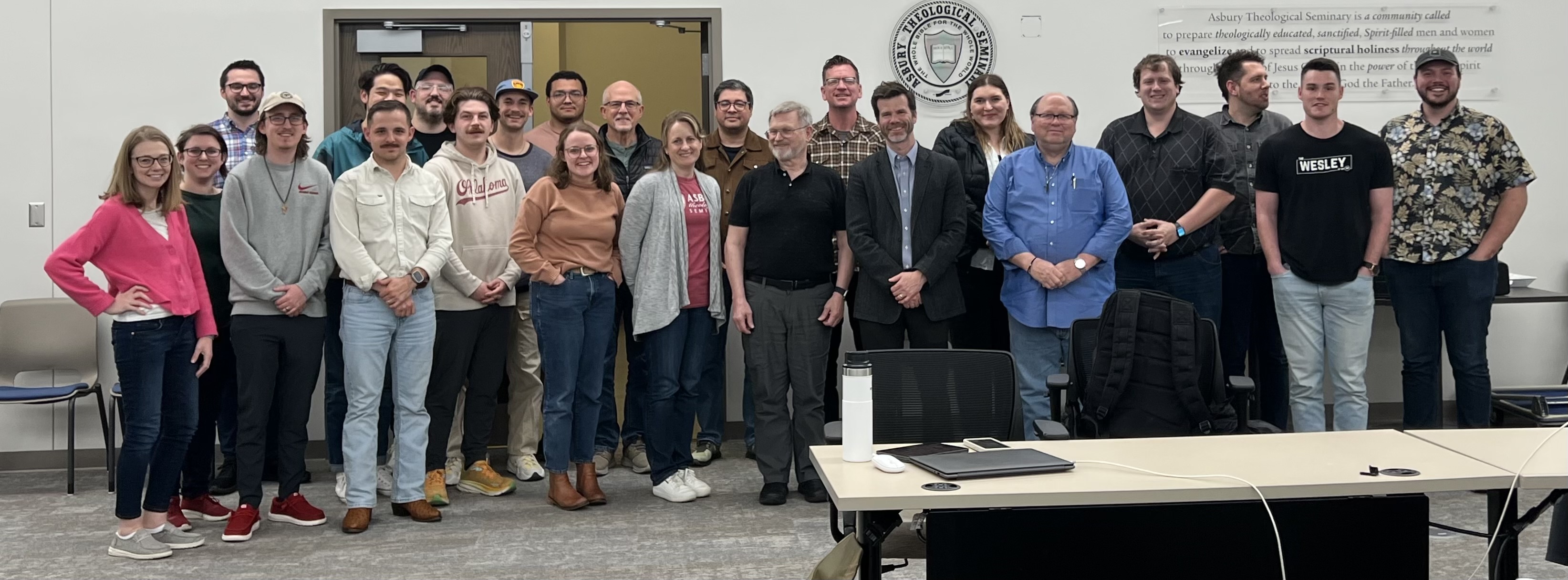
I had the privilege of teaching The Theology of John Wesley, which is one of the core classes at Asbury Theological Seminary this spring. Every student, regardless of degree, must take The Theology of John Wesley to graduate with a Master’s Degree. This is one of the ways Asbury anchors its identity and resists institutional drift. And I love it!
The class also gave me the opportunity to re-read core texts on John Wesley’s theology. First, we read sixty (yes, 60, not 6) of John Wesley’s sermons, including all of the original Standard Sermons. (Whether you want 44 or 52 in the list, they are all in the Collins and Vickers edited volume of Wesley’s sermons!) And we read my colleague Professor Kenneth J. Collins’s John Wesley: A Theological Journey and The Theology of John Wesley: Holy Love and the Shape of Grace. These are both masterful!
The class is a deep dive into Wesley’s theology. It is thorough and has been expertly crafted through decades of experience. I taught the class exactly the way it has been taught by those who have gone before me this semester. I had a blast because I was able to teach in an area I really enjoy teaching. And I was able to continue learning and growing as a follower of Jesus Christ and as a teacher.
Ok, so here is the memory I wanted to share:
One of the places there is always lively discussion, if students are tracking and understanding the material, is around John Wesley’s conviction that one who has experienced justification and the new birth does not commit outward sin. This is based on John Wesley’s reading of the canon of Scripture, particularly passages like 1 John 3:7-10:
Little children, let no one deceive you. Whoever practices righteousness is righteous, as he is righteous. Whoever makes a practice of sinning is of the devil, for the devil has been sinning from the beginning. The reason the Son of God appeared was to destroy the works of the devil. No one born of God makes a practice of sinning, for God’s seed abides in him; and he cannot keep on sinning, because he has been born of God. By this it is evident who are the children of God, and who are the children of the devil: whoever does not practice righteousness is not of God, nor is the one who does not love his brother. (ESV)
Collins brilliantly summarizes this in John Wesley: A Theological Journey:
Justification delivers from the guilt of sin, regeneration from its power or dominion, and entire sanctification from its being. Unfortunately, these distinctions are often neglected in contemporary Methodism where a decided “shift” has taken place; that is, freedom from the power of committing sin is attributed not to the new birth, as it should be, but to Christian Perfection, with the result that freedom from the being of sin is then relegated to the afterlife and glory. (190)
The conversation in class around freedom from the power of sin in regeneration led to a great question. I reached out to Professor Collins to get his perspective and his response was so good I asked for his permission to share it with my students and then to share it with all of you here. Here is how I framed the question:
How do I best talk to students about the correct definition and understanding of the new birth in connection with the band meeting, which both has a prerequisite of the new birth (and more), and weekly questions connected to sin.
I.e., if a students says, If someone does not commit outward sin after they receive justification and the new birth, why are the band meeting questions focused around sin? (I.e., “What known sins have you committed since we last met?”)
Here is Dr. Collins’s reply:
First of all, given the small numbers of people in the band meetings there may not be many responses to the weekly, sin-probing questions among the children of God, but there will likely be at least some responses over time. Real Christians do at times break faith and commit sin of the high hand, so to speak. The way forward then would be and must be one of repentance, of doing the first works afresh. So then, when Wesley affirmed that a born again believer is free from the power and dominion of sin (“The Marks of the New Birth,” “The Great Privilege of Those that are Born of God”) he was not teaching that real Christians would never sin again (a common misunderstanding among my students) but that Christian believers would have grace sufficient to remain faithful and to walk in a trusting and accountable way in the graces of regeneration. How do we bring all of this together? How can we summarize this basic and precious gospel truth which Jesus Christ, himself, affirmed (John 8:34-36) and which John Wesley repeatedly taught? I offer the following summary of the several elements here, though this language is not Wesley’s but my own. However, I do believe that such language captures Wesley’s basic meaning. And so here goes: “Willful, intentional sin, breaking faith with Christ, should be the grave exception in the Christian life and not the rule.” Our problem today, however, in American Christianity in general, and even at times in Methodism in particular, is that we have made sin the rule and grace the exception. We need to turn this upside down. Jesus Christ died for far more than to leave people in the bondages of which they are ashamed.
Second, I think the very great value of such questions for the saints that played out in the band meetings during Wesley’s lifetime is that they are a wonderful means of grace that ensure that responsibility and accountability will remain in place. Think of band members, for example, who are sorely tempted during the week but who in the midst of that temptation are reminded by the Holy Spirit, the Spirit of Truth, that they will have to confess such a sin (if it is committed) before several trusted and beloved others in just a few days. At that point the power of the temptation is broken (1 Cor. 10:13) by the light of the prospect of upcoming fellowship, accountability and love. That’s precisely the point! In other words, the questions of the band meetings are themselves a wonderful means of grace, used by the Holy Spirit, as a means by which faithful Christian discipleship is strengthened and lived out to the glory of God. Put another way, evil and sin love the darkness; however, Wesley made sure that the infrastructure of Methodism in general, and the band meetings in particular would be flooded by an abundance of light in the form of relationship, accountability and the richest love. In short, those questions are both precious and necessary for serious Christian discipleship.
So good!
Want to know more about the band meeting? Scott Kisker and I wrote a book that is designed to reclaim this practice. Check it out here.

 There was a time in my life when I remember feeling a lot of pressure to choose between the importance of a personal relationship with Jesus Christ or the importance of loving and serving other people. Around one group of people, I felt like talking about the need to read the Bible regularly and pray was seen as a form of escapism or navel gazing. Around the other group of people, I felt like concrete actions of love and service to others was fine, as long as it didn’t take away from the clear priority of spending one on one time with God. To be sure, I am oversimplifying the motivations of both groups. I don’t know about you, but I have felt at times like I was put in the awkward position of being asked to choose between cultivating a personal relationship with God or getting outside of myself and doing things for other people.
 Kevin M. Watson