I do not often struggle to keep my composure, but this Sunday March 2 was very emotional for me.
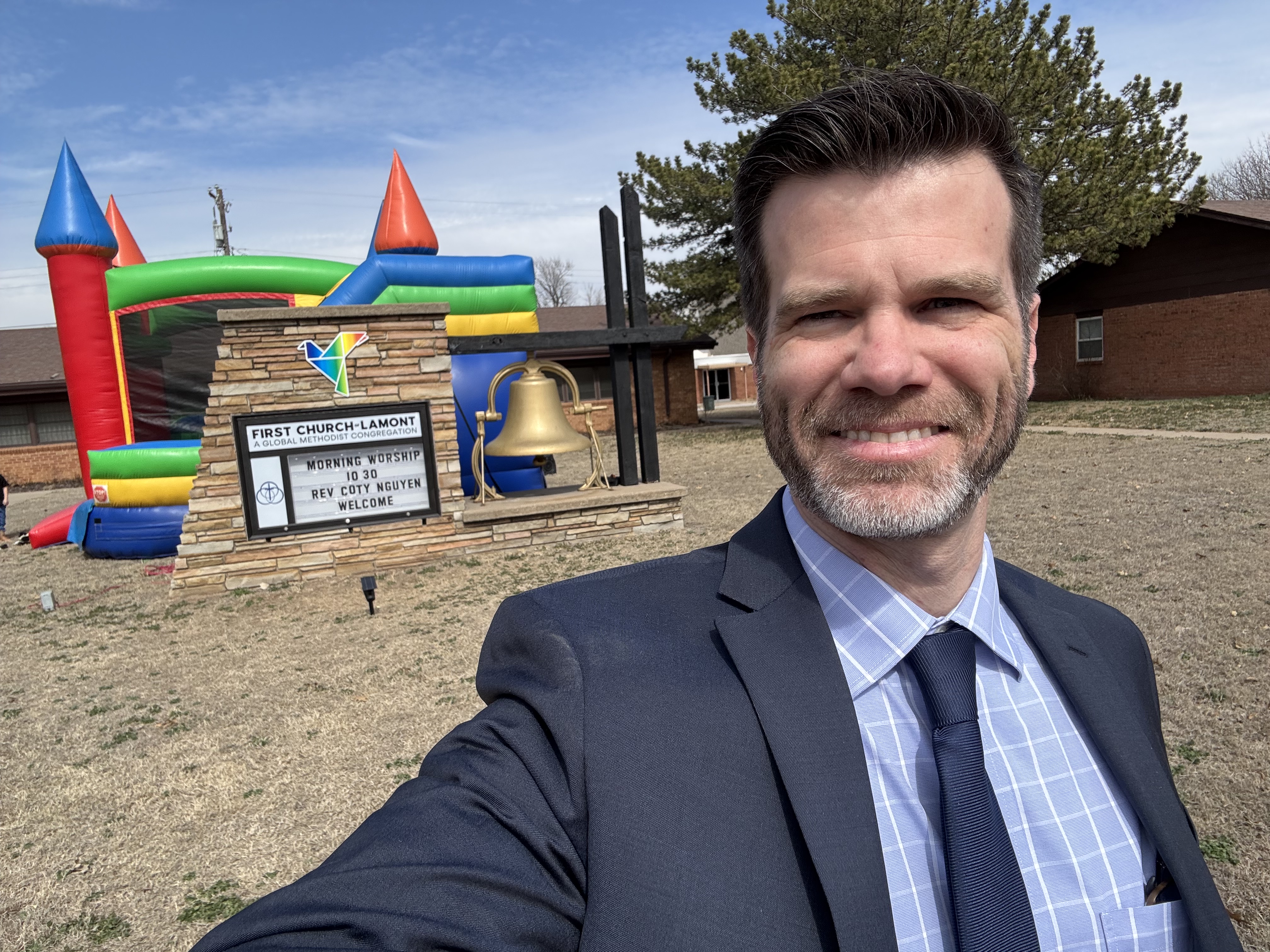
I was blessed to return to Lamont, OK, for the first time in almost 17. I served as the pastor of the Methodist Church in Lamont from 2005-2008.
In conversations with folks there, we realized that it was very close to exactly 20 years ago that I was seated for my first official appointment as a pastor. I was in my final year of seminary. I got married the summer before and we both knew we wanted to return to Oklahoma to serve.
I flew to Tulsa, borrowed a car from my parents, and drove two hours to Lamont, OK. I served for three years in Lamont before I started working on my PhD.
I learned so much during those three years. And I made a ton of mistakes! Here are a few of them for your reading pleasure:
I accidentally set the church yard on fire when the basket holding a Tiki Torch burned through and fell onto the ground in the hottest part of summer. Praise God, someone noticed, acted quickly and got it put out. But, to my embarrassment, there was a very visible black burned area in the grass everyone had to walk by on their way into VBS the rest of the week.
I also preached a six-week sermon series I very creatively titled “Family Matters,” with weeks focusing on things I knew absolutely nothing about from first-hand experience like being a parent or grandparent. Of course, I shared wisdom about marriage from the literally months of experience I had as a husband! (Now, to be fair: I was trying to share wisdom from the Scriptures, not from my own experience. And I believe that preaching from your experience and not Scripture is one of the major mistakes a preacher can make. Nevertheless, that sermon series was probably a bit comical at best, and presumptuous or completely lacking in self-awareness at worst.)
And to take the cake, I didn’t see Ash Wednesday coming (I know… not that hard to figure out) and realized too late we didn’t have ashes. So, I attempted to make some by using ashes from someone’s fireplace that I mixed with water. (No idea why I didn’t google this.) It turns out that doing that can cause a chemical burn. Immediately after the service, people were talking about how it kind of burned and their foreheads were hot. Someone said, “I must be particularly sinful, because I feel like my head is on fire.” Eventually, it was clear that everyone needed to wipe the ashes off right away. One poor woman still had a red cross on her forehead on Easter Sunday.
Despite these embarrassing mistakes (and many others I won’t share for time and to protect the identities of the innocent), the people at Lamont Methodist loved me so well.
A current student of mine at the Asbury Theological Seminary Tulsa Extension Site is now the pastor of First Church of Lamont (now a Global Methodist Church). When he invited me to come back to preach, I joyfully accepted.
You don’t often have the opportunity to return to a place 17 years later and feel like you are stepping back into time with so much being as it was when you left. There were people missing, which was sad. I knew they wouldn’t be there, but I felt their absence. There were also new people. Boys and girls when I pastored in Lamont had become men and women. Many of them had married and had children.
The parsonage next door looked the same. The sanctuary, the fellowship hall, and the parlor all looked the same – in the best way. And there were so many people I immediately recognized. Seeing many of them brought tears of joy to me eyes.
When worship started, I was just overwhelmed with the kindness of the Lord and the generosity of these people to me. We sang songs I’ve sung in places where the Lord has blessed me since I left Lamont.
I felt so thankful for the church. Thankful that these people have been doing their part to hold ground through a difficult season. Thankful that they made hard and faithful choices. Thankful that they are still moving forward, aware that God is not done with them yet.
I think the main reason I struggled to keep my composure in worship was that the Lord showed me that we ended well in Lamont. I was able to grieve an ending in a way that felt healthy looking back. And the church blessed us and released us as we left. They gave us a lovely clock that we have hung on the wall in every place we’ve lived since. I was able to appreciate the gift the people of Lamont gave us with such a gracious end more now than I could understand then.
To be honest, I’m not sure I said much that was helpful to the folks in worship on Sunday. I hope they saw my emotions as a sign of my love and gratitude for them. And even more, I hope they were able to see that as a tiny reflection of the Father’s perfect love for them.
‘For I know the plans I have for you,’ declares the Lord, ‘plans to prosper you and not to harm you, plans to give you hope and a future.’ – Jeremiah 29:11
It took me fourteen years to really understand this.
Check out these unsolicited comments I received after the most recent class I taught at Asbury Theological Seminary’s Tulsa, OK Extension Site. (The class was Wesleyan Discipleship and it was awesome! I asked and received permission from each student to share their encouraging words here.) Notice the emphasis on the atmosphere and what the culture of the class meant to the student.
Here is the first one:
I found my time at Asbury Seminary to be incredibly valuable and not just for the content of the class (which was excellent). There was, for lack of a better word, an anointing on the campus and on the course which caused me to be more focused, settled, and hungry for more of God. I sensed it impacting my life when I was there, and it (or at least a piece of it) has followed me home. I am working hard to cultivate it and give it space. Thank you for allowing me to audit your course.
It still amazes me that students are so hungry that they would travel from out of state, many taking time off of work, to audit this course.
Here is the second one:
I just wanted to say thank you for teaching the class on Wesleyan Discipleship! When you sent out the email prior to our time in Tulsa saying you hoped it would be like a retreat, I was skeptical. But I was happily surprised that it was like a retreat. I came back feeling refreshed and regenerated! Thank you for teaching this class and showing how much you care about the subject and about your students and their well-being. I am grateful and honored that I was able to take a class from you!
Here is the third one:
I just wanted to thank you for the way you ran the hybrid this weekend. I know you said you wanted it to feel more like a retreat and I think you accomplished just that. I don’t know if you got the response you were looking for, but I can tell you some things were revealed to me during your prayer Saturday morning that have brought some clarity to some problems I was having with my ministry. I don’t think the Holy Spirit would have given me that had I not been in the atmosphere you created. I am glad I was in the second group because I could not have shared that Friday. I will be a better pastor to my congregation moving forward for having been there. I don’t know that you could have taught the way you did on any of the other campuses. There are good things going on there in Tulsa. Y’all have quite the team and a very supportive host church as well.
And one more:
I wanted to personally write an email thanking you for all your hard work! It has been a pleasure getting to know you these semesters! … I also admire your sheer honesty and vulnerability with the class! It truly set the mood for everyone else! This last week was such a powerful week and I truly left feeling so filled and inspired to one day put into practice these discipleship techniques! I’ve started implementing them in a youth discipleship group I run and I even reached out to a few friends to start a band meeting style group! Thank you so much! You have truly blessed my seminary experience in many ways!
I deeply appreciate the kindness of each of these students who shared these comments. The unsolicited feedback I received from this course was unprecedented. (I received more than twice as many comments as I’ve shared here.)
I think there was so much of it because I am slow. And the Lord wanted to be sure he got my attention.
Do you see it?!
Let me give some brief context, in case some of the details of the students’ comments are confusing.
At Asbury Theological Seminary’s Extension Sites, we offer online classes and hybrid classes. Hybrids are my favorite. And they are a hybrid of online and in-person classes. The in-person portion of the class is a three-day intensive that happens once per class. In Tulsa, they are from Thursday evening through Saturday late afternoon. We spend 20 hours in two and a half days together.
It is intense.
And it is awesome!
If I had not figured out what really mattered to me, I think the hybrids would probably have gotten no unsolicited encouragement from my students.
One of the great things about teaching is that once you are the instructor of record for a class, you are in charge. You may not have authority anywhere else within the institution, but you do have authority in the classroom.
Until recently, I put most of my focus on what I would guess you would assume to be most important: the content of the actual course.
In other words, I got to choose the required readings. I was responsible for determining the means of evaluating students. And I was the one who would do the actual evaluation and assign grades.
It was up to me to decide what to teach and how to assess whether students had learned what I wanted them to learn.
Most of my energy went into preparing detailed lectures that accurately transferred the most important information.
But when I taught a class that felt like magic, where there was an internal sense of “Yes! This is what I hoped teaching would be like,” and where students seemed to “get it” – it wasn’t because I felt like I’d perfectly delivered the content.
It was something else. Something that was harder for me to articulate.
Looking back, the first time I got a glimpse of this was the Fall 2016 semester when I was teaching at Candler School of Theology at Emory University.
I learned that if I wanted to be able to lead my students, they needed to know that I cared about them.
I remember a specific class in the Fall of 2016 when something was definitely in the air in the room one particular day. And I consciously decided to allow that to take over the agenda for the day. Something shifted that day. The class went to a deeper level than merely handing on information about a particular subject.
This was a key step for me. I was intuitively starting to figure something out. But I still had a lot to learn.
Since moving to teach at Asbury Theological Seminary’s Tulsa Extension Site, I started noticing that what I was hoping to see happen in my classes was happening with a higher percentage of students than I’d ever experienced.
Here is what I finally figured out that I can now name:
Atmosphere is more important than content.
I am now more concerned with the atmosphere in the classroom than I am with the content that will be shared in the classroom.
By atmosphere, I am not really talking about sights, sounds, and smells. Though, these matter.
This is what I mean: culture is more important than content.
My greatest desire for every class I teach, regardless of the subject of the class, is for students to encounter the Lord and continue growing in their faith as they prepare for leadership Jesus’s church.
I want them to grow in understanding. And you can see that some of the comments speak to that. But I am convinced that more growth in understanding happens when you set the right culture.
So, now I work really hard to think through how to create the right atmosphere, the right culture within the class.
This is hard work.
Every class is different.
There is a culture established within Asbury Theological Seminary. And, as two of the comments noted, I think the Lord has given a special anointing to our Tulsa Extension Site that sets a particular kind of culture.
But I must be attentive to the atmosphere for each class and work to set the culture.
How I Work to Create a Great Atmosphere for My Classes
Here are a handful of things I intentionally do to create the right atmosphere for my classes.
First, I accept that it is my responsibility to take responsibility for doing this work. It does not happen spontaneously or by magic.
And so, in each class at Asbury, before the students come to Tulsa, I send an email to set our expectations for the three days we have together. You may have noticed the word “retreat” in several of the student comments above. That is because in this email, I tell students I want the weekend to be a retreat. Some students are skeptical that 20 hours in a classroom in 2.5 days could be anything like a retreat.
The email I send names the values I have for our time together that are discussed in what follows. This sets the expectations for the class and intentionally names what I value most.
Second, I am certain that all of this is dependent on the Lord. If the Lord withdraws his presence, nothing good can happen. (This is really first. But it made sense to me for this article to include it here.)
I am not being sentimental here or using pious language to impress you. I literally mean that I am consciously aware that Kevin cannot create what students need.
One way I express dependence on the Lord and a desperation for him to move is by fasting and inviting my students to fast with me for the 24 hours prior to our in-person intensive. This is not required, it is an invitation. I think fasting is one of the most important and underused basic spiritual practices. And I think corporate fasting is particularly spiritually potent.
One thing I love about the unity God has given us here is that my colleague in Tulsa, Penny Hammond (Tulsa’s Senior Enrollment Advisor), joins us in fasting in preparation for the course.
Third, the class starts by breaking our fast together with a meal that Asbury Theological Seminary provides. This facilities informal conversation and begins creating the kind of community we’re hoping to see.
Fourth, after dinner, we go to worship at Asbury Church (not related to Asbury Theological Seminary).
My calling is to raise up the next generation of leaders for the church. And so, I unapologetically see worshipping the Lord corporately as part of my work as a teacher. We do that in my classes by attending the Thursday evening worship service at Asbury Church.
In my mind, this is not an extra-curricular optional part of theological education. Worship should be thought of as a central piece of the formation and education of the next generation of leaders. And if you know next gen leaders, you know that they already know this!
I particularly love doing this in my context because Asbury Church (Tulsa, OK) is a fantastic church! I cannot imagine having a better partner for the work we are doing in Tulsa. (I love that one of my students noticed this and named it.) Worshipping on Thursday night also means that my students get to experience the preaching of Rev. Andrew Forrest, who is one of the best preachers of our day. At my Wesleyan Discipleship intensive, Andrew preached on the reality of death. It was a perfect way to begin the class. Begin with the end in view: You are going to die. Are you ready? What a great way to begin thinking more intentionally about discipleship!
Asbury Church and Asbury Seminary together gave every student a gift bag with Asbury Church and Asbury Seminary swag. At another hybrid, the church blessed students with gift cards to fast food restaurants near the church so some of the cost of attending a hybrid could be offset. I really appreciate that the church is committed to providing exceptional hospitality for our students in Tulsa.
I believe it is essential for the church and academy to be connected. Seminaries should literally exist to serve the local church. I could not envision a better partnership than Asbury Church’s support of Asbury Seminary’s Tulsa Extension Site.
Fifth, we walk back to the classroom after worship and I begin by sharing more vulnerably and honestly about my own story and my family than I do in public setting, particularly online. I show pictures of my family and talk about what I love about my children. I share about my sense of calling to Tulsa, OK and the at times bumpy road to get here.
I do this because it is who I am. I desire authenticity and vulnerability from others. I value candor and being candid with students is a sign of my respect.
I also do this because small group dynamics show that the level at which the leader shares is the level at which the rest of the group will share. If I want the atmosphere in my class to be a place where students can grieve, ask for prayer around something vulnerable, and seek the Lord together as we are prepared for the next step in our callings, I must be willing to go first.
Because this last class was about Wesleyan Discipleship, I made this explicit and talked about doing it myself and how the same dynamic would be in play when they broke out into the small group exercises we had as a class. And even though I know it is true intellectually, it still stunned me to see in the two groups I observed how the entire group mirrored the vulnerability and honesty of the first person who shared.
Sixth, I then give the students an opportunity to break the ice and ask them to share a bit about themselves.This is fast paced due to the size of our classes. But it gives them a chance to begin to bring their stories into the classroom itself.
Seventh, I work really hard to use students’ names throughout the intensive. This is not a natural strength of mine. I have to work really hard. And in large classes, I sometimes have to humble myself and admit I have forgotten a name, apologize, and ask for help. I’ve noticed that when I do this, the students seem to work more at learning each other’s names as well. This is huge for me, because the goal is not for me to have a relationship with each student only. The goal is for a real community to be established within the class. I want the students to feel connected to each other!
Eighth, I intentionally center Scripture and prayer at the beginning of each part of the class. There is a huge difference between doing this to check a box and doing this in hopes of welcoming the Lord and being led by the Holy Spirit. I will often explicitly give time to listen in silence to the Lord. Sometimes I feel led to offer a particular prompt for how we should listen. If we are resting in silence, I tell the students how long it will be and that I will keep track of the time. This can be such a blessing, because it allows them to relax into the stillness and trust me to keep time.
Ninth, I have a plan for the entire hybrid when it starts. I really do. But I commit to hold it loosely. This may be a place where experience matters. It is not hard for me to lecture for 20 hours on a topic like Wesleyan Discipleship. So, I am not anxious about having enough to say. And I also have greater confidence in my ability to triage what is most important for them to hear from me in person versus what they can glean from assignments. I have a plan, but I mostly use it to check in at breaks to see how the pace is going and to decide if I need to cut things I was planning to do in order to give more time to something that has come up.
My primary concern throughout the intensive is to be present to the Lord and to my students and adjust according to what is happening.
Tenth, finally, and most importantly, I intentionally give time for the Lord to move. And this has never stopped feeling hard for me. It is vulnerable. At the end of in-person semester long classes, I used to always ask: How have you seen God at work in your life throughout this semester?
And every single time, I was afraid it would just be awkward silence. Crickets. No one would say anything. But that never happened! Not even close. There were always students who shared in deeply vulnerable ways of the Lord’s work in their lives that blessed the class.
I have come to see holding space for the Lord to lead and for students to respond as the most important thing I do. It is certainly not all I do. But if I don’t do it, it will not happen. It one of the things that only the person who has authority can do.
I primarily do this by working to listen for God’s guidance. And often, I simply test the room based on a sense I have of the Lord’s leading.
This is more art than science. When I lean into this space, it is often the moment students remember about the class. It is what marks them. And it often brings the content of the course to life.
Two cautions: First, openness to the presence of the Lord with you in class is not in lieu of actually preparing to teach (the same is true for preaching). Second, don’t force anything. Don’t try to make something happen in your flesh. Consciously and explicitly give the Holy Spirit permission to move. And then wait on him and be obedient to his leading.
Ok, this is not an exhaustive list. But this is already too long!
The atmosphere you create is more important than the content you deliver. Great content with inattentiveness to the atmosphere will almost certainly be forgotten.
What kind of atmosphere are you creating in the places you have authority to lead? If you haven’t been giving attention to this, I would encourage you to spend some time reflecting on what it is like to come to the spaces and places where you are leading. How do you think people feel? Perhaps ask a person or two that you believe will tell you the truth.
Atmosphere is where the magic happens.
Kevin M. Watson is Director of Academic Growth and Formation at Asbury Theological Seminary’s Tulsa, OK Extension Site. He is also Scholar in Residence at Asbury Church. His most recent book, Doctrine, Spirit, and Discipline describes the purpose of the Wesleyan tradition and the struggle to maintain its identity in the United States.
Affiliate links, which support the author’s work, used in this post.
My mom died one year ago today. I have spent part of the day reflecting on my favorite memories with her. My immediate family was also able to have dinner tonight with my dad and share stories as a family about my mom.
I shared this story about my mom’s memorial service. It is the best example I have come up with of my mother’s unconditional and self-sacrificial love for me.
It is important that you know that I did not and could not have fully appreciated at the time, how hard this was for my mom. This was largely because she did not show me that my decision was hurting her because of her love for me.
High school was a tough time for me. I went to three high schools in three years. I kind of ran out of steam in the third high school and just didn’t have the energy after a few false starts to keep trying to find my people.
I remember driving to school on the first day of my junior year of high school, which was also the first day I ever drove myself to school, aware that nobody knew or cared that this was my first day to drive to school.
It was a hard year.
I remember going to lunch with my parents one day at the end of a long and discouraging week and one of my parents, I can’t remember who, suggested the possibility of applying to college as a junior. I had no idea that was a possibility, but fairly immediately became interested in it.
I applied to a small liberal arts school in the Midwest, Knox College (most famous for being the site of one of the Lincoln Douglas Debates).
With my parents blessing, I traveled to Knox College to visit the school and see what I thought. Having been to college, my parents knew better than I did that I would love it.
And I did.
A mother sacrificially loving her son, who has no idea his mom’s sacrifice.
So, I went to college after my junior year of high school. The truth is that the details of this story don’t really matter, except one thing:
I had no idea what my mom was giving up in order to support me going to college after my junior year of high school. It not only meant that I would be leaving the nest a year early. It also meant that both of my mom’s children would be leaving the same year.
My mom thought she had a year to recover from one son going off to college before both were gone. Instead, because of my decision, she became an empty nester overnight. She lost a year of parenting and a year she’d expected to have with just me living at home.
I had no idea at the time how selfless and generous it was for my mom to do that. And I had no idea how hard that must have been. The truth is I don’t think I thought about it at all.
And I want you to see what a blessing it was for me that I didn’t know. My mom could easily have let me know how much this was all hurting her. She could have let is passive aggressively slip how painful this was for her, or would be if I chose to do it.
But there was never any guilt trip at all. She had tremendous self-control. And a fierce determination to support my well-being as best she could.
I got a small glimpse of how hard this decision was for my mom a few years later when I heard the story of what happened when my mom took me back to the airport after Winter Break my freshman year.
My grandmother had to accompany my mom because she didn’t know if she’d be able to hold it together. She later told me she just fell to pieces once I was out of sight and gone again. I think that was the moment when she most felt the grief of losing that whole year with me.
From my mom’s perspective, my leaving a year early for college hurt. It was gut-wrenching.
It was bad for her.
But she saw the spark had come back into my eyes.
She saw the excitement of a new challenge and the joy that brought me.
She was not going to deny me any of that. She willingly and whole-heartedly supported me in doing something that was good for me that would cause her true grief. She sacrificed what was best for her because it was good for me.
That’s what my mom did.
Now that I have a kid in high school I have some idea of how hard this was for my mom.
I am forever marked by her love. I am so grateful.
Wow! These past few months have been amazing! My daughter is growing and developing. My wife continues to amaze me, and I truly love her more today than I did the day we were married. I finished my first semester of coursework for my Ph.D. at SMU Tuesday, relaxed with my family Wednesday, and flew to Washington, D.C. today. I am here for the weekend for a conference. I am looking forward to reconnecting with some friends I have not seen in a few years. I am also looking forward to spending this evening with my brother.
Many of you know that I went to seminary at Wesley Theological Seminary, which happens to be here in D.C. It will be nice to be back on campus this weekend, though I have been gone long enough that I feel much more like a visitor than I did last time I was here.
I have also been working on editing the proofs for Blueprint for Discipleship: Wesley’s General Rules as a Model for Christian Living. I have committed to getting any changes to the folks at Discipleship Resources by this coming Monday. This means I have a lot of work to squeeze in over the next few days, but it is also exciting, because it also means that the book is getting closer to publication. I have also been very pleased by the endorsements that Blueprint for Discipleship has received thus far. The book has been endorsed by Ted Campbell, Elaine Heath, Bishop Scott Jones, William Lawrence, Michael Slaughter, Doug Strong, and Lovett Weems.
In the next month I will spend some quality time with my family and study for my field exam in 17th and 18th century Church History, which I will take January 16th.




 Kevin M. Watson