• About Me

Kevin M. Watson

Kevin M. Watson

Category Archives: Wesley

UM Social Media Experiment: The Results

21 Wednesday Jan 2009

Posted by Kevin M. Watson in links, Ministry, Technology, Wesley

≈ 5 Comments

Today concludes the two week time line for the experiment in Methodist social media exposure. There were 759 views of the YouTube video promoting Reclaiming the Wesleyan Tradition: John Wesley’s Sermons for Today There were 44 hits to the video when I discovered it and posted it on the Methodist blogosphere. At the end of the first week there were 619 views. This means that the momentum slowed down significantly after the first week as there were 140 views in the second week. (On the other hand, that is still more than three times as many views as the video had in its first six months of existence.)

Blake Huggins was surprised at how well the experiment was going in a comment he left on my post about the experiment at one week. Henry Neufeld, on the other hand, was disappointed with the results.

I am not exactly sure what to make of the results. I think the experimented would have been more successful if the video that was circulated had not been promoting a book generally, and promoting a book I co-authored more particularly. I noticed comments on several blogs that expressed that they were disappointed to find at the end of the video that it was just promoting another book. (Though I was also surprised that so many people seemed to feel that United Methodists have so much information out there about their books. I have tended to feel the other way, that not very many people know about United Methodist publications outside of a very committed group.) I was also a bit disappointed that the views of the video decreased so rapidly in the second week.

On the other hand, I was surprised that more than 25 bloggers linked to the video in some way on their blog. And I do think it is significant that simply passing on a video was able to revive a video that was basically dead on YouTube. A change from 44 views in 6 months to 715 views in 2 weeks is a significant change. I think that this experiment does show that there exists a significant group of Methodists who are willing to work together in some capacity to raise awareness and get the word out. The big question is: Get the word out about what? Over the last few weeks I have found myself dreaming about the ways that the blogosphere could be used as a resource for helping to better get the Wesleyan message out there – not just to other Methodists, but more deeply into the emerging church and other places where meaningful conversations are happening about what it means to be a Christian, how to live faithfully, the meaning of life, etc.

As I indicated in the original post about this experiment, I will write a letter to the folks at Discipleship Resources and the General Board of Discipleship letting them know about the experiment and encouraging them to think about ways to use the internet as a means of communication and ways to work with Methodists who already have a presence and audience on the web. I will pass on any response that is appropriate to publicly communicate.

In the meantime, what are your thoughts about the experiment? Do you see anything more than this can point to or lead to?

Update: Experiment in UM Social Media Exposure

14 Wednesday Jan 2009

Posted by Kevin M. Watson in links, Technology, Wesley

≈ 4 Comments

Tags

Methodist, Reclaiming the Wesleyan Tradition, Social Media Experiment, Wesley

After one week the YouTube video about Reclaiming the Wesleyan Traditionhas received 619 hits (it had 44 when I discovered it a week and a half ago). The video also now comes up on the second page if you search “Wesleyan” on YouTube. So far the video has been posted on 25 different blogs and has been mentioned on two other blogs that I have found.

Here are the folks who have contributed: Hit the Back Button to Move Forward, Step by Step, Friar’s Fires, McKinney Methodist, Divers and Sundry, Stress Penguin, A Walking Paradox, Sunday’s Child, A United Method, Speaking of Grace, UM Portal, Adventures in Revland, Methoblog, Threads from Henry’s Web, My Ramblings, Thoughts of Resurrection, Thoughts from Nick, Accountable Discipleship, Matt Judkins, A Long Obedience, BlakeHuggins.com, Craig Adams, Ramblings from Red Rose, Fuzzy Thinking

The experiment was also mentioned at The Wesley Report, and Allan R. Bevere

If you have not participated in this experiment and would like to, all you have to do is post the you tube video below on your blog.

The original post about this project pointed to a desire to see how much attention Methodist bloggers could bring to one thing if we collectively talked about it for two weeks. As this has developed I have found myself hoping that this will help folks at GBOD, Discipleship Resources, and other folks who are trying to get our message out there realize that there is a tremendous resource in the Methodist blogging world. (Though, this is certainly not to say that the methoblog is a promotional service for Methodist agencies, just that it might be a good idea to keep us in the loop.) At perhaps a deeper level I have also found myself wondering if there are ways that we can work together to raise awareness of our Methodist/Wesleyan heritage. Are there ways that we can focus on what unites us and together build even more momentum and more of a presence on the web? I would love to hear your thoughts on this.

(Full disclosure: I co-authored the book that is promoted in the video. If you want to see how this video was chosen, or why this experiment was started you can read the original post I wrote when I found the video on YouTube and the post that Gavin then wrote – which was what gave me the idea to do this.)

Seeking Feedback on Asbury Biography

13 Tuesday Jan 2009

Posted by Kevin M. Watson in Book Review, links, Wesley

≈ 2 Comments

Last week, in studying for my upcoming field exam in 17th and 18th century Church History, I realized that Francis Asbury was probably the person who was a key figure in the 18th century who I had the least amount of information about. So, I did a few quick searches and came across America’s Bishop: The Life of Francis Asburyby Darius L. Salter. So, I did something completely out of character, I made an impulse purchase and bought the book.
The book arrived yesterday and it appears to be a serious and substantial biography of Asbury. The text is 362 pages followed by an additional nearly 20 page Bibliography and more than 50 pages of notes. However, there are a few things that make me wonder about this book. First, I could not find any academic reviews of it on the major search engines through Bridwell library. It seems to me that what appears to be the first in depth biography in decades would have been reviewed in a journal somewhere. In other words, why aren’t academics saying anything about it? (On the other hand there is an endorsement from Russel E. Richey on the back cover of the book, and I could have just missed the reviews.) Second, it is published by Francis Asbury Press. At first glance this seems very fitting for a biography of Francis Asbury. However, I would have guessed that Abingdon or someone of the like would have jumped at the chance to publish a major biography of Asbury. And finally, I would have guessed that a book like this would have been written by an expert in American Methodism, rather than someone with a PhD in psychology and religion.

None of these mean that the book isn’t going to be a terrific study of the life of a key figure for American Methodism, they just have made me wonder if I am missing something. So my question is, have you read this book or heard anything about it? Am I missing anything? And are there other biographies of Francis Asbury that you have read and would recommend?

Reclaiming the Wesleyan Tradition on YouTube

03 Saturday Jan 2009

Posted by Kevin M. Watson in Book Review, links, Wesley

≈ 4 Comments

I just stumbled onto this promotional video for Reclaiming the Wesleyan Tradition: John Wesley’s Sermons for Today on YouTube. I had no idea it existed and am very interested to know how it is being used. In any case, here is the video:

By the way, if any of you were not aware that I co-authored this book and have come across it somewhere else, I would love to know how and where you came across it. I would also be very interested in hearing if anyone has used it as a small group study (which is what we had in mind when we wrote the book) and how it was received.

The Wesley Study Bible

16 Tuesday Dec 2008

Posted by Kevin M. Watson in Book Review, links, Wesley

≈ Leave a comment

Tags

Methodism, Wesley, Wesley Study Bible

I have recently learned that Abingdon Press will be publishing in early 2009 The Wesley Study Bible. From what I have read, this sounds like an excellent resource. It is edited by Joel B. Green and William H. Willimon and has over 150 contributors. I am hoping to get my hands on a copy so I can review it in detail here.

You can view an update at the Wesley Report and learn about how to join the facebook Wesley Study Bible group as well.

The retail price of the Wesley Study Bible will be $39.95, but it can be pre-ordered for $24.95.

The Church That Was Born Again

14 Sunday Dec 2008

Posted by Kevin M. Watson in Life, Ministry, Wesley

≈ 7 Comments

Tags

Eldbrooke, Rebirth, United Methodism

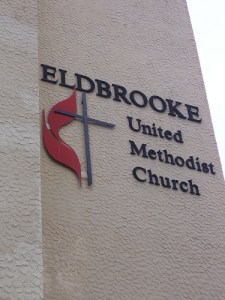
Eldbrooke UMC

Eldbrooke UMC

Elbrooke United Methodist Church no longer exists, at least not as a community of faith that continues to gather together to worship God and serve others. My internship in seminary was at Eldbrooke UMC, where I watched the church yoke itself to Metropolitan Memorial United Methodist Church. The following year it was closed. I graduated from seminary and moved to Oklahoma before Eldbrooke was closed, yet I occasionally heard pieces of news as Eldbrooke was closed and then put up for sale. My internship at Eldbrooke was difficult because I came to love the people at the church, yet the church was obviously not moving in a positive direction. Attendance was low, the building was in disrepair, and people seemed to be fighting just to stay above water.

I saw so much potential for the church, as it was located in a growing neighborhood of Northwest Washington, D.C., within a block of a metro stop. From a strategic standpoint, there seemed to be every reason why the church should be thriving, not dying. Yet, die it did.

I heard that the church would likely ultimately be sold to the highest bidder, which most people thought would mean that the church would be torn down. But due to the church being designated an historical landmark, and other circumstances, it was ultimately sold to another church. And that is how Eldbrooke United Methodist Church became The City Church DC.

I made this discovery when my brother and I walked to Eldbrooke, reminiscing, and noticed that the lights were on and people were in the parking lot. I introduced myself and explained that I had been an intern at this church and was in town for the weekend and asked if there was any way that I could take a quick look around inside. I discovered I was speaking to one of the lead pastors. She seemed genuinely glad to meet me and show me around. She gave me a thorough tour of the church, and introduced me to her husband, the other lead pastor.

I have to say that seeing concrete evidence that a group of people were investing in this church made my heart sing. They have remodeled the sanctuary and the area where we used to have our soup suppers after worship on Sunday morning. And the work continues.

What particularly impressed me was how charitable they were in their discussion of the church. When I introduced myself to the second lead pastor and told him I was currently working on a Ph.D. in church history he immediately responded, “Well, there is a lot of history in this place.” Michael and Heather provided a wonderful example to me of how to work towards unity in the Body of Christ. The City Church DC is nondenominational and, therefore, not United Methodist. But there was not hint of gloating or dismay or judgment of what is, to be honest, a failure of the United Methodist Church. They seemed to see themselves as simply stepping into the history of this church, leading to its next steps of faithfulness and obedience to how they understand God to be at work.

And so Eldbrooke United Methodist Church, which was put to rest a few years ago, was born again. Eldbrooke, which was dead, is now City Church, which is alive and growing. (Michael told me that since they began worshiping in February attendance has grown fro 65 to 130.) I suspect that some United Methodists in the D.C. area may not care much about The City Church DC, but whether United Methodists notice or not, the kingdom is coming. Jesus continues to draw people to himself and he sends them in love to others.

I think this is a great story in and of itself. Yet, it seems to me that there is something in this story that United Methodists can learn from. It should not escape our notice that a church is growing in literally the same location and even in the very same building. In some ways, it seems that the main thing that had to die for the church to live was the United Methodist affiliation of the church. While in some ways that may not be that big of a deal, as the wellness of “the Church” is far more important than the wellness of “The United Methodist Church.” In other ways, Eldbrooke’s legacy may be, more than anything, to question United Methodism. What was it about Eldbrooke UMC, the district that the Church was in, and the Baltimore Washington Conference that made it unable to survive, while it seems to be doing very well with a new start? Was there a failure of the connectional system? Was there a failure of imagination? Of nerve?

Part of Eldbrooke’s legacy may be in the questions that it asks of United Methodists. My sense is that if we are willing to take a hard look at churches like Eldbrooke United Methodist Church, we will find some things that are not easy to acknowledge. We will be led to repent of the ways in which our church has not been faithful to our Lord. Yet, if we are unwilling to acknowledge our mistakes and our sins, how can we expect to move forward? For my part, I lament that United Methodists were not able to resurrect a vibrant ministry in that place, but mostly I praise God that the Church is present and Christ is still being proclaimed at 4100 River Road NW in Washington D.C.

Blueprint for Discipleship – Cover

20 Monday Oct 2008

Posted by Kevin M. Watson in Wesley

≈ 11 Comments

Tags

Blueprint for Discipleship, General Rules, Wesley

Background on the Explanatory Notes (Part II)

04 Thursday Sep 2008

Posted by Kevin M. Watson in Book Review, Ministry, Wesley

≈ 1 Comment

Tags

Explanatory Notes, John Wesley

In my reading today, I came across more information about the Explanatory Notes:

During the previous decade, John had hoped the publication of his Bible commentary, Explanatory Notes Upon the New Testament, would provide doctrinal help for his preachers. The first edition, in 1755, had been prepared more hastily than Wesley had hoped. The second edition the following year was essentially a reprint, though with the errata incorporated. In 1760, however, he and Charles had embarked on a major revision of the work, further refining the biblical text and expanding the notes. They finished this new edition in 1762 and, combined with the collected Sermons on Several Occasions John had published (four volumes by 1760), it provided basic doctrinal guidelines for the preachers.

By the late summer of 1763, Wesley had firmly fixed these two resources as the measure of proper Methodist preaching. (Heitzenrater, Wesley and the People Called Methodists, 212-3)

Heitzenrater goes on to argue that the Model Deed, which controlled access to Methodist pulpits, stipulated that preachers must preach “‘no other doctrine than is contained in Mr. Wesley’s Notes Upon the New Testament, and four volumes of Sermons.’ By this stipulation, the Sermons and Notes became the doctrinal standards for the Methodist preachers.” (Heitzenrater 213)

If you are still reading, you will see that we are starting to get somewhere… The Explanatory Notes were part of the doctrinal standards of early Methodism because they were considered to be an important way of ensuring that the people who preached in Methodist pulpits were preaching a doctrine that Wesley would approve of. Thus, the Explanatory Notes were intended to play an important role in defining what was acceptable Methodist teaching.

This still leaves open for discussion the role that they do actually play today and the role that they should play today.

Background on the Explanatory Notes

03 Wednesday Sep 2008

Posted by Kevin M. Watson in Book Review, Ministry, Wesley

≈ 7 Comments

Tags

Explanatory Notes, John Wesley, United Methodist Church

In a previous post I mentioned that I am reading through John Wesley’s Explanatory Notes on the New Testament. Today, in re-reading Richard Heitzenrater’s Wesley and the People Called Methodists, I came across this passage:

The notes were largely a collation of material from John Heylyn’s Theological Lectures, John Guyse’s Practical Expositor, Philip Doddridge’s Family Expositor, and Johannes Bengel’s Gnomen Novi Testamenti. The latter was one of the first works of modern critical biblical scholarship, and Wesley adopted many of Bengel’s principles of textual criticism. Although the predominance of the material in the notes comes from these sources, Wesley wove them together in such an editorial way that he could own the combined whole. Having acknowledged his debt to these authors in the preface, Wesley chose not to document particular borrowings, as as not to ‘divert the mind of the reader from keeping close to the point in view’ (JWW, 14:235-39). (Heiztenrater, 188)

In a sense then, it would seem that one could argue that our doctrinal understanding of the New Testament comes from John Heylyn, John Guyse, Philip Doddridge, and Johannes Bengel as filtered and collated by Wesley. It is likely that I will not have time in the near future to learn more about these four men, but I would be very interested to explore this further at another time, as I do not know much about any of them, and only recognize Doddridge’s name.

The more I think about the Explanatory Notes and read them, the more surprised I am that they carry the weight of Doctrine for United Methodists. One could ask whether it is necessary to have a Doctrine for the interpretation of the New Testament, but perhaps more to the point, one could ask whether the Explanatory Notes continue to make a relevant contribution to the life of the United Methodist Church.

I would love to hear your thoughts on this.

The Sermon on the Mount as the Key to Happiness

13 Wednesday Aug 2008

Posted by Kevin M. Watson in Wesley

≈ 3 Comments

Tags

Explanatory Notes, Sermon on the Mount, Wesley

I mentioned in another post that I am reading the New Testament with John Wesley’s Explanatory Notes as a devotional exercise (and also out of curiosity to see what they actually say, since they are listed as part of our doctrinal standards). There have been some surprises so far, but the main thing I want to mention in the context of this post is a striking comment Wesley makes at the very beginning of the Sermon on the Mount. In Matthew 5:1-2 the translation Wesley uses reads, “And seeing the multitudes, he went up into the mountain: and when he was sat down his disciples came to him. And he opened his mouth and taught them…” Here is Wesley comment on the phrase “and taught them”:

To bless men, to make men happy, was the great business for which our Lord came into the world. And accordingly He here pronounces eight blessings together, annexing them to so many steps in Christianity. Knowing that happiness is our common aim, and that an innate instinct continually urges us to the pursuit of it, He in the kindest manner applies to that instinct, and directs it to its proper object.

Though all men desire, yet few attain, happiness, because they seek it where it is not to be found. Our Lord therefore begins His divine institution, which is the complete art of happiness, by laying down, before all that have ears to hear, the true, and only true, method of acquiring it.

Observe the benevolent condescension of our Lord. He seems, as it were, to lay aside His supreme authority as our Legislator, that He may the better act the part of our friend and Saviour. Instead of using the lofty style, in positive commands, He, in a more gentle and engaging way, insinuates His will and our duty, by pronouncing those happy who comply with it.”

There is so much here that could prompt a discussion, but I want to focus on what first caught my attention. Wesley seems to be articulating a framework or a lens through which to read the Sermon on the Mount. He seems to be arguing that Jesus gives the Beatitudes in order to map out for us the way to happiness. I think this is very interesting, because this is so relevant to today. Many people are seeking happiness. Yet, on the other hand, few people, it seems to me, view the Sermon on the Mount as good news in their search for happiness. Wesley invites us to read the words of Christ in Scripture as a model and a guide to finding happiness. What is your reaction to this? When you read or hear the Sermon on the Mount, is your reaction that this is good news that leads us to happiness, or is it a reaction of feeling guilty because it points to so much that you fail to do or don’t even want to do?

Wesley writes, “Though all men desire, yet few attain, happiness, because they seek it where it is not to be found.” Where are you looking for happiness? Are you finding it there?

← Older posts
Newer posts →

Blog at WordPress.com.

  • Subscribe Subscribed
    • Kevin M. Watson
    • Join 366 other subscribers
    • Already have a WordPress.com account? Log in now.
    • Kevin M. Watson
    • Subscribe Subscribed
    • Sign up
    • Log in
    • Report this content
    • View site in Reader
    • Manage subscriptions
    • Collapse this bar

Loading Comments...