• About Me

Kevin M. Watson

Kevin M. Watson

Category Archives: United Methodism

Where Do We Go from Here?

09 Monday Feb 2026

Posted by Kevin M. Watson in Book Review, Christian Living, Methodist History, Ministry, United Methodism

≈ Leave a comment

Tags

Aaron Renn, Andrew Forrest, Asbury Church, Christian formation, Christian Smith, Christianity, demographics, John Wesley, Methodism, Negative World, Ryan Burge, Wesley
This is a question that is good and healthy for people and institutions to ask periodically.

This question became acute for churches that left their denominations of many years, often due to the presenting issue of same sex marriage. This has happened across mainline denominations. Perhaps the most public recent separation was within the UMC.

I am now on staff at Asbury Church in Tulsa, OK. Asbury was for years the largest United Methodist Church in its Annual Conference. 

Since leaving the UMC, Asbury has been in a season of discernment about the future after leaving the United Methodist Church. 

Where do we go from here?


The presenting issue for the era of disaffiliation from the UMC was the decades long denominational infighting over sexual ethics, particularly same sex marriage. The breaking point, however, was when it became clear that the bureaucracy of the UMC was willing to nullify the decisions of General Conference when it disagreed with them by simply ignoring them or refusing to enforce them. The decision of bishops and other UMC leaders to impose their judgment over that of General Conference shattered the polity of the UMC, which was the very mechanism that was designed to protect unity in the midst of deep disagreement.

Some orthodox United Methodists could live with the official teaching of the church being one thing on paper and another thing “in real life” happening with no consequence.

I was not one of them.

On the other side of disaffiliation, United Methodism swiftly changed its position on sexual ethics so that its actions are now consistent with its practice. This brought the advantage of consistency and coherence. But it came at the expense of faithfulness to the clear teaching of Scripture at the main pressure point of the present cultural moment.

Some orthodox United Methodist could live with this. I don’t understand how.

If you believe that same sex marriage is not a thing that the Triune God can bless, then I do not understand how you can be “in connection” with a denomination where clergy say that God does bless them and where they regularly occur. The idea that one can be United Methodist and unimpacted by this because it does not happen in your church is either foolish or intellectually dishonest. It is at best incoherent with the basic meaning and purpose of a denomination.


Where do we go from here?

I want to talk about a recent post from Ryan Burge that brings urgency to this question. In fact, it suggests that we don’t have much time left to decide where we are going. And though I will highlight data that relates to the United Methodist Church, the UMC is not the point of this post. I would guess that the Global Methodist Church, the denomination born out of the disaffiliations from the UMC earlier this decade, is probably in a similar position as the UMC is. (Burge does not include date for the GMC in his piece.)

Most importantly, for my focus, Burge’s data is relevant to my own church. We generally fit the picture he shows.


If you are not already familiar with Ryan Burge’s work, you should be. Burge is professor of practice at the Danforth Center on Religion and Politics at Washington University.

He is one of the very few positive examples I can think of where a person has gained a significant platform on social media by delivering consistently thoughtful and nuanced content, particularly regarding the contemporary church. Burge’s work is focused on demographic data, analyzing trends, and pointing to implications for the church.

His recent post “When Are Half Your Members Going to be Dead?” has given urgency to the question:  Where do we go from here?

Are we presuming we have a future, despite all evidence to the contrary?

The heart of Burge’s post is showing how top heavy in terms of age most Protestant denominations are.

I’ll use the UMC to illustrate, but you can see the details of other denominations in the two images I’ve included.
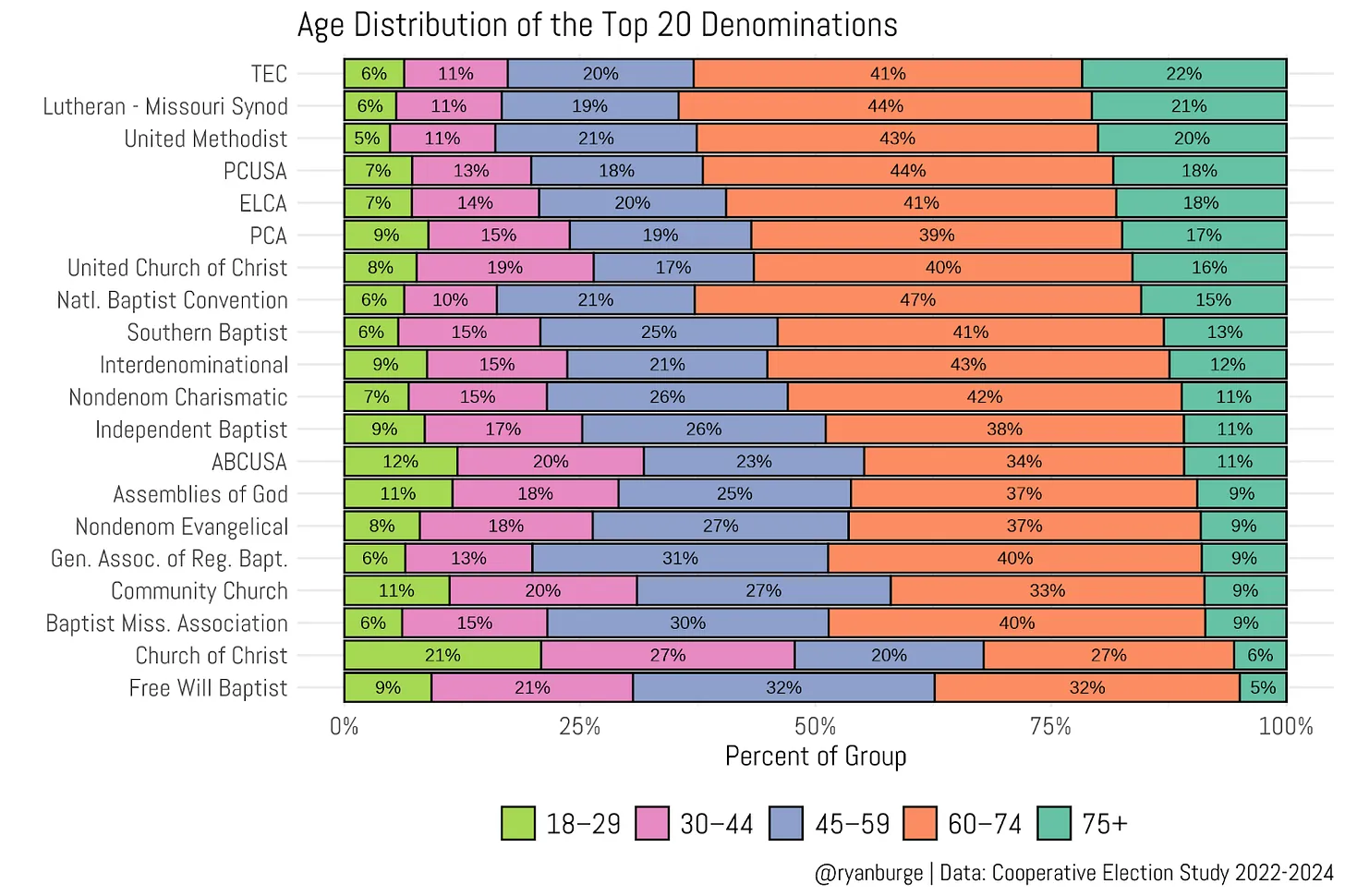
Look how few members in any of these denominations are young. Not one of the 20 denominations listed has more than 50% of its members under 44 years old. In the UMC, only 16% are 18-44.

Burge emphasizes this age range in his article because this is the age range of fertility, broadly speaking. That is, the rest of the folks in the group are not going to be adding to membership by giving birth to children.

He does not unpack this in his post, but another angle of this is the theology, views and values around life itself, and starting families (how soon and how big). The more progressive the denomination, the more likely it is that the fertility rate will be lower even within the age range of fertility.

21% of the membership of the UMC is between 45-59, which is more than 18-44 combined. And, at 43%, there are more than double the number of people who are 60-74 than 45-59. (And there are 8x as many 60-74 year olds as 18-29 year olds.) 63% of the UMC is 60 years and up. 

This represents a demographic crisis.


I want to pause here. I doubt very many United Methodists read my work anymore. I suspect there are a lot of people who read this who are not fond of the UMC. And I think this kind of data brings a tremendous temptation to self-congratulation.

“See, this is why we left?”

And I suspect for most people reading this, you would be completely missing the point.

Is your tribe different?

Self-congratulations, posturing, or denial won’t accomplish anything positive. 


I am thinking about this because this has been a topic of conversation among the staff at Asbury Church, where I serve.

So, to be as clear as I can be about the point of this post: This is not a post to celebrate the seeming demise of others. 

The point is to be in touch with reality so we can ask the question I started with:

Where do we go from here?


Let’s start by stating the obvious:

If the denominations Burge lists do not figure out how to grow younger, they don’t have a future.

That is a descriptive statement, not a moral argument.

We are all mortal. I will die someday. And if no one comes behind me, the thing that I am part of will not exist anymore.

I am worried that older people will be offended by what I write. Please understand me. Age is not a moral issue. It is not immoral to grow old. It is just what happens.

But if an institution consists of primarily senior citizens and is no longer able to reach young people, then it is dying.

This is all the more difficult to talk about in a healthy way because our culture idolizes youth in ways that are damaging to young people and can invalidate the worth and value of older people. The older we are, the more likely we are to experience acutely the limitations of our bodies. 

As we age, moving our bodies becomes more painful.

To young people who do not experience significant pain:

Take time to notice the literal physical pain some of the older members at your church endure to simply come to church. There are people who show heroic courage, strength, and grit by showing up. This will humble you and help you not take your own body for granted. Perhaps it will even encourage you to not take gathering with the faithful for worship for granted.

To older people:

I say to you with love, I know that talking about this can be uncomfortable. It is not at all my intent to signal that you are unimportant or lacking in value. Not at all! You are the reason we are here! My hope for you is that if you turn your hearts towards reaching the next generation (and many of you already have!), you will gain peace and joy knowing that reinforcements are coming and the mission you have given your life to will continue after your death. 

This applies to me. 

We are all moving towards the grave. We all ought to humble ourselves and learn from those who have gone before us. And we should all do all that we can to build up, strengthen, encourage, and bless those who are coming after us.


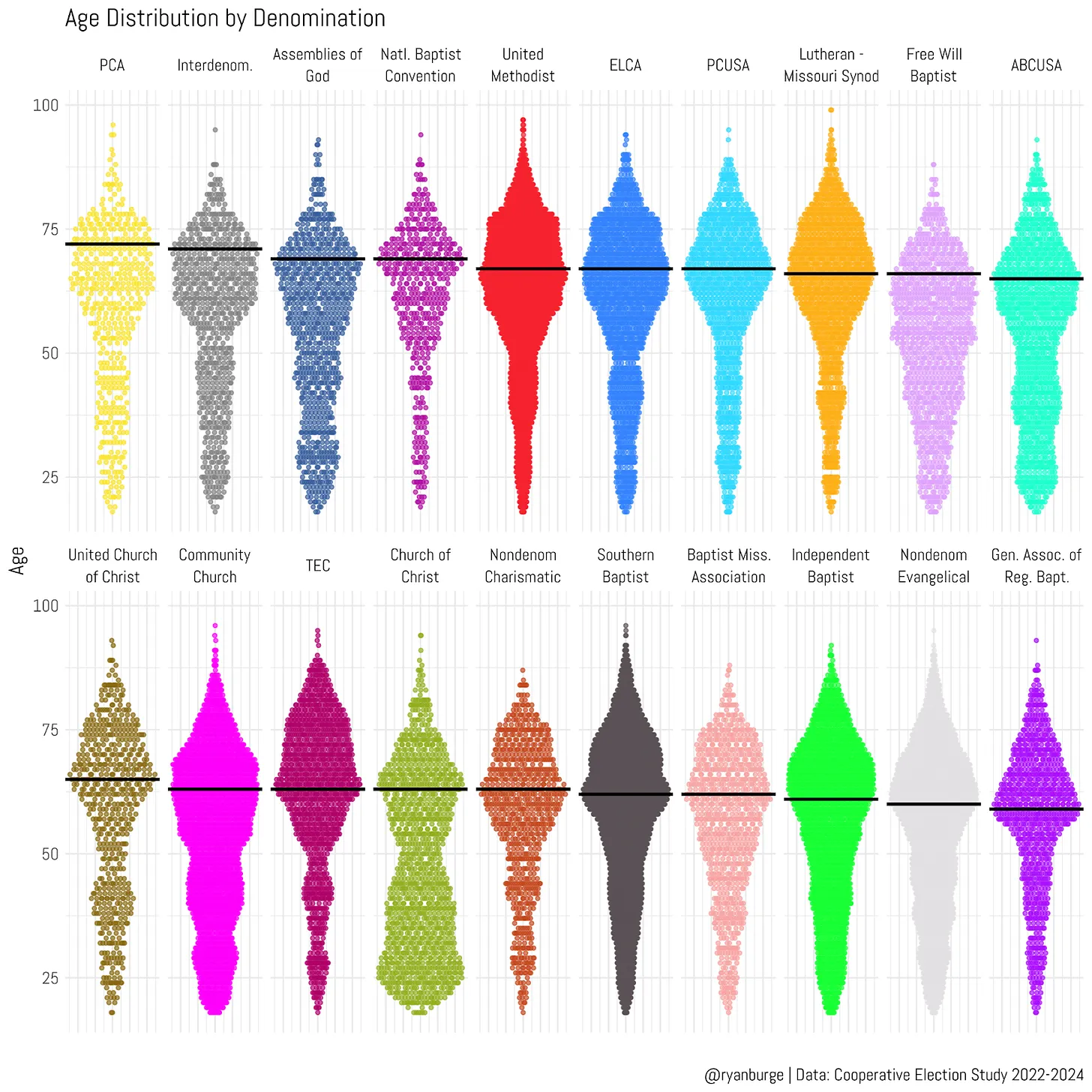
One of the reasons work like what Ryan Burge is doing is helpful and interesting is because it provides a more neutral way to talk about the future. It is hard to ignore or deny that a problem is coming when you look at the second image from Burge’s article.
There is, however, at least one obvious sign of hope for the future. Did you notice that there is one major exception? Look at the Church of Christ.

21% of the Church is 18-29. 27% are 30-44. This means that 48% of the Church of Christ is in the peak fertility range! It also means that the largest percentage in any one of the five age ranges is a tie for 30-44 and 60-74. So, there is a significant generational balance. It gets better. The third largest group is the youngest. Look at the Church of Christ in the second graph. You don’t want a long thin tail, as so many of the denominations included have.

You want, at a minimum, the people coming behind to be able to replace the people and resources of those who are ahead. 


It took a lot of spadework to get to this point. Now, I want to share a few thoughts about this information. Fair warning, it may feel more discouraging before there is hope. But I am writing this post because I do feel hope for the future. I believe the Lord has already given us the way forward, if we would have the courage to take it.

My first thought comes from reading Aaron Renn’s Life in the Negative World and Christian Smith’s Why Religion Went Obsolete. These books are both crucial for thinking about evangelism and discipleship in the contemporary church.

I’ve mentioned Renn’s work here before. Renn argues that we live in “Negative World,” where elite culture is opposed to the core claims and commitments of the gospel. I think he is right. (I wrote a review of Life in the Negative World here.)

Rev. Andrew Forrest, the Senior Pastor at Asbury Church where I work, has written a book that show how to avoid being passive and victims in Negative World and move forward. Hint: Forrest gives away the core concept in his book’s brilliant title: Love Goes First. (I wrote a review of Love Goes First here.)

You should read all three of these books. The church desperately needs leaders who are doing the deep work to think about the times in which we live and who refuse to settle for running plays that worked in the 1950s but simply do not work today.

Here is how reading and thinking about these things came through in reading Ryan Burge’s post:

The work before the church is going to be extremely, nearly impossibly, difficult.

There is so much that could be said here. I’ll say three quick things to illustrate how hard this is going to be.

First, the Baby Boomer Generation is literally a one-of-a-kind event. The really wide parts of the second image represent this generation. There are just less people at each age behind the Baby Boomers. So that is the first demographic reality that makes this extremely difficult.

Second, over the past thirty years the dominant culture has shifted dramatically. In the years immediately following World War II, there was cultural pressure to be a member of a Christian church in the United States. Sometime in the 1990s that shifted to neutral, neither positive nor negative. And in the mid-2010s that shifted further to negative cultural pressure. So, when the Baby Boomer Generation was around my age, there were cultural incentives, or social pressures on people to go to church. Today, with this major loss of members coming in the next 10-15 years, there are negative incentives, negative social pressure on people becoming followers of Jesus. 

Put simply: It is harder to “make” a convert today than it was fifty years ago.

Third, the institutions that represent these groups are sick and dying. In other words, they are not in a place to lead a resurgence or a renewal. They might have been able to do that back when I was in seminary when professors at the mainline liberal seminary I attended talked about the coming “death tsunami” that was headed for the UMC. 

One of the things we talk about all the time at Asbury Church is how hard it is going to be going forward. We are looking for others who share a sense of urgency about figuring out how to lead and move forward “for such a time as this.” Figuring out how to reach people my age and younger is urgent and has to be the top priority for every church or they will not have a future.


As I was looking at Burge’s charts in a staff meeting at Asbury, someone brought the focus back to the Church of Christ: “Why are they different?”

I don’t know much about the Church of Christ. But I do know that sociologists have found that there is something of a law of church growth in the United States. I first came across this in the fantastic book The Churching of America, 1776-2005 by Roger Finke and Rodney Stark. 

Here is the law of church growth in the United States:

High expectation, high demand churches grow. Low expectation, low demand churches decline.

I am sure that the Church of Christ, especially compared to the other denominations Burge includes, is a high expectation and high demand church.

I spent a decade trying to get United Methodists to move away from sloppy nonsense like “open hearts, open minds, open doors.”

Methodism has grown when it has had clear expectations of its members and enforced them. It has declined when it has not.

The Methodist Episcopal Church grew from the smallest Protestant denomination in the U.S. to the largest by far from 1776 to 1850. (See The Churching of America for details.) And during this time, you were required to attend a weekly small group meeting to remain a member. If you missed more than three times in a quarter, you were removed from membership. There was a document that outlined the lifestyle expectations for members in terms of sins to be avoided, concrete actions that expressed love of neighbor, and insisted on a disciplined practice of the means of grace (practices like Bible reading, prayer, worship, holy communion, and fasting). 

This is not the only way early Methodism was a high expectation, high demand church. Read my book Doctrine, Spirit, and Discipline: A History of the Wesleyan Tradition in the United States for a detailed account.

Today, in many churches you can join a church by standing up for a few moments during a worship service and making a few vows. And you won’t be removed from membership even if you don’t keep any of the vows you made.


As I’ve thought about where we are and where we are going, it is just so obvious: This is going to be really difficult. 

In Negative World, there are no longer any incentives for people to come to a church that is more a social club than a place that is focused on Jesus Christ and helping people meet him and give their lives to him as not only savior, but Lord of their lives.

There are a variety of ways you can miss the mark in terms of high expectation and high demand. Cults, for example, are high expectation and high demand. They provide a clear sense of belonging and identity. But they do not make disciples of Jesus Christ.

You can also miss the mark by jettisoning any attempt to be Christian and simply be an activist organization. Many college students and young adults are finding meaning and identity in protest and advocacy that is cult-like in terms of the demands it makes and the all-encompassing sense of belonging and identity it gives (or demands).

When Methodism was at its best, it was a high expectation and high demand church. It was focused on the gospel and was built to ensure that no one lost sight of growing in concrete practical discipleship to Jesus Christ.

You did not have to be a member of Methodism.

But you could not be a member of Methodism in name only.

John Wesley and those who carried on his work from one generation to the next into at least the mid-nineteenth century were marked by a commitment to basic doctrine, spirit, and discipline.

Here is how John Wesley put it in the last years of his life:

I am not afraid that the people called Methodists should ever cease to exist either in Europe or America. But I am afraid lest they should only exist as a dead sect, having the form of religion without the power. And this undoubtedly will be the case unless they hold fast both the doctrine, spirit, and discipline with which they first set out. (J. Wesley, “Thoughts Upon Methodism”)

I wrote a 400-page book about what this meant and how true it has been in the history of the Wesleyan tradition in the United States. 

And I have never been more convinced that this is true than I am today.

One of the things that consistently amazes me about people at my church is their desire to grow. They want to be faithful. And they are eager to be led. It is so encouraging.

In Negative World, this will only become truer.

People who come to our churches will want to know if Jesus is real and if he can make a difference in their lives. When they come to faith, they will want to learn how to follow Jesus. Nominal Christianity doesn’t make sense anymore, especially to younger people.

So, where do we go from here?

We must become churches that are serious about discipleship and formation. 

The bad news is: This will not be easy. In part because the truth is that many of our churches have not been most concerned about discipleship and formation. This means that in addition to the work of building, we also have work to reform, redirect, and change.

The good news is Jesus is real. Everyone knows the Great Commission from Matthew 28. We may need to especially remember the very last sentence of Matthew’s Gospel: “And behold, I am with you always, to the end of the age.”

We are not alone. We have never been alone. 

Church leaders, we’ve got our work cut out for us.

Let’s get to it.
John Wesley’s Sermon “Upon Our Lord’s Sermon on the Mount, Discourse the Tenth”: A Brief Summary

03 Tuesday Nov 2020

Posted by Kevin M. Watson in Christian Living, Methodist History, Sermons, United Methodism, Wesley

≈ 11 Comments

Tags

John Wesley, John Wesley Sermons, Sermon on the Mount

John Wesley, Justification by Faith

This is the 25th sermon in this series. You can expect to see a new post in this series by 10am EST on Tuesday mornings (sorry I’m a bit late today). Just joining the growing number of people reading these sermons? Feel free to start at the beginning by reading the first sermon by John Wesley in this series, “Salvation by Faith,” or jump right in with us!


Background:

Did you know that many of John Wesley’s sermons are part of the formal doctrinal teaching of multiple Wesleyan/Methodist denominations? Wesley’s sermons have particular authority because these were the main way he taught Methodist doctrine and belief.

“Upon Our Lord’s Sermon on the Mount, Discourse the Tenth” is the 25th sermon of the Wesleyan Standard Sermons. It is also the 10th of 13 sermons on the Sermon on the Mount. The fact that 13 of the 44 original Standard Sermons focused on the Sermon on the Mount gives an idea of the importance John Wesley placed on Matthew 5-7. Wesley spends so much time on these three chapters of the Bible because he believed they provide essential teaching from Jesus on “the true way to life everlasting, the royal way which leads to the kingdom.”

In hopes of sparking interest in Wesley’s sermons and Methodism’s doctrinal heritage, here is my very short summary of “Upon Our Lord’s Sermon on the Mount, Discourse the Tenth.” I hope it will inspire you to read the sermon in its entirety yourself. Links to the sermon and other resources are included at the end of this post.


Key quote: 

‘This is the law and the prophets.’ Whatsoever is written in that law which God of old revealed to mankind, and whatsoever precepts God has given by ‘his holy prophets which have been since the world began’, they are all summed up in these few words, they are all contained in this short direction. And this, rightly understood, comprises the whole of that religion which our Lord came to establish upon earth. [23]


One sentence summary:  

Jesus warns against several of the main hindrances of Christianity (such as judging others and casting pearls before swine) and concludes with the Golden Rule.


Scripture passage for the sermon:

“Judge not, that ye be not judged.

For with what judgment ye judge, ye shall be judged; and with what measure ye mete, it shall be measured to you again.

And why beholdest thou the mote that is in thy brother’s eye, but considerest not the beam that is in thine own eye?

Or how wilt thou say to thy brother, Let me pull out the mote out of thine eye; and, behold, a beam is in thine own eye?

Thou hypocrite, first cast out the beam out of thine own eye; and then thou shalt see clearly to cast out the mote out of thy brother’s eye.

Give not that which is holy unto dogs, neither cast your pearls before swine; lest they trample them under their feet, and turn again and rend you.

Ask, and it shall be given you; seek, and ye shall find; knock, and it shall be opened unto you.

For everyone that asketh, receiveth; and he that seeketh, findeth; and to him that knocketh, it shall be opened.

Or what man is there of you, who, if his son ask bread, will give him a stone? Or if he ask a fish, will give him a serpent?

If ye, then, being evil, know how to give good gifts unto your children, how much more shall your Father which is in heaven give good things to them that ask him!

Therefore all things whatsoever ye would that men should do to you, do ye even so to them; for this is the law and the prophets.

– Matthew 7:1-12


Concise outline of “Upon our Lord’s Sermon on the Mount, Discourse the Tenth”

1. In Matthew 7:1-12 Jesus identifies the main hindrances to Christianity and ends with application.
2. In Matthew 5, Jesus described inward religion, “the dispositions of the soul which constitute real Christianity.” In Matthew 6, Jesus shows “how all our actions… may be made holy… by a pure and holy intention.”
3. In the beginnings of Matthew 7, Jesus identifies “the most common and most fatal hindrances of this holiness.”
4. The first hindrance is judging.
5. This caution is needed at every stage of the Christian life.
6. This caution is for non-Christians as well as Christians.
7. Jesus especially cautions non-Christians against judging hypocrisy in Christians.
8. Judging is not only speaking evil of someone, it is also thinking evil of another.
9. “The thinking of another in a manner that is contrary to love is that judging which is here condemned.”
10. “We may not only fall into the sin of judging by condemning the innocent, but also… by condemning the guilty in a higher degree than he deserves.”
11. Judging shows a lack of love “which never draws an unjust or unkind conclusion from any premises.”
12. Another snare to be avoided is condemning a person where there is insufficient evidence.
13. Christians should hesitate to immediately believe a person’s self-accusation.
14. The problem of judging others would be largely solved if we consistently applied Matthew 18:15-17.
15. Once you have addressed the problem of judging others, still be careful you are not too quick to help that you “cast your pearls before swine.”
16. “Give not that which is holy unto the dogs.”
17. Be “very unwilling” to make this determination, but once it is clear someone is proud of their shame and separation from the will of God, do not cast your pearls before them.
18. And yet even if all your attempts to persuade someone fail, there is still prayer.
19. “It is in compassion to the hardness of our hearts, so unready to believe the goodness of God, that our Lord is pleased to enlarge upon this head, and to repeat and confirm what he hath spoken.”
20. God is ready and willing to give good gifts to all who ask.
21. “But that your prayer may have its full weight with God, see that ye be in charity with all men.”
22. The golden rule is recognized well beyond Christianity.
23. This summarizes “the whole of that religion which our Lord came to establish upon earth.”
24. This can be understood positively (do to others what you would want them to do to you) or negatively (do not do to others what you would not want them to do to you).
25. “It is clear to every man’s own conscience, we would not that others should judge us, should causelessly or lightly think evil of us.”
26. “Let us love and honor all men. Let justice, mercy, and truth govern all our minds and actions.”
27. “This is pure and genuine morality.”


Resources:

Read “Upon Our Lord’s Sermon on the Mount, Discourse the Tenth” in its entirety.

Check out my brief summaries of the first twenty-four Standard Sermons:

“Salvation by Faith”

“The Almost Christian”

“Awake, Thou That Sleepest”

“Scriptural Christianity“

“Justification by Faith“

“The Righteousness of Faith“

“The Way to the Kingdom“

“The First-Fruits of the Spirit“

“The Spirit of Bondage and of Adoption“

“The Witness of the Spirit, I“

“The Witness of Our Own Spirit“

“The Means of Grace“

“The Circumcision of the Heart“

“The Marks of the New Birth“

“The Great Privilege of those that are Born of God“

“Upon our Lord’s Sermon on the Mount, Discourse the First“

“Upon our Lord’s Sermon on the Mount, Discourse the Second“

“Upon our Lord’s Sermon on the Mount, Discourse the Third“

“Upon our Lord’s Sermon on the Mount, Discourse the Fourth“

“Upon our Lord’s Sermon on the Mount, Discourse the Fifth“

“Upon our Lord’s Sermon on the Mount, Discourse the Sixth“

“Upon our Lord’s Sermon on the Mount, Discourse the Seventh“

“Upon our Lord’s Sermon on the Mount, Discourse the Eighth“

“Upon our Lord’s Sermon on the Mount, Discourse the Ninth“

I highly recommend the critical edition of Wesley’s sermons, which has excellent references that show his reliance on Scripture throughout his preaching. There are four volumes if you want every known Wesley sermon. They aren’t cheap, but this is the most important publication by Abingdon since its release. Highly recommended!

There is also a three volume edition of Wesley’s sermons in modern English, which is easier to read if you find the 18th century English frustrating. Here is the first volume.


Kevin M. Watson is a professor at Candler School of Theology, Emory University. He teaches, writes, and preaches to empower community, discipleship, and stewardship of our heritage. Click here to get future posts emailed to you. Affiliate links used in this post.

Full Salvation Now: The Reason for Methodism

30 Tuesday Jul 2019

Posted by Kevin M. Watson in Methodist History, United Methodism

≈ Comments Off on Full Salvation Now: The Reason for Methodism

Tags

Christian Perfection, entire sanctification, full salvation

What Are We Here For?

These are trying times in Methodism, perhaps more so for those connected to the United Methodist Church than others at the moment. I have been surprised over the past few months that I have felt an excitement and a growing sense of anticipation.

Don’t get me wrong, it is very easy for me to find things to be discouraged or even angry about the current state of United Methodism. And to be honest, I no longer have hope for the current configuration of United Methodism.

But there is an undercurrent of expectation in my spirit when I think about the future of Methodism.

Unsettled and even chaotic times can provide an opportunity for reevaluation and they can be clarifying. They can help people refocus on the basic purpose or mission that provides the deeper reason for their ongoing commitment in the midst of disappointment and uncertainty.

I am convinced that there is really one reason that Methodism exists.

I wonder what you would say the reason for Methodism is if you had to limit yourself to one thing? My guess is that if this question were asked in local churches, at Annual Conferences, or General Conference that we would get a bewildering array of not just different, but mutually exclusive answers. Which is, of course, one of the main reasons that we are where we are.

Methodism has experienced a loss of identity. This process has been going on for about a hundred years, though it started in many places well before then. Methodists no longer know who we are as a people. We no longer know who God intends for us to be, our purpose. Why is there a Methodism? Aren’t there more than enough options in contemporary Christianity? Why did God raise up Methodists?

Here is my answer: If we pursue anything other than what John Wesley referred to as the grand depositum that God has given to us, then that new thing will be dead on arrival, stillborn. And I am equally convinced that if a people recommitment themselves to this grand depositum that God will breathe new life into this people for their sake and for the sake of a desperate and hurting world.

The grand depositum that God has given to Methodists is the doctrine of Christian perfection, or entire sanctification.

On February 8, 1766 John Wesley, the key founder of the Wesleyan/Methodist tradition, wrote a letter to one of the early Methodist preachers. After the brief greeting of “My Dear Brother” he got straight to the point.


Where Christian perfection is not strongly and explicitly preached, there is seldom any remarkable blessing from God; and, consequently, little addition to the society, and little life in the members of it. Therefore, if Jacob Rowell is grown faint, and says but little about it, do you supply his lack of service. Speak and spare not. Let not regard for any man induce you to betray the truth of God. Till you press the believers to expect full salvation now, you must not look for any revival.


In a time when the need for the revival of Methodism seems as obvious as ever, what would John Wesley say about the prospects of revival? Based on the above letter, he would say we have no right to expect revival because we have not been pressing Christians to expect full salvation now.

What Has Happened to Methodism?

Some might argue that Wesley’s convictions developed and changed over time and that his insistent emphasis on pressing believers to expect full salvation now was one of those things that changed. But less than a year before his death, John Wesley wrote yet another letter, this time to Robert Carr Brackenbury, that once again insisted on the essential importance of entire sanctification for the very reason for Methodism’s existence.

Wesley started the letter by noting that his health was declining as his “body seems nearly to have done its work and be almost worn out.” Perhaps it was facing his impending death that caused Wesley to reflect on the big picture of his life and involvement in Methodism. It was in this context that Wesley offered a powerful description of why God had “raised up” Methodism. Wesley wrote:


I am glad brother D — has more light with regard to full sanctification. This doctrine is the grand depositum which God has lodged with the people called Methodists; and for the sake of propagating this chiefly He appeared to have raised us up.


As Wesley looked back over the more than fifty years of Methodism and thought about the work that he had seen God do during these years, he zeroed in on one particular doctrine as the key explanation for why God had done this surprising thing in his lifetime. The belief in entire sanctification, or full sanctification, was the reason for Methodism.

Methodism exists because God gave us a particular corporate calling – to preach and teach that through faith in Jesus Christ it is possible experience full salvation from sin’s power in your life.

Wesley believed that God raised Methodism up in order to preach and teach Christian perfection. We have so thoroughly failed to steward our own theological heritage that few Methodists have ever heard of Christian perfection. Even fewer Methodists have a sound understanding of Christian perfection. And fewer still have a deep conviction not only that God makes full salvation possible, but that it is possible right now.

It is past time for us to once again press the believers to expect full salvation now.

Kevin M. Watson is a professor at Candler School of Theology, Emory University. He teaches, writes, and preaches to empower community, discipleship, and stewardship of our heritage. Click here to get future posts emailed to you.

Is God’s Will for Marriage Dependent on Cultural Context?

23 Saturday Feb 2019

Posted by Kevin M. Watson in United Methodism

≈ Comments Off on Is God’s Will for Marriage Dependent on Cultural Context?

Recent discussions on social media have helped me clarify one of my deeper concerns about the way the conversation about marriage has been framed heading into the General Conference that starts today. A key question that faces this General Conference, once again, is this: Is marriage dependent on cultural context?

The One Church Plan (OCP) and the Connectional Conference Plan (CCP) both assume that different cultural contexts require a contextualized approach to marriage. Unfortunately, neither plan actually provides a clear argument for why marriage should be thought of in this way. The Commission on a Way Forward (COWF) Report simply begged the question. [Begging the question is often misunderstood. One begs the question when making an argument that assumes the truth of a disputed assertion.] The report assumes that the solution to the ongoing disagreement about same sex marriage is contextualization. But whether marriage ought to be defined and practiced differently in different contexts is at the heart of the disagreement.

Contextualization itself needs careful and sustained attention. Some things are rightly changed or adjusted based on the cultural context. One obvious example is translating the Bible. The Bible ought to be translated into the vernacular of a particular context. The kind of music used in worship, or the length of the worship service, are other examples. Contextualization is crucial in many respects. But not everything is appropriately considered a matter for contextualization. We do not, for example, consider the canon of Scripture to be a matter subject to cultural context.

Whether one can support the OCP or the CCP largely comes down to whether you believe that marriage is the kind of thing that is dependent on cultural context or whether you believe it is not.

Rather than showing why United Methodists should believe that marriage is rightly thought of as dependent on cultural context, the COWF Report simply asserted that it was. If the current understanding of the UMC does not see marriage as a matter subject to cultural context, the COWF Report in begging the question guaranteed at the outset that the current United Methodist understanding of marriage would not be given a fair hearing. The COWF started by privileging “as much contextual differentiation as possible” and explicitly stated that United Methodism’s unity “will not be grounded in our conceptions of human sexuality, but in our affirmation of the Triune God who calls us to be a grace-filled and holy people in the Wesleyan tradition.” (COWF, 6)

A similar question begging move is made in the statement on mutuality a few pages later: “Mutuality. We will recognize all contextual adaptations and creative expressions as valid expressions of United Methodism. No one expression is normative for all others.” (COWF, 10)

The more I think about marriage as potentially having a definition that changes based on beliefs about marriage in a cultural context, the more problematic I find that belief. The logic seems to suggest that whether the church believes that God blesses same sex marriage is dependent on what non-Christians in the surrounding culture think about same sex marriage. What is the basis within the Christian tradition for such a view?

Again, we are not given an argument for such a view. It is simply asserted, repeatedly. I have not seen an explicit argument to for why we should view marriage as dependent on cultural context by supporters of the OCP or the CCP.

Imagine two people of the same sex desire to get married and they seek a Christian marriage. Do United Methodists really intend to say that our affirmation of their marriage is dependent on the plot on God’s earth where their feet are standing?

It seems to me that the logic of contextualization regarding marriage collapses under any scrutiny. If it is right, for example, for two people to get married in one context because their context affirms same sex marriage, is it wrong for those same two people to get married in another geographical location if that context does not affirm same sex marriage? Does the cultural context that the people are in determine whether we affirm or do not affirm same sex marriage? Or is it the cultural context of the people themselves that determines whether we affirm or do not affirm same sex marriage? If it is the latter, what does contextualization mean when one person comes from a cultural context that affirms same sex marriage and the other person comes from a cultural context that does not affirm same sex marriage? If affirmation of same sex marriage is dependent on the context one is physically in, does one take their marriage with them if they move from an affirming to a nonaffirming context? I cannot imagine anyone would want to argue for such an understanding. But I’m not sure we know why it would not be the case given the insistence on the particular importance of context.

To be fair, I think that many United Methodists who support the contextualization approach to marriage do not actually believe that marriage is dependent on context but agree with the result of contextualization plans, i.e., changing the United Methodist Church’s teaching and practice regarding same sex marriage from nonaffirming to affirming.

Bishop Carter, the current President of the Council of Bishops and one of the moderators of the COWF, does not seem to me to really believe that marriage is a matter of contextualization. In a recent AP News article Bishop Carter is quoted as follows, ““We’ve tried to remain together as a global body,” he added. “The challenge is simply that there are some nations where homosexuality is taboo.” A taboo is not usually thought of as something that reflects a rational or logical argument or approach to something. Particularly as used in Western contexts describing non-Western contexts, a taboo is seen to be an irrational rejection of something that is unwilling to even engage arguments. Carter’s use of taboo suggests that he sees the views of “some nations” that do not affirm same sex marriage as coming from a social prohibition that is not a reflection of God’s will, but is irrationally restrictive. The assertion that we are divided because “some nations” where “homosexuality is taboo” is also misleading because it suggests that United Methodists in the U.S. are in agreement in wanting to affirm same sex marriage, which is not at all the case. (The quotation also suggests that the current beliefs and practice of the UMC have no Scriptural or theological warrant, which I don’t think Bishop Carter intended in this quote. It is also entirely possible he was misquoted or quoted out of context here.)

A majority of the Council of Bishops have recommended a plan (the OCP) that is built on the understanding that marriage is contextually determined. I have yet to see a Scriptural argument that marriage ought to be understood in this way. I don’t think I’ve seen a substantive theological argument to this end either. Rather, contextualization has simply been asserted as a self-evident truth.

This conclusion seems to me to be inescapable: Christian marriage is dependent on God and not on the shifting winds of culture. The church’s responsibility is to discern God’s will as best as we can, relying especially on Scripture and our common heritage as Christians, and to offer the truth to the world. We may be wrong. In fact, many of us must be wrong given how deeply divided we are. This is a serious matter and much is at stake. God help us.

Contextualization, The One Church Model, and The #UMC

27 Tuesday Mar 2018

Posted by Kevin M. Watson in United Methodism

≈ 28 Comments

Since the 2016 General Conference of The United Methodist Church, I have been wrestling with the suggestion by many of the top leaders in United Methodism that the deep disagreements in United Methodism about marriage and human sexuality ought to be resolved by locating them in the category of those things contextually determined. And now, contextualization seems to be a key area where the Commission on a Way Forward, which has just concluded its work together, and the Council of Bishops are focusing as they prepare to offer legislation for the 2019 General Conference.

The United Methodist Church would benefit from a careful and sustained conversation about what things are appropriately determined at the level of the local church, district, Annual Conference, etc. It would be even more helpful for The UMC to surface the values that inform these decisions. The UMC may even more desperately need clarity about what practices are binding on all, even when there is disagreement, and why. In our current moment, however, the urgent task before United Methodism is whether God’s design for and involvement in marriage is to be worked out at the level of the local church, various other regional levels, or the General Conference.

As I have read and considered the variety of proposals that would ultimately move disagreements about marriage and human sexuality from the General Conference level to lower levels of the church, I have become increasingly concerned about the integrity of the witness and ministry of United Methodism were such approaches to be enacted. Here is the way the “One Church Model” was described in a recent news release from the Council of Bishops:

The One Church Model gives churches the room they need to maximize the presence of United Methodist witness in as many places in the world as possible. The One Church Model provides a generous unity that gives conferences, churches, and pastors the flexibility to uniquely reach their missional context in relation to human sexuality without changing the connectional nature of The United Methodist Church.

I realize that the Council of Bishops is still deliberating and that the above news release does not represent a final or formal proposal from the Bishops. It is also only one of the two sketches that was provided. I also believe that the members of the Commission on a Way Forward and the moderators of the Commission have done their best, sacrificing time, energy, and resources, in order to serve the church. I am grateful for this work. What follows is an attempt to honor the work that has been done so far by giving it serious attention and consideration in hopes of serving the church that I love.

My deep concern with the One Church Model is that it would make it impossible for gays and lesbians to receive sound pastoral care across United Methodism. Christians who experience same sex attraction rightly seek their church’s guidance on how to live faithfully as followers of Jesus Christ. Or, to put it in Wesleyan language, they want to know what “holiness of heart and life” looks like for them. The “One Church Model” suggests that divergent understandings of marriage would exist at different levels of United Methodism. This would mean that people who moved from one UMC to another might experience whiplash in the beliefs about marriage and the pastoral care they received as a result of those beliefs. The language from the press release suggests that it would be possible, for example, for decisions about same sex marriage and the ordination of “self-avowed practicing homosexuals” to be made at the Annual Conference level of United Methodist polity. How, exactly, would it work when a United Methodist moves from an Annual Conference that has voted to officiate same sex marriages and has been legitimately married in a local church in that context to an Annual Conference that has voted to reaffirm the current United Methodist understanding of marriage? And how would the opposite scenario work? Would the gay Christian who chooses to embrace celibacy as a result of the ministry of a church that does not affirm gay marriage need to be convinced that his or her beliefs about marriage and sexuality were wrong when they moved to an Annual Conference that affirms gay marriage? Would they be able to be supported and affirmed in their own convictions?

These scenarios are deeply problematic for both pastoral care and church teaching. A church that were to adopt such an approach as its considered position would be offering such a confused and damaging witness to gay and lesbian Christians on the church’s understanding of marriage that it would be engaged in a kind of ecclesial malpractice.

The proposal that same sex marriage is a matter of contextualization is ultimately an argument that God’s best for you is dependent on where you live. If you live in a part of United Methodism where the majority affirms same sex marriage, then same sex marriage is God’s best for you. If you live in a part of United Methodism where the majority affirms the traditional understanding that marriage is between one man and one woman, then God’s best for you cannot include same sex marriage. This possibility is only even potentially intellectually satisfying if we are entirely focused on ourselves and doing whatever is necessary to fight for the survival of an institution. It is unsatisfying intellectually as soon as we turn from looking at ourselves and looking instead to God the Father, Son, and Holy Spirit.

If the Council of Bishops wants to move the “One Church Model” forward, they need to offer United Methodists theologically sound reasons for why the church ought to view human sexuality as a contextual matter and not a matter of basic Christian faith and practice.

Another concern with proposals like the “One Church Model” is that they put the burden firmly on the individual to do their own work to figure out which kind of United Methodist Church one is considering, since there would no longer be consistent standards across United Methodism regarding Christian marriage. Would churches be required to clearly advertise their position on same sex marriage on their website and in their bulletin so first-time visitors would be spared the potential embarrassment of incorrect assumptions about the views of a particular local church? How would local churches be prepared and equipped to explain to laity the rationale for inconsistent views of marriage existing within one denomination?

One potential response to what I’m arguing is that this level of incoherence already exists in United Methodism. Many Bishops, Annual Conferences, pastors, and local churches refuse to abide by the polity of their own church. How is this different?

This is the very problem the Commission on a Way Forward is meant to resolve. The refusal to enforce The United Methodist Church’s teaching on marriage has been devastating to the unity of United Methodism. On Wesley’s understanding of schism, these actions are by definition schismatic (see Wesley’s sermon “On Schism”). But as problematic as these actions have been, offering an incoherent theology and practice of marriage as a denomination would be even worse. The contemporary UMC does have a consistent position on same sex marriage. The problem currently is a lack of adherence to the polity of the church, not an intentional embrace of an incoherent theology of marriage.

I’ve written elsewhere that on Wesley’s understanding The UMC is already in schism at the present moment due to the division within the church over same sex marriage. I also argued there that Wesley cannot be used in support of a vision of “unity that lacks specificity and conviction regarding God’s intention for Christian marriage.” We cannot preserve unity by sacrificing a commitment to a coherent doctrine and discipline (or beliefs and practice). Relativizing United Methodism’s understanding of Christian marriage based on context will not produce unity and it will result in unacceptable pastoral care for all people created in the image of God.

Unity in United Methodism

26 Thursday May 2016

Posted by Kevin M. Watson in United Methodism

≈ 20 Comments

Tags

Methodism, United Methodism, unity

I’ve been following the conversations about unity during and since The United Methodist Church’s General Conference. The appeal to unity is powerful and appealing. And it is at one level effective because calling for unity is, well, unifying. I am in favor of unity. I want United Methodism to be unified, desperately. I also have a growing concern that appeals to unity in our current moment are often superficial and act as a kind of opiate to numb us to reality. We should be actively working toward unity. But we should not do so in ways that are vague, distract us from reality, and fail to either bring about meaningful unity or address the reasons we are currently divided. Here are two more specific thoughts I’ve had about unity that I’ve been chewing on since General Conference:

1. It is interesting that the value of unity is often used as a rationale for not enforcing the Discipline. One of the basic purposes of polity is to make unity possible. If you took away the presenting issues related to profound disagreements about human sexuality, I suspect one would be able to get pretty broad and firm agreement that the very purpose of polity is to secure unity within a denomination. The idea that polity is a barrier to unity, rather than part of what makes unity possible, reveals some serious problems in a tradition. I suspect that the appeal to unity as a rationale for not upholding the Discipline virtually guarantees disunity.

2. I find that appeals to unity are typically vague and lack any concrete precision when they are connected to the deep disagreements we currently have about human sexuality. Consider same sex marriage: A group of United Methodists believes that there can be no such thing as Christian marriage that is composed of two people of the same gender. Another group of United Methodists believes that not only are such marriages possible, but that it is harmful to deny people access to same gender marriages. A third group is frustrated by the inflexibility of these two groups. The appeal to unity most often comes from people in this third group. But I don’t believe I have seen someone from this group make a theological argument for why one church can be both for and against same sex marriage and how such a position would express the value of the Church’s unity. I can’t recall a theological argument from someone in this camp that argues that same sex marriage is a matter of indifference to God. As far as I can tell, the most accurate way of describing the current crisis of unity in United Methodism is precisely that people are convinced that God is not indifferent about these matters and they deeply and profoundly disagree about what faithfulness looks like. The hard truth is that, short of divine intervention, this is not going to change.

In moments of crisis, United Methodists often fall back on an appeal to unity. The appeal to unity feels good because we are fighting for the church. The litmus test for the value of an appeal to unity should be this: Does it address the reasons we are divided and offer a concrete solution that can bring about actual unity? Leaders within United Methodism need to consider whether appeals to unity that cannot pass this basic test may actually be doing more harm than good in our current moment.

Blog at WordPress.com.

  • Subscribe Subscribed
    • Kevin M. Watson
    • Join 367 other subscribers
    • Already have a WordPress.com account? Log in now.
    • Kevin M. Watson
    • Subscribe Subscribed
    • Sign up
    • Log in
    • Report this content
    • View site in Reader
    • Manage subscriptions
    • Collapse this bar
 

Loading Comments...