• About Me

Kevin M. Watson

Kevin M. Watson

Category Archives: Uncategorized

The Schuyler Personal Size Quentel Bible: Excellent Layout with More Portability

11 Friday Sep 2020

Posted by Kevin M. Watson in Uncategorized

≈ 3 Comments

Fine Bibles and Tradeoffs

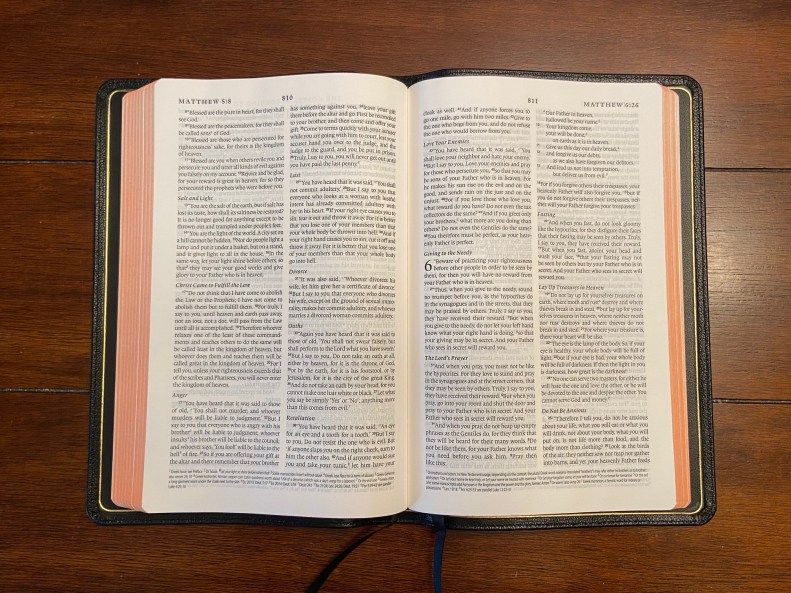
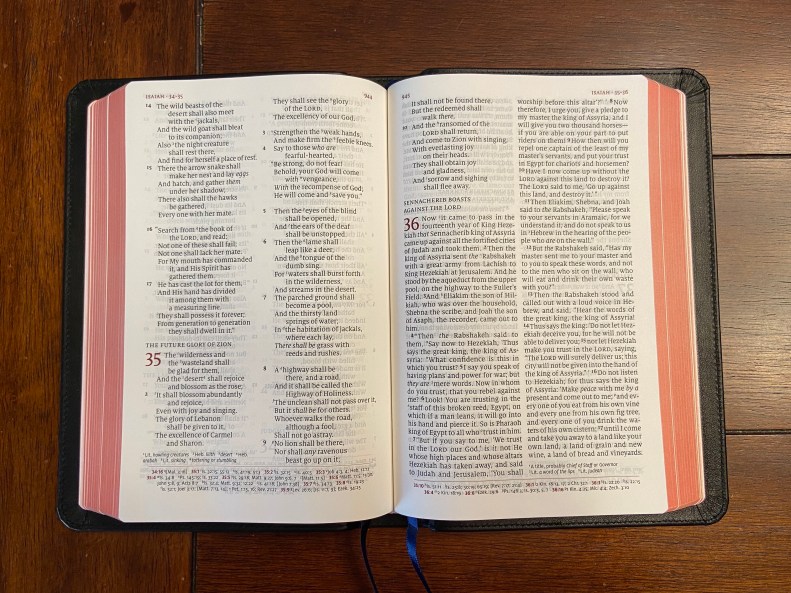
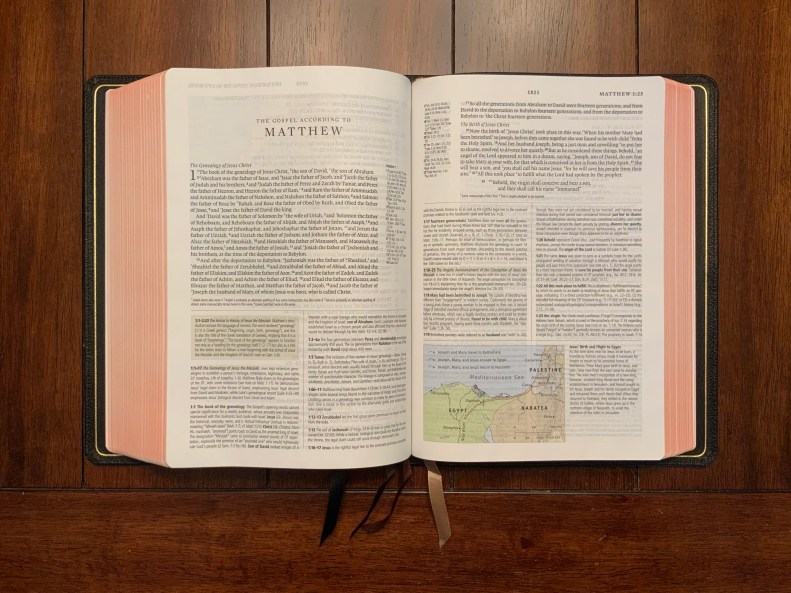
The very first fine Bible I got my hands on was the Schuyler Quentel NIV. This Bible seemed too good to be true. When I opened the box, I was greeted with the delightful rich smell of leather. The layout was astounding because it was so readable. At first glance, you might assume that the Bible is so readable because it has no cross references. In double-column Bibles, the references are almost always in a thin column between the two columns of text. The Schuyler Quentel does have cross references, but it removed the references column and placed the references in the footer. You have access to the references when you need them, with a much more clean and readable page. The Quentel is my favorite layout for a double-column reference Bible.

With so much to love about the Schuyler Quentel, there was one thing that disappointed me about it. The Bible just seemed a bit too big or bulky. It felt to me like a Study Bible. (These kinds of critiques are often unfair. A smaller Bible will be critiqued because the pages are too thin and the writing shows through the pages, which is what allows the Bible to be small. Or, it will be critiqued because the font is too small, making it hard to read. And a Bible with a more readable font and thicker pages that don’t show the text on the opposite side of the page as clearly is criticized for being too bulky, when a larger font and thicker pages requires a larger Bible.)

Choosing a fine Bible is, in many ways, about tradeoffs. I am frequently asked by readers to recommend a Bible. And my response is always a question, because there is not one Bible that is straightforwardly perfect. How do you rank the variety of variables in a Bible? Do you have a strong preference for a particular translation? How important is font size (this is an essential factor if you simply cannot read below a particular font size)? Are cross references a requirement? How important are other design choices (such as single column versus double column)? What is your budget? Is there a particular kind of leather that is essential for the cover? Or color?

All of this is to say, as much as I loved the Schuyler Quentel, I couldn’t help feeling like it was just a bit too big.

Enter the Schuyler Personal Size Quentel

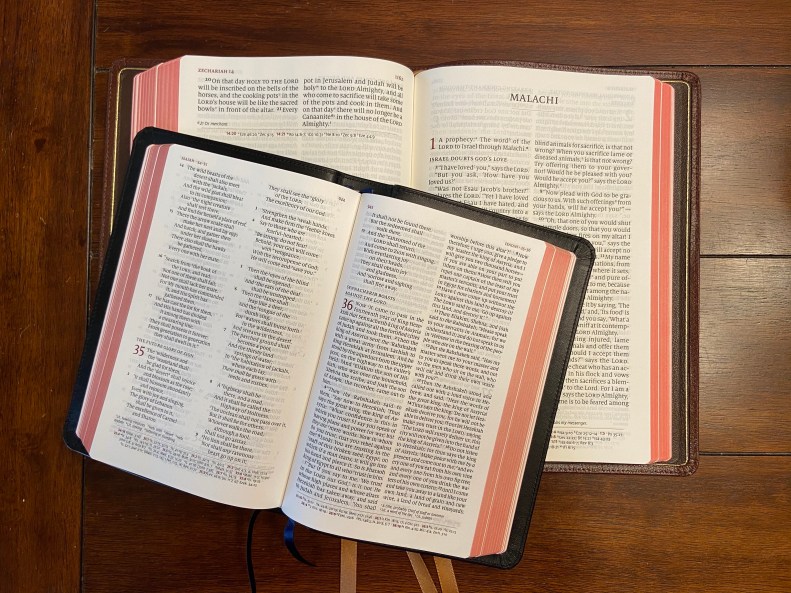
Schuyler’s Personal Size Quentel has the exact same layout (as long as you are comparing the same translation) as the Quentel, but in a smaller format. This means that if you compare the NIV Quentel to the NIV Personal Size Quentel the same words are in the same place on the same page. I love this feature, because it means that you get to choose between ease of reading in a large size or portability with a smaller font. (Another advantage is that someone could buy both and have the best of both worlds.)

The folks at Schuyler were kind enough to send me a Personal Size NKJV in black calfskin leather. The Schuyler Quentel I have in NIV is roughly 10” x 6 3/4” x 1 3/4” with the pages being 9.1″ x 6.1”. The Personal Size Quentel I have is roughly 7 3/4” x 5 1/4” x 1 1/4” with the pages being 7” x 4.7″. The Personal Size Quentel is still fairly thick. I really like the way it feels in the hand. I think the balance between page size and thickness is great. The size and feel is similar to reading a mass market paperback book (slightly bigger).

I was excited to get my hands on a calfskin binding because they have one significant advantage over a goatskin binding: they are significantly more affordable. I believe the difference in price is typically $185 for a goatskin edge-lined binding and $120 for a calfskin paste off binding. The difference in price has more to do with the quality of the binding than the quality of the leather. Edge-lined bindings are widely considered to be the most durable, with paste off bindings being less so. (I’ve explained this in more depth in my review of Cambridge’s NRSV Reference edition.)

The calfskin cover is great! It has a very smooth texture. It is noticeably different than a typical goatskin cover, which usually has a more pebbly and textured grain. (Another matter of personal preference in deciding which Bible to buy!) It feels great. Buttery is a word commonly used to describe the feel of a cover like this. The stiffer cover on a smaller Bible designed to take with you may be an advantage in helping protect it. Considering the difference in price, I would choose the calfskin over the goatskin for the Personal Size Quentel.

Another great feature of both the Schuyler Quentel and the Personal Size Quentel is that Schuyler has committed to this format across translations. They have published each format in ESV, NASB, NKJV, and NIV. Availability varies, as Schuyler is one of the most popular producers of fine Bibles and their print runs tend to sell out fairly quickly.

One of the most surprising things to me about the Personal Size Quentel is how readable it is even in the smaller version. Schuyler says the Personal Size Quentel comes in an 8.5 point font size. For comparison, the Quentell is 11 point font.

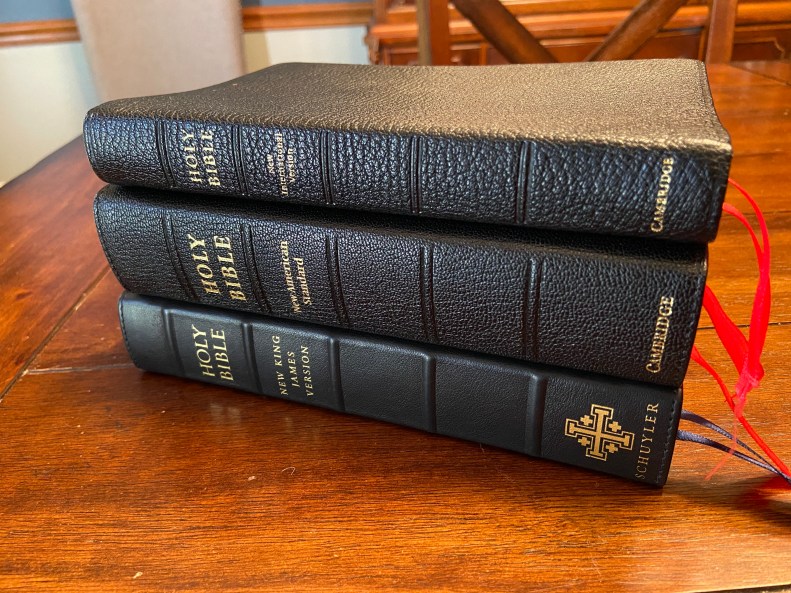
The two most obvious comparisons of this Bible are the Cambridge Pitt Minion and the Cambridge Clarion. Like the Schuyler Personal Size Quentel, both of these Cambridge Bibles are available in a wide range of translations. The Pitt Minion is the smallest of the three (it is particularly thin in comparison to the Personal Size Quentel and the Clarion.) However, the 6.75 point font in the Pitt Minion is noticeably smaller than that of the Personal Size Quentel. The Clarion has a slightly larger font size and is a single column layout. (For photos of the text and layout, see my reviews of the Pitt Minion and Clarion above.) It is also noticeably thicker than the Personal Size Quentel. When comparing the three for this review, I was surprised at how well the more affordable calfskin stacked up against the significantly more expensive Cambridge Clarion goatskin.

Conclusion

The Schuyler Personal Size Quentel is a fantastic Bible. I’ve spent a lot of time with the Schuyler Quentel I got several years ago. The Personal Size Quentel is what I hoped it would be, particularly as far as my initial sense that the Quentel just felt a bit too big. I am grateful I have both because I would really struggle to choose between them. If forced to choose, I would go with the Personal Size Quentel because I can envision taking it with me when I travel and it is still very readable with my current vision. Highly recommended!


Kevin M. Watson is a professor at Candler School of Theology, Emory University. He teaches, writes, and preaches to empower community, discipleship, and stewardship of our heritage. Click here to get future posts emailed to you. Schuyler generously provided a copy of this Bible in exchange for my honest review.

John Wesley’s Sermon “Upon our Lord’s Sermon on the Mount, Discourse the Second”: A Brief Summary

08 Tuesday Sep 2020

Posted by Kevin M. Watson in Uncategorized

≈ 17 Comments

John Wesley, Justification by Faith


This is the 17th sermon in this series. You can expect to see a new post in this series by 10am EST on Tuesday mornings. Just joining the growing number of people reading these sermons? Feel free to start at the beginning by reading the first sermon by John Wesley in this series, “Salvation by Faith,” or jump right in with us!


Background:

Did you know that many of John Wesley’s sermons are part of the formal doctrinal teaching of multiple Wesleyan/Methodist denominations? Wesley’s sermons have particular authority because these were the main way he taught Methodist doctrine and belief.

“Upon Our Lord’s Sermon on the Mount, Discourse the Second” is the 17th sermon of the Wesleyan Standard Sermons. It is also the 2nd of 13 sermons on the Sermon on the Mount. The fact that 13 of the 44 original Standard Sermons focused on the Sermon on the Mount gives an idea of the importance John Wesley placed on Matthew 5-7. Wesley spends so much time on these three chapters of the Bible because he believed they provide essential teaching from Jesus on “the true way to life everlasting, the royal way which leads to the kingdom.”

In hopes of sparking interest in Wesley’s sermons and Methodism’s doctrinal heritage, here is my very short summary of “Upon Our Lord’s Sermon on the Mount, Discourse the Second.” I hope it will inspire you to read the sermon in its entirety yourself. Links to the sermon and other resources are included at the end of this post.


Key quote: 

And it is impossible to satisfy such a soul, a soul that is athirst for God, the living God, with what the world accounts religion, as with what they account happiness. The religion of the world implies three things: first, the doing no harm, the abstaining from outward sin – at least from such as is scandalous, as robbery, theft, common swearing, drunkenness; secondly, the doing good – the relieving the poor, the being charitable, as it is called; thirdly, the using the means of grace – at least going to church and to the Lord’s Supper. He in whom these three marks are found is termed by the world a religious man. But will this satisfy him who hungers after God? No. It is not food for his soul. He wants a religion of a nobler kind, a religion higher and deeper than this. He can no more feed on this poor, shallow, formal thing, than he can ‘fill his belly with the east wind.’ True, he is careful to abstain from the very appearance of evil. He is zealous of good works. He attends all the ordinances of God. But all this is not what he longs for. This is only the outside of that religion which he insatiably hungers after. The knowledge of God in Christ Jesus; ‘the life that is hid with Christ in God’; the being ‘joined unto the Lord in one Spirit’; the having ‘fellowship with the Father and the Son’; the ‘walking in the light as God is in the light’; the being ‘purified even as he is pure’ – this is the religion, the righteousness he thirsts after. Nor can he rest till he thus rests in God. [II.4]


One sentence summary:  

Wesley explains meekness, hungering and thirsting after righteousness, and being merciful and their blessings.


Scripture passage for the sermon:

“Blessed are the meek; for they shall inherit the earth.
Blessed are they which do hunger and thirst after righteousness; for they shall be filled.
Blessed are the merciful; for they shall obtain mercy.” – Matthew 5:5-7


Concise outline of “Upon our Lord’s Sermon on the Mount, Discourse the Second”

I. Blessed are the meek

1. Blessed are the meek; for they shall inherit the earth.
2. The meek are not those who cannot discern good from evil.
3. Nor does it imply being without zeal for God.
4. Meekness is resignation – a calm acquiescence to God’s will.
5. The truly meek can clearly discern what is evil; and they can also suffer it.
6. This divine temper should not only abide, but increase in us day by day.
7. Meekness restrains not only the outward act.
8. Wesley makes the comparison to murder that only happens in the heart.
9. You can be angry at sin but not give way to it.
10. God will not excuse our defects in some areas because of our exactness in another area.
11. Let there be no delay in what so nearly concerns your soul.
12. The meek shall inherit the earth.
13. The meek still have a more eminent part in the “new earth.”

II. Blessed are they which do hunger and thirst after righteousness

1. Our Lord has been more immediately employed in removing the hindrances of true religion.
2. Righteousness is the image of God, the mind which was in Christ Jesus.
3. This hunger of the soul, this thirst after the image of God, is the strongest of all spiritual appetites.
4. A summary of the “General Rules.” And their insufficiency for those who hunger and thirst after righteousness.
5. Blessed are they who do thus hunger and thirst after righteousness; for they shall be filled.
6. If God has given you this hunger, pray that it may never cease.

III. Blessed are the merciful

1. The word used by our Lord more immediately implies the compassionate, the tender-hearted; those who, far from despising, earnestly grieve for those that do not hunger after God.
2. This love if of vast importance.
3. Love of neighbor is long-suffering and patient toward all people.
4. In order to overcome evil with good, love is kind.
5. Love does not envy.
6. Love does not hastily condemn.
7. Love is not puffed up.
8. Love is not rude or unwillingly offensive.
9. Love doesn’t seek its own temporal good.
10. Such love is not provoked.
11. Love doesn’t think evil.
12. Love does not rejoice in inequity.
13. Love rejoices in the truth.
14. Love covers all things, except to confront evil.
15. Love thinks the best of others.
16. Love hopes all things.
17. Love endures all things.
18. Even though things look terrible in the face of this ideal, still hope. May your soul continually overflow with love.


Resources:

Read “Upon Our Lord’s Sermon on the Mount, Discourse the Second” in its entirety.

Check out my brief summaries of the first sixteen Standard Sermons:

“Salvation by Faith”

“The Almost Christian”

“Awake, Thou That Sleepest”

“Scriptural Christianity“

“Justification by Faith“

“The Righteousness of Faith“

“The Way to the Kingdom“

“The First-Fruits of the Spirit“

“The Spirit of Bondage and of Adoption“

“The Witness of the Spirit, I“

“The Witness of Our Own Spirit“

“The Means of Grace“

“The Circumcision of the Heart“

“The Marks of the New Birth“

“The Great Privilege of those that are Born of God“

“Upon our Lord’s Sermon on the Mount, Discourse the First“

I highly recommend the critical edition of Wesley’s sermons, which has excellent references that show his reliance on Scripture throughout his preaching. There are four volumes if you want every known Wesley sermon. They aren’t cheap, but this is the most important publication by Abingdon since its release. Highly recommended!

There is also a three volume edition of Wesley’s sermons in modern English, which is easier to read if you find the 18th century English frustrating. Here is the first volume.


Kevin M. Watson is a professor at Candler School of Theology, Emory University. He teaches, writes, and preaches to empower community, discipleship, and stewardship of our heritage. Click here to get future posts emailed to you. Affiliate links used in this post.

Crossway ESV Heirloom Study Bible: A One of a Kind Study Bible

03 Thursday Sep 2020

Posted by Kevin M. Watson in Uncategorized

≈ 3 Comments

Crossway’s ESV Heirloom Study Bible is unique in that it combines all of the research tools of a Study Bible with the material and craftsmanship of a premium Bible. Before seeing this Bible, I would have assumed that it would be impossible to pull off a Study Bible that is of the same quality as the kind of Bibles I’ve reviewed here in the past. After having spent quite a bit of time with this Bible, I can’t even remember why I thought that.  This is a great Bible!


Cover

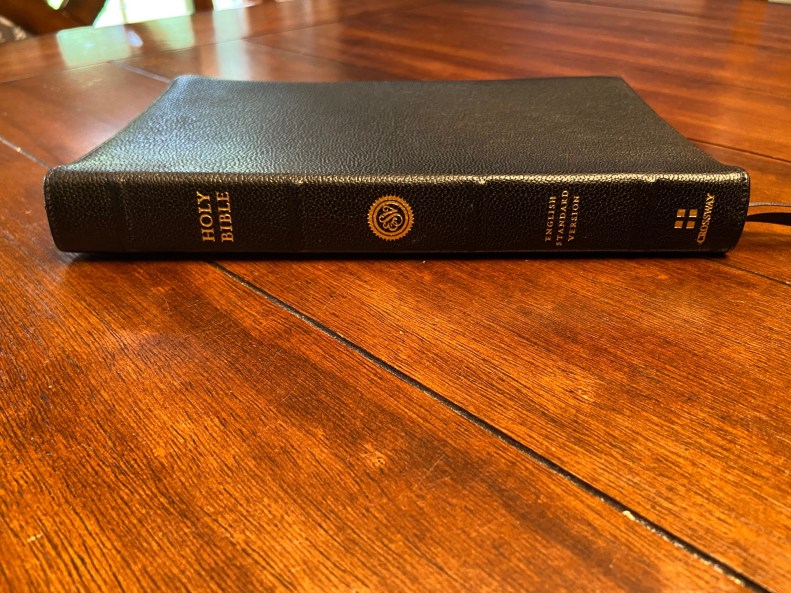
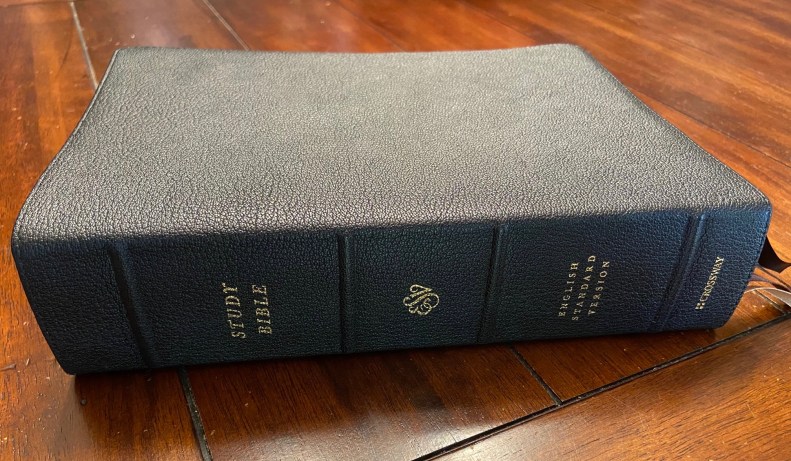
The ESV Heirloom Study Bible has a black goatskin cover with edge-lined binding. The cover feels very similar to other Crossway goatskin covers I’ve held. It is a bit less glossy with more a matte finish than the Crossway ESV Heirloom Thinline Bible I recently reviewed.

The cover has a fairly low profile, which I like given how large the Bible is. The front and back covers do not have any writing. The spine has gold lettering with bands that in my view perfectly fit the profile of the Bible. I really like the cover on this chunky Bible.


Layout

Crossway ESV Heirloom Study Bible

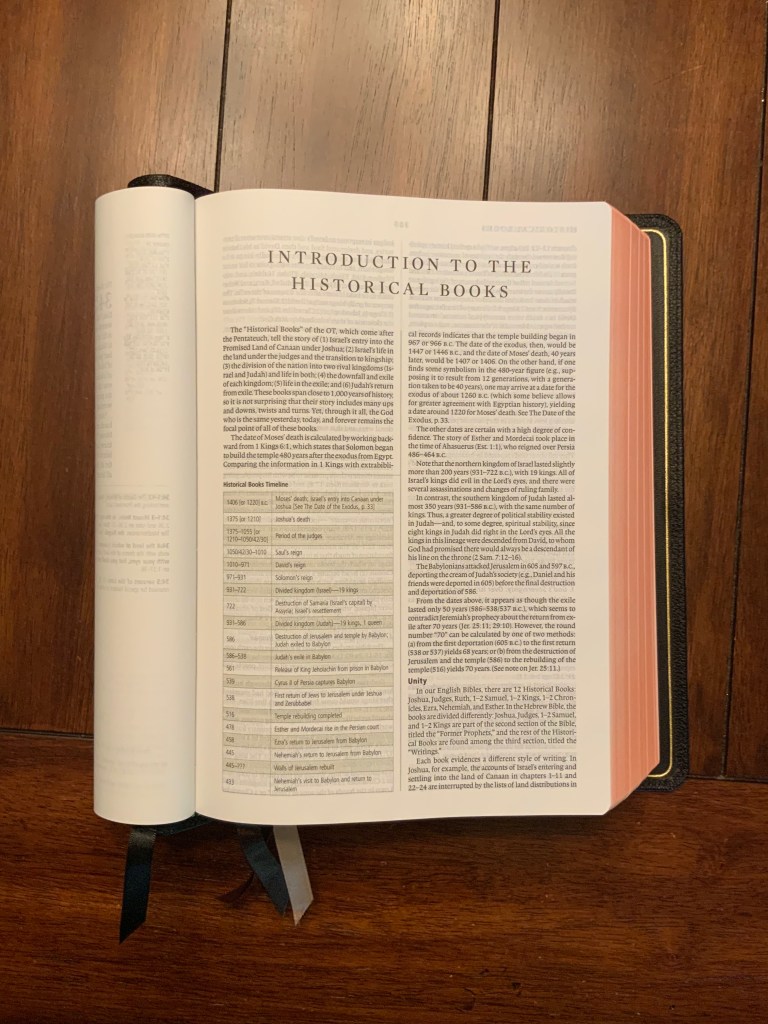
The layout of Crossway’s ESV Heirloom Study Bible is identical to the ESV Study Bible in other bindings. The outstanding feature of the layout of this Bible is that it is single column. Study Bibles are often double column because it helps get more words on each page. The notes are double column in this Bible, but the text of Scripture is single column. This is a great design choice, as it creates a very clear visual difference between Scripture and commentary on Scripture.

As I would expect in a Bible that is nearly 3,000 pages, the paper in this Bible is quite thin. I would not want it to be any thicker, as this Bible is already very stout. (I measured mine at 2 3/8” thick.) Because of the thinness of the paper, there is a fair amount of show-through. I find it acceptable, given what this Bible is. Despite this, I really like the paper in this Bible, particularly compared to other Study Bibles. It has more of a matte than glossy finish. The color on the 240 maps look great as well.


Other Features

Crossway ESV Heirloom Study Bible

This Bible has the features you would expect in a Study Bible. There are more than 2 million words with 20,000 notes to guide your study of Scripture. The ESV Study Bible also has extensive cross references, which I always appreciate. The Bible has art-gilt page edges, which are very nicely done. I really like the look of the art gilding on such a thick Bible. While most premium Bibles have two or three ribbons, this one has four ribbon markers. This was a great design choice, as the addition of a fourth ribbon works well proportionally with the thickness of this Bible. I do wish the ribbons were half an inch longer. They look short to me and barely reach the corner of the page.


Conclusion

Crossway ESV Heirloom Study Bible

Fine Bibles are expensive. And so they already have a pretty specific target audience. I suspect that this Bible may have the most specific audience of any Bible I’ve reviewed. The retail price of the ESV Heirloom Study Bible is the most expensive I’ve seen at $375. It is typically significantly discounted by online distributors. (It was $236.71 on Amazon as of this writing and has often been offered for less than $200.) All this is to say that I suspect that this Bible is most likely to be bought by someone who has previously owned an ESV Study Bible and is an enthusiast of that specific Bible. That has made me wonder if this Bible was riskier for Crossway to commit to publishing. I love that they took the risk. They have created a Bible that is exceptionally crafted and has serious tools for studying Scripture. If you are a fan of the ESV Study Bible, I highly recommend Crossway’s ESV Heirloom Study Bible.


Kevin M. Watson is a professor at Candler School of Theology, Emory University. He teaches, writes, and preaches to empower community, discipleship, and stewardship of our heritage. Click here to get future posts emailed to you. Affiliate links used in this post. Crossway provided a review copy of this Bible in exchange for an honest review.
John Wesley’s Sermon “Upon our Lord’s Sermon on the Mount, Discourse the First”: A Brief Summary

01 Tuesday Sep 2020

Posted by Kevin M. Watson in Uncategorized

≈ 19 Comments

John Wesley, Justification by Faith


This is the 16th sermon in this series. You can expect to see a new post in this series by 10am EST on Tuesday mornings. Just joining the growing number of people reading these sermons? Feel free to start at the beginning by reading the first sermon linked below, or jump right in with us!


Background:

Did you know that many of John Wesley’s sermons are part of the formal doctrinal teaching of multiple Wesleyan/Methodist denominations? Wesley’s sermons have particular authority because these were the main way he taught Methodist doctrine and belief.

“Upon Our Lord’s Sermon on the Mount, Discourse the First” is the sixteenth sermon of the Wesleyan Standard Sermons. It is also the first of thirteen sermons on the Sermon on the Mount. The fact that 13 of the 44 original Standard Sermons focused on the Sermon on the Mount gives an idea of the importance John Wesley placed on Matthew 5-7. Wesley spends so much time on these three chapters of the Bible because he believed they provide essential teaching from Jesus on “the true way to life everlasting, the royal way which leads to the kingdom.”

In hopes of sparking interest in Wesley’s sermons and Methodism’s doctrinal heritage, here is my very short summary of “Upon Our Lord’s Sermon on the Mount, Discourse the First.” I hope it will inspire you to read the sermon in its entirety yourself. Links to the sermon and other resources are included at the end of this post.


Key quote: 

And what is it which he is teaching? The Son of God, who came from heaven, is here showing us the way to heaven, to the place which he hath prepared for us, the glory he had before the world began. He is teaching us the true way to life everlasting, the royal way which leads to the kingdom. And the only true way; for there is none besides – all other paths lead to destruction. From the character of the speaker we are well assured that he hath declared the full and perfect will of God. He hath uttered not one tittle too much: nothing more than he had received of the Father. Nor too little: he hath not shunned to declare the whole counsel of God. Much less hath he uttered anything wrong, anything contrary to the will of him that sent him. All his words are true and right concerning all things, and shall stand fast for ever and ever. [.3]


One sentence summary:  

The Sermon on the Mount is essential teaching for the Christian life and the promise of blessing that comes through poverty of spirit and mourning are a key foundation of the sermon.


Scripture passage for the sermon:

“And seeing the multitudes, he went up into a mountain, and when he was set, his disciples came unto him:
And he opened his mouth and taught them, saying,
Blessed are the poor in spirit; for theirs is the kingdom of heaven.
Blessed are they that mourn; for they shall be comforted.” – Matthew 5:1-4


Concise outline of “Upon our Lord’s Sermon on the Mount, Discourse the First”

1. Introduction to the sermon and context of the passage.
2. Let us observe who it is that is speaking, that we may take heed how we hear.
3. He is teaching that the Son of God, who came from heaven, is showing us the way to heaven.
4. Who is teaching? One having authority, not as the scribes.
5. All men allow with regard to some parts of the ensuing discourse.
6. Maybe they will say the reason of the thing requires such a restriction because it is absurd or contradicts other Scripture. But neither is the case.
7. Jesus speaks here as a person has never previously spoken.
8. With what amazing love does the Son of God here reveal his Father’s will to man!
9. With what authority does he teach! He speaks as God!
10. This divine discourse is divided into three parts: Matthew 5 contains the sum of all true religion in 8 particulars. Matthew 6 has the rules for right intention which we are to observe in all outward actions. And Matthew 7 cautions against the main hindrances of religion.

I. Blessed are the poor in spirit

1. The eight particulars Jesus lays down can be understood as the stages of a Christian’s course and also the things that are important at all times for every Christian.
2. The foundation of all is poverty of spirit.
3. Poverty of spirit does not mean only freedom from the love of money.
4. The poor in spirit are the humble, those convinced of sin.
5. Their guilt is before them and they know the punishment they deserve.
6. They knows they cannot obey the outward commands of God.
7. Poverty of spirit is a just sense of our inward and outward sins, our guilt and helplessness.
8. Reinforces by engaging Romans 1:18.
9. Christianity ends just where heathen morality ends.
10. Sinner awake! Know thyself!
11. Righteousness is the life of God in the soul, the mind which was in Jesus Christ.
12. Theirs is the kingdom of heaven – the humble turn to Christ and find salvation in him.
13. Poverty of Spirit begins where a sense of guilt and of the wrath of God ends, and is a continual sense of our total dependence on God for everything good.

II. Blessed are they that mourn

1. Blessed are they that mourn, for they will be comforted.
2. Expands the meaning of mourning.
3. They mourn after God.
4. Blessed are they who mourn because they shall be comforted by the witness of the Spirit. Full assurance of faith.
5. This process of mourning for an absent God and recovering the joy of the Lord’s countenance is shadowed in John 16:19-22.
6. The children of God still mourn for the sins and miseries of mankind.
7. But all this wisdom of God is foolishness with the world.
8. But let not the children of God be moved by these things.


Resources:

Read “Upon Our Lord’s Sermon on the Mount, Discourse the First” in its entirety.

Check out my brief summaries of the first fifteen Standard Sermons:

“Salvation by Faith”

“The Almost Christian”

“Awake, Thou That Sleepest”

“Scriptural Christianity“

“Justification by Faith“

“The Righteousness of Faith“

“The Way to the Kingdom“

“The First-Fruits of the Spirit“

“The Spirit of Bondage and of Adoption“

“The Witness of the Spirit, I“

“The Witness of Our Own Spirit“

“The Means of Grace“

“The Circumcision of the Heart“

“The Marks of the New Birth“

“The Great Privilege of those that are Born of God“

I highly recommend the critical edition of Wesley’s sermons, which has excellent references that show his reliance on Scripture throughout his preaching. There are four volumes if you want every known Wesley sermon. They aren’t cheap, but this is the most important publication by Abingdon since its release. Highly recommended!

There is also a three volume edition of Wesley’s sermons in modern English, which is easier to read if you find the 18th century English frustrating. Here is the first volume.


Kevin M. Watson is a professor at Candler School of Theology, Emory University. He teaches, writes, and preaches to empower community, discipleship, and stewardship of our heritage. Click here to get future posts emailed to you. Affiliate links used in this post.
Crossway Heirloom Thinline Bible: Portable, Easy to Read, and a Delight to Use

28 Friday Aug 2020

Posted by Kevin M. Watson in Uncategorized

≈ 5 Comments

There are so many factors that make a fine Bible exceptional. Here is what I think is most important: Do you want to pick up the Bible again and again? Do you enjoy holding it and, most importantly, reading it? Crossway’s Heirloom Thinline Bible is an excellent example of getting it right. The font in noticeably larger than Cambridge’s Pitt Minion (previously reviewed here) but because of the simple minimalist two-column layout, the Bible is in a surprisingly small package. This is a Bible you can take with you on the go without adding much more bulk than the smallest portable Bibles, with the benefit of significant enhancement in ease of reading.


Cover

Crossway ESV Heirloom Thinline Bible Cover

The Crossway ESV Heirloom Thinline Bible reviewed here is black goatskin. The cover feels substantial, while still being very flexible.The grain is a great balance between either too smooth or too pebbly. It has a really nice texture. The spine has four ribs, which I think are perfect. The lettering on the spine is gold. The design comes close to overkill for me, as there is both the ESV logo and English Standard Version spelled out in addition to “Holy Bible” at the top and Crossway’s logo at the bottom of the spine.

This Bible has edge-lined binding, which is known to be the most durable. One drawn back for edge-lined Bibles for me has sometimes been a stiff hinge where the pages don’t lay flat when the Bible is opened. My sense is that if you don’t have a basis for comparison, this is something that most people would never notice. But if you’ve see an edge-lined Bible that has a flexible hinge (here’s a great example), it is disappointing to see a stiffer hinge. I like to be able to roll the cover around the back of the Bible when I’m reading, which is harder to do with stiff hinges. However, this is less of an issue with the Crossway Heirloom Thinline because of how thin it is while still having a fairly wide page, particularly in proportion to each other. This is a minor concern from my perspective and would not keep me from purchasing this Bible.


Layout

This Bible has a very simple, minimalist layout. I love it!

It has 8-point type, which I consider to be quite large for a Bible with this profile. It is double-column with paragraphs (instead of each verse being separated).  The Bible is black lettering throughout (the words of Jesus are not in red). There is a relatively concise concordance containing 2,400 word entries and 10,000 Scrpiture references. It also has color maps.

This Bible surprised me because I would ordinarily eliminate from consideration a Bible without cross references. This Bible would not be possible in the profile and font size with any additional apparatus. Crossway’s Heirloom Thinline Bible is close to ideal in terms of the combination of portable size with enjoyable reading experience. This advantage makes the lack of references logical.


Conclusion

My enthusiasm for premium Bibles comes from a conviction that the printed word matters. In a time when we spend more and more time with exceptionally well crafted and addictive devices, we need Bibles that are beautifully designed and enjoyable to hold and read. The more Bibles I’ve been able to get my hands on, the more convinced I am that these are a worthwhile investment, particularly as they are made to last a lifetime.

The Crossway ESV Heirloom Thinline Bible is beautifully designed and enjoyable to hold and read. I find myself picking it up and flipping through it because it is so well made and engaging. This is a fantastic Bible. Crossway did a great job on this one!


Bonus: If you’ve tried to read the Bible cover to cover without success, try this!

Crossway has impressed me with their thorough support for the ESV across the board. In addition to their Heirloom line, they also have creatively and thoughtfully produced a variety of Bibles. Outside of the Heirloom Bibles, my favorite is easily the ESV Reader’s Bible, Six-Volume Set.

Have you always wanted to read through the entire Bible, but tend to get bogged down somewhere in Leviticus and just never make it through?

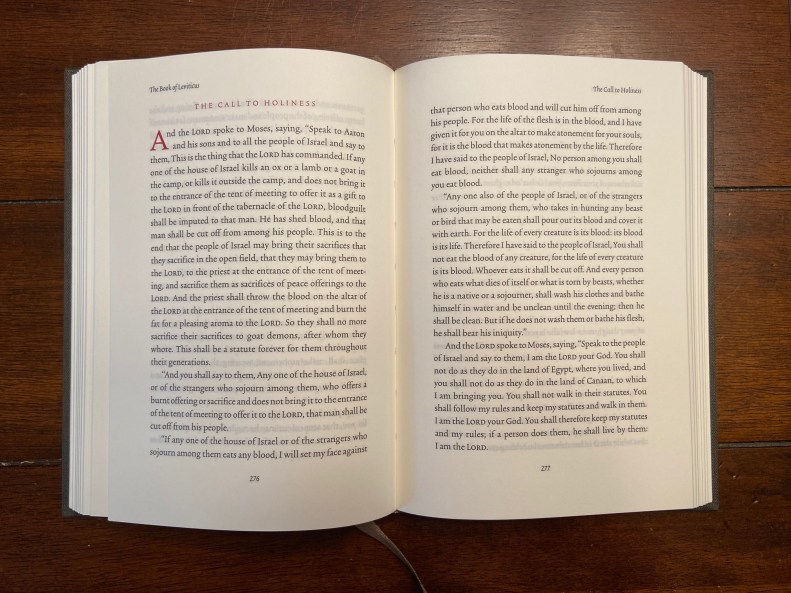
If so, I would highly recommend giving this Bible a try. It is designed to be read like you actually read. Each of the six volumes can be comfortably held in your hands and has paper, font size, and margins similar to a typical book you would read from front to back. The paper is much thicker than a typical Bible (like a normal book) and there are no distracting additions on the page. (There aren’t even chapter or verses.)

I highly recommend this Bible for immersive reading of Scripture. If you want to read through the entire Bible in a relatively short period of time, you should check out this set.


Kevin M. Watson is a professor at Candler School of Theology, Emory University. He teaches, writes, and preaches to empower community, discipleship, and stewardship of our heritage. Click here to get future posts emailed to you. Affiliate links used in this post. Crossway provided a review copy of this Bible in exchange for an honest review.

John Wesley’s Sermon “The Great Privilege of Those that Are Born of God”: A Brief Summary

25 Tuesday Aug 2020

Posted by Kevin M. Watson in Uncategorized

≈ 19 Comments

John Wesley, Justification by Faith


This is the 15th sermon in this series. You can expect to see a new post in this series by 10am EST on Tuesday mornings. Just joining the growing number of people reading these sermons? Feel free to start at the beginning by reading the first sermon linked below, or jump right in with us!


Background:

Did you know that many of John Wesley’s sermons are part of the formal doctrinal teaching of multiple Wesleyan/Methodist denominations? Wesley’s sermons have particular authority because these were the main way he taught Methodist doctrine and belief.

“The Great Privilege of Those that Are Born of God” is the fifteenth sermon of the Wesleyan Standard Sermons. In this sermon, Wesley describes 1 John 3:9 as the “great privilege of those that are born of God.” Are those who have faith in Christ and have experienced the new birth really able to stop sinning? How is that possible? And if so, how is it that people who are born again fall back into sin? Wesley engages these questions in this bold sermon.

In hopes of sparking interest in Wesley’s sermons and Methodism’s doctrinal heritage, here is my very short summary of “The Great Privilege of Those that Are Born of God.” I hope it will inspire you to read the sermon in its entirety yourself. Links to the sermon and other resources are included at the end of this post.


Key quote: 

You see the unquestionable progress from grace to sin. Thus it goes on, from step to step. (1). The divine seed of loving, conquering faith remains in him that is ‘born of God’. ‘He keepeth himself’, by the grace of God, and ‘cannot commit’ sin; (2). A temptation arises, whether from the world, the flesh, or the devil, it matters not; (3). The Spirit of God gives him warning that sin is near, and bids him more abundantly watch unto prayer; (4). He gives way in some degree to the temptation, which now begins to grow pleasing to him; (5). The Holy Spirit is grieved; his faith is weakened, and his love of God grows cold; (6). The Spirit reproves him more sharply, and saith, ‘This is the way; walk thou in it.’ (7). He turns away from the painful voice of God and listens to the pleasing voice of the tempter; (8). Evil desire begins and spreads in his soul, till faith and love vanish away; (9). He is then capable of committing outward sin, the power of the Lord being departed from him. [II.9]


One sentence summary:  

It is the great privilege of all who are born of God to resist voluntary transgressions of the law.


Scripture passage for the sermon:

“Whosoever is born of God doth not commit sin.” – 1 John 3:9


Concise outline of “The Great Privilege of Those that Are Born of God”

1. It has frequently been supposed that being born of God was the same thing as being justified.
2. Though in time they are indistinguishable, they are not the same. Justification is a relative change. The new birth is a real change.
3. Not discerning the difference has caused great confusion.
4. We need to consider ‘whosoever is born of God’ and then in what sense ‘he doth not commit sin.’

I. The meaning of the expression “Whosoever is born of God.”

1. Being born of God is not merely being baptized, but a vast inward change.
2. The natural birth is the easiest way to understand the spiritual.
3. The unborn child has little knowledge of the visible world.
4. He that is not yet born cannot sense the spiritual world because his senses aren’t opened up and there is a thick veil.
5. As soon as a child is born, his senses are opened.
6. So it is with him that is born of God.
7. He has scarce any knowledge of the invisible world.
8. When he is born of God, his whole existence is changed. Wesley uses the image of spiritual respiration.
9. The eyes of his understanding are opened, he clearly sees the love of God and his promises.
10. His ears are opened and the voice of God no longer calls in vain.

II. In what sense does the one born of God not sin?

1. In what sense does the one born again ‘not commit sin?’ The one who receives love from God every moment gives back love and praise.
2. Wesley defines sin as a voluntary transgression of the law.
3. But it is a plain fact that people born of God have sinned.
4. David was born of God and committed the horrid sins of adultery and murder.
5. There are examples even after the sending of the Holy Spirit. Ex. Barnabas
6. An example from Galatians 2:12-14.
7. Wesley seeks to reconcile the previous examples with the assertion of John that “whosoever is born of God doth not commit sin.” He answers: So long as “he that is born of God keepers himself, the wicked one toucheth him not.” (1 John 5:18) Wesley outlines how someone falls back into sin.
8. Wesley illustrates this with the example of David’s sin.
9. The progress from grace to sin (see the steps in the key quote above)
10. Wesley illustrates this using Peter as an example.

III. Does sin precede or follow the loss of faith?

1. The loss of faith must precede the recommitting outward sin.
2. The life of God in a believer continually requires the inspiration of the Holy Ghost.
3. God does not continue to act upon the soul unless it re-acts upon God.
4. Let us fear sin more than death or hell. Watch always that you may always hear the voice of God.
5. A second fruit of the love of God is universal obedience to him we love, and conformity to his will, being zealous of good works.


Resources:

Read “The Great Privilege of those that are Born of God” in its entirety.

Check out my brief summaries of the first fourteen Standard Sermons:

“Salvation by Faith”

“The Almost Christian”

“Awake, Thou That Sleepest”

“Scriptural Christianity“

“Justification by Faith“

“The Righteousness of Faith“

“The Way to the Kingdom“

“The First-Fruits of the Spirit“

“The Spirit of Bondage and of Adoption“

“The Witness of the Spirit, I“

“The Witness of Our Own Spirit“

“The Means of Grace“

“The Circumcision of the Heart“

“The Marks of the New Birth“

I highly recommend the critical edition of Wesley’s sermons, which has excellent references that show his reliance on Scripture throughout his preaching. There are four volumes if you want every known Wesley sermon. They aren’t cheap, but this is the most important publication by Abingdon since its release. Highly recommended!

There is also a three volume edition of Wesley’s sermons in modern English, which is easier to read if you find the 18th century English frustrating. Here is the first volume.


Kevin M. Watson is a professor at Candler School of Theology, Emory University. He teaches, writes, and preaches to empower community, discipleship, and stewardship of our heritage. Click here to get future posts emailed to you. Affiliate links used in this post.
Some Good News

21 Friday Aug 2020

Posted by Kevin M. Watson in Uncategorized

≈ 10 Comments

Candler School of Theology recently announced that I have been promoted to associate professor of Wesleyan and Methodist Studies. I was also granted tenure.

Here is the announcement.

I want to say thank you to the many friends, family, and colleagues who have generously invested their time, energy, and resources in me. I eagerly await the day I can say thank you in person.

In 2006, the Lord called me to work for the renewal of the church by pastoring seminary students who are preparing to become pastors. When I first heard that calling, I was certain it could only happen if God opened the doors for me that needed to be opened. Some of those doors have been hard to walk through.

But the One who called me has been faithful every step of the way.

Paul’s prayer for the Ephesians (Ephesians 3:14-21) has been special to my family. The end of this prayer is the best way I can express my gratitude to God:

Now to him who is able to do immeasurably more than all we ask or imagine, according to his power that is at work within us, to him be glory in the church and in Christ Jesus throughout all generations, for ever and ever! Amen.


Kevin M. Watson is a professor at Candler School of Theology, Emory University. He teaches, writes, and preaches to empower community, discipleship, and stewardship of our heritage. Click here to get future posts emailed to you.

John Wesley’s Sermon “The Marks of the New Birth”: A Brief Summary

18 Tuesday Aug 2020

Posted by Kevin M. Watson in Uncategorized

≈ 20 Comments

John Wesley, Justification by Faith


This is the 14th sermon in this series. You can expect to see a new post in this series by 10am EST on Tuesday mornings. Just joining the growing number of people reading these sermons? Feel free to start at the beginning by reading the first sermon linked below, or jump right in with us!


Background:

Did you know that many of John Wesley’s sermons are part of the formal doctrinal teaching of multiple Wesleyan/Methodist denominations? Wesley’s sermons have particular authority because these were the main way he taught Methodist doctrine and belief.

“The Marks of the New Birth” is the fourteenth sermon of the Wesleyan Standard Sermons. In this sermon, Wesley identifies the marks that one who has experienced justification by faith and the new birth will have. When people experience the new birth, what should we expect their lives to be like? This sermon addresses that question. The answer of faith, hope, and love may initially seem simple. But the way that Wesley fleshes this out is rich and raises deep questions about the Christian life and our expectations for life in Christ.

In hopes of sparking interest in Wesley’s sermons and Methodism’s doctrinal heritage, here is my very short summary of “The Marks of the New Birth.” I hope it will inspire you to read the sermon in its entirety yourself. Links to the sermon and other resources are included at the end of this post.


Key quote: 

This it is, in the judgment of the Spirit of God, to be a son or a child of God. It is so to believe in God through Christ as ‘not to commit sin’, and to enjoy, at all times and in all places, that ‘peace of God which passeth all understanding’. It is so to hope in God through the Son of his love as to have not only the ‘testimony of a good conscience’, but also ‘the Spirit of God bearing witness with your spirits that ye are the children of God’: whence cannot but spring the ‘rejoicing evermore in him through whom ye have received the atonement’. It is so to love God, who hath thus loved you, as you never did love any creature: so that ye are constrained to love all men as yourselves; with a love not only ever burning in your hearts, but flaming out in all your actions and conversations, and making your whole life one ‘labour of love’, one continued obedience to those commands, ‘Be ye merciful, as God is merciful;’ ‘Be ye holy, as I the Lord am holy;’ ‘Be ye perfect, as your Father which is in heaven is perfect.’ [IV.1]


One sentence summary:  

The marks of the new birth are faith, hope, and love.


Scripture passage for the sermon:

“So is everyone that is born of the Spirit.” – John 3:8


Concise outline of “The Marks of the New Birth”

1. How is everyone born again, born of God? What is implied in being a son or child of God? What is the new birth?
2. I propose to lay down the marks, just as I find them in Scripture.

I. The First Mark of the New Birth Is Faith

1. The first mark of the new birth is faith.
2. It is not a barely notional or speculative faith.
3. True living faith is not only an assent, but a disposition which God has wrought in a person’s heart.
4. An immediate and constant fruit of this faith is power over sin.
5. Power over outward sin is affirmed in John.
6. Whosoever is born of God does not sin (more engagement with John).
7. Another fruit of this living faith is peace.

II. The Second Mark of the New Birth Is Hope

1. A second mark of those who are born of God is hope.
2. This hope implies (1) testimony of our own spirit. We walk in sincerity and (2) the witness of the Spirit.
3. The Spirit himself bears witness with our spirits that we are the children of God.
4. All who have received this one Spirit cry “Abba Father” together.
5. Blessed are they that mourn, for they shall be comforted.

III. The Third Mark of the New Birth Is Love

1. A third scriptural mark, the greatest of all, is love.
2. He is so joined unto the Lord as to be “one spirit.”
3. The necessary fruit of this love for God is love for our neighbor.
4. Love of God and neighbor will lead to keeping the rest of the commandments.
5. A second fruit of the love of God is universal obedience to him we love, and conformity to his will, being zealous of good works.

IV. Summary

1. A summary of what has been said so far.
2. The question is not what you were – what are you now?
3. Don’t say: I was once baptized; therefore I am now a child of God.
4. To say you cannot be born again but in baptism is to seal yourself under damnation.
5. Verily, verily, I say unto you, you must also be born again.
6. May all who prepare their hearts yet again to seek God’s face receive again that Spirit of adoption and cry out, Abba, Father!


Resources:

Read “The Marks of the New Birth” in its entirety.

Check out my brief summaries of the first thirteen Standard Sermons:

“Salvation by Faith”

“The Almost Christian”

“Awake, Thou That Sleepest”

“Scriptural Christianity“

“Justification by Faith“

“The Righteousness of Faith“

“The Way to the Kingdom“

“The First-Fruits of the Spirit“

“The Spirit of Bondage and of Adoption“

“The Witness of the Spirit, I“

“The Witness of Our Own Spirit“

“The Means of Grace“

“The Circumcision of the Heart“

I highly recommend the critical edition of Wesley’s sermons, which has excellent references that show his reliance on Scripture throughout his preaching. There are four volumes if you want every known Wesley sermon. They aren’t cheap, but this is the most important publication by Abingdon since its release. Highly recommended!


Kevin M. Watson is a professor at Candler School of Theology, Emory University. He teaches, writes, and preaches to empower community, discipleship, and stewardship of our heritage. Click here to get future posts emailed to you. Affiliate links used in this post.

John Wesley’s Sermon “The Circumcision of the Heart”: A Brief Summary

11 Tuesday Aug 2020

Posted by Kevin M. Watson in Uncategorized

≈ 23 Comments

John Wesley, Justification by Faith


This is the 13th sermon in this series. I took a few weeks off in July, but generally you can expect to see a new post in this series by 10am EST on Tuesday mornings. Just joining the growing number of people reading these sermons? Feel free to start at the beginning by reading the first sermon linked below, or jump right in with us!


Background:

Did you know that many of John Wesley’s sermons are part of the formal doctrinal teaching of multiple Wesleyan/Methodist denominations? Wesley’s sermons have particular authority because these were the main way he taught Methodist doctrine and belief.

“The Circumcision of the Heart” is the thirteenth sermon of the Wesleyan Standard Sermons and is the first that Wesley actually preached. The sermon is a revised version of a sermon he preached at St. Mary’s, Oxford on January 1, 1733. This is a sermon Wesley himself identified as a crucial summary of his understanding of salvation and holiness.

In hopes of sparking interest in Wesley’s sermons and Methodism’s doctrinal heritage, here is my very short summary of “The Circumcision of the Heart.” I hope it will inspire you to read the sermon in its entirety yourself. Links to the sermon and other resources are included at the end of this post.


Key quote: 

In general we may observe it is that habitual disposition of the soul which in the Sacred Writings is termed ‘holiness’, and which directly implies the being cleansed from sin, ‘from all filthiness both of flesh and spirit’, and by consequence the being endued with those virtues which were also in Christ Jesus, the being so ‘renewed in the image of our mind’ as to be ‘perfect, as our Father in heaven is perfect’. [I.1]


One sentence summary:  

The circumcision of the heart is a radical change, an inner transformation, where by faith we receive humility, faith, hope, and love.


Scripture passage for the sermon:

“Circumcision is that of the heart, in the spirit and not in the letter.” – Romans 2:29


Concise outline of “The Circumcision of the Heart”

1. If Christ be risen, ye ought then to die unto the world, and to live wholly unto God.
2. This is a hard saying to natural people.
3. Circumcision of the heart is a right state of soul.

I. What is the circumcision of the heart?

1. The habitual disposition of the soul which in the Sacred Writings is termed holiness, directly implies being cleansed from sin and being renewed in mind so as to be perfect as our Father in heaven is perfect.
2. Circumcision of the heart implies humility, faith, hope, and charity.
3. We are convinced we are not sufficient to help ourselves.
4. It is a disregard of that honor which comes of man.
5. Faith alone is able to make us whole.
6. It is a faith that is mighty through God to pull down strongholds.
7. All things are possible to him that thus believes.
8. This faith delivers from the yoke of sin.
9. Brings hope and testimony of their own spirits that they are children of God.
10. He will renounce the works of darkness, every appetite, and affection not subject to the laws of God.
11. Add to all of this love and you have the circumcision of the heart.
12. It implies we love our brother and sister also.
13. Have no end, no ultimate end, but God.

II. Reflections that naturally arise from such an inquiry

1. No one has a title to the praises of God unless his heart has been circumcised by humility.
2. None shall obtain the honor that comes from God until his heart is circumcised by faith.
3. A caution against laying another foundation, in seeking to ground religion on the “eternal fitness of things.”
4. Importance of faith and works.
5. None is truly led by the Spirit unless the Spirit witnesses with their spirit that they are children of God.
6. It is time for people to deal faithfully with their own souls.
7. This is not any easy effortless road.
8. It requires daily self-denial.
9. Reemphasis on the centrality of a heart circumcised by love.
10. Do everything to the glory of God, set our sights completely on giving our hearts to God.


Resources:

Read “The Circumcision of the Heart” in its entirety.

Check out my brief summaries of the first twelve Standard Sermons:

“Salvation by Faith”

“The Almost Christian”

“Awake, Thou That Sleepest”

“Scriptural Christianity“

“Justification by Faith“

“The Righteousness of Faith“

“The Way to the Kingdom“

“The First-Fruits of the Spirit“

“The Spirit of Bondage and of Adoption“

“The Witness of the Spirit, I“

“The Witness of Our Own Spirit“

“The Means of Grace“

I highly recommend the critical edition of Wesley’s sermons, which has excellent references that show his reliance on Scripture throughout his preaching. There are four volumes if you want every known Wesley sermon. They aren’t cheap, but this is the most important publication by Abingdon since its release. Highly recommended!


Kevin M. Watson is a professor at Candler School of Theology, Emory University. He teaches, writes, and preaches to empower community, discipleship, and stewardship of our heritage. Click here to get future posts emailed to you. Affiliate links used in this post.
John Wesley’s Sermon “The Means of Grace”: A Brief Summary

04 Tuesday Aug 2020

Posted by Kevin M. Watson in Uncategorized

≈ 23 Comments

John Wesley, Justification by Faith


This is the 12th sermon in this series. I took a few weeks off in July, but generally you can expect to see a new post in this series by 10am EST on Tuesday mornings. Just joining the growing number of people reading these sermons? Feel free to start at the beginning by reading the first sermon linked below, or jump right in with us!


Background:

Did you know that many of John Wesley’s sermons are part of the formal doctrinal teaching of multiple Wesleyan/Methodist denominations? Wesley’s sermons have particular authority because these were the main way he taught Methodist doctrine and belief.

“The Means of Grace” is the twelfth sermon of the Wesleyan Standard Sermons and focuses on a crucial concept for Wesleyan discipleship. In hopes of sparking interest in Wesley’s sermons and Methodism’s doctrinal heritage, here is my very short summary of “The Means of Grace.” I hope it will inspire you to read the sermon in its entirety yourself. Links to the sermon and other resources are included at the end of this post.


Key quote: 

By ‘means of grace’ I understand outward signs, words, or actions ordained of God, and appointed for this end – to be the ordinary channels whereby he might convey to men preventing, justifying, and sanctifying grace….

The chief of these means are prayer, whether in secret or with the great congregation; searching the Scriptures (which implies reading, hearing, and meditating thereon) and receiving the Lord’s Supper, eating bread and drinking wine in remembrance of him; and these we believe to be ordained of God as the ordinary channels of conveying his grace to the souls of men. [II.1]


One sentence summary:  

The means of grace are concrete spiritual disciplines set apart by God as the most reliable way we receive preventing, justifying, or sanctifying grace.


Scripture passage for the sermon:

“Ye are gone away from mine ordinances, and have not kept them.” – Malachi 3:7 (KJV)


Concise outline of “The Means of Grace”

I. Misuses and misunderstandings of the means of grace

1. Are there any ordinances since life and immortality were brought to light by the gospel?
2. Some began to mistake the means for the end – to place religion in doing, not in a heart renewed.
3. To those who abused them, they didn’t do what they were intended.
4. Some sought to reform misuse by pointing out the uselessness of the means for their own sake or as a work.
5. Some went too far the other way and began to say outward religion was nothing.
6. This is particularly embraced by those tired and ready to sink into indolent activity.

II. Proper understanding of the means of grace

1. Means of grace – outward signs, words, or actions ordained of God, and appointed for this end – to be the ordinary channels whereby he might convey to men preventing, justifying, or sanctifying grace. Means of grace are prayer, searching the Scriptures, and receiving the Lord’s Supper.
2. The whole value of the means depends on their subservience to the end of religion.
3. All outward means, if separate from the Spirit of God, cannot profit at all.
4. The use of all means will never atone for one sin, the blood of Christ alone atones.
5. A large proportion of Christians abuse the means of grace to the destruction of their souls.
6. By grace ye are saved.
7. How do I wait upon God for salvation?
8. It cannot be that the Word of God is silent on such an important point.

III. The witness of Scripture regarding the use of the means of grace

1. All who desire the grace of God are to wait for it in the means of grace. The first is prayer (Wesley cites Matthew 7:7-8 and Matthew 13:46).
2. God tells us to use prayer and promises it will be effectual. (Matthew 7:9-11, Luke 11:13)
3. We receive of God by importunately asking what otherwise we should not receive at all! (Luke 11:5, 7-9)
5. Matthew 6:6.
6. James 1:5.
7. 2nd: search the Scriptures (John 5:39) – hearing, reading, meditating on Scripture.
8. 2 Timothy 3:15, and 16-17.
9. Scripture is good for doctrine, reproof, correction, instruction.
10. All who desire the day to dawn search the Scriptures.
11. 3rd: the Lord’s Supper (1 Corinthians 11:23-26).
12. Let all who truly desire the grace of God partake of the Lord’s Supper.

IV. Objections

1. You cannot use these means without trusting in them. If I am troubled when I leave off the means, that indicates being troubled because I willfully disobeyed God, not that I trusted in the means.
2. This is seeking salvation by works. Waiting in the way God has ordained is not that.
3. Christ is the only means of grace. This is a mere play on words.
4. Scripture directs us to wait for salvation – Yes, in the way God ordained (i.e, using the means of grace).
5. God has appointed another way – “stand still and see the salvation of God.”
6. Doesn’t Paul say, ‘If ye be dead with Christ, why are ye subject to ordinances?’ (Col 2:20) The great truth must stand: all who desire the grace of God are to wait for it in the means he hath ordained.

V. How to use the means of grace

1. How should these means be used?
2. Hearing or conversation is often first.
3. No particular order is required and the means can be varied.
4.a. God is above all means. He can do whatever he pleases.
4.b. Let it be deeply impressed in your soul – there is no power in this.
4.c. In using all means, seek God alone. Use means as means – in order to renew your soul in righteousness and true holiness.
4.d. Take care not to take pride in your use of the means.


Resources:

Read “The Means of Grace” in its entirety.

Check out my brief summaries of the first eleven Standard Sermons:

“Salvation by Faith”

“The Almost Christian”

“Awake, Thou That Sleepest”

“Scriptural Christianity“

“Justification by Faith“

“The Righteousness of Faith“

“The Way to the Kingdom“

“The First-Fruits of the Spirit“

“The Spirit of Bondage and of Adoption“

“The Witness of the Spirit, I“

“The Witness of Our Own Spirit“

I highly recommend the critical edition of Wesley’s sermons, which has excellent references that show his reliance on Scripture throughout his preaching. There are four volumes if you want every known Wesley sermon. They aren’t cheap, but this is the most important publication by Abingdon since its release. Highly recommended!


Kevin M. Watson is a professor at Candler School of Theology, Emory University. He teaches, writes, and preaches to empower community, discipleship, and stewardship of our heritage. Click here to get future posts emailed to you. Affiliate links used in this post.
← Older posts
Newer posts →

Blog at WordPress.com.

  • Subscribe Subscribed
    • Kevin M. Watson
    • Join 369 other subscribers
    • Already have a WordPress.com account? Log in now.
    • Kevin M. Watson
    • Subscribe Subscribed
    • Sign up
    • Log in
    • Report this content
    • View site in Reader
    • Manage subscriptions
    • Collapse this bar
 

Loading Comments...