• About Me

Kevin M. Watson

Kevin M. Watson

Category Archives: Uncategorized

Free Books!

06 Tuesday Jan 2015

Posted by Kevin M. Watson in Uncategorized

≈ 3 Comments


Today is Seedbed’s birthday. To celebrate, digital downloads of all of Seedbed’s books are free today only. This includes my book The Class Meeting: Reclaiming a Forgotten (and Essential) Small Group Experience. Get it here. I would also highly recommend picking up Howard Snyder’s classic The Radical Wesley, which you can get here.

Happy Birthday, Seedbed!

Catholic Spirit and Methodist Doctrinal Commitments

12 Wednesday Nov 2014

Posted by Kevin M. Watson in Uncategorized

≈ 9 Comments

Why do Methodists so often emphasize the need for a “Catholic Spirit” when we come together for internal conversation as Methodists?

More than two years ago, I wrote a post about Wesley’s sermon “Catholic Spirit,” and the ways it is often misused in contemporary Methodism. Writing that post got at part of what has concerned me about recent appeals to this particular sermon. But there was something else that continued to bother me that I am just starting to try to articulate.

Why is it that when Methodists come together for Annual Conference and General Conference, meetings that are by definition for insiders, so often the focus is on what it means to be Christian, broadly speaking, instead of focusing more specifically on what it means to be a Methodist Christian?

Why is it, for example, that we often seem to instinctively appeal to “Catholic Spirit” instead of “Scripture Way of Salvation?”

When early Methodists gathered at the first conferences, they talked about “What to teach?” “How to teach?” and “What to do, how to regulate our doctrine, discipline, and practice.”[1] They answered these questions with specificity and often explicitly explored the extent of agreement they had with others, as well as where exactly the disagreement was. These conversations were focused on sharpening the particular doctrinal commitments that the people called Methodists had. They were not focused on watering down the importance of particularity or clarity about who they were and what they believed as Methodists.

My impression in reading the “Minutes” of early Methodist conferences is that Methodists were talking about basic Christian doctrine. But they were doing so with the kind of specificity that led them to begin to note points of emphasis that were different from other contemporary Christian communities. They asked questions like, “Have we not then unawares leaned too much towards Calvinism?”[2] And so in early Methodist “Minutes” of Conferences, you find Wesley and his followers wrestling with areas of agreement and points of disagreement with other Christians.

Today, Methodists commonly protest such doctrinal specificity, arguing that we should not be overly concerned about these kinds of precise doctrinal conversations, because doctrine is divisive.

The concern that doctrine is divisive is powerful at a very basic level, because it describes what can happen when we are honest about what we believe and how important we think believing specific things is. Beliefs can lead to division. It is not always true, but it can be true. But it is only true in the sense that it describes what is the case. People often assume that this description necessarily leads to a prescription, namely, that doctrine is bad or harmful because it leads to division. Further, there is an assumption that simply avoiding doctrinal specificity will necessarily lead to unity.

The alternative to specificity about doctrinal commitments, however, is not the virtue of unity. The alternative to doctrinal clarity is theological incoherence.

I suspect it has been unintentional, but calls to downplay the importance of doctrine sometimes sound like a call to be less passionate about things that have long been viewed as essential Christian beliefs. Such calls also ignore the conviction that doctrine is not intended to divide, but to unite around one coherent and identifiable faith.

Another concern that people who resist a vital role for doctrine in the Christian life is that doctrinal commitments can lead to vices like wrath. Commitment to beliefs may lead to wrath, but it in no way necessarily follows that a commitment to particular doctrines must lead to such vice. One can easily reject using harsh words in response to someone you disagree with, without also having to say that a person needs to hold their beliefs more loosely. (Moreover, in encounters with Methodists on some Facebook discussion pages, I have found that “progressives” and “traditionalists” are equally capable of saying unkind and unloving things to one another. I have frequently seen people on Facebook that people who do not believe that Methodism should have an uncompromising commitment to basic orthodoxy are nevertheless capable of wrath towards those with whom they disagree.)

Finally, and perhaps most importantly: Asserting that doctrine is divisive and that clergy should not have to affirm certain doctrines is itself a belief. The logic that criticizes commitment to orthodoxy because it is divisive seems to fall on its own logic. Arguing that doctrine is unimportant is a belief. And it is one that is divisive, because many people passionately believe that doctrine is not only important but an essential healing balm that enables us to know God, to love God, and to know how then we shall live. On what grounds can one argue, then, that doctrinal commitments should be rejected because they are divisive?

I think Methodists are often tempted to divert attention from doctrinal distinctiveness, or specificity, because they are afraid that doing so will further damage the fragile unity that has characterized United Methodism from its beginning.

But, when Methodists primarily focus on “Catholic Spirit” and basic Christian affirmations at the level of Annual and General Conference we are being a bit pretentious. It seems like we are acting like we are the entire Church, when the reality is that we are only one small part of it. We don’t have to talk at Conferences in ways that include all Christians, because we are not The Church.

I am grateful for The United Methodist Church, for Wesleyan theology, and for the method that gave Methodism its name. But we are only part of a greater whole. In other words, our primary focus when we come together at Annual Conference doesn’t need to be on figuring out how big of a tent we can pitch, because we aren’t the whole Christian tent.

Exhorting one another to cultivate a “Catholic Spirit” in our time together as The United Methodist Church is precisely backwards. At Annual Conference and General Conference, we should be refining what it is that we believe as one part of Christ’s Body in the world. We should wrestle with where the points of departure are of Methodist theology and various other Christian communities.

Please don’t misunderstand me. We should continue cultivating a “Catholic Spirit.” UM pastors should reach out in their communities to pastors from other denominations, seeking to work together with people in their specific contexts whose “heart is right, as my heart is with thy heart.”[3] And they should rejoice to work together with Christians outside of United Methodism, to explore the ways in which they can cooperate in ministry. And United Methodists should continue to seek ways for greater cooperation at the denominational level with other parts of our family as Christians. We should be passionate about finding ways to express the reality that the Church is one, holy, catholic, and apostolic.

But we best express a “Catholic Spirit” when we know who we are.

United Methodism has a theological identity, but it often seems embarrassed by it. Methodists often go to great lengths to distance themselves from the particularities of what The UMC says we believe.

The UMC has tried pitching a tent that is so big it is arguably bigger than the Church itself. I think that experiment has largely failed. A more fruitful approach might be to ask ourselves the same questions that Wesley and the earliest Methodists asked themselves when they gathered together: “What to teach, How to teach, and What to do, how to regulate our doctrine, discipline, and practice.”

When Methodists gather together at Methodists gatherings we should not act like we are the entire Church. We should instead see if we can, by the grace of God, make a bit of progress in figuring out who God is calling us to be as a particular part of the Church in this time and place. In doing so, may we discover that doctrine is not an enemy that threatens to divide us, but is essential to being united in worshiping God the Father, Son, and Holy Spirit and learning to love our neighbor as ourselves.

[1] “Minutes” of 1749; in The Bicentennial Edition of the Works of John Wesley, vol. 10: 778.

[2] Ibid., 781.

[3] John Wesley, “Catholic Spirit”; in Bicentennial Edition of the Works of John Wesley, vol 2:89.

Holy Conferencing: A Presentation to the UM Council of Bishops

05 Wednesday Nov 2014

Posted by Kevin M. Watson in Uncategorized

≈ 10 Comments

I was invited by the Committee on Faith and Order of The United Methodist Church to give a presentation on holy conferencing to the Council of Bishops of The UMC on November 3, 2014. Below is the manuscript I used when I spoke, though I did depart from it in a few places. I have been asked by several people if I would make my notes available, and so am publishing them here. I have written previous articles here on this topic here, here, and here.

If there were one thing that United Methodism could do today that would be most likely to bring deep renewal and an outpouring of the Holy Spirit to our church, what would it be?

I believe that reclaiming an accurate understanding of holy conferencing in contemporary United Methodism is the most important thing that we could do as a church. And I believe that if we were to reclaim this practice, that God would bless our efforts and we would see profound renewal in communities where this took place. I really believe that. But everything hinges on getting right what holy conferencing is.

This morning I’m going to sketch what holy conferencing is, make a few brief comments about what it isn’t, and then offer some suggestions for reclaiming this practice in contemporary United Methodism.

What Holy Conferencing Is

First, a bit of bad news: This phrase is almost always associated with John Wesley, but he didn’t actually say it. Holy conferencing most likely comes from Wesley’s use of Christian conference, a phrase he used once in the 1763 doctrinal minutes typically referred to as the “Large Minutes.”

The reference occurs in a passage where attention is being given to whether leaders in Methodism are consistent in their own use of the means of grace and in encouraging others to use them as well. For Wesley, means of grace are practices that God has chosen as ways in which God reliably and consistently makes God’s self available to us.

In the “Large Minutes,” Wesley lists Christian conference as one of only five instituted means of grace. Instituted means of grace are the special category for the outward signs, words, or actions ordained of God for all times and places by which God conveys grace to people created in the image of God. They are grounded in commandments from Jesus in Scripture. In other words, these are practices that are not limited by the particularities of cultural context, historical era, etc. Placing Christian conference in this category is significant, then, because it is putting the practice in the same category as prayer, searching the Scriptures, the Lord’s Supper, and fasting – the other instituted means of grace. And it is claiming that Christ has instructed us in Scripture to seek him in this way.

So, here’s what is said in the one reference to Christian conference:

Are we convinced how important and how difficult it is to order our conversation right?

Is it always in grace? Seasoned with salt? Meet to minister grace to the hearers?

Do we not converse too long at a time? Is not an hour at a time commonly enough?

Would it not be well to plan our conversation beforehand? To pray before and after it?[1]

That’s it. Wesley didn’t provide a more thorough explanation or description of Christian conference because he would have assumed Methodists knew what he meant by the phrase. There is broad agreement among Wesleyan scholars who have studied Wesley’s own use of the phrase that by “Christian conference” Wesley was referring to the practice of cultivating growth in holiness in community through conversation about our experience of God. The primary places where early Methodists practiced “holy conferencing,” then, was in the class meeting and the band meeting.

The class meeting was a group of 7-12 people. The groups had women and men in them and were divided primarily based on geographic location. The basic question of the class meeting was “How is it with your soul?” Or, “How does your soul prosper?”

Now, the language of prosperity has a lot of baggage in our current day. However, it is worth noting the positive assumption that is underneath the original phrasing of the question. The assumption of early Methodists was that by gathering together to talk about one’s present experience of God that people’s lives with God would prosper, or thrive. And this was the case.

It is also important to note that class meetings were small groups focused on transformation, and not information. It was not a group study of a book, or even the Bible. The content was the participants’ lives with God. And in early Methodism, when people gathered together weekly to discuss their experience of God, they became more sensitive to God’s presence and work in their lives, and developed a vocabulary for talking about this experience.

In “A Plain Account of the People Called Methodists,” Wesley described the impact of the class meeting on Methodists:

It can scarce be conceived what advantages have been reaped from this little prudential regulation. Many now happily experienced that Christian fellowship of which they had not so much as an idea before. They began to ‘bear one another’s burdens,’ and ‘naturally’ to ‘care for each other.’ As they had daily a more intimate acquaintance with, so they had a more endeared affection for each other. And ‘speaking the truth in love, they grew up into him in all things which is the head, even Christ; from whom the whole body, fitly joined together, and compacted by that which every joint supplied, according to the effectual working in the measure of every part, increased unto the edifying itself in love.”[2]

Wesley found that bearing one another’s burdens and caring for each other came through intimate knowledge of what was going on in each other’s lives. And, by the grace of God, such knowledge led to “a more endeared affection for each other.” As Methodists came to know each other, really know each other more, they loved one another more – not less! They also were able to speak more effectively into each other’s lives in ways that led to growth in holiness.

This practice is at the heart of our current mission: To make disciples of Jesus Christ for the transformation of the world. We have room to grow in helping the average Methodist learn how to speak to a lived experience of God. Too often, in interactions with lay Methodists, it seems that they simply do not have a vocabulary with which to speak to God’s presence and activity in their lives. Addressing this deficit should be of fundamental concern to leaders in the church.

In early Methodism, class meetings were also the basic mark of membership. A Methodist was someone who attended a weekly class meeting. And when the Methodist Episcopal Church was formally constituted as a denomination in the United States, the class meeting continued to be the primary location for membership. Weekly attendance was required to maintain membership in the church.

In the version of the Doctrines and Discipline of the Methodist Episcopal Church annotated by Francis Asbury and Thomas Coke in 1798, they wrote the following about the importance of the class meeting:

It is the thing itself, christian fellowship and not the name, which we contend for…. for about twenty or thirty years we have rarely met with one who has been much devoted to God, and at the same time not united in close christian fellowship to some religious society or other [meaning a small group like the class meeting] . . .

We have no doubt, but meetings of christian brethren for the exposition of scripture-texts, may be attended with their advantages. But the most profitable exercise of any is a free inquiry into the state of the heart. We therefore confine these meetings to christian experience. . . In short, we can truly say, that through the grace of God our classes form the pillars of our work, and, as we have before observed, are in a considerable degree our universities for the ministry.[3]

During the period of time that the class meeting was the “sinews of Methodism,” American Methodism grew from one of the smallest Christian groups in American in 1776 at 2.5 % to the largest, by far, in 1850 at over 30%.[4] This growth is one of the most explosive and spectacular growths of Christianity in the history of Christianity. The class meeting was the heartbeat of the vitality of early Methodism.

The next level of small group formation in early Methodism was the band meeting, which was a group of 5-7 people. The groups were divided by gender and marital status. They were voluntary, though highly encouraged for people who had experienced justification by faith and were earnest in their desire for ongoing growth in holiness. To be in band, you had to be open to honest, searching, and piercing conversation.

Once you were admitted, the basic activity of the bands was confession of any sins committed since the previous meeting. It is crucial to note that confession of sin was for the sake of growth in holiness, not to increase guilt or shame. The beginning of the “Rules of the Band Societies,” for example, started this way: “The design of our meeting is to obey that command of God [citing James 5:16], ‘Confess your faults one to another, and pray one for another that ye may be healed.’”[5] So, Methodists confessed sin in hopes of experiencing healing and transformation.

The band meeting was rooted in Methodists audacious optimism that God’s grace could free them to the uttermost from sin’s grip on our lives. This is a practice you would not find in many United Methodist churches today, but there are women and men in every community where there is a United Methodist presence who are oppressed by the burden of secret sins, even things that are deep in their past, and the haunting question, or fear, whispered in their ear by the accuser: “Could anyone really love you, if they really knew you?”

Methodists took this accusation head on and through this practice brought people again and again back to God’s unconditional and healing love. Similar to Wesley’s account of the class meeting, in bands Methodists tended to grow in love for each other the more deeply they entered into each other’s lives.

When Wesley referred to Christian conferencing, what we now call holy conferencing, as an instituted means of grace, he was referring to the kind of intimate and focused conversation about one’s lived experience of God and pursuit of a saving and healing relationship with Jesus Christ that were found in the class meeting and the band meeting.

What Holy Conferencing Is Not

Before I move to application, let me pause to note that holy conferencing is more than it has sometimes been seen to be.

When holy conferencing started receiving more attention in The UMC a few years ago, the term was mostly misused. The most common misuse of the phrase has been one that sees holy conferencing as polite disagreement. At times, holy conferencing has been deployed as a way of urging civility in the midst of controversy.

At its best, viewing holy conferencing as a polite conversation, or being nice when we disagree, provides an often-needed reminder to treat one another with respect in the midst of deep disagreement. This is important, very important. But it is not enough.

At its worst, holy conferencing as being polite or nice can be a way of filibustering or procrastinating coming to difficult conclusions. Or, it can be a way of passive aggressively trying to force people to hold deeply held convictions loosely.

Finally, discussions of holy conferencing have at times seemed to value the way in which conversation happens more than the content of the conversation. When we make the way we converse more important than what we converse about and the conclusions we come to, we either deemphasize the importance of beliefs or convictions, or worse, insist that there are no right answers.

Remember that Wesley believed that holy conferencing was an instituted means of grace. This means that Wesley believed that this practice was one of five practices that God instituted as a way that God’s grace would be made available to us.

Going forward, we need to reject thin accounts of holy conferencing as polite conversation or being nice when we disagree. We need a clear articulation of what holy conferencing is: It is the distinctive way that Methodists gather together to talk about their relationship with God in order to grow in love for God and neighbor.

Some Suggestions for Reclaiming Christian Conferencing Today

So what does all of this mean for us today? What does it mean for you as the bishops of The UMC?

Holy conferencing, or better yet, Christian conferencing is a part of our heritage. It is a practice we should celebrate and promote, because God has used this practice to make a difference in the lives of countless people in our past. And it is a practice we are privileged to steward today. If Wesley was right, if holy conferencing is an instituted means of grace, then it is one of the few ways that we can say with confidence – God is always present in this practice – always! So, if we believe that holy conferencing is an instituted means of grace, it really makes sense to bet the house on it – though, of course, we wouldn’t really do that because we all know United Methodists don’t gamble!

I was thrilled in preparing to speak to you today to see the way that Faith and Order sees holy conferencing as one of the distinctive gifts that Methodism has to offer to the broader church. They explicitly point to the class and band meeting as the key way this concept was expressed in early Methodism. This is the best example of what seems to me to be a very positive turn towards a desire to reclaim a more robust version of holy conferencing throughout the denomination.

And I could not agree more with Faith and Order’s description of holy conferencing as an essential gift the Spirit has given to The UMC understanding of what it means to be the church. Holy conferencing, rightly understood, is at the core of who we are as Wesleyan Christians!

In difficult times for The UMC, the momentum building for a denomination wide return to the practice of holy conferencing is exciting and reason for optimism. There is much that threatens to divide United Methodism, but this is a practice that has been unifying in a number of contexts.

Contemporary examples of this practice in UM contexts:

Kitchen Groups at Munger Place UMC in Dallas, TX

Kitchen Tables at The Table UMC in Sacramento, CA

Contemporary examples of this practice in non-UM contexts:

Life Groups at Life Church.tv

12 Step Groups (analogous to band meetings)

Momentum has been building to return to this practice, I think in part because others have been stealing, or borrowing, this part of our heritage and thriving. The Holy Spirit seems to be at work in pockets of Wesleyan/Methodist communities, leading a return to this practice. I am wondering if this momentum could become an avalanche of grace?

Here are a few ways that we could work with what God seems to be doing in our midst:

First, we could make holy conferencing a theme of the next General Conference. By this I mean offering preaching and teaching on the role that this has played in our tradition, lifting up the churches that are already returning to this practice – and there are other examples beyond the ones I’ve already mentioned – and casting a vision for a return to a transformation driven approach to Christian discipleship. I think this should be grounded in our mission to make disciples of Jesus Christ for the transformation of the world. And it should be explicitly global in scope, indeed, many parts of global Methodism are leading the return to Wesleyan small group formation. A particularly good example is Longing to Meet You, which is a guide to starting Wesleyan small groups that are intentionally from a Wesleyan perspective written by Korean Methodists.

The basic practice of holy conferencing is ideally suited to a denomination that is seeking to become a truly global church, because it is simple and it isn’t over defined. There is ample room for adaptation and change for churches in a variety of contexts. It has the virtue of being stubbornly focused on what is essential: women and men seeking to grow in holiness together as a community of faith by the grace of God. And it keeps our lives in God at the center, no hiding. But this basic practice can be inhabited in a variety of ways.

From the General Conference level, you could also emphasize this in the same way at Annual Conferences.

Another advantage of teaching and preaching on this practice at both the General Conference and Annual Conference level is that it would provide the opportunity to cast a common vision of what holy conferencing is, and gently correct some of the misuses of the practice in our recent history.

Then, at the district level, workshops on holy conferencing could be offered where pastors and lay leaders could receive training on how to lead small groups in learning once again to be attentive to God’s work in their lives and give voice to their experience of God. This, in my view, would be the layer at which to focus on equipping people to actually start these kinds of groups.

One way that I’ve tried to contribute to this work is my own life as an academic. I believe that scholars should be committed to writing scholarship that advances the guild in which they are affiliated. But I also think that scholars, especially those teaching in theological seminaries, must be committed to scholarship that is in service to the church and to making their scholarship accessible to the church. I have studied the history of early Methodist small group formation, particularly the band meeting, publishing a book with Oxford University Press (Pursuing Social Holiness: The Band Meeting in Wesley’s Thought and Popular Methodist Practice). I have tried to translate that work for the church with my recent publication, The Class Meeting: Reclaiming a Forgotten (and Essential) Small Group Experience. My publisher, Seedbed, has kindly provided a complimentary copy of this book for each of you, which you should have already received.

The goal of this book is to provide both a basic introduction to Wesleyan small group formation and a guide to starting Wesleyan small groups. In other words, it could be seen as a guide to reclaiming holy conferencing. I wrote the book because I believe that God wants The UMC to return to a form of this essential means of grace. I hope it is a resource that you will find helpful in your leadership of our church. If I can help you in other ways, please let me know.

When Methodists have used this practice, when they have “watched over one another in love,” God has consistently blessed the people called Methodists. The strategic significance of the class meeting as the fuel of Methodism as a missional movement has been widely recognized by historians. There is no reason we cannot retrieve a version of this practice in our own day. I am certain that if we do, God will not fail to bless the undertaking and pour out the Spirit in renewing and recreating ways. May it be so! Amen.

[1] John Wesley, “The Large Minutes”; in The Works of John Wesley, vol. 10 The Methodist Societies The Minutes of Conference, edited by Henry D. Rack (Nashville, TN: Abingdon, 2011), 855-857.

[2] Wesley, “A Plain Account of the People Called Methodists”; in The Works of John Wesley vol. 9 The Methodist Societies History, Nature, and Design, edited by Rupert E. Davies (Nashville, TN: Abingdon, 1989), 262.

[3] 1798 Doctrines and Discipline of the Methodist Episcopal Church, 147-148.

[4] Roger Finke and Rodney Stark, The Churching of America, 1776-2005: Winners and Losers in Our Religious Economy. (New Brunswick, NJ: Rutgers University Press, 2008), 56.

[5] John Wesley, “Rules of the Band Societies”; in The Works of John Wesley, 9:77.

Did Wesley Really Say That? (Here’s How to Find Out)

08 Monday Sep 2014

Posted by Kevin M. Watson in Uncategorized

≈ 8 Comments

Did John Wesley really say that? The purpose of this post is to help you be able to find out for yourself, usually relatively quickly, whether Wesley really said that (whatever “that” is).

Of all the things I have written on this blog over the years, my series of posts on things commonly attributed to John Wesley that he did not actually say are among the most popular.

Because of these posts, I now fairly regularly receive questions from readers through email, facebook, and twitter asking me if Wesley did say something that they’ve come across. I really appreciate these questions, because they show that people really do care about being good stewards of their tradition. Preachers don’t want to unintentionally misquote Wesley in a sermon or church newsletter. I also can’t help but smile when someone says something like, “I read this attributed to Wesley online, but it doesn’t sound like Wesley to me.” It gives me joy to see evidence of people reading Wesley for themselves and starting to get a feel for his literary voice.

One of the deep goals of this blog and my work as a scholar, teacher, and pastor is to equip people to better engage their own tradition for themselves. While it is great to have people ask me to confirm a quote from Wesley, it is even better to help people gain confidence in finding out for themselves whether Wesley did or did not say something. (Note: This basic approach can be used for any historical figure.)

So, here is how to find out in about five minutes whether John Wesley really said something:

Imagine you are playing a game called “Did Wesley Really Say That?” (This could be a best seller!) There are two ways to win the game. First, find the quotation in a scholarly edition of Wesley’s works. (Examples of scholarly editions of Wesley’s works that count are any of the volumes in this series, or this, this, and this. Of course, there are others. A book of quotations like this does not count.) If you find a quote in a scholarly edition of Wesley’s sermons, Wesley did actually say that. You win!

Second, find a scholarly article that states that Wesley did not say this. Professor Richard P. Heitzenrater of Duke Divinity School has published a number of pieces that draw attention to quotations commonly attributed to Wesley that he did not actually say – or at least that cannot be demonstrated to have come from him. My favorite is an article he wrote in this book. If you find a scholar in the field of Wesleyan/Methodist studies saying that Wesley did not say that, you win! You are safe assuming that Wesley did not say it.

The quickest way to get to win is by doing an internet search for the quotation followed by a comma and then John Wesley. If Wesley said it, you will usually be able to fairly quickly find a link to a trustworthy internet source. Not all online sources are trustworthy, in fact most aren’t (for more on what sources are trustworthy, see below).

Let’s take two different quotations commonly attributed to Wesley as a way of illustrating each way to win.

“An ounce of love is worth a pound of knowledge.” Did Wesley really say that?

The picture below shows the way the search should be entered, with the first results.

Ounce of love, Wesley

Remember that winning is not finding any webpage that attributes the quote to Wesley. In the image search, the Wikiquote page is good because it has an actual citation to a scholarly edition of Wesley’s letters. You can also use the date of the letter to look up the letter in the Telford edition of Wesley’s letters, which is currently the most comprehensive scholarly edition of Wesley’s letters. So, you win! Wesley did say that.

To illustrate the challenge of the internet, the second link, goodreads.com, is not a good source. If you click on the link, none of the quotes have any citations. And, not surprisingly, they include many things Wesley did not say. Towards the bottom of the first page on the Google search, there is a link to the Wesley Center Online site, which is a reliable online source. It is also always a good sign when you get the specificity of a letter written to a specific person on a particular date, in this case to Joseph Benson on November 7, 1768.

Let’s try one more.

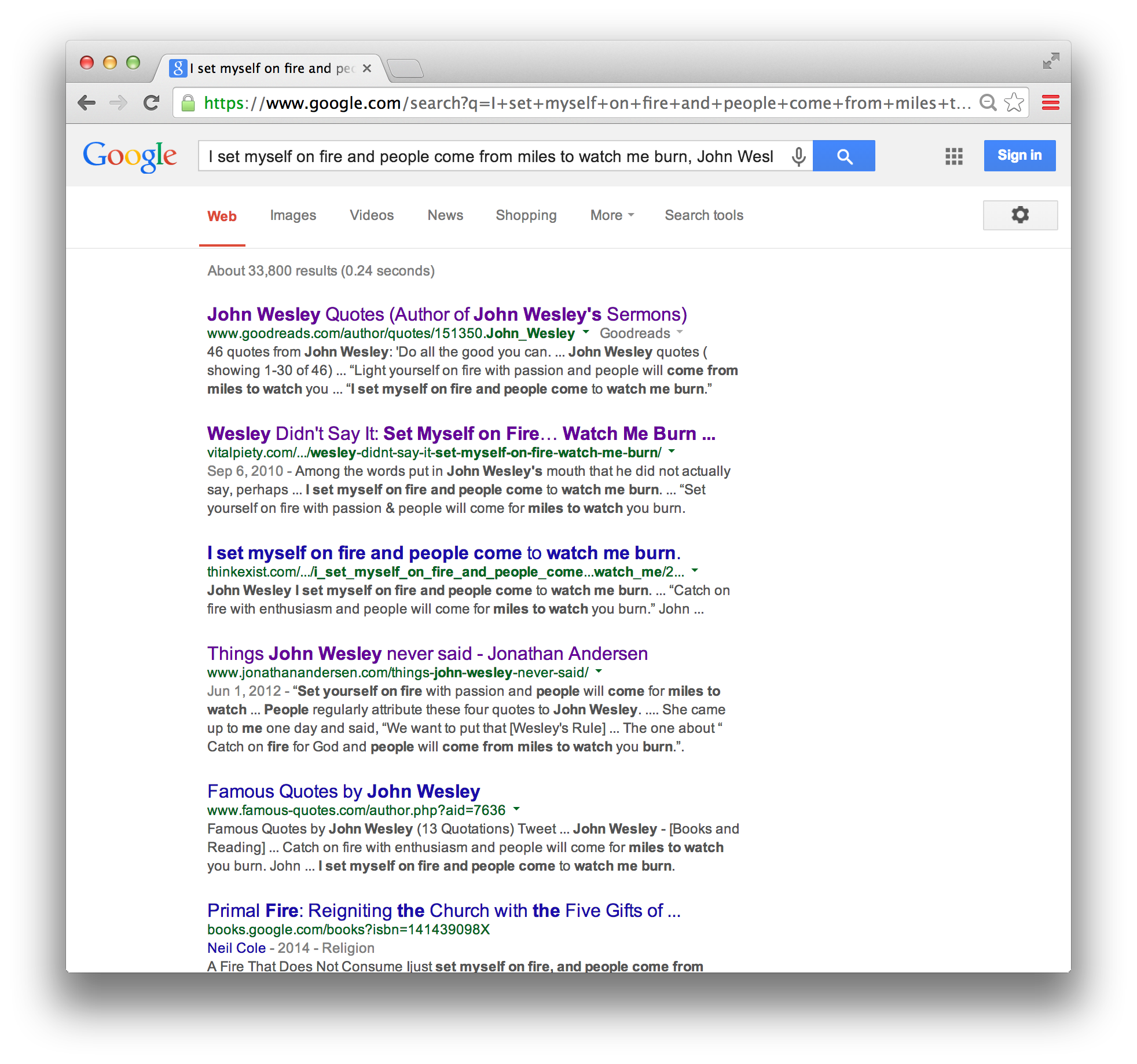
“I set myself on fire and people come from miles to watch me burn.” Did Wesley really say that?

The picture below shows the way the search should be entered, with the first results.

Set myself on fire, not Wesley

The first link on Google “John Wesley Quotes (Author of John Wesley’s Sermons)” initially looks promising. But it is again from goodreads.com, and you will not find a citation at all. So, this is not a reliable website. The second link is a blog post I wrote four years ago saying that Wesley did not say this. A blog post should be considered to be suspect. However, a blog post by a PhD in the field of Wesleyan/Methodist Studies gives you very good evidence that Wesley did not in fact say it. A scholarly article like the one I mentioned by Professor Heitzenrater is even better. Of course, if you can find a citation in a scholarly edition of that person’s writings then you are entitled to say he or she did in fact say this. In this instance, you will not find a citation to a scholarly edition of Wesley’s writings because there is no evidence that he said this.

Things that do not count as winning:

Any kind of commerorative or decorative item. I would guess that Cokesbury has sold thousands, if not tens or hundreds of thousands, of items that attribute things to John Wesley that he did not actually say. Just because you bought something at Cokesbury store with a quotation attributed to John Wesley does not mean he actually said it.

A book of quotations. These are notorious for not having good citations. Their primary goal, to inspire with short pithy sayings, makes them notorious for misquoting historical figures.

Any non-academic book. A non-academic book should site the source of any direct quotation. They often do not. If they do, they also often still do not site a scholarly edition. Citing a quote from another book that is still citing it from another book means you are still playing the game. To win you must find it in a scholarly edition of Wesley’s works.

Let me say a bit more about the internet. Finding the quote on the internet may or may not count as winning. Think of the internet as being like paper publications. Blogs and other forms of social media are like pen and ink publications (journals, letters, etc.). You would not ordinarily consider these to be authoritative in an academic sense. However, a handwritten letter by Frank Baker (who edited the first two volumes of the best scholarly edition of John Wesley’s letters) to Albert Outler about a Wesley quote would be very good evidence, precisely because of the specific person who wrote the letter.

If the website is a respectable academic or ecclesial website that is making Wesley’s works available online, then, that counts. You win! Wesley did actually say that. (You can find a few examples here and here.)

If the website is a personal website, facebook, twitter, or anywhere else online, the safest approach is to say that it does not count, especially for demonstrating that Wesley did say something. You still have to get to a scholarly edition of Wesley’s works. I have been amazed (and exasperated) at how misquotes of Wesley absolutely thrive on twitter.

Another option is a draw. If you cannot find the quote by Wesley in a scholarly edition of his works, then you neither win or lose. In this instance, do not attribute the quote to Wesley. You should only attribute a quote to someone when you have a primary source citation that shows the person actually said that. In this case, you don’t have it.

The final option is to lose. How do you lose the game? You lose by saying that Wesley said something that he did not actually say. Being as careful and accurate as we can be with our heritage matters. When you say that Wesley’s self-professed evangelistic strategy was to “set myself on fire and the people come from miles to watch me burn” you misrepresent and distort the tradition, because Wesley did not really say that.

I hope this helps you find out for yourself whether Wesley really said “that.”

Wesley Didn’t Say It: “Be present at our table, Lord…”

18 Monday Aug 2014

Posted by Kevin M. Watson in Uncategorized

≈ 5 Comments

“Be present at our table, Lord, be here and everywhere adored.”

The so-called “Wesley Grace,” according to Methodist historian Richard P. Heitzenrater, did not originate with John Wesley. It was created by one of the early preachers in early Methodism, John Cennick. Heitzenrater indicates that it is possible that Wesley used this poem, but it is certain it did not originate with him.

The common misattribution of this quotation to John Wesley is discussed in Heitzenrater’s recent chapter, “The Wesleyan Tradition and the Myths We Love” in A Living Tradition: Critical Recovery and Reconstruction of Wesleyan Heritage, edited by Mary Elizabeth Mullino Moore (Kingswood Books, 2013). The chapter discusses a variety of ways that the history of John Wesley’s life has been distorted or invented by Wesley’s biographers (and increasingly through careless repetition of inaccurate information through the internet). It is one of the best academic pieces I have read in some time for a variety of reasons. I highly recommend it.

In any event, Wesley did not create the “Wesley Grace.” We can add it to the list of things he did not say:

“holy conferencing” [Original post here.]

“personal and social holiness” [Original post here.]

“Do all the good you can, by all the means you can, in all the ways you can, in all the places you can, at all the times you can, to all the people you can, as long as ever you can.” [Original post here.]

“I set myself on fire and people come to watch me burn.” [Original post here.]

“In essentials, unity; in non-essentials, liberty; and, in all things, charity.” [Original post here.]

Kevin M. Watson is Assistant Professor of Wesleyan and Methodist Studies at Candler School of Theology, Emory University. You can keep up with this blog on twitter @kevinwatson or on facebook at Vital Piety.

Personal Update: Exciting News!

22 Thursday May 2014

Posted by Kevin M. Watson in Uncategorized

≈ 7 Comments

I have news I’d like to share that may be of interest to readers of this blog.

I have recently accepted an offer to join the faculty at Candler School of Theology at Emory University as Assistant Professor of Wesleyan and Methodist Studies. I am honored to join with the faculty at Candler and thrilled to be able to teach Wesleyan/Methodist studies at one of the flagship United Methodist seminaries.

The majority of my teaching at Candler will be teaching the Methodist History course required of all candidates for ordination in The United Methodist Church. This is the first class I taught as a PhD student at Southern Methodist University. And it is my favorite class to teach, so getting to teach it regularly is a dream come true! I am also looking forward to teaching other courses in Wesleyan/Methodist studies as well as in the History and Interpretation of Christianity and Contextual Education.

I am eager to get to know my colleagues at Candler and to learn from them. The welcome I have already received has been wonderful. I am also looking forward to connecting with folks in the North Georgia Conference of The UMC, as well as other Annual Conferences in the region.

As excited as I am, there is also sadness. I am sad because I will deeply miss colleagues and students at SPU, which has been a fantastic community to be a part of the past three years. It is hard to step away from what is happening at SPU, particularly Seattle Pacific Seminary, because I am certain its best days are still to come. My family will miss the relationships that have blessed us these past three years, particularly through church. We will leave Seattle aware that we are leaving a part of ourselves behind. And we will take cherished memories with us.

Many times over the past few days, I’ve remembered the clear sense of calling I had that led me to apply to PhD programs: I felt called to pastor seminary students who were preparing to become pastors. This calling has always been particularly directed towards the church in which I am ordained, The United Methodist Church. And my academic focus is on the history of the Wesleyan/Methodist tradition. Candler provides an incredible opportunity to live into these different aspects of my vocation.

I am humbled by this opportunity and grateful to God for providing it!

Wesley Didn’t Say It: “Holy Conferencing”

09 Tuesday Jul 2013

Posted by Kevin M. Watson in Uncategorized

≈ 14 Comments

“Holy conferencing”

Wesley never said that.

This phrase has become a bit of a buzzword in contemporary Methodism and it is almost always connected to John Wesley. Wesley did use the phrase “Christian conference.” And most people who use “holy conferencing” make a connection to “Christian conference.”

In the “Large Minutes” Wesley listed “Christian conference” as one of five instituted means of grace (practices that were instituted by Christ). The instituted means of grace in the “Large Minutes” are: prayer, searching the Scripture, the Lord’s Supper, fasting, and Christian conference.

Here is what is said about Christian conference in this context:

5. Christian Conference.
Are we convinced how important and how difficult it is to order our conversation right?
It is always in grace? Seasoned with salt? Meet to minister grace to the hearers?
Do we not converse too long at a time? Is not an hour at a time commonly enough?
Would it not be well to plan our conversation beforehand? To pray before and after it?
[Bicentennial Edition of the Works of John Wesley, edited by Henry D. Rack, 10:856-7.]

“Christian conference” is often used as a synonym for “holy conferencing,” which seems to mean polite conversation, or being nice when we disagree. But is that what Wesley meant by the phrase? I am writing a post that explores this question, which will be up in a day or two.

For now, there is no evidence that Wesley used the phrase “holy conferencing.” We can add it to the list of things he did not say:

“personal and social holiness” [Original post here.]

“Do all the good you can, by all the means you can, in all the ways you can, in all the places you can, at all the times you can, to all the people you can, as long as ever you can.” [Original post here.]

“I set myself on fire and people come to watch me burn.” [Original post here.]

“In essentials, unity; in non-essentials, liberty; and, in all things, charity.” [Original post here.]

Kevin M. Watson is Assistant Professor of Historical Theology & Wesleyan Studies at Seattle Pacific University. You can keep up with this blog on twitter @kevinwatson or on facebook at Vital Piety.

The Invisible Wesleyan Message

14 Thursday Feb 2013

Posted by Kevin M. Watson in Uncategorized

≈ 26 Comments

I raised a question on twitter and facebook that I want to explore here, where I can develop things a bit more and where, I hope, you will feel free to comment without the constraint of 140 characters.

Here is how I put it on facebook:

“It seems to me that Wesleyans are almost invisible in social and print media. An informal survey on twitter, for example, named Adam Hamilton as the UM leader most likely to have the largest following on twitter. Hamilton has 9,000 followers. This is staggeringly small compared to Mark Driscoll (about 350,000 followers), John Piper (about 450,000 followers), or Rick Warren (about 900,000 followers).

Does the invisibility of Wesleyans in social media and print spheres matter? What is at stake?”

(As of this writing, the United Methodist who has been identified with the largest following on twitter is Tim A. Stevens (@timastevens), who is currently serving as the executive pastor at Granger Community Church with 38,000 followers. Leonard Sweet also has many more than Hamilton with near 26,000. Feel free to comment with an update if you know of someone who has more followers.)

I raised the question in a more concise way on twitter (you can follow me there @kevinwatson) and had several interesting exchanges there as well. Someone has also suggested the hashtag #andcanitbe if you want to contribute to the conversation, or follow it, there.

A few calls for nuance that have been made and are worth repeating. United Methodist and Wesleyan are not necessarily the same thing. And United Methodists don’t have the market cornered on being Wesleyan. In other words, there are United Methodists who aren’t Wesleyan. There are also Wesleyans who are not United Methodist.

I also feel compelled to say that the purpose of this is not to disparage the Reformed tradition, or to suggest that any of the names I mentioned are the best representations of the Reformed tradition. They are simply anecdotal. I recently saw a video clip where Mark Driscoll explicitly stated that he knows many Arminians who love Jesus, and that he would welcome Arminians to join Mars Hill. I would hope to see Wesleyans be at least as charitable to Driscoll as he is willing to be towards us.

But the purpose is to say that we are not doing a very good job of getting our message out. For at least five years I have heard people raise the lack of visibility of Wesleyans in print publications, for example, with some regularity and frustration. I once heard a UM leader make the point that you would not find hardly any books in Barnes and Noble that were written from a Wesleyan perspective. Since hearing that comment, several informal perusals of book stores has confirmed that observation in my own experience. And in many ways the discrepancy is actually worse in Christian bookstores. Now that physical Cokesbury stores are closing, there is almost nowhere a person who is searching for Christian resources can go to find material that is deeply Wesleyan. I’m actually not sure you can overstate the gap that currently exists between the effectiveness with which folks in the Reformed tradition are getting out their message compared to Wesleyans.

So, do you think this matters? Why? Most, but not all of you, who have already contributed on twitter and facebook did think it matters. And by all means, if you have already chimed in on facebook or twitter, please contribute here as well!

What We Are FOR Isn’t Good Enough

12 Tuesday Feb 2013

Posted by Kevin M. Watson in Uncategorized

≈ 18 Comments

What we are for isn’t good enough. It just isn’t.

In fact, I’m not even sure that within The United Methodist Church there is consensus about what we are for.

What horrifies me is that I’m not sure United Methodists are capable of coming up with a vision that meets the demands of our own faith. I am afraid we may have lost faith in anything other than ourselves.

When I have experienced the UMC at its broader levels of organization, it has been very discouraging. I am saddened to witness good, sincere, and wonderful people trying so hard to show the rest of the church that God has been at work in our midst. It makes me sad, because I usually feel like most people don’t believe the hype.

When we are most passionate, we are too often talking about what we have done for God, not what God has done for us.

It is not good enough to be in favor of doing nice things, even for God or in the name of God.

We are dying. And it is because we are not certain we believe the world needs Jesus. But if the world doesn’t need Jesus, it surely doesn’t need us.

The world doesn’t need us to do something for it. The need is far more desperate and devastating than that. We are not enough. We never have been enough, even in our glory days. The world needs – people need – a relationship with God, the Father, Son, and Holy Spirit.

Far too often, an agnostic theology is lurking behind our actions. At our worst, our service seems to be motivated by a sort of guilt about our privilege. It becomes a kind of bargaining chip, and a sophisticated one at that! We make peace with our affluence, or at least try to, by doing something for someone else every once in a while.

There is no hope for The United Methodist Church unless what we are for is adequate to the gospel that justifies our existence.

We should stubbornly and persistently be for this very gospel. The good news is that in Jesus of Nazareth the Word became flesh and dwelt among us. Through the life, death, and resurrection of Jesus, God’s grace has been unleashed on a broken and hurting world.

I am almost tempted to say that United Methodists should fast from doing things for God. Instead, we should relearn how to talk about what God has already done for us. We need to start by telling ourselves about Jesus, about what he has already done for us and which we cannot do for ourselves – practicing it until none of us are embarrassed or hesitant to say the name of Jesus. We need to state clearly that we are all desperate for God’s grace, that without it we are utterly and hopelessly lost.

We should be for conversion. We should be unapologetically in favor of calling people to turn away from sin and towards God’s grace, because we are certain that this is the hope that we can offer them. We need to state clearly that we are justified by faith in Christ, not by our works. We need to know that we cannot save ourselves.

We need to be for holiness. Not because we are confident in our ability to make ourselves better, but because we believe that the resurrection of Jesus from the dead means that sin and death no longer have the last word and no longer should inhibit our hope for what is possible now by the grace of God.

We need to quit carelessly denying the possibility of complete freedom from sin in this life. Instead, we need to be honest and broken by our complicity with the ways of sin and death. Rather than endorsing sin by thoughtlessly saying “nobody’s perfect”, we need to recognize that sin continues in our lives because we will it to continue. We sin not because we must, but because we choose sin over the freedom that God gives us from sin.

Methodists who are worthy of the name should be unabashedly in favor of Christian perfection. What is at stake is not a vague theological principle. Our hope is at stake. Where is our hope? If it is in ourselves or human capacity, then we would be foolish to preach Christian perfection. But if our hope is in the One who has shattered sin and death’s hold on all who are created in the image of God, then why would we, how could we, tell anyone that God does not want them to experience complete freedom from all that keeps them from abundant life in the triune God?

The message of entire sanctification is not going to be extinguished before Jesus returns. When the MEC persecuted and expelled B. T. Roberts, largely because of his proclamation of Christian perfection, the Holy Spirit raised up a new people. Ultimately, this is God’s message and not our own.

I could be wrong, but I am afraid that United Methodism is where it is because we have not recognized the extent to which we are beggars in need of mercy, and we have not offered a message with sufficient sustenance to a world starving for the fullness of God’s grace.

We probably need to reorganize. We probably need to be more adaptive in leadership. But none of this matters if we don’t really believe the message we are proclaiming. Do we really believe in a risen savior? Do we really believe he is enough for a broken and hurting world? Do we really believe that the Holy Spirit is active, bringing healing and wholeness?

We are dying because what we are for is not enough. Our imagination and energy have drifted away from proclaiming the gospel with passion, energy, and conviction. When we encounter broken people, too often we are unsure if Jesus is enough.

Jesus is more than enough. And the truth is that he is all that we really have to offer. Thanks be to God, in Christ we are offered forgiveness of real sins, and freedom from sin’s pull on our lives. And as long as we are alive, we have the incredible opportunity to share this message of reconciliation and healing with the world.

Seattle Pacific Seminary Has Been Approved for United Methodists

08 Wednesday Aug 2012

Posted by Kevin M. Watson in Uncategorized

≈ 3 Comments

Seattle Pacific Seminary, the seminary at Seattle Pacific University, has been added to the list of schools approved for United Methodist candidates for ordination by the University Senate of The United Methodist Church. I was thrilled to receive this news from my Dean earlier this summer, because it means that God has provided a way for me to live into a major part of my sense of calling – to pastor United Methodist seminary students who are preparing to become pastors. I am so grateful to get to teach and prepare future United Methodist pastors!

While I am ecstatic for personal reasons, I am even more grateful for the affirmation that SPS has received from The United Methodist Church because I strongly support SPU’s general vision and commitments as a university and its more particular mission as a seminary. The main purpose of this post, then, is to try to help get the word out about SPS and our ability to train UM students for ordained ministry.

The key foci of Seattle Pacific Seminary are affectionately referred to as the AAA model. Our vision for seminary is that we should be an academy, an abbey, and an apostolate. Here is how it is described on the website:

The interplay of scholarship, spiritual edification, and service defines our unique vision for educating both undergraduate and seminary students – all informed by our Wesleyan heritage that joins “knowledge and vital piety” as a means of changing the world.

Academy

SPU is known for its rigorous yet supportive academic environment. Whether you are an undergraduate or a seminary student, you will learn in close collaboration with faculty colleagues from many disciplines across the University. Our professors are outstanding biblical and theological scholars who value academic excellence, research, and teaching in service to the church, and have a deep Christian faith.

Learning goals of the Academy

We teach so that you and other students will:
• Develop an informed and reflective faith.
• Develop confidence in the Christian faith.
• Be able to interpret Scripture deftly and thoughtfully.
• Understand how the divine revelation of Scripture and the canonical tradition are informed by reason and the experience of the Holy Spirit.
• Learn and evaluate different worldviews operative from the perspective of Christian faith.

Abbey

In the School of Theology, we stress accountable discipleship, and provide opportunities for you to worship and fellowship in intentional Christian community. Our purpose is that you and your professors will be formed more and more in the image and likeness of Jesus Christ.

Learning goals of the Abbey

We teach so that you and other students will:
• Shape your life around Christian character and values.
• Cultivate personal spiritual disciplines in your life.
• Engage others of different beliefs in civil discourse and with a catholic spirit.
• Be able to nurture others in Christian faith.
• Recognize your membership in the body of Christ, entering into the moral and theological discourse of the one, holy, catholic, and apostolic church.

Apostolate

The School of Theology is also an “apostolate” — a place of sending forth. As a student, you will participate in service activities (acts of mercy and justice), especially with the poor. And you will sometimes find yourself stretched beyond your comfort zone — for the sake of the gospel — through urban or global multicultural experiences. In the School of Theology, prayer, and service provide you with the seedbed for scholarly study, vocational exploration, and preparation for leadership in the congregation, the campus, and the classroom.

Learning goals of the Apostolate

We teach so that you and other students will:
• Be prepared to discern, own, and be equipped for your vocation.
• Be deeply rooted in the worship and ministry of a local congregation.
• Articulate your faith in a winsome and engaging manner, in order to share it with others.
• Be prepared to engage in global and intercultural settings.

I will say more in another post about why I think SPS is a great place for United Methodist who are preparing for ministry. For now, I will say that my favorite way that we seek to bring the abbey piece to life is by having all of our seminary students participate in a weekly Wesleyan class meeting. (If you are unfamiliar with class meetings, you can read more about them here.)

The goal of the class meeting requirement is to provide a place for students to experience the Wesleyan understanding of “social holiness” as they care for one another and pursue continued growth in their relationship with the Triune God. This experience will also equip students to organize and lead class meetings in their future ministries. My hope is that by being a part of this kind of communal Christian formation students will both continue to grow in their faith during their time in seminary and be prepared to help others experience transformational small groups in the local church.

← Older posts
Newer posts →

Blog at WordPress.com.

  • Subscribe Subscribed
    • Kevin M. Watson
    • Join 369 other subscribers
    • Already have a WordPress.com account? Log in now.
    • Kevin M. Watson
    • Subscribe Subscribed
    • Sign up
    • Log in
    • Report this content
    • View site in Reader
    • Manage subscriptions
    • Collapse this bar
 

Loading Comments...