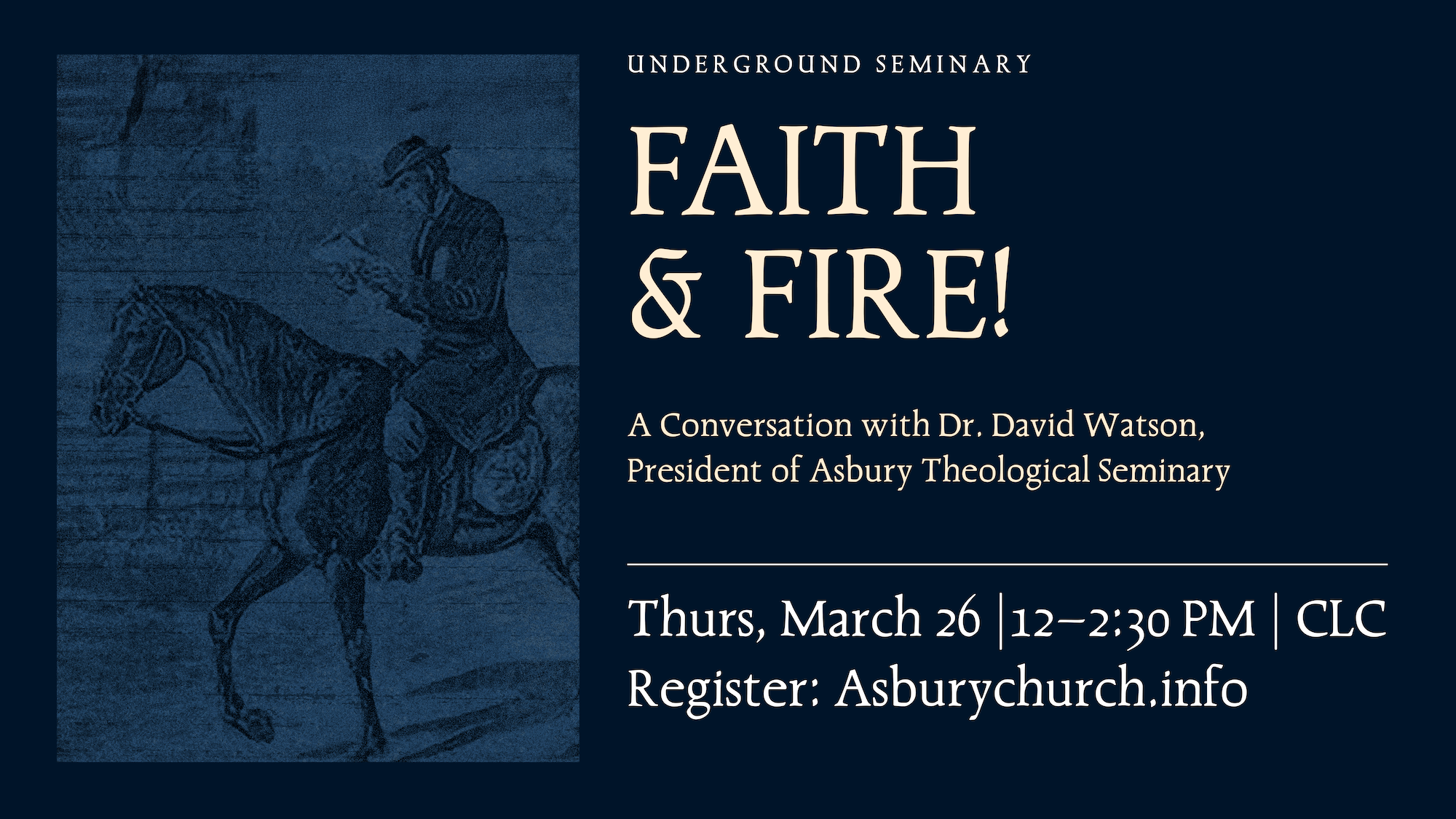
Asbury’s President, Dr. David Watson, is coming to Tulsa to lead an Underground Seminary at Asbury Church. This is going to be a lot of fun. Dr. Watson will talk about what is needed to thrive in ministry. And this is also a kind of book launch for a book we wrote together, Faith & Fire: Methodism as a Move of God. You can still register for this event, here. A copy of the book is included with registration.
He is also preaching in a seminary chapel service this Friday at 11am in Mason Chapel at Asbury Church. Dr. Watson will preach on Romans 8:12-17, “A Case of Mistaken Identity.” I am excited to hear him preach this great passage. No need to register for chapel, just show up! Lunch will follow and is provided by Asbury Church.
Oh, and Dr. Watson will also preach at Asbury Church on Palm Sunday at 9 & 11 am. Join us!
This is all exciting for me because it is connected to the in-person intensive for the Wesleyan Discipleship hybrid class I am teaching. This is my favorite class that I have ever taught. It is an introduction to the history and theology of discipleship in the Wesleyan tradition, with particular focus on the Wesleyan class and band meeting and their practical implementation.
One more thing: We have started receiving applications for the second year of Asbury Church’s Fellowship Program, which I lead. The first year has been great and I am really excited to welcome the next group of Fellows to Asbury. Apply by April 17, 2026. Details here.
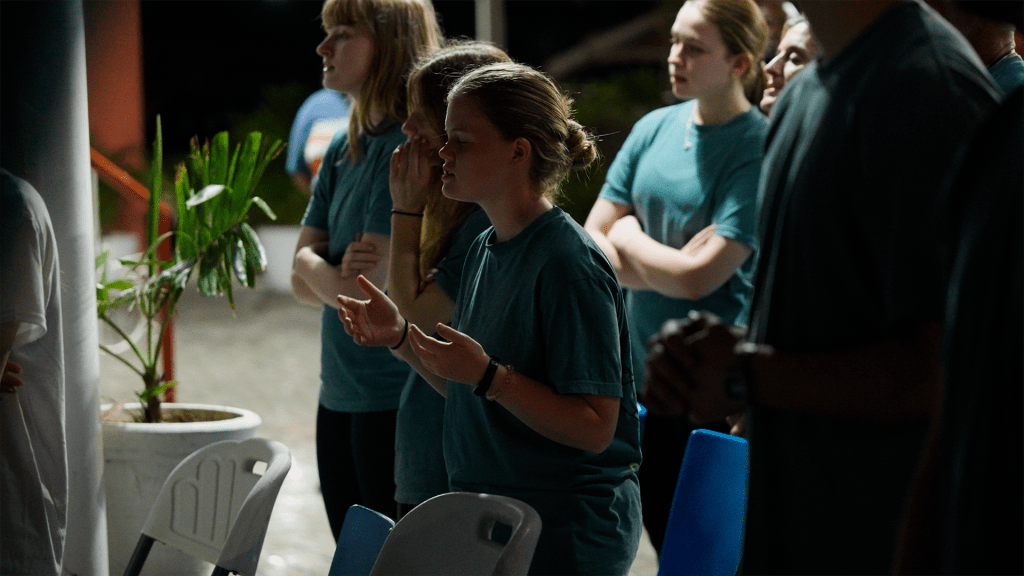
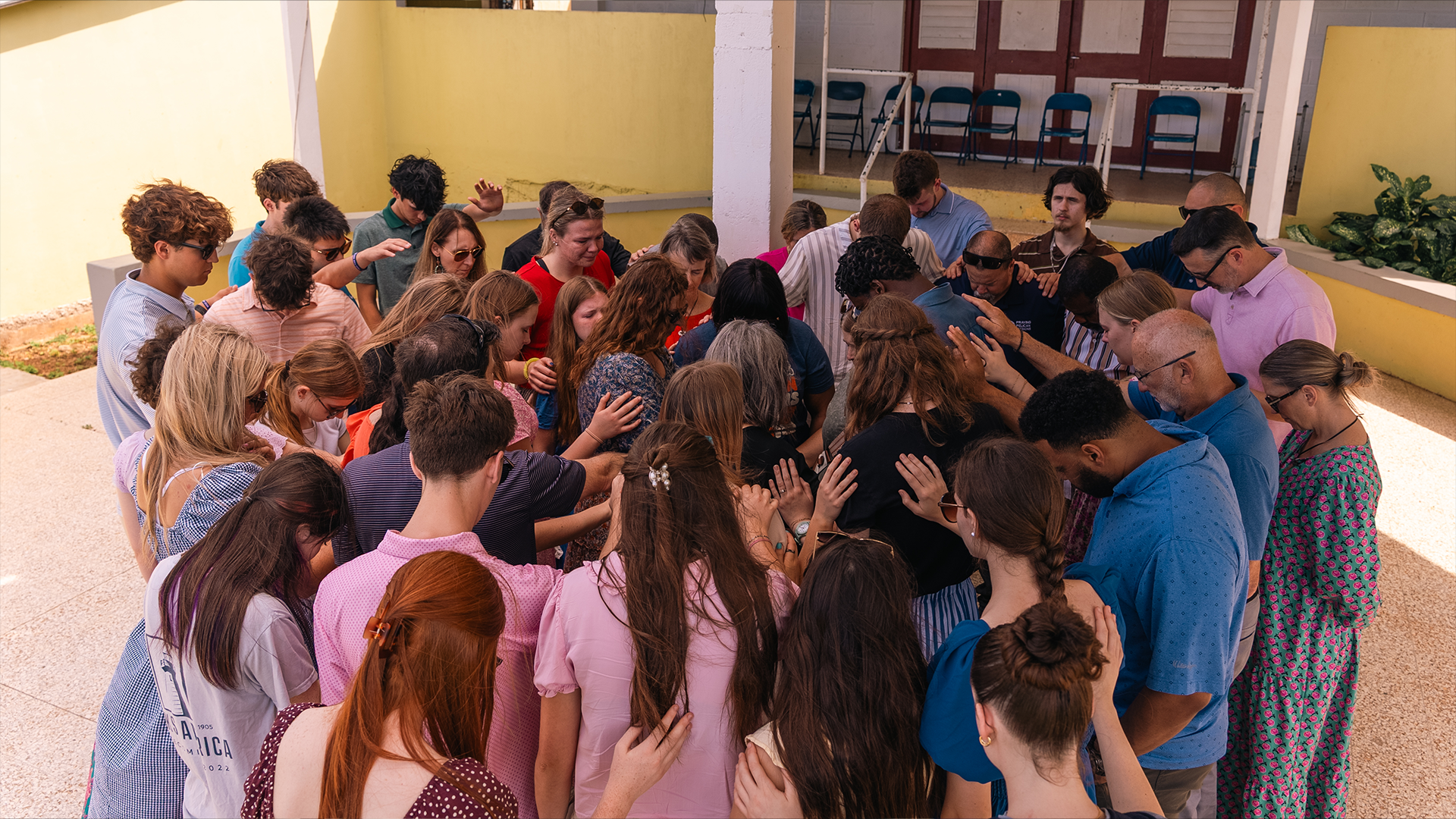
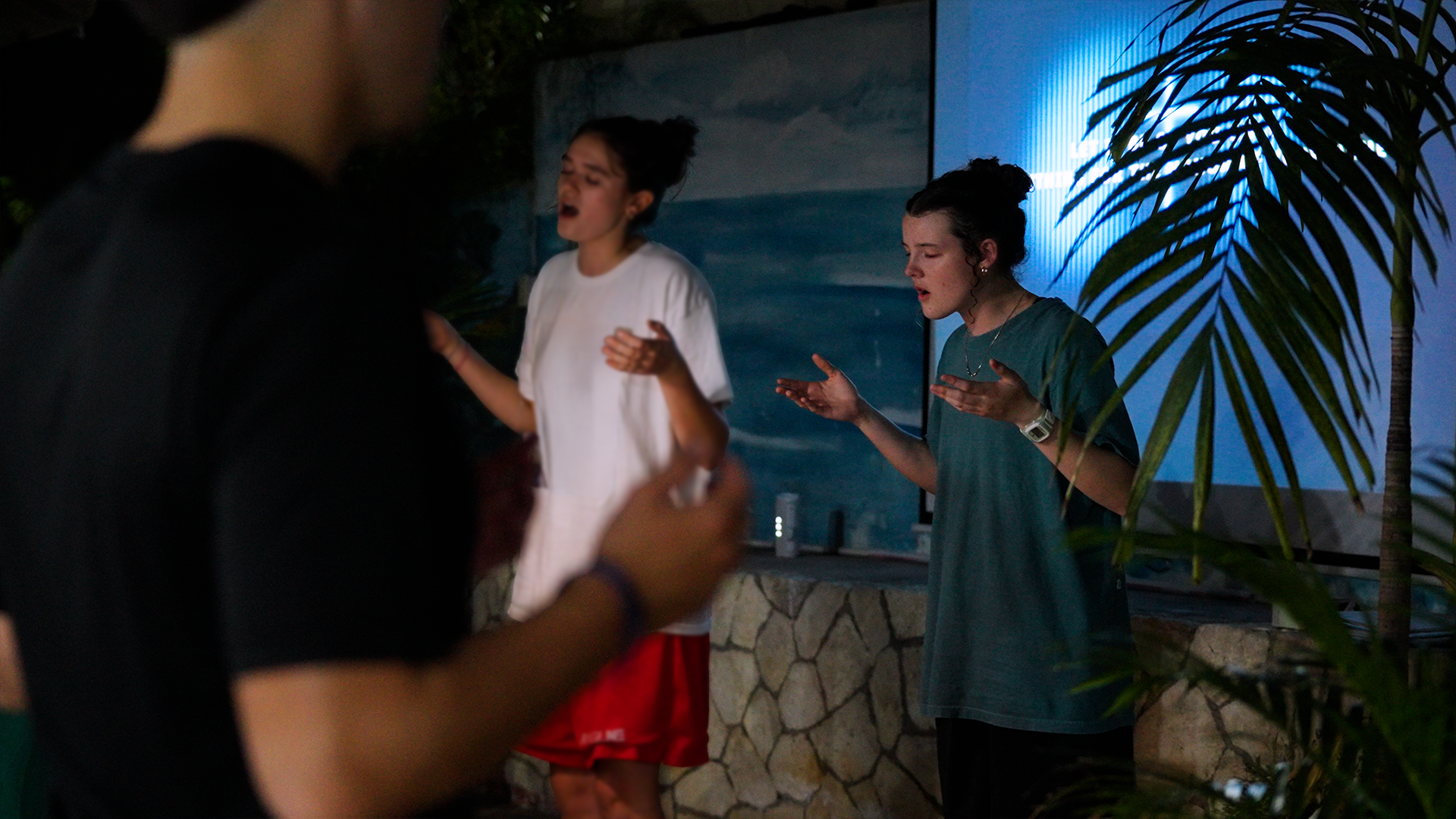
P.S. Last week, I went with a group of high school juniors and seniors from Asbury Church’s student ministry to Jamaica for a Spring Break mission trip. I enjoyed every part of the trip (except for the very beginning when the power was out at the Southwest ticket counter).
I had not been on a mission trip in 20 years, though they have been impactful in my life. I expected my favorite part to be the mission work itself and the time with the folks in Jamaica. Don’t get me wrong, that was all awesome!
But my favorite part, by far, was getting to know the students from our church better. It was a reminder of something I already knew but was blessed to see again. They love worshipping the Lord. I saw passion and hunger for connecting with the Lord. And the Holy Spirit is so quick to come and meet them in their hunger. It was so so fun! Jesus is so kind to us.
Kevin M. Watson is a Pastor and the Senior Director of Christian Formation at Asbury Church in Tulsa, OK. He is also on the faculty at Asbury Theological Seminary, anchoring the Seminary’s Tulsa, OK Extension Site. His most recent book, Doctrine, Spirit, and Discipline describes the purpose of the Wesleyan tradition and the struggle to maintain its identity in the United States. Affiliate links, which help support my work, used in this post.
For several years now, I have tried to read 100 books a year. I have not hit the target more than I have.
A quick random aside: How are your New Year’s Resolutions going? Did you make any? I realized this year with a simple clarity that I unapologetically love New Year’s Resolutions! It does not bother me at all if they are not your thing. My clarity came from a thought I randomly had in mid-Fall last year:
New Year’s Resolutions work for you if you are still thinking about them in October.
This totally happened for me last year. In October, I realized I was way behind the pace (so far, I could not realistically catch up). But it motivated me to start reading again. I’m just better when I’m reading.
Last year I ended up reading 88 books. This year, I am off to a good start and ahead of the pace. But there is a long way to go. We’ll see how it goes!
I not only enjoy reading, I enjoy a good book recommendation. I hope you do too! I read a lot of books I really enjoyed last year. Maybe the highlight for me was finishing reading the Chronicles of Narnia series out lout to my kids. (You should absolutely read them in the original publication order and not the chronological order imposed on them by later publishers.) My kids are all avid readers and do not need me to read out loud to them. But I wanted them to hear one of my favorite stories in their father’s voice. And there are just so many characters in those books that are so fun to read out loud. (Puddleglum!)
I decided I wanted to write a top five post to celebrate and share my favorite books from the year. I had a hard time getting my list pared down to a manageable size. For whatever reason, I noticed a handful of books I really liked that were also new releases last year. So, I decided to limit this to a top five of new release from the past year. Hope you like it!
I am listing my top five new releases of 2024 in reverse order for one reason: It seemed more fun to me.
Of the five books I list here, this is the most demanding read. (Not coincidentally, it is the only one published by a University Press.) I do not mean this as an insult. I am only naming it to set expectations. You should read this book. But it will require a lot of you. And that’s ok, because, as I tell my kids: You are capable of great struggle!
James Davison Hunter, who previously wrote another very influential book – To Change the World – argues in Democracy and Solidarity that the roots of solidarity in the United States are breaking down and dissolving. There must be some degree of unity within any political organization for it to work. Hunter offers a detailed and sophisticated description of how this has worked in the history of the United States. He then makes the case that we are at a breaking point in terms of the solidarity required to persist as a stable political order. This is not a hysterical reactionary clickbait piece. It is a thoughtful, measured, and carefully argued book that people across the spectrum will find things with which they agree and disagree.
When I recently saw a clip of politicians refusing to shake hands during a ceremony related to the peaceful transfer of power, it bothered me in a way it would not have had I not read this book. Democracy and Solidarity is a sobering but deeply relevant book.
I was already familiar with Renn’s Three Worlds of Evangelicalism framework and find it to be a helpful way of thinking about where we’ve been and how the church ought to respond in the present. I think Renn’s book is the first book I pre-ordered because I intentionally wanted to help the author have the best possible chance of a successful book launch that increased the book’s visibility. I am thankful for Aaron Renn because he has started many important conversations that people in more obvious positions should have started but were unable or unwilling to do so because of a lack of imagination, willingness to do the work to think deeply about hard things, or simple cowardice. I am thankful his ideas are gaining influence and being taken seriously.
Part I, where he explains and makes the case that we are in Negative World, is the best part of the book. I have come to think of the rest of the book as helpful suggestions or first drafts of what it looks like to live faithful as a follower of Jesus Christ (both personally and corporately) in Negative World. My guess is it will be practitioners who figure out how to most effectively do much of this work (and I’m pretty sure Renn himself would agree with this from his other work I’ve followed). In other words, Renn serves as a very helpful prod to recognize that the times have changed, and we need Negative World strategies to win in Negative World.
If I’m following correctly, I think Rod Dreher believes in aliens (see chapter 6). Ok, now that I have your attention, here is what really fascinated me and encouraged me about this book. Dreher lets the reader in to his very personal story with the supernatural. He has experiences which are not explainable in purely rational terms or through the laws of nature and what we know about how the world works.
I have walked a similar journey in the sense that I have had immediate and supernatural encounters with the Lord that defy academic explanation. That felt like a problem because, well, I am an academic. (I care more about being an effective pastor than being an effective academic, but I am trained as one and am a seminary professor.) In his previous book The Benedict Option, Dreher put his finger on the need for communities of belonging, deep formation, and strengthening in an increasingly anti-Christian context. In a way I did not expect when I began reading this book, I think Dreher may have named the reality that we are all charismatics now. By this, I do not mean that everyone is literally a charismatic in terms of some precise definition. What I mean is that the church, across the entire Body of Christ, is rediscovering the presence and power of the Holy Spirit. There is an openness to the work of the Holy Spirit in a way that I did not experience when I was in seminary. Dreher wrote in a way that seemed to me to come from a place of vulnerable sharing. I sensed it felt risky to him to share the parts of his story he shared. And something about this book made me think we have crossed a line where testimony to the “weird” stuff won’t seem weird or abnormal much longer. And that is a good thing! Again, I am thankful for Dreher’s courage in writing and releasing this book to the world.
Abigail Shrier has written two major books, and they are both amazing. Her first book, Irreversible Damage: The Transgender Craze Seducing Our Daughters,courageously shone a light on the impact of transgender ideology on young women and the excesses of the hasty embrace of the movement by many in the cultural mainstream. In 2024, she wrote Bad Therapy: Why the Kids Aren’t Growing Up. Shrier helped me think through two things that were concerns in the back of my mind but that I could not articulate.
First, therapy does not seem to wrestle with iatrogenic injury. An iatrogenic injury is an injury that is caused by the intervention of a care giver. This is uncontroversial in medicine. The possibility of iatrogenic injury needs to be discussed more with therapy. Second, and related to the first, Shrier discusses the lack of an end goal in some approaches to therapy. Sometimes people come to a place where they feel they cannot cope in life in general without their counselor or therapists’ constant engagement and guidance of their lives. This seems unhealthy and the opposite of what you would expect at the outset when choosing to engage the services of a counselor or therapist.
I am tempted to qualify this in many ways because I know this is a tender area for many. I will just say here that if my summary does not sit with you, feel free to skip this book. Or, it might be that it would be especially worthwhile for you to read and consider Shrier’s analysis.
At some level, I think everyone knows that the rise of smartphones and social media has not been good for us. In The Anxious Generation, Haidt pulls the fire alarm and demonstrates just how detrimental the “phone-based childhood” is for kids. For parents who have already given their children smartphones and access to social media, there will be much temptation to defensiveness or feeling like the die has been cast and nothing can be done. I think this is a hopeful book, because it is always better to live in reality than deny it. We have reached a turning point where we collectively now know that smartphones and social media have a net negative impact on children and adolescents and it is not even close.
This book is the best new book I read last year because it is a piercing diagnosis of the problem. And it also offers hopeful and helpful practical suggestions for a way forward.
Bonus: Or, a Humble Brag
Ok, let’s be real. If you’ve follow me at all you know that none of these books are really my favorite new release in 2024. I had a new book come out in 2024. And it is my favorite. Doctrine, Spirit, and Discipline: A History of the Wesleyan Tradition in the United Statesis both a history of where the Wesleyan/Methodist tradition has been as it continues to fracture and divide. I also hope the book is a sign pointing to a hopeful and faithful future for those who carry the mantle of the Wesleyan theological heritage. If you haven’t read it yet, the price is the lowest right now on Amazon that I’ve seen. I hope you will check it out!
Links in this post are affiliate links and help support my work.
I have been tracking the education requirements for ordination in the Global Methodist Church (GMC) since the denomination’s beginning. In conversations in the church and in the academy, I see some consequences of decisions the GMC has made that I’m not sure are recognized for a variety of stakeholders.
This post is specifically about the requirements for theological education in the GMC. This is not a major emphasis of mine here. I am writing this post because I’ve been thinking about this quite a bit of late and wonder if I may be seeing some things that would be helpful to name. The overall intent of this post is to flush out what I think are some unexamined assumptions in hopes that it might help both the GMC as an institution and individuals pursuing ordination in the GMC. To be clear: I am operating on the assumption that the GMC is operating in good faith and doing the very best they can!
Brief Background
Let me offer a summary of my understanding of ordination itself and the educational requirements for ordination in the GMC to provide context.
First, one can be ordained a deacon in the GMC after completing 10 required courses. All 10 courses are required (i.e., there are no electives).
Second, all elders have been ordained a deacon. If one is called to be ordained an elder, one must first complete all requirements to be ordained a deacon (and be ordained as a deacon). One then must complete 10 additional required courses. 8 of these 10 courses are required for all elders. 2 additional courses much be taken from a choice of, I think, 12 elective options.
All elders have been ordained deacons. Not all deacons will become elders. (This is following historical precedent, but that is another post.)
So, 10 required courses for ordination as a deacon.
10 additional courses for ordination as an elder.
20 courses total to be ordained an elder.
These courses do not have to be taken from one institution, and they do not have to be of the same level academically. Prospective ordinands can take courses in an “alternative educational pathway” (the GMC’s language) which is like what Course of Study was/is in the United Methodist Church, or they can take accredited Master’s level courses from a list of approved schools.
Ok, that is the basic context/background. Here are some implications I see that are significantly different than the way the process worked in the UMC.
First, in my opinion, the GMC has created a disincentive for people to complete accredited Master’s degrees.
There are pros and cons to this.
The most obvious pro is that this approach lowers the financial bar substantially for people who feel a calling to ministry to meet the requirements for ordination. The GMC approach also makes it significantly more convenient to check the boxes in terms of ordination requirements. In one video I heard from a GMC Board of Ordained Ministry, it was discussed that students can take courses at multiple different institutions according to preference/convenience. Finally, this approach comes out of a desire to have a process that serves the entire global church, where there is not consistent access to Master’s level theological education.
There are a few cons as well. The academic quality of the various options will vary quite a bit. If someone takes a non-accredited Course of Study type class for one class and an accredited Master’s level course for another class, they are getting a significantly different educational experience across the classes. Another con is that the GMC approach (particularly compared to that of the UMC) will hurt seminaries. Seminaries are expensive and the current models are not built on guessing which a la carte classes students not enrolled as degree seeking students might want to take any given semester. I can understand why the GMC would not find this a compelling concern for a variety of reasons. But in my view, the GMC approach is asking academic institutions to work in a way that is not viable. Again, I think the first is a more significant con than the second. I do think there is room to think about academic requirements for ordination as a partnership between the GMC and the parts of the theological academy they choose to work with.
Second, related to the above, the GMC has created an incentive to meet educational requirements through “alternative educational pathways.”
The category of “alternative educational pathways” is hard for me to completely pin down. I think it is supposed to be what Course of Study was in the UMC.
However, there is a major difference in how Course of Study functioned in the UMC than how the “alternative educational pathway” functions in the GMC. In the UMC, the Course of Study was a way to meet some standard of education for people who were serving as local pastors, which was a distinct (and confused) category of non-ordained pastoral leadership. I agree with the GMC’s move to simply delete this theologically problematic position in the church. Local pastors were second-class citizens in the UMC. And yet, within that context (the problems and limitations on being a local pastor) there are ways in which a more expedient and much cheaper approach to education makes some sense. (For what it is worth, I taught in multiple Course of Study Schools during my time as a United Methodist seminary professor, and I loved the students I had in these classes!)
I feel like it is often missed that in the GMC because there are no local pastors, the “alternative educational pathways” are an equally valid pathway to ordination as a more traditional seminary education.
There is also confusion within the GMC about what the standard for these pathways is exactly. I have been told the “alternative educational pathways” were 1/3 the work of a master’s level course. I have heard from others that it should be 2/3. And I have recently heard a Board of Ordained Ministry presentation on Zoom that seemed to suggest they were supposed to be Master’s level quality. In my mind there is a lack of clear thinking about how all of this fits together. An accredited seminary, for example, should not be expected to offer a non-accredited class at a steep discount that is essentially the same course. If they are expected to do that and try to do so, they will be competing against themselves. It would be like Rolex selling the “really good deal” on a “Rolex” you can find on the sidewalk in New York.
The “alternative educational pathway” will be easier and cheaper. And as a result, the GMC has created an incentive structure for prospective ordinands to meet educational requirements through this easier path, particularly because there is not the downside that there was with the UMC in terms of ordination.
Pros: Each course is cheaper than master’s level course work. These courses range from $200-$500 per course. They are less work and so easier to complete practically.
Cons: The GMC is, unintentionally I assume, incentivizing expediency and pragmatism on the road to ordination. I would advocate for doing the exact opposite. If someone wants to serve as an ordained deacon or elder in the church, they should be called to more and greater challenge. In fairness, my sense is that most who advocate for the easier path do so because of the need they see for getting folks serving in empty pulpits now. The need is great! I totally get that. I just think there are other ways that can be addressed while still calling people who want to be ordained to more. The most obvious con is that students who take the alternative educational pathway will get an inferior education to those who pursue Master’s level education. (If that is not assumed, I need help understanding what the distinction is.)
Note: I realize that there are a variety of challenges and nuance needed here. There are socio-economic challenges that are valid and real. And there are realities in the global church that are different than those in the U.S. I would maintain, however, that we ought to work to address these challenges in ways that raise the bar everywhere rather than lowering the bar in places that may have greater access to resources.
Third, the GMC may not be setting people up to succeed after ordination when they enter the job market.
If I am understanding GMC polity correctly, there is no guaranteed appointment in the GMC (as there was in the UMC). This is a big difference! In the UMC, you could meet ordination requirements however you wanted and once you got ordained the playing field was level. Everyone was guaranteed an appointment. I.e., you would get a job.
This is not the case in the GMC. A new GMC ordinand will either already have a job or be looking for one. And they will be competing with other GMC ordinands for the same jobs. GMC polity does not guarantee an ordained pastor employment.
My assumption, then, is that credentialing will be more important in the GMC for employment than it was in the UMC. Imagine 3 people apply for a position as the sole pastor of a GMC church that averages 100 people in person in worship on Sunday morning. All other things being equal, here are the ways they met their educational requirements for ordination:
Candidate 1: Completed a GMC approved “alternate educational pathway” that was 1/3 to 2/3 as rigorous as Master’s level accredited coursework.
Candidate 2: Completed educational requirements through a grab bag of courses, some unaccredited and some a la carte classes at various seminaries in Master’s level courses.
Candidate 3: Completed an accredited Master’s degree that satisfies all GMC educational requirements.
Who do you think will get the job?
I would guess that all other things being equal Candidate 3 gets hired every time. Of course, there is a ton of simplification there. But I have not seen much reflection on the real-world realities of trying to get a job after you get ordained and how the decisions you make in the ordination process may help or hinder your job search.
And there are a variety of other ways the educational pathway one chooses can potentially help or hinder the likelihood of them being hired. For example, does taking the easier route now to get through the ordination process more quickly make it less likely you would be selected to be the lead pastor of a large church down the road?
Final Thoughts
A part of me feels like the GMC is of two minds about education in preparation for ministry. And I can understand much of this. UMC seminaries did not serve orthodox Wesleyans very well. There is a reason many laity referred to seminary as “cemetery” when I was going through the ordination process. There was a real concern that I would lose my faith or be deformed in such a way that I could no longer effectively serve in Christian ministry. And I actually believe that concern was understated rather than overstated.
I think it would be an improvement to restrict “alternative education pathways” to cases of necessity. Many I’ve talked to suggest this is informally the case. It has not seemed clear to me in the GMC’s official statements.
I believe the M.Div. will continue to be the gold standard for theological education in preparation for full time vocational ministry. Of course, I could be wrong about that.
I think the burden is going to be more on the ordinand him or herself to make choices that are in their own long-term interest. And considering that, I think people preparing for ordination, particularly in the United States, will be best prepared to lead in the church and actually get a job if they complete a Master’s level theological education.
In addition to the M.Div., I have worked to create a 60 credit degree at Asbury Theological Seminary that exactly meets all requirements for ordination in the GMC. This is a concrete expression of our commitment to a partnership with the GMC. If someone can get an M.Div., I would recommend that they do. If they cannot, I would encourage them to check out our Master of Arts in Christian Ministries (MACM) degree, which is exactly the GMC ordination requirements. The degree can be completed through online and hybrid classes, or residentially in Wilmore, KY. So, you can do it from anywhere. (Though, of course, I want you to come to Tulsa!) When you complete the degree, you will be fully eligible for ordination and you will have a Master’s degree that you will have for the rest of your life.
If you want to know more, please reach out to me here (scroll to the bottom of the page).
These are some of the things I’ve been thinking about over the past few years re. GMC educational requirements. I hope it can serve the GMC!
1. I love living in Tulsa as much as I thought I would.
I grew up spending a few weeks with my grandparents every summer. When I graduated from college, my parents moved to Tulsa. So, my entire life, I have had close family that lived in Tulsa. But I had never lived here. And it hadn’t even occurred to me that I could live here. A few years ago, I started sensing a draw to Tulsa. I had never felt a sense of calling to a place. I am so thankful for God’s goodness in bringing us here!
2. I love teaching at Asbury Theological Seminary as much as I thought I would.
My first time on Asbury Theological Seminary’s campus was 2017. That seems impossible to me. I had been curious about Asbury for a long time but had not actually been on campus until I was invited to preach in chapel just before the 2017 meeting of the Wesleyan Theological Society, which was held at ATS that year. (You can watch that sermon here, if you want to take a trip down memory lane!) I remember walking around campus and sensing the Spirit’s presence in an almost overwhelming way.
In my first year, I taught Church History One, Basic Christian Doctrine, and a new course on the history and practice of Wesleyan Discipleship. And the students in every class have been fantastic! It has been such a gift to me to be at a place where my convictions are deeply in sync with the institution where I serve, with my colleagues, and with my students. I am blessed!
3. Hybrid classes are fun!
Every class I have taught to date has been in the hybrid format. This means that the classes have online modules where students complete assigned readings and other assignments. Once during the semester, there is a three-day intensive where everyone gathers together in the same place. (Asbury Theological Seminary offers hybrid classes in Wilmore, KY as well as at each of our Extension Sites: Tulsa, OK; Orlando, FL; Colorado Spring, CO; Memphis, TN; and Tampa, FL.)
As I was praying about my first hybrid last Fall, I felt like the Lord kept giving me the word “retreat.” As in, the hybrid is supposed to be a retreat for students. And to be honest, I thought to myself: there is no way students are going to buy that 20 hours of time in class over three days is going to feel like a retreat!
As the Lord usually does when I argue, I just kept hearing the word “retreat.” Finally, I embraced it and sent an email that felt very naïve to my students. I encouraged them to come expecting the time to be a retreat. I invited them to make a plan to put aside all other distractions and be present to the Lord and each other.
And that first hybrid just might be my favorite teaching experience I’ve ever had. We spent time together in prayer, even praying for one another. We worshipped together. Oh, I also lectured some. Several students confessed that my email about the retreat seemed crazy to them, but that to their surprise the hybrid did indeed feel like a retreat.
Only God!
I am learning to relax into the time we have together in the intensives and shift from trying to cram 20 hours of lecturing into the class to being present to the Holy Spirit and his agenda for our time together. I still have a lot to learn. But the journey has been so fun.
I can’t wait to see what God does in my classes this year!
4. Asbury Church is more of a blessing than I could have asked or imagined.
I cannot express what a gift it has been to me personally and to my entire family to be at Asbury Church. Rev. Andrew Forrest is an exceptional preacher. I don’t know how he does it week after week. And he is as good or better of a leader than he is a preacher. Serving on the Asbury pastoral team under his leadership has been a gift.
A highlight for me at Asbury Church was our Summer of Prayer series for six weeks right in the middle of the summer. We invited the church to press in to prayer in a deeper way. We preached through the book of James. We had a night of Prayer and Worship on a Wednesday during the series. The Holy Spirit was present in a powerful way that I believe broke something new open in the church. I got to preach the last sermon of the series and preached on James 5:13-16 and invited people to respond by coming forward to receive prayer for healing. The interest in healing and testimonies to healing seems to be building from the Summer of Prayer. (You can check that sermon out here, if interested.)
More Lord!
The sermon I preached felt like releasing something that has been in me for a long time. It was really important to me to know that I was operating under the authority of the leadership of the church. And throughout the series I experienced spiritual covering and blessing to be who I am in Christ in a way I have never experienced. I still can’t really describe what a blessing it has been. I am so thankful!
5. Asbury Theological Seminary is trusted by an even broader section of the church than I realized.
I knew that Asbury Theological Seminary was viewed as the premier seminary across the Wesleyan evangelical family throughout the world. I did not realize the degree of interest there is in building relationships with Asbury in many nondenominational and independent churches that have typically done most of their preparation for ministry in house.
I hosted a gathering of pastors from a variety of nondenominational churches here in Tulsa to talk about the work they are doing to raise up the next generation of leaders for the church. I was humbled that they would make time to come to Tulsa and consider a partnership with Asbury. Everything about the time together was fun! Great conversation. Exceptional leaders in parts of the Body of Christ I’m eager to get to know better. Openness to the Holy Spirit. Deeply committed to basic Christian orthodoxy. And aware of what time it is. Check out this description of the gathering.
The thing I most enjoyed about this meeting was spending time with leaders in the broader church who sharpen me and help me be better at what I do. My calling is to raise up the next generation of leaders for the church. It is all about the church. And so, the more I can be around excellent pastors the better!
Asbury Theological Seminary is known throughout the church. And as people are sensing that some places may be shifting away from their historic commitments, there is growing openness and interest in partnering with Asbury. I am so curious to see what God does!
The first year in Tulsa has been better than I could have hoped. But do you know my favorite thing about where I am at right now? I am even more excited by several things I am working on now than what I have experienced in the past. I have a deep confidence that the best is yet to come.
Some of my favorite people to do ministry with are the folks at Spirit & Truth. If you have not heard of this ministry, you should check them out right now. For several years now, they have hosted a yearly conference in Dayton, OH at Stillwater Church. This year, they were led to shift to regional gatherings in Alabama, Texas, and Ohio. Maybe even more than these conferences, Spirit & Truth’s sweet spot is going to specific local churches and offering training on evangelism and discipleship empowered by the Holy Spirit.
Spirit & Truth is gifted at introducing people to the presence and power of the Holy Spirit as a person they can partner with to share the gospel. If you invite Spirit & Truth to minister at your church, they will offer excellent teaching on evangelism and discipleship that is practical and immediately applicable. More importantly, they will partner with the Spirit to activate the laity in your church and send them out into your community to talk and pray with real people in your community.
For decades the church in the United States, at least the parts I have been connected to, has been engaged in a sophisticated program of procrastination. We have programmed evangelism, reading books, meeting in classrooms, even forming committees, but we have not engaged with people outside the walls of our church. We have planned and strategized, but not acted. We have talked to each other about these things more than we have spent time with the Lord and sought his direction. We have talked about people who do not know Jesus more than we have talked with them.
Matt, Maggie, and Emma know God the Father intimately. They have been changed by Jesus Christ and the power of the gospel. And they have each been filled with and empowered by the Holy Spirit. They are also exceptionally gifted at helping churches experience the presence of the Holy Spirit in their midst. They are willing to be used by the Lord to break up ground in local churches and make room for real Christianity. They don’t have techniques or gimmicks. But they also don’t flinch or lose their nerve when the Spirit of God comes in power in answer to their prayers.
Ok, so that is my pitch to you to reach out to Spirit & Truth!
I started writing this post to share my experience at the recent Spirit & Truth regional conference in Conroe, TX and First Methodist Conroe, where John Wayne McMann is the lead pastor. (For more on what the Lord did, check out Spirit & Truth’s podcast episode with John Wayne McMann.)
Matt asked me to be part of the gathering in Conroe several months ago, I’m not quite sure how far back. But I had really been looking forward to this conference. Matt and I had touched base a few times about what the direction he was sensing from the Lord for the conference, and I had a pretty good idea of the direction I thought I was supposed to take with my message.
I felt like the Lord was asking me to share more vulnerably than I have in this kind of space about my own experience with the Holy Spirit. I felt like I was supposed to share how I, sometimes by fits and starts, have grown in my ability to hear God’s voice and have grown in a hunger to see God heal people inwardly and physically. I also felt like I was supposed to be more unscripted than normal.
This is vulnerable for me for a variety of reasons. First, I know there have been many excesses throughout the history of the church. (I’ve seen many of them in teaching Church History.) Second, pretty much every part of my own formation in the church (and even more so in the academy) taught me to trust what I could know objectively, particularly facts, dates, and ideas I could read in books and master enough to do well on tests. Third, for much of my life, more than I realized, I really wanted to be in control. (Ok, God is still working here.) There is probably more, but that gives you an idea.
But.
I have seen God do things that are powerful, immediate, and life changing and I don’t want to miss the opportunity to be part of what God is doing now in his church because I am unsure of what will happen next, or I’m worried I’ll fall on my face.
So, I did the best I could to share about my experience with the prophetic and how I’ve seen the Lord heal. I tried to share in humility about the times I’ve missed it, gotten it wrong, or at least not gotten to see the full picture. My sense is that at least some of the excesses in the Pentecostal/charismatic world come from the same need to be in control as are found on the anti-supernatural side of the street.
And so, any time I have an impression or a sense that the Lord is speaking, I try to offer it gently and with open hands. I don’t always get it right. But, again, I’ve seen the Lord open doors to ministry I didn’t even know were there, sometimes simply by being willing to ask a question that was persistent in my head all day and seemed completely random.
I’m sharing this here because I want you to know that the Holy Spirit is alive and active. And he is so good!
I am also sharing this here because I want you to know that if I can grow in my faith, willingness to take risks to see the Lord move, and openness to receiving gifts from the Spirit, so can you!
Finally, I’m sharing this here because I don’t think we were meant to go it alone in any part of the Christian life. We need to learn from those who have gone before us. Spirit & Truth has been a place where the Lord has met me and ministered to me in powerful ways. It has also been a place where I have learned and grown in my confidence to minister in the power and authority of the Holy Spirit.
I preached 1 Corinthians 1:18 – 2:5 at the Spirit & Truth Conference in Conroe. I want this to be true of my life and ministry:
My message and my preaching were not with wise and persuasive words, but with a demonstration of the Spirit’s power, so that your faith might not rest on human wisdom, but on God’s power.
Asbury Theological Seminary recently announced my hire as Director of Academic Growth & Formation. I am delighted to share this news with you. I am one of many new hires Asbury has made as they continue to strengthen what was already an outstanding faculty. You can read more about some of the new faculty that will be joining Asbury here.
I have felt drawn to Asbury’s Tulsa, OK Extension Site since I first heard about it several years ago. I will continue to teach in my new role. I will also get to work on Asbury’s commitment to introducing students to Wesleyan band meetings. Because of Asbury’s deep Wesleyan roots, the seminary has had a commitment to small group formation as a part of the student experience. These groups give students the opportunity to “watch over one another in love,” as Wesley put it. They also give students experience in leading small groups so they will be equipped to lead dynamic small group ministries where they serve. I am thrilled to get to partner with colleagues in Formation at Asbury to equip students to build community and connection in their ministry contexts and make disciples through these tried and tested small groups.
I have already been energized by the conversations I’ve had with people at Asbury Seminary and Seedbed around band meetings. The resurgence of Wesleyan small group formation in the contemporary church is one of the most encouraging things I’ve seen in the church over the past decade. Asbury has been the key leader in reclaiming this practice, particularly through their vision for Seedbed and New Room.
I will also have the opportunity to work to build Asbury’s Tulsa Extension Site. I think this is what I am most excited about. When I lived in Georgia, people would occasionally press me to transfer my conference membership. Wherever we have lived, I have always had a sense of calling to stay connected to Oklahoma. Tulsa, in particular, has felt like home throughout my life. I am excited to be able to invite students I care about and want to work with to spend some time in a place I love.
As someone who has primarily worked in the academy, but whose heart beats for the local church, experience has shown me how important healthy local churches are to theological education.
Tulsa is the home to not just one but two of the strongest Methodist Churches in the United States (Asbury Church and First Methodist). Each church has a strong and unique heritage. Both churches have also added new senior pastors in the past year. And they are dear friends who are both people I have long said I would love to have pastor my family. Andrew Forrest is just finishing his first year at Asbury Church. And Andrew Thompson has been in place for six months at First Methodist. And these are just two of many churches in the region I believe are on the verge of revival.
I also believe Tulsa provides a model where people who are already serving in local church contexts can be further equipped and strengthened for the work God has called them to without having to leave their ministry context. One of the best ways to learn and grow is by doing. Students at Asbury Seminary – Tulsa will only come to Tulsa for 2.5-day hybrid courses a few times a year. The on campus meetings will be both academically rigorous and spiritually invigorating. The rest of the student’s academic work will be done where they live. This is a model for theological education that puts the needs of the church first without sacrificing academic quality.
I thrive when I am in a context I genuinely believe in and passionately support. I believe in Asbury Theological Seminary and the opportunities at the Tulsa Extension Site. I am eager to work with the students there that God is raising up to lead in the church.
I am also grateful to God for opening a door for me to join the team at Asbury Theological Seminary because tectonic plates are shifting in the culture, the academy, and the church.
During times of significant change and upheaval, the historian in me looks to places that are already tried and tested. Asbury Theological Seminary has demonstrated its commitment to basic Christian orthodoxy, the authority of Scripture, and its value in raising up evangelical Wesleyan pastors for the church for a century. Asbury did this in an environment where it would have benefitted from compromising its values and theological commitments. More than any institution I know of over the past one hundred years, Asbury Theological Seminary has resisted the tendency that besets nearly every institution to drift from its founding commitments.
I experienced how seriously the faculty take stewarding Asbury’s identity and commitments during my candidacy for this position. It was clear to me that this was not a mere formality. Rather, the faculty take ownership of the institution’s identity and commitments with integrity.
Asbury Seminary is a community called to prepare theologically educated, sanctified, Spirit-filled men and women to evangelize and to spread scriptural holiness throughout the world through the love of Jesus Christ, in the power of the Holy Spirit and to the glory of God the Father.
Let’s go!
Oh, one more thing: Remember how I said that I would love for Andrew Forrest or Andrew Thompson to be my family’s pastor? Andrew Forrest is now my family’s pastor! In God’s goodness to us, I am not only the Director of Academic Growth & Formation at Asbury Seminary, I am also the Scholar in Residence at Asbury Church. Asbury Church, through Tom Harrison’s leadership (who was long-time senior pastor of Asbury Church before Andrew), has always had a strong partnership with Asbury Theological Seminary. The Seminary’s Tulsa Extension Site is located on Asbury Church’s property in the Development Center. I cannot imagine a church more invested than Asbury Church in the future of theological education. I believe it will be essential for many churches to stand up and be counted in the coming years. The church must insist academic institutions entrusted with training women and men for Christian ministry maintain an unwavering commitment to biblical orthodoxy and an unabashed commitment to the ongoing formation of those students in the likeness of Jesus Christ as they are learning, growing, and leading in the church.
If you or someone you know is considering seminary, please reach out! I would love to talk with you about Asbury’s many degree options and how they can help you grow in your calling.
Kevin M. Watson is Director of Academic Growth & Formation at Asbury Theological Seminary. He is anchored at the Seminary’s Tulsa, OK Extension Site.
Tellia Ann Watson died on January 24, 2023 in Tulsa, Oklahoma. She was sixty-nine years old. Tellia is survived by her husband, Matt; sons Brad (and wife Heidi) and Kevin (and wife Melissa); grandchildren Bethany, James, Eden, Henry, George, and Thomas; and siblings Susan Cherry and Roger Hennington.
Born in Wichita, KS, in the Wesley Hospital, Tellia moved many times throughout her childhood. Tellia graduated from Memorial High School (Tulsa, OK) in 1971. She graduated summa cum laude from Monmouth College in 1977. Tellia Watson was a devoted wife and mother. She was married to Matt for 51 years. She regularly said that being a mother was her most important job, which was evident in the ways she prioritized her family throughout her sons’ childhoods. She was also a constant and steadfast source of support and strength for Brad and Kevin and their families.
Tellia was a committed disciple of Jesus Christ. She was a member of Asbury Church in Tulsa. An avid reader in general, she spent time reading the Bible and other devotional material daily. Tellia also enjoyed playing board games and card games, particularly with her grandchildren. Named “Nani” by her grandkids, she was most comfortable in the role of gracious loser and delighted in seeing them win. She beamed doing anything with her grandkids and smiled when hearing about them even in her last days.
Tellia Watson is preceded in death by Willard Mack Hennington (father), Lanora Frances Miner Hennington (mother), and David Hennington (brother). A celebration of Tellia’s life will be held at 10am on February 3 at Asbury Church, 6767 S. Mingo Road, Tulsa, OK 74133.
In lieu of flowers, the family requests any charitable donations be given to Asbury Church: http://www.asburytulsa.org.
This is the 34th sermon in this series. It is very encouraging to see how many people are reading these posts and clicking through to read the sermon itself. Just joining the growing number of people reading these sermons? Feel free to start at the beginning by reading the first sermon by John Wesley in this series, “Salvation by Faith,” or jump right in with us!
Background:
Did you know that many of John Wesley’s sermons are part of the formal doctrinal teaching of multiple Wesleyan/Methodist denominations? Wesley’s sermons have particular authority because these were the main way he taught Methodist doctrine and belief.
“Catholic Spirit” is the 34th sermon of the Wesleyan Standard Sermons. Of all of Wesley’s sermons, “Catholic Spirit” may be the most frequently cited today by contemporary Methodists. In my view, the sermon is often misused to justify a big-tent vision for Methodism. But the sermon is intentionally titled “Catholic Spirit” and not “Methodist Spirit.” In other words, the sermon provides a vision for how Christians can extend love and goodwill towards one another when they disagree on matters of belief and practice that prevent them from being in the same denomination. Click here and here to read posts I’ve written that unpack how this sermon is often misused or misunderstood. This is a powerful and convicting sermon when Wesley’s words are read carefully and on their own terms.
In hopes of sparking interest in Wesley’s sermons and Methodism’s doctrinal heritage, here is my very short summary of “Catholic Spirit.” I hope it will inspire you to read the sermon in its entirety yourself. Links to the sermon and other resources are included at the end of this post.
Key quote:
“But while he is steadily fixed in his religious principles in what he believes to be the truth as it is in Jesus; while he firmly adheres to that worship of God which he judges to be most acceptable in his sight; and while he is united by the most tender and close ties to one particular congregation, his heart is enlarged toward all mankind, those he knows and those he does not; he embraces with strong and cordial affection both neighbours and strangers, friends and enemies. This is catholic or universal love. And he that has this is of a catholic spirit. For love alone gives the title to this character: catholic love is a catholic spirit. [III.4]
One sentence summary:
This sermon describes the love and good-will that Christians ought to have towards one another across denominational or confessional lines; they can be united in love though they cannot be united in one body.
Scripture passage for the sermon:
“And when he was departed thence, he lighted on Jehonadab the son of Rehab coming to meet him. And he saluted him and said, Is thine heart right, as my heart is with thy heart? And Jehonadab answered, It is. If it be, give me thine hand.”
– 2 Kings 10:15
Outline of “Catholic Spirit”
1. The royal law of love is due to all mankind. 2. We have a special obligation to love God. 3. Daily experience shows that people do not love one another as God has commanded. This is because “they cannot all think alike” and “they cannot all walk alike.” 4. “But although a difference in opinions or modes of worship may prevent an entire external union, yet need it prevent our union in affection? Though we cannot think alike, may we not love alike?” 5. Wesley introduces the Scripture he chose for the sermon as a way into his “Catholic spirit”
I. First, “Is your heart right, as my heart is with your heart?” 1. There is no questioning at the outset of Jehonadab’s opinions, though there were certainly points of difference. 2. Jehu “lets Jehonadab abound in his own sense.” 3. “It is an unavoidable consequence of the present weakness and shortness of human understanding that several men will be of several minds, in religion as well as in common life.” 4. Everyone believes that their opinions are true. But we cannot be certain that all of our opinions are true. Indeed, some of them are almost certainly false. But we don’t know which ones, or we would change our minds. 5. “Who can tell how far invincible ignorance… may extend.” 6. “Every wise man, therefore, will allow others the same liberty of thinking which he desires they should allow him; and will no more insist on their embracing his opinions than he would have them to insist on his embracing theirs.” 7. Secondly, Jehu did not question Jehonadab’s way of worshipping. 8. “As long as there are various opinions, there we be various ways of worshiping God; since a variety of opinion necessarily implies a variety of practice.” 9. How do we choose among so much variety of belief and practice? “No man can choose for, or prescribe to, another. But everyone must follow the dictates of his own conscience, in simplicity and godly sincerity.” 10. “Although every follower of Christ is obliged… to be a member of some particular congregation… none can be obliged by any power on earth but that of his own conscience to prefer this or that congregation to another, this or that particular manner of worship.” 11. “I dare not, therefore, presume to impose my mode of worship on any other.” Wesley also includes form of church government, liturgy or form of prayer, posture and manner of receiving the Lord’s Supper, and administration of baptism in this category. 12. What is, then, implied in the question: “Is your heart right, as my heart is with your heart?” First: “Is your heart right with God?” Wesley here includes a variety of doctrines as required: “Do you believe his being and his perfections? HIs eternity, immensity, wisdom, power?” 13. “Do you believe in the Lord Jesus Christ?” Wesley again includes here a litany of questions that require affirmative assent, such as “Having absolutely relinquished all your own works, your own righteousness, have you ‘submitted yourself to the righteousness of God which is by faith in Christ Jesus?'” 14. “Do you love God… ‘with all your heart, and with all your mind, and with all your soul, and with all your strength’? … Has the love of God cast the love of the world out of your soul?” 15. “Are you employed in doing not your own will, but the will of him that sent you?” 16. “Are you more afraid of displeasing God than of either death or hell?” 17. “Is your heart right toward your neighbor? Do you love as yourself, all mankind, without exception?” 18. “Do you show your love by your works? While you have time, as you have opportunity, do you in fact ‘do good to all men?'”
II. “If it be, give me your hand.” 1. “I do not mean, ‘Be of my opinion.'” 2. “I do not mean, ‘Embrace my modes of worship,’ or, ‘I will embrace yours.’… We must both act as each is fully persuaded in his own mind. He includes form or government or church polity, infant baptism, and communion in the category where differences do not prevent “catholic spirit.”[This is a key paragraph that shows that Wesley could not have intended this paragraph to apply for relationships within one denomination, but was intended to be applied across denominations.] 3. “I mean, first, love me.” 4. “Love me… with the love that is long-suffering and kind; that is patient.” 5. “I mean, secondly, commend me to God in all your prayers.” 6. “I mean, thirdly, provoke me to love and to good works.” 7. “I mean, lastly, love me not in word only, but in deed and truth.” 8. “Two things should be observed with regard to what has been spoken under this last head: One, that whatever love, whatever offices of love, whatever spiritual or temporal assistance, I claim from him whose heart is right, as my heart is with his, the same I am ready, by the grace of God, according to my measure, to give him: Two, that I have not made this claim on behalf of myself alone, but of all who heart is right toward God and man, that we may all love one another as Christ has loved us.”
III. From the previous, we can learn what a “catholic spirit” is. 1. “There is scarcely any expression which has been more grossly misunderstood, and more dangerously misapplied, than this: but it will be easy for any who calmly considered the preceding observations to correct any such misapprehensions of it, and to prevent any such misapplication. … First, a catholic spirit is not speculative latitudinarianism. It is not an indifference to all opinions: this is the spawn of hell, not the offspring of heaven. This unsettledness of thought, this being ‘driven to and fro, and tossed about with every wind of doctrine,’ is a great curse, not a blessing; an irreconcilable enemy, not a friend, to true catholicism. 2. Second, “a catholic spirit is not any kind of practical latitudinarianism. It is not indifference as to public worship, or as to the outward manner of performing it. 3. Third, “a catholic spirit is not indifference to all congregations. 4. “But while he is steadily fixed in his religious principles in what he believes to be the truth as it is in Jesus; while he firmly adheres to that worship of God which he judges to be most acceptable in his sight; and while he is united by the most tender and close ties to one particular congregation, his heart is enlarged toward all mankind, those he knows and those he does not; he embraces with strong and cordial affection both neighbours and strangers, friends and enemies. This is catholic or universal love. And he that has this is of a catholic spirit. For love alone gives the title to this character: catholic love is a catholic spirit. 5. “A mean of a catholic spirit is one who… gives his hand to all whose hearts are right with his heart.” 6. “You, O man of God, think on these things! If you are already in this way, go on. If you have until now mistaken the path, thank God who has brought you back! And now run the race which is set before you, in the royal way of universal love. Take heed, lest you be either wavering in your judgment or hardened in your sympathies: but keep an even pace, rooted in the faith once delivered to the saints, and grounded in love, in true catholic love, till you are swallowed up in love for ever and ever!”
I highly recommend the critical edition of Wesley’s sermons, which has excellent references that show his reliance on Scripture throughout his preaching. There are four volumes if you want every known Wesley sermon. The sermon outlined in this post is in volume II. These books aren’t cheap, but this is the most important publication by Abingdon since its release. And they are designed to last. Highly recommended!
There is also a three volume edition of Wesley’s sermons in modern English, which is easier to read if you find the 18th century English frustrating. Here is the first volume.
William J. Abraham has just published a three volume edition of the 44 Standard Sermons, with his own commentary. I just received my copy and am very excited to get into them! Check them out here. We are now in the third volume of Abraham’s edition.
Kevin M. Watson is a professor at Candler School of Theology, Emory University. He teaches, writes, and preaches to empower community, discipleship, and stewardship of our heritage. Click here to get future posts emailed to you. Affiliate links used in this post.
Seedbed has just published my newest book, Perfect Love: Recovering Entire Sanctification – The Lost Power of the Methodist Movement. I have more excitement and nervous energy about this book than any other book I have written. I wrote two books from a sense of direct calling from God to write on a particular topic at a particular time. The first one was The Class Meeting. This book is the second. After a conversation with Andy Miller at Seedbed, I sensed it was time to invite John Wesley’s spiritual heirs to boldly claim the doctrine he believed was the reason God breathed life into Methodism in the first place.
Since I started writing the book, I have seen people experience powerful and dramatic growth in holiness. And I know of at least one recent testimony to entire sanctification. And I am confident there are others! God is up to something in our tribe.
It is time to recover entire sanctification, the lost power of the Methodist movement.
Seedbed is hosting a Summer Book Club and you are invited to join! This group will be unlike other book clubs. We will not merely read a book and discuss interesting ideas together. We are joining together to press in after God and ask him to give us the indescribably precious gift of perfect love. We are going to read, yes. But, more importantly, we are going to pray. And we are going to seek all that God has for us. After all, as my friend and Seedbed Sower in Chief J. D. Walt says, “The best of the gospel is the rest of the gospel.”
I hope you will join me. You need this. And Methodism needs this.
Kevin M. Watson teaches, writes, and preaches to empower community, discipleship, and stewardship of our heritage. Click here to get future posts emailed to you.
My family will be making a significant transition this summer. I will be transitioning from being a member of the faculty at Candler School of Theology, Emory University to joining the pastoral staff at First Methodist Waco. I am so excited to join the pastoral staff at the church as Associate Pastor of Discipleship!
This is a challenging post to write because I am thinking of so many different audiences as I write this. I am aware that this post will be read by people where we live. It will also be read by people at our new church. And it will be read by a lot of people who have followed this blog over the years and will wonder why I am stepping out of an academic position where I earned tenure just about a year ago in order to return to the local church.
First of all, I want to say that the past seven years have been wonderful in so many ways. God has been so faithful to us! Our family has thrived here. When we moved to Atlanta, we had a 1st grader, a child starting pre-K, and one who was just barely walking. Our youngest is now older than our oldest was when we got here. Melissa and I are so grateful to have lived here for this season. Thanks are especially due to Grayson United Methodist Church! We have been blessed to have a community come around us and love each one of us so well. We will take countless memories with us and cherish the friendships that we all have formed throughout this season. Thank you for all you have done for us and all you have been to us.
My time at Candler School of Theology, Emory University was filled with blessings as well. I got paid for seven years to teach, read, write, think, and pray with students. I am regularly surprised and delighted to receive emails from former students updating me on their lives and thanking me for teaching them. It is still surreal to me that I got paid to teach and that people acted like I had done them a favor. Candler provided generous and exceptional support for my work as a scholar that allowed me to do research that would not have been possible otherwise, especially the work on Old or New School Methodism?
Candler also provided a context where I was able to think more carefully about the teachings of the United Methodist Church. Over the past seven years I learned, I hope, how to more effectively advocate for my church’s doctrine and discipline. In my classes, we talked openly about the controversies facing the UMC, in part because I’ve never been very good at ignoring the elephant in the room. As an elder in the church who was teaching students preparing for ordination in the same church, I felt obligated to do what I could to try to help students think as well as they could about these issues. I also wanted them to hear the most faithful and gracious case I could make that affirmed the current teaching of their church.
But my favorite part of teaching was getting to talk with students about the keys to Methodism’s spiritual vitality when British and American Methodism experienced revival. I loved teaching the class on Methodist doctrine, where I walked through the way of salvation, particularly engaging students on Wesley’s audacious optimism of the possibility of perfect love, by the grace of God, in this life. And I loved teaching the class on the central importance of small groups in early Methodism. I enjoyed teaching both of these particular classes so much because I believe they are still relevant for Methodists today. I want to see them come back to life in local churches today. I am certain that where Methodist churches return to the doctrine, spirit, and discipline with which they first set out, God’s blessing will follow.
And above all else, I loved praying with my students. I prayed at the beginning of each class. And I invited students to ask me to pray with them. The highest honor given to me over the past seven years was when a student would reach out to me for prayer. And it was such a gift to see the Lord move in the lives of my students! I have had the particular privilege these last few years of having a student become my pastor and my family’s pastor. God is good!
Candler has been supportive of my teaching and scholarly career since the day I arrived, and I know that support ultimately derives from my Dean’s generosity and kindness to me, for which I am grateful. Jan Love has been consistently kind, generous, and gracious to me. The gift of tenure that Candler gave me last year is just one example of many of the support shown to me over the past several years. I would be lying if I said that making the decision to leave wasn’t hard.
So, why am I leaving full-time teaching within the academy to serve on a pastoral staff in the local church?
The short version is because I believe God has called me to this place and to this role. Melissa and I have had a growing sense that doors were closing here and that God was going to open a new door for us to walk through. We have been praying regularly for God to open the door that He wanted to open and to keep doors closed that should stay closed. And we prayed that God would unite us as husband and wife, that we would be deeply unified in our desire to walk through the door God opened.
In the academy, it is often hard to make space for testimony and speaking to a sense of God’s guidance and direction in one’s life. It is important for me to say that we are making this move because we feel like God is in it. Above all else, we want to be faithful to the Lord and grow in our love and dependence on Jesus.
And I cannot express just how excited I am to be joining the staff at First Methodist Waco! Pastor Ryan Barnett, the senior pastor, is a person I deeply respect who has shown moral courage. His love for Jesus and Christ’s church is visible. I am humbled to join his team. In the brief interactions I’ve had with the other pastors on staff, I have been extremely impressed. Pastor Brandon has already been a gift and encouragement to our family. (Our kids cannot wait to visit Fabled!) I am also aware of the faithful witness of those who have served before me. I hope to honor their work by building on it.
It took me awhile to recognize what was happening, but I have had a growing desire to be more fully involved in the life of the local church, not only as an active participant, but as a leader on the ground in the local church. When Pastor Ryan invited me to come and serve in this role, it caught me a bit off guard at first. But I realized that he was asking me to do what I have been urging pastors across Methodism to do for the past thirteen years. My passion has been calling Methodists to return to their roots in deep discipleship to Jesus Christ, giving all of their lives to Jesus. Methodists have historically done an exceptional job of helping people avoid being merely fans of Jesus, but leading people to become deeply committed followers of Jesus Christ. In the work I have done on Wesleyan discipleship, especially the need to reclaim class and band meetings, the response I’ve gotten time and time again is something like this: “Ok, we agree with everything you’ve said. But how do we actually do this on the ground in the local church?” This is where people have often wanted to hear more.
And so when I was asked to step into a multi-site congregation, one of the strongest and healthiest congregations in the Central Texas Annual Conference, and to focus particularly on discipleship systems and building small groups and community to help Christians grow in their faith, it just made more and more sense. My soul shifted from: “What will people say if you walk away from tenure at Emory?” to simply sensing a deep peace and a simple, “Yes!”
I want to give myself to this work. This is an opportunity for me to put into practice what I have been researching and writing about my entire academic career. I have always hoped that my academic work was ultimately in service to the church. Being given the chance to practice what I’ve preached, so to speak, is a tremendous opportunity!
And so, to the folks at First Methodist Waco: Melissa and I are so excited to meet you and build relationships with you! I am a Texan. I was born in Houston and lived there until just before starting school. We moved back to Houston when I was in high school. And anyone who knows me at all knows I am a die-hard and unapologetic Houston Astros fan. Our second child was born in Dallas, when I was working on my PhD at Southern Methodist University. So, we are 40% Texan already! I can’t wait to get back to Texas!
I want to spend time learning about you and your church. I want to get to know you first. I want you to know up front that I have two main goals at the outset. First, by the grace of God, I will do everything I can to help you know where you are in your walk with Jesus. You need to know where you are before you can know what the next step is. Second, once you have a sense of where you are in your life with Christ, again, by the grace of God, I will do everything I can to come alongside you to empower you to take the next step in your faith. There is nothing more meaningful or fulfilling in this life than seeing people grow in their faith.
People of First Methodist Waco, we cannot wait to meet you!
(Click here for the announcement First Methodist made yesterday afternoon.)
Kevin M. Watson teaches, writes, and preaches to empower community, discipleship, and stewardship of our heritage. Click here to get future posts emailed to you. Affiliate links used in this post.




 Kevin M. Watson