• About Me

Kevin M. Watson

Kevin M. Watson

Author Archives: Kevin M. Watson

John Wesley’s Thoughts Upon Methodism (Part II)

27 Wednesday Jun 2007

Posted by Kevin M. Watson in Uncategorized

≈ 4 Comments

In yesterday’s post I introduced the following quote from John Wesley:

I am not afraid that the people called Methodists should ever cease to exist either in Europe or America. But I am afraid lest they should only exist as a dead sect, having the form of religion without the power. And this undoubtedly will be the case unless they hold fast both the doctrine, spirit, and discipline with which they first set out.

Wesley argues that Methodism will become nothing more than a dead sect unless it holds fast to the “doctrine, spirit, and discipline with which they first set out.” In order to explore this in a bit more depth we need to ask first, what was the doctrine with which the early Methodists first set out? Lucky for us, Wesley answer this very question in “Thoughts Upon Methodism”:

That the Bible is the whole and sole rule both of Christian faith and practice. Hence they learned: (1). That religion is an inward principle; that it is no other than the mind that was in Christ; or in other words, the renewal of the soul after the image of God, in righteousness and true holiness. (2). That this can never be wrought in us but by the power of the Holy Ghost. (3). That we receive this and every other blessing merely for the sake of Christ; and, (4), that whosoever hath the mind that was in Christ, the same is our brother, sister, and mother.

A few paragraphs later he summarizes his “constant doctrine” as “salvation by faith, preceded by repentance, and followed by holiness.”

Therefore, the foundation for Methodist doctrine, according to Wesley, is the Bible. It is the entire and only rule for both Christian faith and practice. That is one thing about the quadrilateral that seems to have the potential to confuse people. Wesley clearly did not place tradition, reason, and experience on equal footing with Scripture. If tradition, reason, or experience contradicts the clear teaching of Scripture, then Wesley would say, follow the Scriptures.

From searching the Scriptures, Wesley and the early Methodists learned that the goal of religion was the renewal of the soul after the image of God, in righteousness and true holiness. This renewal comes by grace and not by works, by the work of Jesus Christ. And finally, that anyone who has the mind that was in Christ is our brother, sister, and mother. Or as he says in the second part of his description of Methodist doctrine; it is salvation by faith, preceded by repentance and followed by holiness.

So, contemporary Methodists? How are we doing with the first of the three keys Wesley mentions? My initial reaction is that technically we have preserved a Wesleyan doctrine in The Book of Discipline. However, my suspicion is that the actual beliefs that Methodists have depends more on what part of the country they live in, than on what the BOD says Methodists should believe. One extreme seems to be a general idea that being a Methodist means being open and tolerant. It is an oversimplification of Wesley’s sermon “The Catholic Spirit” where tolerance is advocated without remembering that there were essentials that were not negotiable for Wesley (like salvation by faith, preceded by repentance and followed by holiness). It is not that there is anything wrong with tolerance, it is just that simply accepting other people and their differences was not what brought the Methodist revival to life. It was not what gave the Methodist the form and power of godliness.

The other extreme seems to be one where there is a strong emphasis on justification by faith, on the need to be born again, but this emphasis is not followed up with an equally strong emphasis on holiness or sanctification. In this extreme, the journey of Christian discipleship has actually just begun, but the person who has been born again acts as if they just crossed the finish line.

Sadly, taking growth in holiness seriously seems like a novelty to many people today. It often feels like it is something that people today view as a quaint notion from a long time ago. Yet, you could make the argument that the focus on holiness and entire sanctification was the hallmark of Methodism. The idea that we can and should grow in grace, and the determination to be methodical in so doing was what made Methodists distinct from other Christians.

It may seem like I am painting a pretty bleak picture. But, I do have hope. It feels to me like there is an increasing awareness of the need to reclaim a doctrine that is recognizably Wesleyan. There seems to be building momentum among contemporary Methodists to learn what it means to be Methodist. My hope is that an awareness of the characteristics of our particular heritage will rekindle an excitement and zeal for living into our Wesleyan heritage.

What do you think?
John Wesley’s Thoughts Upon Methodism

26 Tuesday Jun 2007

Posted by Kevin M. Watson in Uncategorized

≈ 25 Comments


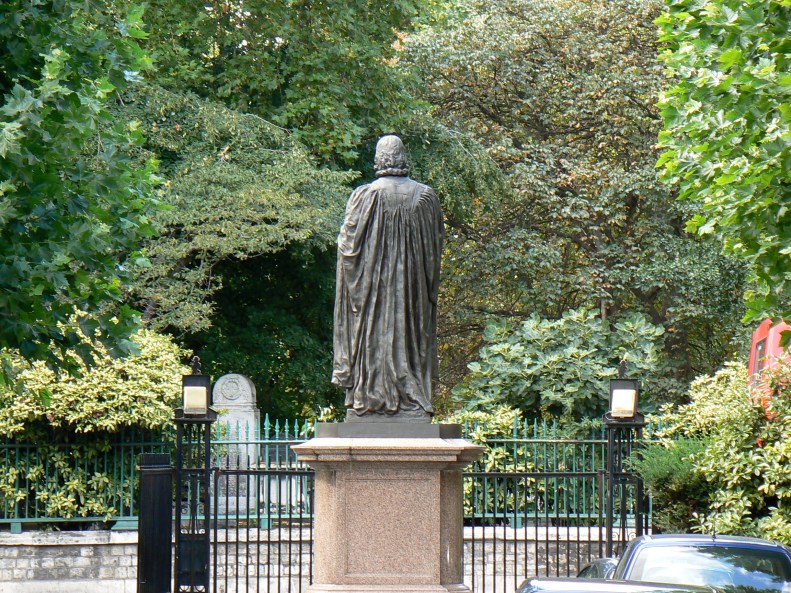
In 1786, the founder of Methodism, John Wesley, looked back on the revival begun during his lifetime. He seemed to think that it was well enough established that it would not immediately vanish after his death. However, he was not content with the survival of a lifeless sect that hung around, but failed to renew souls in the image of their creator. He wrote in “Thoughts Upon Methodism” :

I am not afraid that the people called Methodists should ever cease to exist either in Europe or America. But I am afraid lest they should only exist as a dead sect, having the form of religion without the power. And this undoubtedly will be the case unless they hold fast both the doctrine, spirit, and discipline with which they first set out.

This passage is one that haunts me. It is as if Wesley continues to challenge all who call themselves Methodists to continue to have the zeal to “spread Scriptural holiness” that the early Methodists had. I can’t read this quote without asking myself the obvious question: Is the United Methodist Church in America a dead sect, does it have the form or religion without the power? Or have we held fast to the doctrine, spirit, and discipline with which we first set out?

I plan on looking at the three keys that Wesley lifts up in this passage in the days to come (doctrine, spirit, and discipline). Until then, I would be very interested in your reaction to the implicit question Wesley asks us today, Are we a dead sect, or do we have he form and power of godliness?

Kevin M. Watson teaches, writes, and preaches to empower community, discipleship, and stewardship of our heritage. Connect with Kevin. Get future posts emailed to you.

Saving Money in New York City

23 Saturday Jun 2007

Posted by Kevin M. Watson in Uncategorized

≈ 2 Comments

(Disclaimer: I am not a travel agent, or qualified to give advice like this at all… so read this, and follow in my footsteps at your own risk!)

My wife and I are going on vacation to New York City soon. I have been trying to wrap up all the details of the trip over the past few weeks. The last main piece that I needed to figure out was hotels. You may realize this, but hotels are expensive in the Big Apple! I looked at expedia and priceline, and hotels that didn’t have reviews about people getting bug bites while staying there were just more than I was willing to pay.

I found a solution that I was very happy with, one that allowed me to save a substantial amount of money and get a nicer hotel than I otherwise would have. Here’s the scoop… I have always been intrigued by priceline’s option to name your own price on plane tickets. In the end, I just wasn’t willing to live with the lack of control of the times that the flights would depart and arrive. But on priceline it looks like you can name your own price for anything: flights, hotels, rental cars. So I ended up deciding to see what you had to do to name your own price for a hotel room.

To make a long story short, I ended up getting a 3 star hotel for $100 a night that was advertised for $250 a night! I consider that to be substantial savings! (And, $100 a night was cheaper than any hotel that was listed under priceline’s published rates, so I got a much nicer hotel than I would have otherwise been able to afford for less than the price of a 1 star hotel.) I will let you know the final verdict after I have actually stayed there, but so far I would say I am very pleased.

Here is how it works. You pick the dates that you want to stay and you make an offer for how much you are willing to pay per night (this does not include taxes, the total including taxes will be shown on the next screen) . Then you have to pick what star hotel you want, 1, 2, 3, or 4 stars. When you click on each star it will tell you the average rate for that level hotel. Finally, and this is what gave me the comfort level I needed to take the risk, you choose a location. There is a map of Manhattan and you choose a specific area on that map that your hotel will be guaranteed to be within if you offer is accepted.

Here is an example: If you choose Midtown West (assuming you are somewhat familiar with Manhattan) your hotel will be in between 5th and 9th avenues going East and West and between 55th and 41st streets from North to South. (This is basically Times Square and the surrounding Broadway district.)

I am not sure how this would work in less dense cities, because what I really liked about this was that you could know within a few blocks exactly where your hotel would be, which from my perspective was the main risk associated with naming my own price on a hotel in NYC.

So, there is my insider information. If you are going to NYC in the near future, you should consider naming your own price on priceline.com. Have any of you had positive or negative experiences with priceline’s name your own price feature?

A Helpful take on Evolution vs. Intelligent Design

20 Wednesday Jun 2007

Posted by Kevin M. Watson in Article Review

≈ Leave a comment

One of the debates that has been the most frustrating to me personally has been the debate about Evolution and Intelligent Design. It is not because I am an expert and know what I am talking about and I am frustrated that other people are so wrong in where they are coming from. In fact, I am anything but an expert. The personal frustration has been that I have seen this debate become a major stumbling block to people having faith in God. From the perspective of someone who is not an expert on this debate, it seems like the more the ID folks try to make sure God doesn’t get defined out of science, the more many scientists become determined to do just that.

I am saddened and concerned by the degree of hostility that seems to exist among people on different sides of this issue.

J. Scott Turner has written a very interesting article in the June 12, 2007 issue of Christian Century that helped me clarify some of what was bouncing around in my head. (Unfortunately, I cannot find a link to this article on the CC website, but I would encourage you to pick up a copy of the magazine, I found it to be worth the read.)

Turner writes as a scientist who seems to be a bit confused as to why so many other scientists are approaching this issue from a rather unscientific perspective. The article caught my attention because I began reading expecting it to basically tear a hole in the Intelligent Design argument. But, rather than really discussing the arguments between ID and Evolution in much of any detail, he actually talks about what is at stake when these arguments become so heated, and when they are settled not in labs or in academic publications, but through litigation and in courtrooms.

Turner writes that from his perspective ID is at bat with two strikes already against it:

It seems less than sporting, then, to call the pitch while it’s still in the air, which is precisely what many of my colleagues insist on doing, sometimes quite vehemently. This, to me, is the most problematic thing about the controversy: it’s not ID that keeps me awake at nights, but the tactics and attitudes of certain colleagues who really should know better. In Pogo’s immortal words, “We have met the enemy and he is us.”

Turner ends the article by essentially arguing that if ID is really such bad science, scientists ought to be able to demonstrate that through the work that they do. They should not resort to making it illegal to teach ID or resort to creating straw men that distract normal people who don’t know the subtleties of the discussion (like me) from the actual areas where research is coming to different conclusions.

In discussing a recent court case in Dover, PA, Turner concludes:

Many of my scientific colleagues were involved in this case. One would hope that they would have taken a stance of principled neutrality, offering a robust defense of academic freedom tempered with the sober recognition that freedom means that sometimes people wil think, speak and even teach things one disagrees with. Instead, my colleagues took sides; many were actively involved as advocates for the plaintiffs, and they were cheered on by many more from the sidelines. Although there was general jubilation at the ruling, I think the joy will be short-lived, for we have affirmed the principle that a federal judge, not scientists or teachers, can dictate what is and what is not science, and what may or may not be taught in a classroom. Forgive me if I do not feel more free.

I don’t know about you, but that made me think. Could it be that both sides are coming at this from the wrong perspective? It does seem odd to place the responsibility for what can be taught in schools in the hands of a judge.

Sunday’s Sermon, Humbling

19 Tuesday Jun 2007

Posted by Kevin M. Watson in Uncategorized

≈ Leave a comment

This past Sunday I preached on Luke 7:36-50 which recounts the episode where Jesus is having a meal with Simon the Pharisee and a sinful woman begins to wet his feet with her tears and wipe them with her hair. This was one of those sermons where I felt God working on me as I prepared ther sermon. I was deeply struck by the differnce between Simon and the woman. The woman’s humility, and really Simon’s lack of need. The woman seems to find forgiveness and salvation in the midst of her humility and deep awareness of need.

I fear that most American Christians are not aware of how in need they are. We tend to look much more like Simon the Pharisee (except we often don’t take obedience to the law nearly as seriously as Simon does) than we do the woman weeping at the Lord’s feet. I don’t know about you, but it is all too easy for me to forget that I am in need of grace. I sometimes forget that if not for grace I would not even be able to stand. Reading and praying over Luke 7:36-50 was a helpful and humbling reminder that I need to be saved, that I cannot save myself.

If you are interested, you can listen to this sermon by clicking here or by clicking on the deeply committed sermons link on the right.

Another Year Older

18 Monday Jun 2007

Posted by Kevin M. Watson in Uncategorized

≈ 6 Comments

Today is my 26th birthday. 26 is an interesting birthday because it seems like a transition where you are just getting older each year, rather than gaining independence and responsibility. Even last year, I could easily rent a car and car insurance rates went down. But I am not aware of any advantage that you gain simply because you are 26 instead of 25. (If I am forgetting something, please let me know!)

But today I have mostly found myself thinking about how blessed I am to have so many people in my life who love me so well. I thank God for giving me the gift of life and for all the blessings of the past year. I hope and pray that I will be faithful to the grace given to me and that I will continue to grow in my love of both God and neighbor in the year to come. There is so much to be thankful for.

Reclaiming the Wesleyan Tradition: John Wesley’s Sermons for Today

15 Friday Jun 2007

Posted by Kevin M. Watson in Uncategorized

≈ 4 Comments

I mentioned receiving the proofs for Reclaiming the Wesleyan Tradition: John Wesley’s Sermons for Today yesterday, but I neglected to say very much about it.

This book is intended primarily to be a resource for small group study. It can be used in a variety of ways, but the most obvious way is for it to be used as a 13 week study with each week’s lesson explaining one key part of the Wesleyan Way of Salvation. (The first lesson is an exception, it is an introduction to John and Charles Wesley. ) After the first lesson, each lesson is designed to have participants read one of John Wesley’s sermons and then the lesson helps unpack and explain the main ideas found in the sermon. Each lesson has a suggested plan for reading the sermon as well as the lesson, in order to make it more manageable.

Each lesson contains both the original sermon by John Wesley, as well as the study materials for unpacking Wesley’s sermon. The lessons address key theological concepts of the Way of Salvation such as: Original Sin, Prevenient Grace, Justification, The New Birth, The Means of Grace, Sanctification, Christian Perfection, The New Creation, and others.

We created this resource because we are convinced that the most promising path to renewal for Methodism is through a renewed understanding and a renewed commitment to our Wesleyan heritage. This resource seeks to help people understand that heritage so that Methodist churches can once again live into it.

Reclaiming the Wesleyan Tradition is scheduled to be published in September 2007 by Discipleship Resources. You can view a promotional brochure of the book here. Please be aware that this link is to a file that is almost 2MB, so if you have a slow connection, it may take a minute to download.

If you have any questions, you are welcomed to post them and I will do my best to respond.

Reclaiming the Wesleyan Tradition Proofs are Here!

14 Thursday Jun 2007

Posted by Kevin M. Watson in Uncategorized

≈ Leave a comment

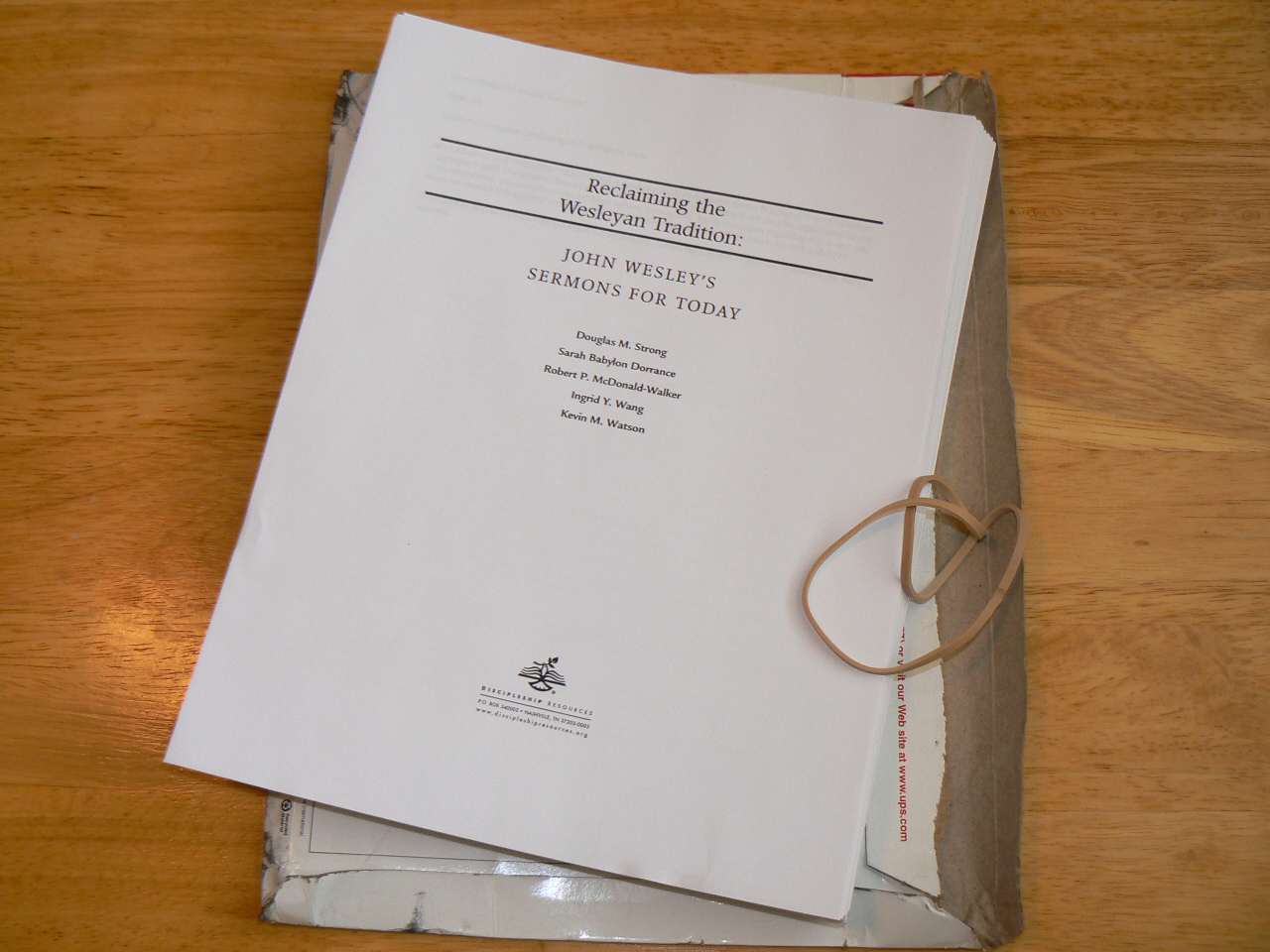
p1020606.jpg

I am working on a book with Douglas M. Strong, Sarah Babylon Dorrance, Robert P. McDonald-Walker, and Ingrid Y. Wang. The book is called Reclaiming the Wesleyan Tradition. It is scheduled for publication in September of this year. You can see the cover here.

The proofs just got here, which means we have one more intense round of editing and then we are done with our work. Being a part of this project has really been an amazing experience, and I believe we have created a resource that has great potential to introduce people to John Wesley’s sermons and to help them come to know more profoundly what the basics are of Methodists beliefs.

I am sure I will write more about this later, but for now it is just exciting to see concrete progress and another step toward this idea becoming a reality.

Barbara Brown Taylor on the Poured-Out Church

14 Thursday Jun 2007

Posted by Kevin M. Watson in Article Review

≈ Leave a comment

Barbara Brown Taylor has written an excellent article in the May 29, 2007 issue of Christian Century. Barbara Brown Taylor is discussing some of the correspondence she has received since writing her recent book Leaving Church. (If you are interested Adam Walker Cleaveland has recently written a review of Leaving Church on his blog pomomusings, you can read his review here.

In the article in Christian Century, Barbara Brown Taylor writes: What I cannot figure is how any church organized around the self-donation of Jesus can stay invested in self-preservation. What would it look like for a church to lay down its life for its friends?

She concludes the article: Leaving church, I believe, is what church is for – leaving on a regular basis, leaving to see what God is up to in the world and joining God there, delivering all the riches of the institution to those who need them most, in full trust that God will never leave the church without all that it needs to live.

Amen! If you are interested in reading the full article, you can read it here.

Thanks to Barbara Brown Taylor for giving some profound thoughts to chew on this morning! What are your thoughts about this article?

Welcome to deeply committed 2.0!

13 Wednesday Jun 2007

Posted by Kevin M. Watson in Uncategorized

≈ 3 Comments

Thank you for finding the new site! I have been blogging now for just over one month. During that month, I realized that there were some things that I would like to be able to do with this blog that I could not figure out how to do with blogger. So, ultimately, I decided to move deeply committed here to wordpress.

I do want to remind you that if you want to continue your subscription to deeply committed, you need to subscribe to this site. Your old subscription will no longer bring you new posts. The right sidebar has links that enable you to subscribe to deeply committed 2.0 in a reader or as an email subscription. For you information, the feed address is: feeds.feedburner.com/DeeplyCommitted

Also, if you have included deeply committed in your blogroll, thank you! Would you be so kind as to update the url, so that folks will be directed here, rather than to the old site?

Because I am still new to the blogosphere, this transition was more labor intensive than I expected. I am glad to be here at wordpress, but even more than that, I am looking forward to putting energy into writing, rather than tweaking widgets and changing the color scheme (so it doesn’t look quite as much like a certain blog that I will not name… this one. Sorry Andrew…

Anyway, welcome to deeply committed 2.0.

← Older posts
Newer posts →

Blog at WordPress.com.

  • Subscribe Subscribed
    • Kevin M. Watson
    • Join 368 other subscribers
    • Already have a WordPress.com account? Log in now.
    • Kevin M. Watson
    • Subscribe Subscribed
    • Sign up
    • Log in
    • Report this content
    • View site in Reader
    • Manage subscriptions
    • Collapse this bar
 

Loading Comments...