• About Me

Kevin M. Watson

Kevin M. Watson

Author Archives: Kevin M. Watson

Munger Place – Membership

13 Thursday Jan 2011

Posted by Kevin M. Watson in Christian Living, Life, Ministry, Wesley

≈ 6 Comments

Tags

Andrew Forrest, Church Membership, Munger Place


I think Munger Place Church, a congregation of Highland Park UMC, is doing some great things. I want to share a few things I have experienced at Munger that I think could be instructive for the broader United Methodist Church.

A few weeks ago I attended the membership class for Munger with my wife. The class was two hours on a Wednesday night, and there were more than fifty people there – and this was the third membership class! Part of Andrew’s vision for Munger is that he wants it to be a place where everyone is welcomed with open arms on the one hand, but where there are meaningful standards for membership on the other hand.

Incidentally, I am in complete agreement with Andrew here. I think the best way to measure whether a church has meaningful membership standards is whether the average attendance is higher than the membership of the church. My guess is that most United Methodist congregations have a membership that is two times larger than the average weekly worship attendance of the church. When this is the case it reveals that the members of the church do not think something as basic as showing up at church is essential to being a member of the church. As Andrew said in the membership class, this is a model that a health club would love. You could buy one treadmill and have 10 million members!

Currently, Munger Place has four expectations of each person who takes the extra step of becoming a member of the church. 1) Attendance at weekly worship service; 2) Support the church financially with consistent giving; 3) Participate in a weekly small group, which Munger calls Kitchen Groups; 4) Serve others, particularly the last, the least, and the lost.

I appreciated the way Andrew communicated these four expectations in a way that showed that they really were expected of members, but avoided coming across as legalistic of Pharisaic. Andrew also stated explicitly that if people were unsure of whether they were ready to make these commitments, they were welcomed – and encouraged! – to continue to be active in the church without taking the step of becoming a member.

Just exactly how members will be held accountable for keeping these expectations remains to be seen. But Andrew has already raised the standards for the typical United Methodist Church by having a mandatory membership class. And if this Sunday is an indication, I am told that there were about one hundred people who joined the church the first time they were given the opportunity. (I was disappointed to miss worship, as I was in Atlanta for an academic conference.)

I have spoken with a few people who joined the church and have been thrilled to hear how meaningful it was to them. One person talked about how big of a step this was in their life. Another person said that it was so meaningful they had tears of joy as they made their commitment to ministry through and with the church. One person emailed me to celebrate becoming a part of Munger and joining the UMC for the first time. The email concluded, “Go Wesley!”

One of the things that excites me the most about Munger is that I have met several people who are captivated by the Wesleyan vision for the Christian life. These women and men do not have the anxiety about the future of our denomination that many lifelong Methodists have. In fact, they hardly seem to notice the decline, because they are too captivated by the God who is changing their lives.

And if this weren’t enough… this is all happening in a church that was closed because it was no longer financially viable. New life. Resurrection. Thanks be to God!

Published in Methodist Review

06 Thursday Jan 2011

Posted by Kevin M. Watson in Article Review, Life, Methodist History, Wesley

≈ 2 Comments

Tags

Band meeting, Early Methodism, Methodist Review, Wesley

For those of you who may be interested in my research on the early Methodist band meeting, I have recently had an article published in Methodist Review an online, peer-reviewed academic journal. The title of my article is “Forerunners of the Early Methodist Band Meeting” and (as the title suggests) it explores the key antecedents that influenced the development of the Wesleyan Methodist bands.

If you want to read the article, you simply have to register with Methodist Review (which is free) and then download the PDF file. Once you register you have access to both vols. 1 and 2 of the journal and can download any or all of the articles that have been published.

Munger Place in the News

05 Wednesday Jan 2011

Posted by Kevin M. Watson in Article Review, Christian Living, Ministry

≈ 1 Comment

Tags

Andrew Forrest, Mary Jacobs, Munger Place

Mary Jacobs of the United Methodist Reporter has recently written a feature piece on Munger Place Church. Munger is the church that my family has been involved with since it began the process of relaunching about a year ago. Public worship services began in October and have been ongoing since. I have been working on a longer post on Munger in my head for weeks now, but until I get it down here I will say that there are two things that I think Munger Place is doing that offer a model for The United Methodist Church.

First, campus pastor Andrew Forrest is serious about working to reclaim a contemporary equivalent of the early Methodist class meeting. Andrew calls these groups Kitchen Groups, and they are primarily focused on creating a space where people come together to talk about how their journey as followers of Jesus Christ is going – that is the primary purpose and activity of Kitchen Groups.

The second thing about Munger that really excites me is that it is providing an opportunity for a young person with obvious gifts to gain real ministry experience in a growing church. Andrew will graduate from Perkins School of Theology this spring, and as a result is in the process of applying for commissioning as an elder. It excites me that he is not just observing, but leading and even preaching at a church that had 700 people in attendance on its first week in worship and has consistently had 400 people a week in worship since. For all the talk about the need for younger clergy in the denomination, I don’t often see younger clergy given this kind of opportunity to thrive in ministry. If the UMC is serious about attracting the best and brightest of the up and coming generations, it will need to be willing to take risks on gifted people like Andrew.

You can visit Munger’s website here.

The Methodist Class Meeting for the 21st Century: Where Are They Now?

18 Thursday Nov 2010

Posted by Kevin M. Watson in Accountability, Christian Living, Methodist History, Ministry, Wesley

≈ 22 Comments

Tags

class meeting

It has been awhile since I have added to my series on the class meeting for the 21st century. (If you have missed this series and want to learn more about the relevance of Wesleyan class meetings for the 21st century, click here for the last post and an outline of the entire series.) I recently received a great question from a reader about my post on the class meeting for the 21st century. The basic question was, Are there Methodist churches that have class meetings? The question is so good, I am going to dedicate a post to it.

The short answer is Yes!

In the Dallas-Fort Worth area I have worked with several ministries about starting something like a contemporary version of the class meeting. Here are three different ministries and the way that they have implemented a 21st century version of the class meeting in their unique contexts:

1. Munger Place Church

Munger Place Church is a congregation that was relaunched by Highland Park United Methodist Church. Public worship began at Munger Place just over a month ago. Munger Place has adopted the class meeting as their basic approach to small groups, which they call “Kitchen Groups.” In the first month as a worshiping congregation, Munger has already had a small group launch that resulted in starting five Kitchen Groups. The leaders for these five groups came from a previous small group that began meeting last spring. My family has been part of the leadership team that helped “relaunch” Munger Place and we have been blessed to be involved with Kitchen Groups as well. I am excited by the way that Andrew Forrest, the campus pastor, has embraced the class meeting model and renamed it. When Andrew talks about membership at Munger Place, he always mentions that part of the expectations of membership include involvement in a Kitchen Group. (One caveat: The link to the Kitchen Group page on the Munger website contains a video that is not specifically about Kitchen Groups. The video was actually made by Cornerstone for their small group ministry, which has a bit different emphasis.)

2. S.M.U. Wesley Foundation

This is an example of a way that a United Methodist campus ministry is implementing a Wesleyan approach to small groups. This year, the Wesley Foundation at Southern Methodist University has started both class meetings and band meetings. Every time I meet with the director, Andy Roberts, and intern from Perkins School of Theology, Robert Perales, I leave energized and excited by the ways that both Andy and Robert are pouring themselves into the students at S.M.U. From the conversations with them, I am coming to see campus ministry as a context that is particularly ripe for Wesleyan forms of communal Christian formation. Andy has recently invited me to speak with the students leaders at the Wesley Foundation over a few weeks in the Spring – I can’t wait!

3. Nexus Community, A Church of the Nazarene

Finally, I was invited by Nexus Community, which at the time was part of Richardson Church of the Nazarene and has since become a new church plant, to share with them about the history of Wesleyan small groups and their contemporary relevance. The last time I spoke with them, I broke the congregation up into small groups and we did a “speed class meeting.” This gave everyone a chance to experience a very abbreviated form of the class meeting and dip their toes in the water of talking about their lives with God. Nexus has since started three class meetings, one meets at the church and two meet in the leaders’ homes.

These are just three examples, and I only know about them because of the ways I have been invited to walk beside them as they begin to reclaim the Wesleyan practice of “watching over one another in love.” Do you know of churches that have 21st century class meetings? Have you been in one? Please leave a comment and share your experience!

Campbell on the Wesleyan Belief in Entire Sanctification

15 Monday Nov 2010

Posted by Kevin M. Watson in Book Review, Christian Living, Methodist History, Wesley

≈ 3 Comments

Tags

Christian Perfection, entire sanctification, Ted Campbell, Wesley, Wesleyan Beliefs

In a previous post, I recommended Ted A. Campbell’s Wesleyan Beliefs: Formal and Popular Expressions of the Core Beliefs of Wesleyan Communities. One of the highlights of the book is Campbell’s discussion of the continuing relevance of the Wesleyan doctrine of entire sanctification or Christian perfection. Campbell makes the most persuasive and helpful case for the ongoing value and relevance of the Wesleyan doctrine of entire sanctification that I have read in some time. Here is the key passage:

The doctrine of entire sanctification is a great gift at the heart of historic Wesleyan communities, a gift that, I am inclined to say, Wesleyan Christians could neglect only at the peril of losing what has been the heart of their distinctive beliefs. It is grounded in the consistent biblical mandate that the end (telos) or goal of human existence is complete love for God, and love for our neighbors as the natural concomitant and sign of love for God… I find John Wesley’s twofold rationale for the doctrine of entire sanctification unassailable:
1. God intends that we should love God completely.
2. God can accomplish what God intends.
Once these two points are understood, the doctrine of entire sanctification can be understood as the heart of biblical religion… It creates a space where ancient saintliness can meet modern life and thus it is a gift of grace for the contemporary world. (233)

Amen!

Almost Christian

12 Friday Nov 2010

Posted by Kevin M. Watson in Book Review, Christian Living, Ministry

≈ Leave a comment

Tags

Almost Christian, Christian formation, Kenda Dean, Youth ministry

I recently finished reading Kenda Dean’s new book, Almost Christian: What the Faith of Our Teenagers is Telling the American Church. As I said in a previous post that recommended several books I have recently read, I would recommend this book to anyone who is interested in youth ministry, young people, or the state of the American Church.

To put it differently, if the beginning of Dean’s book doesn’t make you want to read more, then you may not want to read it:

Let me save you some trouble. Here is the gist of what you are about to read: American young people are, theoretically, fine with religious faith – but it does not concern them very much, and it is not durable enough to survive long after they graduate from high school.
One more thing: we’re responsible.
If the American church responds, quickly and decisively, to issues raised by studies like the National Study of Youth and Religion… then tending the faith of young people may just be the ticket to reclaiming our own. As the following pages attest, the religiosity of American teenagers must be read primarily as a reflection of their parents’ religious devotion (or lack thereof) and, by extension, that of their congregations. (3-4)

As Dean says a few paragraphs later, “lackadaisical faith is not young people’s issue, but ours.” (4)

In other words, this book is as much about the current state of the American church as it is about the state of youth ministry or the faith of youth themselves. Dean sees the faith of teenagers as a mirror that shows the American church the faith that it is teaching to them. Part of Dean’s argument is that the church is doing a decent job of forming young people in the faith that they are practicing. The problem is that this faith is “an imposter faith that poses as Christianity, but that in fact lacks the holy desire and missional clarity necessary for Christian discipleship” (6)

Here is the question that should cause American Christians to do some serious soul-searching: “What if the church models a way of life that asks, not passionate surrender but ho-hum assent? What if we are preaching moral affirmation, a feel-better faith, and a hands-off God instead of the decisively involved, impossibly loving, radically sending God of Abraham and Mary, who desired us enough to enter creation in Jesus Christ and whose Spirit is active in the church and in the world today?” (12)

Dean’s work moves beyond Christian Smith and Melinda Denton in Soul Searching: The Religious and Spiritual Lives of American Teenages and the National Study of Youth and Religion (NYSR), which was the research that informed the book. Here is the central question that Dean explores in Almost Christian: “How can the twenty-first-century church better prepare young people steeped in Moralistic Therapeutic Deism for the trust-walk of Christian faith?” (22)

The argument of the book, then, contains a detailed description of the problem of the “parasite” of Moralistic Therapeutic Deism, several positive examples of what it looks like to “claim a peculiar God-story,” and several descriptive chapters that outline suggestions for “cultivating consequential faith.”

Almost Christian has gained attention in many venues. An article about the book on CNN.com even stirred up some controversy. As of this writing, there are more than 5,000 comments to the article. This is an important book that raises some serious questions, not just about ministry to youth and young adults, but about the contemporary state of Christianity in America.

After reading the book, the question I am left with is: What tools or insights does an intentionally Wesleyan approach to Christian formation offer? Admittedly, this is a question beyond the scope of Dean’s book, but I believe the Wesleyan tradition has a rich contribution to make to attempts to “cultivate consequential faith” in Christians both young and old(er)!

Generation Rising: A Future with Hope for The UMC

08 Monday Nov 2010

Posted by Kevin M. Watson in Accountability, Book Review, Christian Living, Methodist History, Ministry, Wesley

≈ 2 Comments

Tags

Christian accountability, Generation Rising, new book, small groups

Andrew Thompson has written a post about a book that Abingdon will be publishing in the Spring, Generation Rising: A Future with Hope for the United Methodist Church. Thompson is the editor of the book, which features chapters from twelve different younger leaders in the UMC about the future of the denomination. (Click on the link to Andrew’s post to see a list of the authors of the various chapters, the titles of each chapter, and the cover of the book.)

I was thrilled to be asked by Andrew to write a chapter on the role of small groups for the future of the UMC. My chapter gives a brief history of the role of “watching over one another in love” through a form of small group accountability in early Methodism. I then explore the relevance of the past for the present by addressing some of the challenges to embracing this Wesleyan communal practice in the 21st century. Ultimately, I argue that a return to such a practice will be essential for the renewal of United Methodism. I see the chapter I wrote for Generation Rising as a key part of what I have been doing here in my series on the relevance of the class meeting for the 21st century. If you have found that conversation to be beneficial, I hope you will read my chapter.

I am excited to be a part of this project, because I am thrilled to be part of a collaborative effort to give voice to what younger leaders in the UMC think is needed in order for United Methodism to have a future with hope. One of my frustrations about efforts to restore vitality to our denomination is that they typically fail to represent the vision or insights of the people who are the future of the church. This project is one attempt by younger folks in United Methodism to share what our sense is of where we are and what the most promising and hopeful way forward is. It is written by people who love the church and are committed to it.

I appreciate Andrew’s vision, initiative and leadership in conceiving this project, and his work to bring it to fruition. I also appreciate Abingdon Press’s recognition of the importance of giving voice to the experience and insights of younger generations within the church. Ultimately, I hope Generation Rising is only the beginning of a broader conversation about the way forward for the church.

Recommended Reading

27 Wednesday Oct 2010

Posted by Kevin M. Watson in Book Review, Christian Living, links, Methodist History, Wesley

≈ 4 Comments


I want to recommend three books that I have recently read (in one instance, re-read) and three books that I am really looking forward reading.


Almost Christian: What the Faith of Our Teenagers is Telling the American Church
by Kenda Dean.

If you are involved in ministry with youth and young adults, you should read this book. If you have children and care about them becoming mature Christians, you should read this book. Oh, and if you care about people in this demographic… you should read this book.

I just finished reading Almost Christian and (as you may be able to tell) I thought it was excellent. Almost Christian chews on the research and data that was released with Christian Smith and Melinda Lundquist Denton’s Soul Searching: The Religious and Spiritual Lives of American Teenagers, which has already made a big splash in conversations about the formation of youth and young adults. I plan on blogging about Dean’s book in the near future, so I won’t say more at this point.


Charles Wesley and the Struggle for Methodist Identity by Gareth Lloyd.

I re-read this book during my time working in the Methodist Archives in Manchester. Gareth Lloyd is also the archivist for the Methodist material in Manchester. Lloyd’s book does two things that are both major contributions to Wesleyan Studies and the history of Methodism. First, he argues that John Wesley’s perspective has dominated the history of Methodism in ways that have distorted the picture. Thus, Charles Wesley and the Struggle for Methodist Identity seeks to begin to restore some balance and bring the picture back into focus. The second contribution of Lloyd’s work is that the book acts as a kind of guide to the primary source material that has all too often been overlooked by Methodist historians. One of Lloyd’s key arguments is that scholarship relating to Charles Wesley is inadequate because it has tended to rely on nineteenth century secondary source material, rather than going back to the original materials. Because of his position at the Rylands, Lloyd is the ideal person to make this case and to provide suggestions as to where key materials are that have yet to be mined.

Warning: The main negative of this book is its price. It is currently only available in hardcover and is $99. (Oh, you can purchase a Kindle version, which is $20 cheaper.)


Wesleyan Beliefs: Formal and Popular Expressions of the Core Beliefs of Wesleyan Communities by Ted A. Campbell.

Finally, Ted A. Campbell’s latest contribution to Wesleyan Studies has just come off the presses. If nothing else, you should read this book because it is endorsed by both Richard P. Heitzenrater and Randy L. Maddox. Maddox’s endorsement suggests that “Campbell’s careful study should put to rest finally the frequent caricature of Methodism as unconcerned about doctrinal beliefs… This is a must-read for scholars of the Wesleyan/Methodist tradition and beyond!”

My brief summary of Campbell’s argument would be that studies of Methodist or Wesleyan doctrine or beliefs have tended to fall into one of two camps. They are either focused on a rigid study of official doctrinal statements or academic contributions from members of these traditions, or they are focused on the opposite extreme of the popular practices and expressions of faith of Wesleyan or Methodist faith communities at particular points in time. In Wesley Beliefs, Campbell aims to bring these two legitimate foci into conversation with one another. In so doing, he finds that the study of official statements of doctrine along with more popular expressions of lay spirituality (such as hymnals, catechisms, and the architectural design of churches) reveal significant harmony.

(Full disclosure: Ted Campbell is my Ph.D. advisor here at S.M.U., so I am perhaps predisposed to think highly of his work.)

Here are three books that I am chomping at the bit to get my hands on, in fact I hope to be able pick up a few this weekend at the American Academy of Religion. Since I have not read them, I will not comment on them any further at this point, except to say that I think they are worth checking out.

The Methodist Experience in America, Vol 1: A History
by Russell E. Richey, Kenneth E. Rowe, and Jean Miller Schmidt

From Aldersgate to Azusa Street: Wesleyan, Holiness, and Pentecostal Visions of the New Creation edited by Henry H. Knight III.

T&T Clark Companion to Methodism edited by Charles Yrigoyen, Jr.

Getting Back into the Swing of Things… Slowly.

26 Tuesday Oct 2010

Posted by Kevin M. Watson in Life

≈ 1 Comment

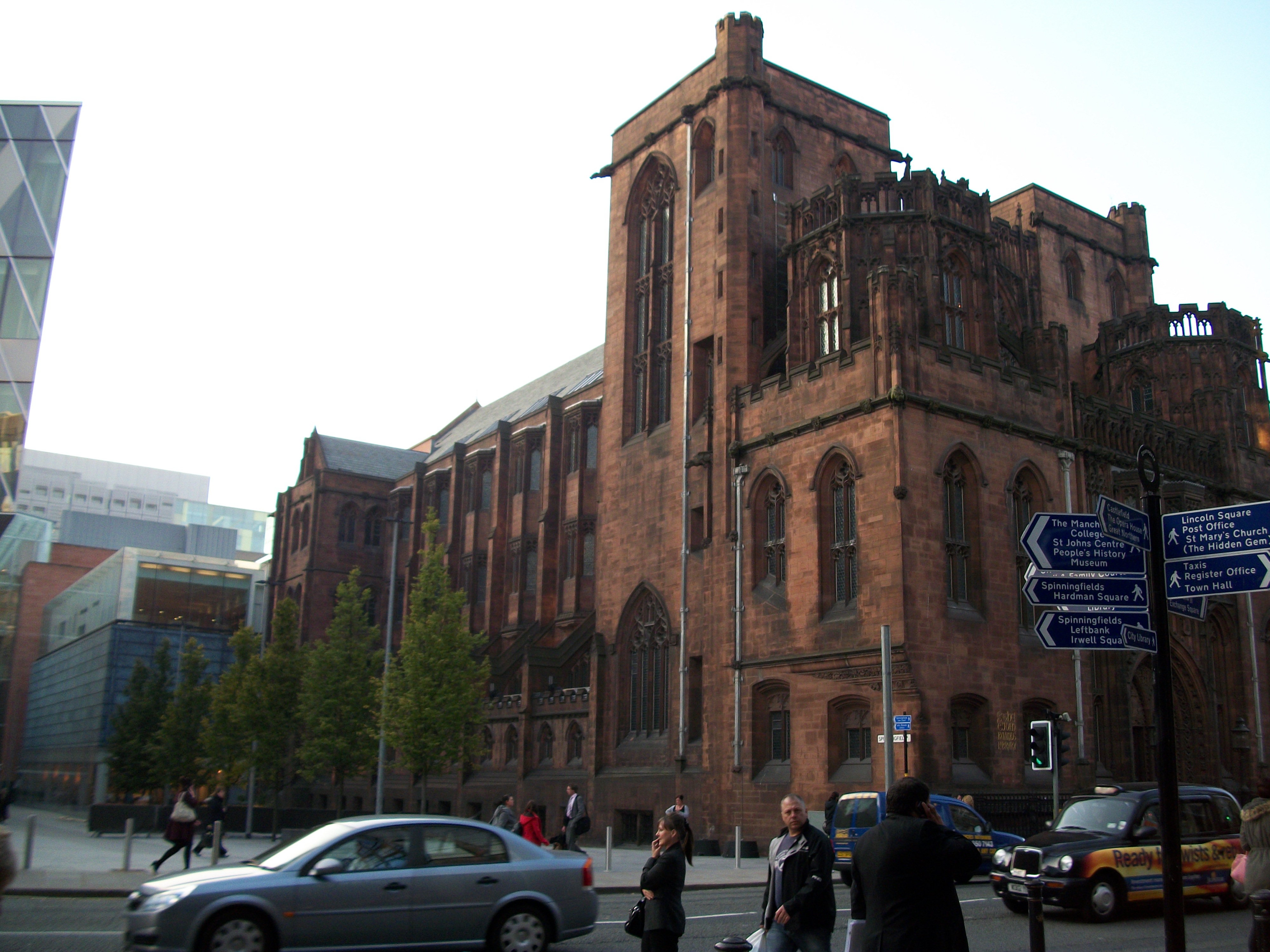
Congratulations to Mike Weaver, who correctly answered the question in my jet-lagged post about my trip to the John Rylands University Library in Manchester, England. The Rylands contains an amazing amount of material on early Methodism, much of which is largely unexplored. I was at the Rylands for almost a month, reading furiously from open till close every day, and I still did not read everything that I could have. (Thanks to the expert guidance and direction of Dr. Gareth Lloyd, I was able to look at all of the material that is most relevant to my dissertation.)

My research in Manchester focused primarily on unpublished manuscript letters and diaries of early Methodists. I found more material than I expected and I am very excited to dig into the more than 2,500 photos I took and the more than 100 pages of notes I took on my computer. I am really looking forward to mining this material and getting into the next chapter of my dissertation.

Returning to the United States has been a bit more jarring than I expected, mostly because my children do not seem to adjust time changes as easily as my wife and I do. (There is something very surreal and painful about having your two and a half year old wake you up at 4:30 am, because she is convinced it is well after the time we normally get up.) Happily, both kids are now sleeping through the night when it is actually night-time again.

Thankfully I am starting to catch my breath, because this weekend I am heading to the annual meeting of the American Academy of Religion. I am presenting a paper in the Wesleyan Studies section, which this year is focused on Methodism and the Civil Rights Movement. My paper, “In the Shadows of Segregation: Methodist Seminaries and the Civil Rights Movement”, explores the connection of two Methodist seminaries to the Civil Rights Movement (Perkins School of Theology at S.M.U. and Boston University School of Theology). I thoroughly enjoyed the research I did for this paper. In particular, I was able to interview several people who were students or faculty at these two institutions about their involvement. Among the people I interviewed, one that was particularly significant to me was speaking with James V. Lyles, who was one of five African-American students who integrated Perkins School of Theology in 1952.

So, there you have a brief snapshot of where I have been and where I am going. I do have several blog posts percolating in my mind. I am looking forward to writing them and continuing to grow and be challenged by your comments. Thank you for staying tuned!

Where I’ve Been the Last Four Weeks…

15 Friday Oct 2010

Posted by Kevin M. Watson in Uncategorized

≈ 5 Comments

This is where I spent the majority of the past four weeks. Do you know where or what this is?

I am looking forward to getting back into the rhythm of blogging, more to come.

← Older posts
Newer posts →

Blog at WordPress.com.

  • Subscribe Subscribed
    • Kevin M. Watson
    • Join 368 other subscribers
    • Already have a WordPress.com account? Log in now.
    • Kevin M. Watson
    • Subscribe Subscribed
    • Sign up
    • Log in
    • Report this content
    • View site in Reader
    • Manage subscriptions
    • Collapse this bar
 

Loading Comments...