
Tags
Bible, Christianity, Dallas Willard, discipleship, Divine Conspiracy, faith, Jesus, Parable of the Pearl of Great Price, Parable of the Treasure in the Field, Parables
When people come to my office, they often comment on the number of books I have.
I think the most common question I am asked is:
Have you actually read all of these?
The answer is a definite no.
As many times as I’ve been asked that question, there is a question a pastor asked me once that I remember vividly, I think because the question was so wise:
Of all of these books, if you could only recommend I read one, which one would it be?
What a great question! It was simple and profound.
I also had a bit of a “All of my children are my favorite moment” before realizing that books are not at all children.
I was surprised at how hard this question was for me to answer. I probably sat and thought about it for a full minute (which is really a long time when someone is standing in front of you waiting on your answer).
My final answer was Dallas Willard’s The Divine Conspiracy: Rediscovering Our Hidden Life in God. That question was asked and answered about five years ago.
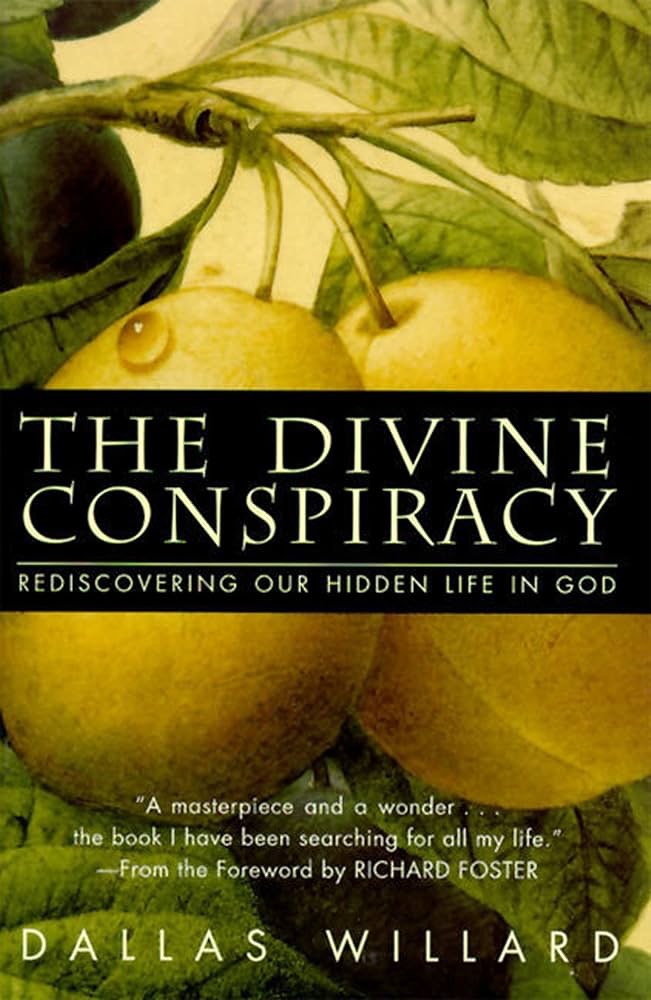
As part of the Asbury Fellows Program, I lead a discussion of a book with the Fellows each month. And this week we discussed Dallas Willard’s The Divine Conspiracy, which gave me the chance to reread it for the first time in many years.
I am so thankful that this book, which I first read when I was in college, did not let me down when I returned to it nearly thirty years after it was first published.
Willard diagnosed some basic places where the American church had lost its way and worked to bring her back to health and wholeness.
I would say that The Divine Conspiracy is the best, and most demanding, book on discipleship to Jesus Christ I have ever read.
If you have not read this book, you should stop what you are doing and order it right now.
I may return to this book here over the coming weeks because there is so much here worthy of emphasis and reflection.
For now, I want to share one key piece that has stood out to me since reading it.
In the last third of the book, Willard describes something that really gets at the foundation of our faith. We really can’t move on, at least not in a productive and healthy way, until we really get this. Or, perhaps, we literally will not move forward until we do.
This a long quote, but it is so good:
There are many people who would like to be the constant student and co-laborer with Jesus in all the details of their lives. Many of these are professing Christians; some are not. But in either case, living as an apprentice with Jesus in The Kingdom Among Us is usually not something that seems accessible to them. No wonder, then, that practical, experimental steps seem to be lacking. They do not really understand what discipleship to him is, and it therefore remains only a distant, if beautiful, ideal.
It is now generally acknowledged, as we have noted, that one can be a professing Christian and a church member in good standing without being a disciple. There is, apparently, no real connection between being a Christian and being a disciple of Jesus. And this is bound to be rather confusing to a person who would like to be a disciple. For what exactly would one do who didn’t intend to go into “full-time Christian service” but still wanted to be a disciple in something like the sense just outlined?
I believe we can identify definite steps that will prove effective. But before discussing them we need to be quite clear about our preliminary objective. Because, as we have seen, a disciple of Jesus is one who is with Jesus, learning to be like him, what, we must ask, is the state of soul that would bring us to choose that condition? What would be the thinking, the convictions about reality, that would lead someone to choose discipleship to him?
Obviously one would feel great admiration and love, would really believe that Jesus is the most magnificent person who has ever lived. One would be quite sure that to belong to him, to be taken into what he is doing throughout this world so that what he is doing becomes your life, is the greatest opportunity one will ever have. (291-2)
In the next section, Willard points to two of Jesus’s parables that “illustrate the condition of soul that leads to becoming a disciple.” These are the parable of the treasure hidden in the field and the pearl of great price. They are found in Matthew 13:44 -46. Here they are:
The kingdom of heaven is like treasure hidden in a field, which a man found and covered up. Then in his joy he goes and sells all that he has and buys that field.
Again, the kingdom of heaven is like a merchant in search of fine pearls, who, on finding one pearl of great value, went and sold all that he had and bought it.
These two very short parables contain a foundational truth about Christian discipleship. If you miss it and move forward, you will most likely build a form of Pharisaic works-righteousness rather than the kind of relationship with Jesus that he himself desires.
And this is where Willard is just stunningly excellent. Read this slowly:
These little stories perfectly express the condition of soul in one who chooses life in the kingdom with Jesus. The sense of the goodness to be achieved by that choice, of the opportunity that may be missed, the love for the value discovered, the excitement and joy over it all, is exactly the same as it was for those who were drawn to Jesus in those long-ago days when he first walked among us. It is also the condition of soul from which discipleship can be effectively chosen today. (292)
Like the parables of the treasure in the field and the pearl of great price, the “deal” is so good you don’t even think about whether you want to take it. You immediately gather up everything you need to be sure you get the bargain.
It is that stunningly good.
It is entirely to your benefit.
It is a blessing.
It is a joy to receive.
It is like the most ridiculously good Christmas a child could ever imagine.
And the offer of life with Jesus is real!
And it is, indeed, entirely to our benefit.
If it seems otherwise, we have not yet fully understood, much less received, the full gospel. Jesus is not trying to pull one over on us. He is not trying to take good things from us that we must grit our teeth and give him anyway, because eternity is at stake.
Jesus offer us life and life abundant.
He is exceedingly good.
He is unimaginably generous.
This is wonderful news. But there is a tinge of sadness as I think about this. And that is because the good news of Jesus is so much better than many of his own followers have realized.
Kevin M. Watson is a Pastor and the Senior Director of Christian Formation at Asbury Church in Tulsa, OK. He is also on the faculty at Asbury Theological Seminary, anchoring the Seminary’s Tulsa, OK Extension Site. His most recent book, Doctrine, Spirit, and Discipline describes the purpose of the Wesleyan tradition and the struggle to maintain its identity in the United States.Affiliate links, which help support my work, used in this post.
 Kevin M. Watson