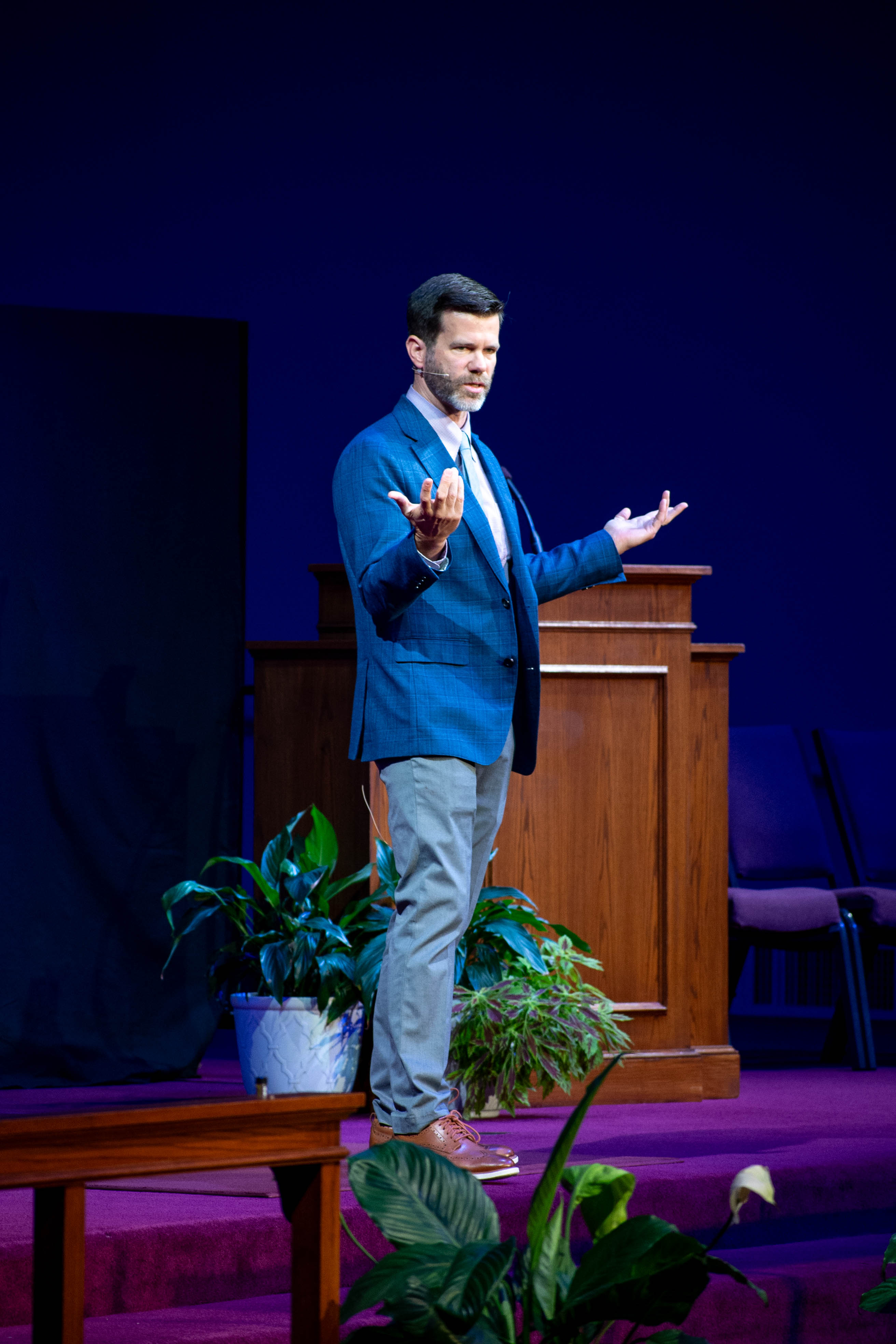
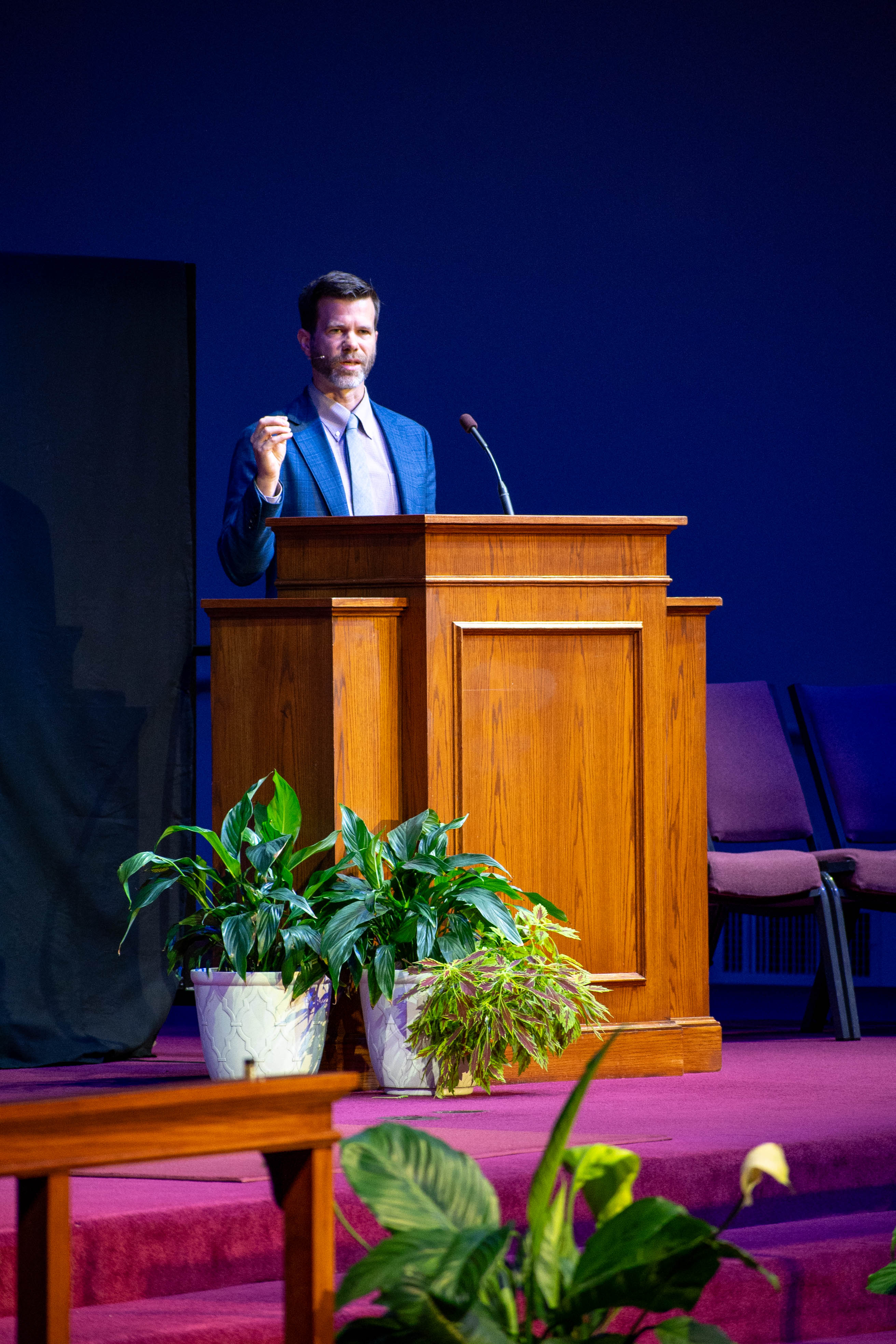
The Rev. Andrew Forrest, the senior pastor at Asbury Church in Tulsa, OK, interviewed me about my new book this past weekend in all of our services. It was so fun!
Andrew is not only a gifted communicator, he also has the ability to help other people refine and clarify their own ideas. It was really fun to see his mind work in terms of distilling what was most important from the book for people at Asbury Church.
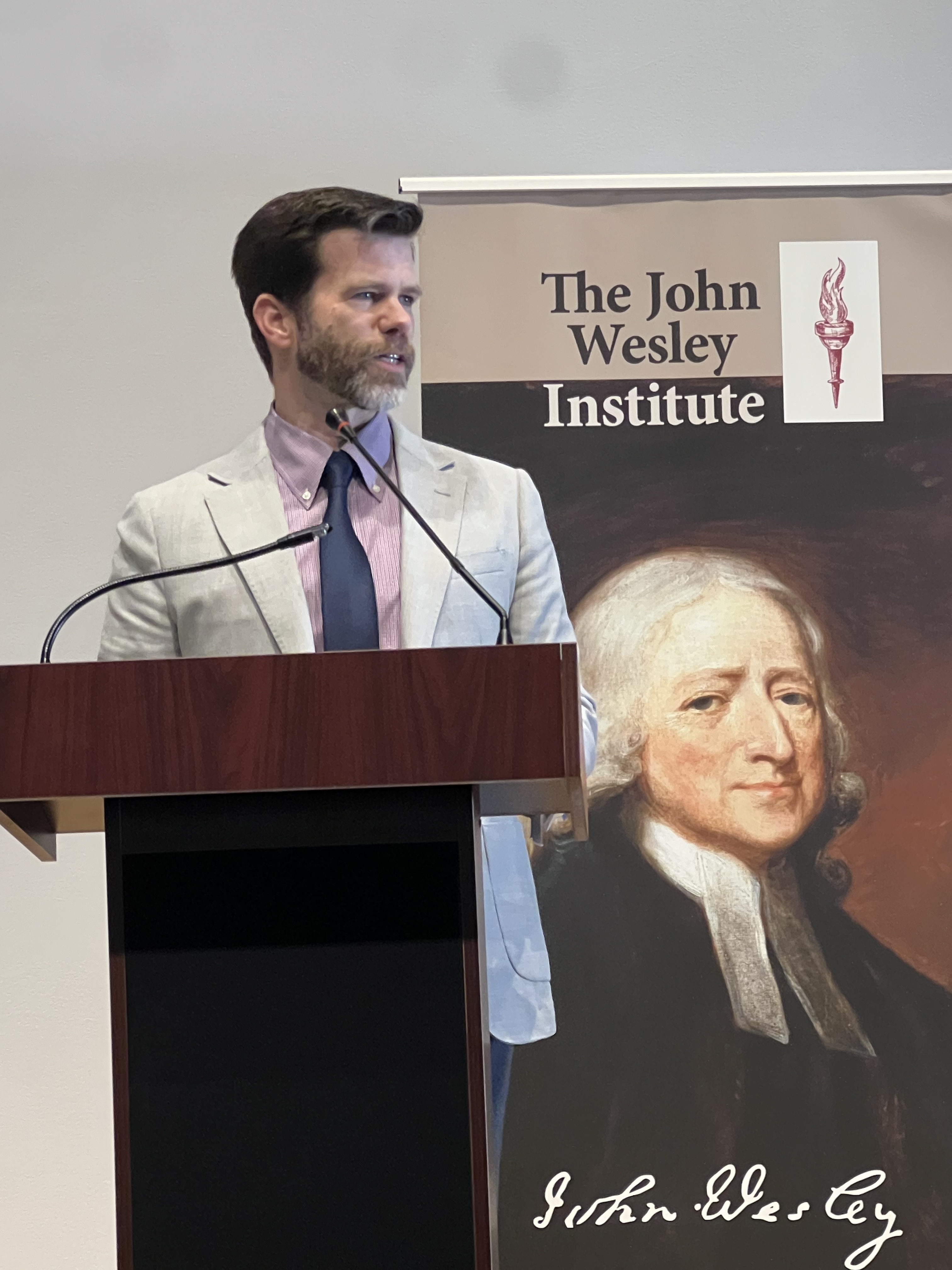
Here is a screenshot of the interview. Click the link below to view it.
Doctrine, Spirit, and Discipline: A History of the Wesleyan Tradition in the United States has already sold out of the first print run! (It continues to be available as an e-book and an audio book.) I am thrilled by the interest the book has received and look forward to seeing it continue to build.
As I’ve talked with people about the book, I’ve only become more convinced of its importance for such a time as this. As we move into new futures, it is essential that we be able to recognize real Methodism from cheap imitations. In order to do so, we have to know where we have come from and be regrounded in our identity. I believe John Wesley was right to lay out the following as the litmus test for Methodist vitality:
“I am not afraid that the people called Methodists should ever cease to exist either in Europe or America. But I am afraid lest they should only exist as a dead sect, having the form of religion without the power. And this undoubtedly will be the case unless they hold fast both the doctrine, spirit, and discipline with which they first set out.” – John Wesley “Thoughts upon Methodism” (1786)
My book describes the doctrine, spirit, and discipline with which Methodists first set out and traces adherence to them across the history of the Wesleyan family in the United States.
Methodists were at the center of the First Great Awakening and the Second Great Awakening. I am convinced that one way or another, the DNA of real Methodism will be at the center of the Third Great Awakening.
I am so thankful to the Lord that this day has arrived!
If you haven’t picked up a copy of the book, I hope you will today!
Here is the summary of the book from the dust jacket:
An expansive, substantive history of the Wesleyan tradition in the United States, Doctrine, Spirit, and Discipline offers a broad survey of the Methodist movement as it developed and spread throughout America, from the colonial era to the present day. It also provides a theological appraisal of these developments in light of John Wesley’s foundational vision. Beginning with Wesley himself, Watson describes the distinctiveness of the tradition at the outset. Then, as history unfolds, he identifies the common set of beliefs and practices that have unified a diverse group of people across the centuries, providing them a common identity through a number of divisions and mergers. At a time when sweeping changes continue to transform Methodism and the pan-Wesleyan movement, Watson shows that the heart of the Wesleyan theological tradition is both more expansive and substantive than any singular denominational identity.
For more information check out the post I wrote here.
Zondervan has created a fantastic page for the book here.
Buy the book at Amazon here (affiliate link) or through Zondervan directly here.
I have been interviewed on several podcasts about the book. I will update interviews as they go live.
I was on Art of Holiness with Rev. Dr. Carolyn Moore. Check it out here.
I was on Spirit & Truth with Rev. Dr. Matt Reynolds. Check it out here.
The interest in this book has been so encouraging to me. Thank you so much to each of you who have bought the book. I am grateful!
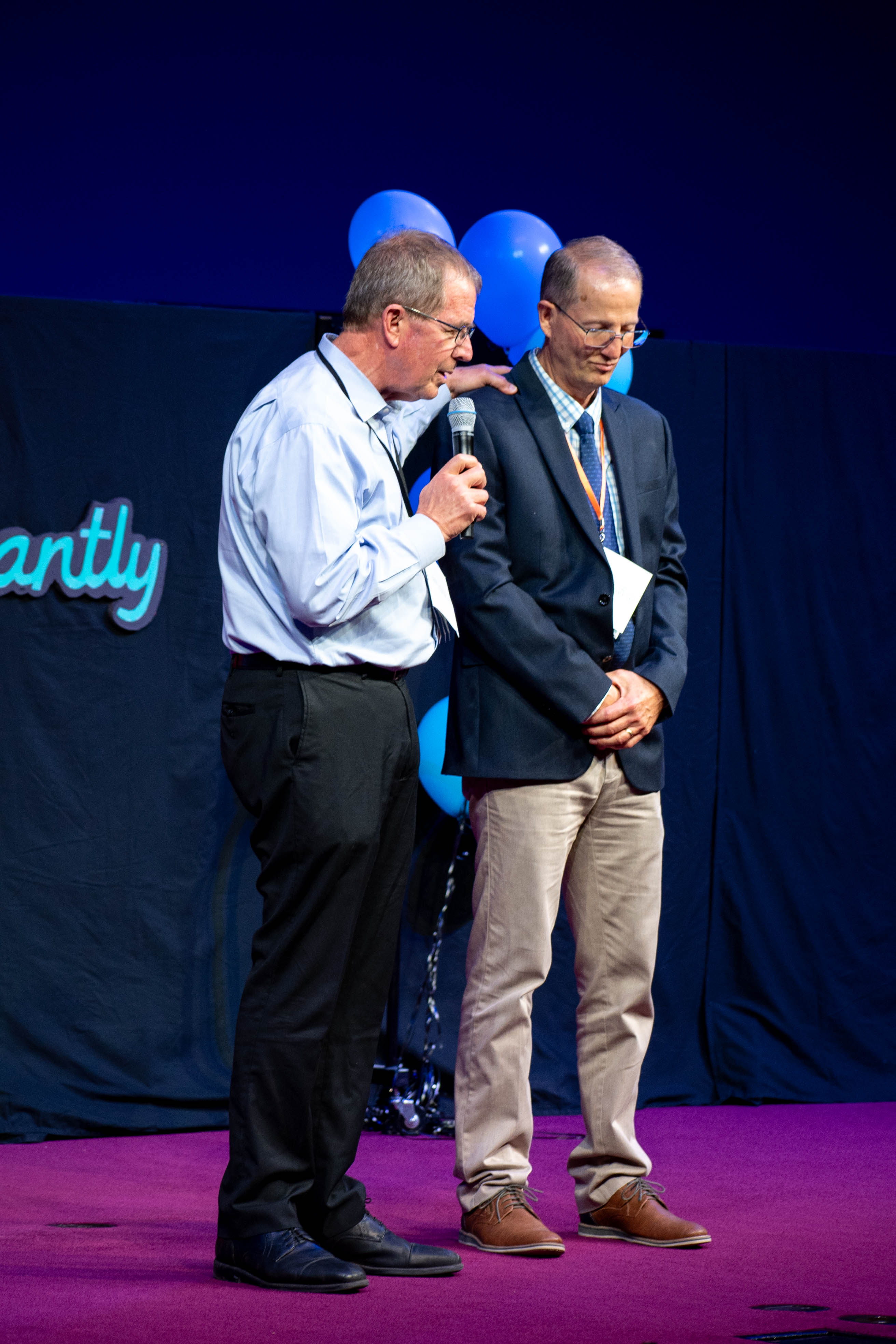
When Rev. Mike Schafer, President pro tem, of the West Plains GMC Annual Conference reached out to me last fall and asked me to preach and teach at the upcoming conference, I was thrilled! And the West Plains Annual Conference exceeded my expectations.
One of my favorite moments of the conference was when Mike described something he had never had happen in his entire ministry: an Annual Conference attendee asked if they could bring a friend! That gives an idea of the atmosphere and spiritual environment in West Plains.
I showed up planning to preach one message, and instead spoke on Matthew 13:44:
The kingdom of heaven is like treasure hidden in a field, which someone found and hid; then in his joy he goes and sees all that he has and buys that field. [NRSV]
I shifted because the Spirit did something when Mike prayed for me right before my sermon. I don’t remember exactly what he prayed, but it had something to do with the Spirit opening me up to receive what he wanted to say, even if it was different than what I’d planned. I had been wrestling with a sense that what I had prepared was not quite right and Mike’s prayer brought clarity that I was supposed to change courses and trust the Lord.
The truth is that I don’t really remember most of what I said because it was so unscripted. That is not a comfortable place for me. And I didn’t think I did a great job. When Mike gave an altar call after my sermon, I went to the altar and repented and apologized to the Lord because I just felt like I missed it with my message.
I am grateful for the exceptionally gracious feedback I received from many people in West Plains about how the Lord had used the sermon for them.
God is good!
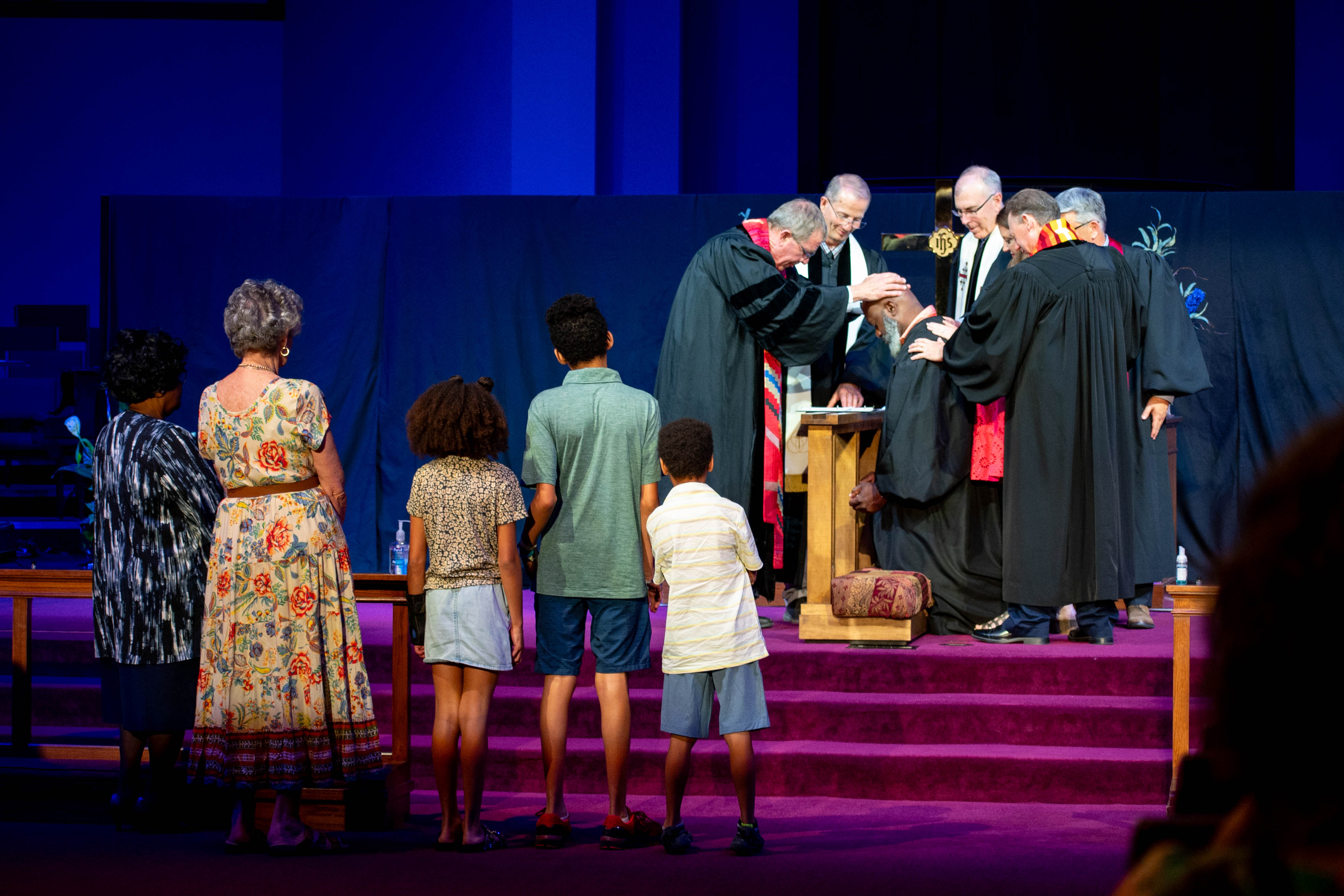
The ordination service was powerful as well. A few things really stood out to me. First, the unity in the room, not only among the ordinands, but also among the clergy and laity in attendance was palpable and a joy. When Bishop Jones went through the Historic Questions, it was the first time in my ministry I wasn’t wondering if people meant “No” even though they were saying “Yes.”
Bishop Jones led in a way that kept the focus on the main thing and the seriousness of what was happening. That was a gift to experience.
Two other things happened in the ordination service that were beautiful. First, immediately after ordination, Bishop Jones celebrated Communion and the newly ordained served the rest of the congregation. It was so well done! Second, after Communion, Bishop Jones gave an invitation to receive a call to ministry during the final song. I saw at least three people from the congregation respond to that invitation! I don’t think I’ve ever witnessed that before. It was so hopeful and encouraging to just have a strong focus on the significance of ordination and even more so on the Triune God who speaks and calls us to serve.
Rev. Schafer asked me to speak on Wesleyan discipleship, focusing on class and band meetings on Saturday morning. If you know me, it is pretty easy to convince me to do that! I have been thinking quite a bit about the old(er) Barna survey that is outlined in the book Maximum Faith (you can find a summary of the ten stops of the Christian life here). I summarized those findings and the way they point to the need for relational connection and deeper discipleship across the church in the United States. This, in my view, only increases the importance of returning to our Wesleyan heritage of intentional discipleship through small groups.
I had a blast teaching that material!
Finally, I got to experience two of the three TED-style talks given by folks in West Plains. Wow! The first talk was about a fire ministry after the massive fires in Texas last year. Even more than that, it was a powerful testimony about God’s work in one woman’s life. The second talk was by a rancher and a lawyer who felt called to co-pastor the GMC church in their town. The commitment to the local church and the authority of Scripture was powerful! I wish I’d been able to stay for the final one and the rest of the afternoon!
Preaching and teaching at a place like the West Plains Conference is an enormous privilege. It still surprises me to be asked to speak in places like this. I love doing it and it is a blessing to me. Every time, I think, I can’t believe I get to do this! God has been so kind to me and I am thankful.
One final thing about my time at this conference. Mike Schafer will become the first Connectional Operations Officer for the Global Methodist Church, starting August 15, 2024. Leadership in West Plains recognized Mike for his service as the first President of the West Plains Conference and gave thanks for this new role. One of the people who praised Schafer’s leadership in West Plains commented that he was exactly the right person to serve in this new key leadership role in the GMC because he had not spent his entire career trying to receive this kind of position. I loved the way that was put! And it rings true of my experience with Mike. His selection for this role is encouraging to me and a hopeful sign of things to come for the Global Methodist Church. (You can read more about Rev. Schafer and his new role here.)
Thank you, West Plains, for having me! And special thanks to Emma Stonum for sharing the photos I’ve used in this post.
Reminder: My new book releases next Tuesday, June 25th
My new book Doctrine, Spirit, and Discipline: A History of the Wesleyan Tradition in the United States releases on Tuesday, June 25th. I wrote a post about the book here. Please check it out. This is the first book I’ve directly asked folks to pre-order. Doing so helps the long-term success of the book in a variety of ways. It would really help me out if you would take a moment to head to Amazon (affiliate link) or Zondervan and order the book now. I am really encouraged by the early interest in this book! Thank you so much to all of you who have already pre-ordered it.
In this time of rapid change and chaos, it is imperative that we reground ourselves in our identity. This book explains the core identity of the Wesleyan theological tradition and points to lessons from the past that will help us be more faithful in the present and future.
In some ways, I have been working on this book my entire scholarly career. I started this project in earnest seven years ago. This is the most ambitious writing project I’ve undertaken. I believe it is also the most important book I’ve written.
Why?
One of the main problems I have been trying to solve throughout my work in the church and the academy is identifying the core content of the Wesleyan/Methodist theological tradition. What does it mean to be Wesleyan or Methodist?
My sense has been that many different parts of the Wesleyan tradition have been undergoing a crisis of identity for various reasons. Some have pursued cultural respectability at the expense of coherence and clarity. Others have moved away from the riches of their heritage in the Holiness Movement to generic evangelicalism. Much more could be said on this.
In Doctrine, Spirit, and Discipline, I argue that there is an identifiable theological tradition running through the Wesleyan/Methodist theological tradition in the United States. It was clearly articulated by John Wesley in the beginnings of Methodism in Britain. And this theological vision, along with the method that gave it its name, was embraced explicitly by the founders of the first denominations founded in the United States.
My sense is that the Wesleyan theological tradition is in a time of both fragmenting and realigning. I don’t think we can know yet how things are going to sort out. There are even very good reasons to think that denominational identity will not have the purchase in the future that it has had in the past.
With all this change and uncertainty, there is one thing of which I am confident: I am convinced the founding vision of John Wesley and the first Methodists is as relevant for our day as it was for theirs, if not more so.
Before we can do anything else, we need to know who we are. Getting clear of our identity requires knowing our history. We need to know where we’ve come from.
Doctrine, Spirit, and Discipline is my attempt to tell the story of the Wesleyan tradition in the United States in a way that intentionally, though I am sure imperfectly and incompletely, tells the story through a broader lens than it has been typically told.
I also do the best that I can to wrestle with the issues and challenges facing the church today. I do this because I am convinced that our past is an essential guide for a better future.
I have been humbled by the endorsements this book has received. This book has been described as “the definitive history of the Wesleyan movement in the United States.” Here are a few endorsements, you can read more at the landing page Zondervan has created for the book.
“Kevin Watson’s newest book, Doctrine, Spirit, and Discipline, is not just the latest history of Methodism in America. Rather, it’s a tour de force. Previous historical accounts have viewed the institutions that resulted in the United Methodist Church as the truly legitimate Methodist trajectory, while offering just a fleeting look at other Wesleyan denominations. But rather than seeing African American, Holiness, and Pentecostal church bodies as schismatic and somewhat peripheral to the Methodist story, Watson treats them as central. Why? Because these groups, though smaller in size than better-known, larger institutions (Methodist Episcopal/Methodist/United Methodist), often maintained Wesley’s theological foundation more consistently. Watson sees Wesley’s formulation of “doctrine, spirit, and discipline” as the “common foundation for a broad tradition”—not broad theologically, but broad geographically, ethnically, and denominationally. This book, then, is not only necessary reading for all American Wesleyans but also an essential corrective to the overall narrative of the Methodist legacy in the United States.” —DOUGLAS M. STRONG, Paul T. Walls Professor of Wesleyan Studies, professor of the history of Christianity, Seattle Pacific University
“I was captivated on the first page of Doctrine, Spirit, and Discipline. Immediately the reader is taken into the early life of John Wesley with this theme developed through his own personal life and expanded as he leads this great awakening throughout England and then more thoroughly developed in the US. However, Kevin Watson does not shy away from the power struggles, the issues of slavery, and the divisions even to this present day. He gives very generous history of the Black church, the Pentecostal movement, the Holiness movement, and various denominations which comprise what is known as the pan-Wesleyan movement today. In all this it is obvious the themes that continue to hold this diverse group together from the beginnings of John Wesley. It is written in such a way that is inspirational and at the same time with a strong researched theological and historical foundation. This book is a treasure for the classroom, leaders in the pan-Wesleyan movement both lay and clergy, and those outside the movement to discover the strength of the doctrine, spirit, and discipline initiated by John Wesley that has been effective for some 250 years. Yes, a book for now and future generations.” —JO ANNE LYON, general superintendent emerita, the Wesleyan Church
“A faithful witness to the people called Methodists in England and in America, this colossal volume expeditiously moves from Wesley to American Methodism and its extended branches to the current state of Wesleyanism today. Watson masterfully retells a well-chronicled narrative in terse, accessible, lucid prose, covering not just the contours of Wesleyan history with its highs and lows but also its various doctrinal developments and disputes and ecclesial divisions. The moral of the story, as indicated by the quote from which the title is taken, is that Methodism at its best is a blazing, fiery force of renewal and at its worst an inert, acculturated institution. Although coming in at nearly 500 pages, this volume is concise and highly accessible. Well-illustrated, highly detailed, and informative, Doctrine, Spirit, and Discipline is suitable for the classroom and will make a fine addition to any shelf of classic volumes on Methodist history.” —PETER J. BELLINI, professor of church renewal and evangelization in the Heisel Chair, United Theological Seminary
“This book is destined to become the standard reference work for everyone who wants a better understanding of the Wesleyan tradition. More important, however, is that anyone who seeks the blessing of holiness in his or her own life will find inspiration and encouragement on every page. Churches that preach the life-giving message of sanctification, including the Salvation Army, owe a tremendous debt of gratitude to Dr. Watson for this outstanding work.” —KENNETH G. HODDER, USA national commander, the Salvation Army
I need your help.
Please pre-order my book. There is much about the publishing world I don’t understand. One thing I do know is that pre-orders are crucial to a book’s success. You can pre-order the book on Amazon here (affiliate link) or directly through Zondervan here. Amazon has a pre-order price guarantee and books like this are typically discounted as they get closer to the release date. Zondervan is currently offering a 30% sale!
I don’t think I’ve ever made a direct request like this before. It would be a big help to me if you would place a pre-order for this book now. If you do, you can also get immediate access to chapters 1 & 2 by entering your email and book order number at the bottom of the page here: https://zondervanacademic.com/doctrine-spirit-and-discipline
I am so excited to see something I’ve been working on for so long finally be released. Thank you so much for your support!
Kevin M. Watson is Director of Academic Growth and Formation at Asbury Theological Seminary. He is anchored at the Seminary’s Tulsa Extension Site. He is also the Scholar in Residence at Asbury Church in Tulsa, OK.
I don’t know about you, but I find it so encouraging when I read something outside of the church that highlights the value of what Christians do.
Here is an example I just came across:
One of the cornerstones of the Wesleyan movement throughout John Wesley’s lifetime was a small group called the band meeting. There were a list of prerequisites for joining a band meeting. But the basic activity of the band was pretty simple – confession of sin for the sake of growth in holiness.
At the weekly meeting, participants each answered five questions:
1. What known sins have you committed since our last meeting?
2. What temptations have you met with?
3. How were you delivered?
4. What have you thought, said, or done, of which you doubt whether it be sin or not?
5. Is there anything you desire to keep secret?
(You can read the entire “Rules of the Band Societies” here.)
I first joined a band meeting when I was a seminary student. And joining that band meeting was, by far, the most important part of my seminary experience.
Not long after I graduated from seminary, I began to feel a more specific calling to pastor people who were preparing to become pastors. If I was going to pursue that calling, it would mean that I would need to complete a PhD. When I realized that no one had studied the band meeting in depth, I decided to write my PhD dissertation on the band meeting in John Wesley’s thought and in the popular experience of the first Methodists. I revised my dissertation and published it with Oxford University Press as Pursuing Social Holiness: The Band Meeting in Wesley’s Thought and Popular Methodist Experience.
During my work on the band meeting, I noticed that the fifth question was removed at one point by an editor of the original “Rules of the Band Societies” (the document where the five questions was published) sometime around the early nineteenth century.
As best I can remember, the fifth question was not used in the first band meeting I joined.
Is there anything you desire to keep secret?
It isn’t hard to come up with reasons why that question might be disappeared. It is intense! If you have a secret, kind of by definition you don’t want to share it. But the question is a game changer because it brings everything into the light of Christ and his healing grace in the appropriate place.
The book is an in-depth and interesting study of secrets and the role they play in our lives.
The big takeaway at the end of the book could not have been much better aligned with the early Methodist band meeting and its simple question: Is there anything you desire to keep secret?
At the end of the book, Slepian shows that while everyone has had or has a secret, it is helpful to be able to share secrets with people you know and can trust.
All the way back in the 18th century, Methodists were creating band meetings in order to not only share secrets, but to seek the wholeness and healing described in James 5:16
Therefore confess your sins to one another, and pray for one antoher, so that you may be healed. The prayer of the righteous is powerful and effective.
Secular scientific study is confirming the instincts Christians have always had. How cool is that?
For an introduction to what a band meeting is and a guide to starting band meetings in our own day, check out the book I wrote with Dr. Scott T. Kisker, The Band Meeting.
On January 19-20, 2024, a group of more than 70 scholars met in Alexandria, VA to discuss the doctrine of holiness and its ongoing relevance for the contemporary church. The gathering was remarkable to me because of its size, the focus on holiness itself, and the prerequisites for participation in the gathering:
affirm the historic creedal faith of the church
hold to traditional moral standards
embrace a Wesleyan theological vision
The purpose of the Summit was:
To craft a document designed for the faithful by leading scholars that clearly describes a Wesleyan view of holiness of heart and life. The teachings of John and Charles Wesley will provide the foundation for this document and serve as a uniting principle to guide our work. Of course, following the Wesley brothers’ direction, we will always look to scripture and the faithful interpretation of scripture within the Church’s tradition. This uniting principle will enable a large Wesleyan tent to find a common voice. Or to put it differently, the Wesley brothers make it possible for us – in all of our diversity – to write a document that can be endorsed by everyone from a high church Methodist to a Pentecostal and everyone in-between.
I was asked to give one of two keynote addresses at this gathering, Dr. Warren Smith of Duke Divinity School gave the other.
Here I am, mid-pontification.
Here are a few reflections from my time at this gathering:
First, the Lord has raised up a surprising number of conservative Wesleyan scholars who are willing to publicly be seen as such. This is surprising because most of us have come from institutions that were not trying to produce us. In fact, several come serve in contexts where there is pressure not to be associated with these kinds of gatherings.
I see this as a hopeful sign of God’s provision for the church.
Second, I was reminded of what I already know: Spiritual warfare is real and the Holy Spirit is alive and active. When I was initially asked to give a keynote at this gathering, I was excited and happy to accept. But as the day drew nearer and I began to work on my address, my preparation was difficult and unenjoyable in a way that was abnormal for me. To be candid, I was really dreading speaking at this gathering. This is probably because the last few years in the academy have been particularly challenging for me. More than that, I believe I was experiencing interference from the enemy. Added to that is the feeling that we aren’t supposed to talk about spiritual warfare or anything supernatural in academic contexts.
Let me say that I while I am sure there were those who disagreed with parts of what I said in my presentation, I did not experience any hostility from anyone at the Summit. On the contrary, I received words of affirmation and encouragement that were humbling and beyond anything I deserved. I was blessed to be surrounded by people who love well.
Third, there were a couple of interactions that felt healing and redemptive connected to some of the most painful times of my life in the academy. This was a completely unexpected and surprising gift to receive. I share it here because it reminded me of something I want to offer as an encouragement:
Suffering in the moment often feels even more painful because it seems pointless. There have been times I did the best I could to be faithful that increased suffering. This was the hardest for me to take when it led to suffering not only for me, but for my family. The Lord showed me at this gathering that God has used my witness in the past to strengthen other people. I had no idea. I don’t think we usually get to see these kinds of things, but it is such a blessing when we do! (And, of course, my suffering could also be because of bad decisions or mistakes I have made.)
Fourth, I think part of my dread going into the gathering was that I did not want to go to a dry academic conference where we could not be openly hungry for the presence of the Holy Spirit. The greatest blessing to me of the weekend was getting to see how many colleagues in the academy are hungry for more of the Spirit. On Saturday night, a Church of God in Christ bishop preached, Bishop John Mark Richardson, and he gave an invitation. Then, Dr. Cheryl Bridges-Johns gave a word of knowledge with a specific call to prayer. And in a room full of academics, there was a wonderful response to the move of the Spirit. People came forward to receive prayer. It was awesome!
Finally, this gathering pressed me to think more deeply about the distrust that exists between the church and the academy. I shared my conviction that I think this is understandable and largely rational by the church. During my time as a United Methodist, I think most seminaries did a better job saying that their purpose was to serve the local church for marketing purposes than they actually served the church.
I have a lot of thoughts on this, some of which I am still working through. I may write more on this down the road. For now, I’ll just offer two questions that I think can help church leaders think through these things:
First: Does the institution tend to produce people who are more effective pastors than they were before they attended that institution? I don’t think you can overstate the importance of an established track record here in terms of thinking about what is most likely to lead to the best outcome for the church.
Second, has the institution taken stands that hurt them politically with any constituency that are in alignment with your values and commitments? If they have shown their hand, so to speak, at a cost to themselves, you can trust that this represents their true commitments, values, and priorities.
I am encouraged by the number of individuals the Lord has raised up who affirm basic Christian orthodoxy, are Wesleyan, and affirm traditional moral standards. I hope these men and women will guide the institutions where they serve to more faithfully serve the local church. Raising up the next generation of leaders for Christ’s church is the key reason seminaries exist. If they lose this first love, the church is right to cease supporting them.
I’ve been following the conversations about unity during and since The United Methodist Church’s General Conference. The appeal to unity is powerful and appealing. And it is at one level effective because calling for unity is, well, unifying. I am in favor of unity. I want United Methodism to be unified, desperately. I also have a growing concern that appeals to unity in our current moment are often superficial and act as a kind of opiate to numb us to reality. We should be actively working toward unity. But we should not do so in ways that are vague, distract us from reality, and fail to either bring about meaningful unity or address the reasons we are currently divided. Here are two more specific thoughts I’ve had about unity that I’ve been chewing on since General Conference:
1. It is interesting that the value of unity is often used as a rationale for not enforcing the Discipline. One of the basic purposes of polity is to make unity possible. If you took away the presenting issues related to profound disagreements about human sexuality, I suspect one would be able to get pretty broad and firm agreement that the very purpose of polity is to secure unity within a denomination. The idea that polity is a barrier to unity, rather than part of what makes unity possible, reveals some serious problems in a tradition. I suspect that the appeal to unity as a rationale for not upholding the Discipline virtually guarantees disunity.
2. I find that appeals to unity are typically vague and lack any concrete precision when they are connected to the deep disagreements we currently have about human sexuality. Consider same sex marriage: A group of United Methodists believes that there can be no such thing as Christian marriage that is composed of two people of the same gender. Another group of United Methodists believes that not only are such marriages possible, but that it is harmful to deny people access to same gender marriages. A third group is frustrated by the inflexibility of these two groups. The appeal to unity most often comes from people in this third group. But I don’t believe I have seen someone from this group make a theological argument for why one church can be both for and against same sex marriage and how such a position would express the value of the Church’s unity. I can’t recall a theological argument from someone in this camp that argues that same sex marriage is a matter of indifference to God. As far as I can tell, the most accurate way of describing the current crisis of unity in United Methodism is precisely that people are convinced that God is not indifferent about these matters and they deeply and profoundly disagree about what faithfulness looks like. The hard truth is that, short of divine intervention, this is not going to change.
In moments of crisis, United Methodists often fall back on an appeal to unity. The appeal to unity feels good because we are fighting for the church. The litmus test for the value of an appeal to unity should be this: Does it address the reasons we are divided and offer a concrete solution that can bring about actual unity? Leaders within United Methodism need to consider whether appeals to unity that cannot pass this basic test may actually be doing more harm than good in our current moment.
In my previous post, I discussed my concern with the imprecise use of Christian conferencing in the Advance Daily Christian Advocate and the push to reclaim Christian conferencing at the General Conference level. Recent reporting on Christian conferencing leaves me with the impression that the discussion around Christian conferencing has taken a significant step back over the past year. These two UMNS articles [1] [2] have very different understandings of Christian conferencing. Curiously, there is no indication of an awareness of tension between the two or commentary on the shift.
More broadly, I’m not sure United Methodism is currently operating with a collective understanding of either grace or the means of grace that is sufficiently robust. If we aren’t clear about either of these, we cannot hope to be clear about what concrete expressions of means of grace like Christian conferencing ought to look like. Richard P. Heitzenrater’s “The Exercise of the Presence of God: Holy Conferencing as a Means of Grace” is a helpful starting point for a Wesleyan understanding of grace, means of grace, as well as parsing “holy conferencing” and “Christian conferencing.”
While I am discouraged by the recent direction that the discussion of Christian conferencing seems to have taken, particularly as seen in the Advance DCA, I continue to be eager to see The United Methodist Church return to an authentic retrieval of Christian conferencing. So, how can we do a better job of articulating what Christian conferencing is? And where are the best places to work toward a return to this practice?
Andrew C. Thompson’s recent book The Means of Grace offers a substantive and accessible introduction to the means of grace in general, as well as to Christian conferencing more specifically. In his chapter on Christian conferencing, Thompson points out that “fellowship” and “Christian conferencing” are synonyms in Wesley’s writing. For Thompson, “There’s a deeply spiritual component to fellowship, in Wesley’s mind, that makes it centrally about the work of transformation…. Christian believers were gathered together with their hearts open to the work of the Holy Spirit and with a desire to receive God’s grace” (90). Considering the way that conferencing is used in Wesley’s writing, Thompson writes, “Christian conference… is about believers coming together to focus on their faith: to pray, to share their experience of God, to seek advice and to offer counsel, and even to confess their sins and ask for forgiveness” (90).
The recent work of Methodist historians like Heitzenrater and Thompson provides a good foundation for working toward a coherent collective understanding of Christian conferencing at the General Conference and Annual Conference level. Again, because of the current lack of clarity and precision in defining Christian conferencing, the best approach is to focus on teaching on this practice at General Conference and Annual Conference, not implementation. In our current moment, attempting to go straight into practice at General Conference is premature, will most likely waste time, and comes across as trying to manage or control the conversation to people from nearly every perspective.
The best place to begin working toward reclaiming Christian conferencing would be at the district level where you could offer workshops and training. The key place of implementation is the local church, where ongoing relationships are present. Among Methodist historians, there has been a general consensus that the class meeting is one of the best concrete examples of what Wesley had in mind by Christian conferencing being an instituted means of grace.
I have been encouraged by the momentum I have seen building for a retrieval of a contemporary expression of the class meeting. This past Sunday, it was announced at the church I attend that 150 people had signed up to join a new small group ministry that is an intentional reclaiming of the class meeting (and 85 people have already been actively involved in similar groups). This is only one example of the broader interest I am seeing in not just talking about transformation-driven small groups, but in experiencing them. A return to something like the class meeting is something laity are ready for and are responding to in contemporary Methodism. The time seems to be ripe for a deeper engagement with not only Christian conferencing as an instituted means of grace, but also the class meeting and the band meeting as prudential means of grace for “the people called Methodists.”
The specificity of the class meeting as an example of Christian conferencing is helpful for a host of reasons. First, Christian conferencing is a means of grace for everyone, not just General Conference delegates. The primary emphasis for reclaiming this practice needs to be at the local church level and not the General Conference to be sure that all are invited into a practice that is at the core of what it means to be a Methodist.
Second, the class meeting’s focus was answering the question: “How does your soul prosper?” This question reminds us that the key focus of Christian conferencing in early Methodism was on God and peoples’ experience with God, or their search for a deeper experience with God’s presence and power in their lives.
Third, the class meeting was a small group that was intended to meet together for the long haul, not a few times over a couple of weeks. Christian conferencing can occur in isolated meetings, but I do not think that should be seen as the normal experience of Christian conferencing. Christian conferencing is most likely to occur in the context of ongoing community.
One of the reasons I find this to be a difficult topic is because Christian conferencing can occur in a variety of contexts. In thinking about Christian conferencing more over the past few weeks, I’ve realized that I have to say that it is theoretically possible for Christian conferencing to happen at General Conference. It cannot be defined restrictively as a particular type of small group meeting. And yet, I am as convinced as ever that it is foolish to have General Conference be the primary point of emphasis, or the starting point for reclaiming Christian conferencing, in our current moment. Based on the past several General Conferences, we simply do not have good reason to think that genuine Christian conferencing is likely to happen in Portland.
Christian conferencing is a precious part of our heritage as Methodists. It is too important to trivialize or gut of its power as a means of God’s transforming grace. It is not everything that happens at General Conference, as has been suggested by conversations around the pre-General Conference meetings in January. In a time when United Methodism is desperate for renewal, we should absolutely look to our past for guidance. We should struggle to discern where God has been at work in the past in hopes of being renewed in the present. I am all for retrieving Christian conferencing. In fact, my recent book The Class Meeting is an attempt to provide a practical resource for retrieving the most basic aspect of this practice within the local church.
My worry is that we are currently on a course that will disillusion the key leaders of our church with the value of one of our most basic practices. Recent appeals to this practice have not resulted in what I would consider to be Christian conferencing. Instead, there seems to be a persistent tendency to (mis)use Christian conferencing as a way of sanctifying decisions after they have been made that is self-justifying.
To be clear on where I come down on Rule 44: I do not think Rule 44 represents a faithful expression of Christian conferencing. I do not believe Rule 44 would facilitate Christian conferencing.
If we continue in the directions suggested by the Advance DCA, I fear that those who would be most poised to advocate for churches to return to the authentic practice of Christian conferencing will come to have a very negative connotation associated with the phrase. Many already do. The consequence could well be that our key leaders become apathetic to Christian conferencing entirely. Even worse, they might actively oppose attempts to reclaim Christian conferencing based on negative experiences at General Conference that were not actual experiences of the practice.
Much is at stake for the ongoing vitality and coherence of Methodism. May God grant us wisdom and discernment as we continue to work towards reclaiming a practice that is essential for authentic Methodist identity and practice.
Kevin M. Watson is Assistant Professor of Wesleyan and Methodist Studies at Candler School of Theology, Emory University. You can keep up with this blog on twitter @kevinwatson or on facebook at Vital Piety.
I was invited by the Committee on Faith and Order to speak to the Council of Bishops of The United Methodist Church on “holy conferencing” at its November, 2014 meeting in Oklahoma City. The invitation was very encouraging to me, particularly because the working documents that Faith and Order shared with me on their work on the topic were quite strong. I had previously expressed concerns about misuses of the term holy conferencing, where one of only five instituted means of grace in the Wesleyan view had been distorted so that it had become little more than trying to be nice to each other when we disagree. In contrast to previous misuses of the phrase, Faith and Order was working on an account that was more theologically substantive and engaged more robust practices. As I recall, nearly every document they shared with me identified the early Methodist class meeting and band meeting as the most concrete expression of Christian conferencing in early Methodism.
I went to the Council of Bishops meeting with a real sense of optimism. I felt that I was being given the chance to build on this positive momentum and encourage the leadership of United Methodism to reclaim an authentically Wesleyan approach to Christian communal formation. In this spirit, I began my presentation by asking the bishops to consider what would be “one thing that United Methodism could do today that would be most likely to bring deep renewal and an outpouring of the Holy Spirit to our church?” My answer was “reclaiming an accurate understanding of holy conferencing in contemporary United Methodism.” But I was quick to add, “everything hinges on getting right what holy conferencing is.”
My basic advice was for there to be preaching and teaching on the concept of Christian conferencing at the General Conference and Annual Conference levels. I suggested that the most productive place to seek to return to this practice would be at the district level and especially the local church. (You can read the manuscript I used in my presentation here.)
I don’t think reclaiming the practice of Christian conferencing should start at the General Conference level because it is asking people to do something that most of them have never done with people they do not know. I don’t think you can take it for granted that people know what Christian conferencing is in contemporary United Methodism. General Conference is not the wisest place to implement Christian conferencing. Rather, it is a prime opportunity to teach people what it is so that they can begin working towards a return to it on the ground at the local church level.
As I read reports of the pre-General Conference meeting in Portland last month, I was initially encouraged to see that the Commission on General Conference featured Christian conferencing prominently in its work. The shift away from “holy conferencing” to “Christian conferencing” is a positive move. The desire to lift this practice up at General Conference is also laudable. However, the more I read about the use of Christian conferencing in the Advance DCA, as well as reporting on it by UMNS and other places, the more I fear that we are in for another General Conference that reinforces the distortions of one of the most distinctive practices of the Methodist heritage.
The Advance Daily Christian Advocate contains guidelines for Christian conferencing, especially with “A Few Sentences on Christian Conferencing” on page 22. There are also several places where there is a proposed language change from “Conference business” to “Christian conferencing”. Perhaps most significant is “Rule 44,” a proposed rule change to the “Rules of Order” that would allow for a group discernment process instead of the usual parliamentary procedure, which observes Robert’s Rules of Order.
In reading through the references to Christian conferencing in the ADCA, my impression is that this phrase is being used to try to have a better conversation about controversial topics. The sentences from The Committee on Faith and Order appear to be a combination of past misuses of the phrase with some corrections and more responsible interpretation. In reading through the sentences, I had a kind of déjà vu experience. Some of it sounded like it came from the manuscript I used when I spoke to the Council of Bishops. Other parts seemed to reaffirm what I critiqued or rejected. In its current form, the document could be used either to support a robust theological vision for reclaiming Christian conferencing or to support a gross distortion of the practice. There is simply not enough precision to rule either out.
In my view, the Advance DCA fails to offer a clear definition of what Christian conferencing is. How do we know when we are doing it? How do we know when attempts to Christian conference are falling short of what ought to be considered an instituted means of grace? Reading through the ADCA, I feel a bit like we are hoping that if we say “Christian conferencing” enough that somehow it will happen. I’m also left with the impression that we still lack a coherent and compelling articulation of what it in fact is.
Clearly defining Christian conferencing is a real challenge, and all the more so because Wesley himself did not offer a clear definition. The one time he refers to Christian conferencing, all he offers are a series of rhetorical questions that could be used to support misuses of the practice.
The need for a deeper understanding of Christian conferencing is one of the main reasons my advice to the Council of Bishops was that General Conference and Annual Conference would be the appropriate contexts for preaching and teaching on Christian conference and the role it has played in our tradition –not trying to engage in the practice itself. If we are not crystal clear on what the practice is that we are trying to reclaim, then we don’t seem to have much hope of succeeding in practicing it at General Conference – the most highly politicized and stressful expression of our collective life together.
Stay tuned: The next post will point towards a clear articulation of what Christian conferencing is and ways to reclaim this practice in contemporary Methodism.
Kevin M. Watson is Assistant Professor of Wesleyan and Methodist Studies at Candler School of Theology, Emory University. You can keep up with this blog on twitter @kevinwatson or on facebook at Vital Piety.
Life has been hectic the last month and a half! My thoughts recently turned to this blog and I realized that I had not announced here that The Class Meeting: Reclaiming a Forgotten (and Essential) Small Group Experience is now available. The book can be purchased in print directly from Seedbed at the previous link. (It is only available in print directly from Seedbed.) It can also be purchased electronically through a variety of e-formats, including Amazon Kindle. This link will take you directly to Amazon’s Kindle listing for the book.
My previous post included several of the advanced reviews that the book received.
Finally, I wrote a post for Seedbed.com that was published on the day the book was released. I also did a video interview that they published. You can view the post here and the interview here.
I am encouraged and grateful for the enthusiasm I am seeing for reclaiming the Wesleyan class meeting. Thank you for your support!






 Life has been hectic the last month and a half! My thoughts recently turned to this blog and I realized that I had not announced here that
  Kevin M. Watson