
Tags
Aaron Renn, Andrew Forrest, Asbury Church, Christian formation, Christian Smith, Christianity, demographics, John Wesley, Methodism, Negative World, Ryan Burge, Wesley
This is a question that is good and healthy for people and institutions to ask periodically.
This question became acute for churches that left their denominations of many years, often due to the presenting issue of same sex marriage. This has happened across mainline denominations. Perhaps the most public recent separation was within the UMC.
I am now on staff at Asbury Church in Tulsa, OK. Asbury was for years the largest United Methodist Church in its Annual Conference.
Since leaving the UMC, Asbury has been in a season of discernment about the future after leaving the United Methodist Church.
Where do we go from here?
The presenting issue for the era of disaffiliation from the UMC was the decades long denominational infighting over sexual ethics, particularly same sex marriage. The breaking point, however, was when it became clear that the bureaucracy of the UMC was willing to nullify the decisions of General Conference when it disagreed with them by simply ignoring them or refusing to enforce them. The decision of bishops and other UMC leaders to impose their judgment over that of General Conference shattered the polity of the UMC, which was the very mechanism that was designed to protect unity in the midst of deep disagreement.
Some orthodox United Methodists could live with the official teaching of the church being one thing on paper and another thing “in real life” happening with no consequence.
I was not one of them.
On the other side of disaffiliation, United Methodism swiftly changed its position on sexual ethics so that its actions are now consistent with its practice. This brought the advantage of consistency and coherence. But it came at the expense of faithfulness to the clear teaching of Scripture at the main pressure point of the present cultural moment.
Some orthodox United Methodist could live with this. I don’t understand how.
If you believe that same sex marriage is not a thing that the Triune God can bless, then I do not understand how you can be “in connection” with a denomination where clergy say that God does bless them and where they regularly occur. The idea that one can be United Methodist and unimpacted by this because it does not happen in your church is either foolish or intellectually dishonest. It is at best incoherent with the basic meaning and purpose of a denomination.
Where do we go from here?
I want to talk about a recent post from Ryan Burge that brings urgency to this question. In fact, it suggests that we don’t have much time left to decide where we are going. And though I will highlight data that relates to the United Methodist Church, the UMC is not the point of this post. I would guess that the Global Methodist Church, the denomination born out of the disaffiliations from the UMC earlier this decade, is probably in a similar position as the UMC is. (Burge does not include date for the GMC in his piece.)
Most importantly, for my focus, Burge’s data is relevant to my own church. We generally fit the picture he shows.
If you are not already familiar with Ryan Burge’s work, you should be. Burge is professor of practice at the Danforth Center on Religion and Politics at Washington University.
He is one of the very few positive examples I can think of where a person has gained a significant platform on social media by delivering consistently thoughtful and nuanced content, particularly regarding the contemporary church. Burge’s work is focused on demographic data, analyzing trends, and pointing to implications for the church.
His recent post “When Are Half Your Members Going to be Dead?” has given urgency to the question: Where do we go from here?
Are we presuming we have a future, despite all evidence to the contrary?
The heart of Burge’s post is showing how top heavy in terms of age most Protestant denominations are.
I’ll use the UMC to illustrate, but you can see the details of other denominations in the two images I’ve included.
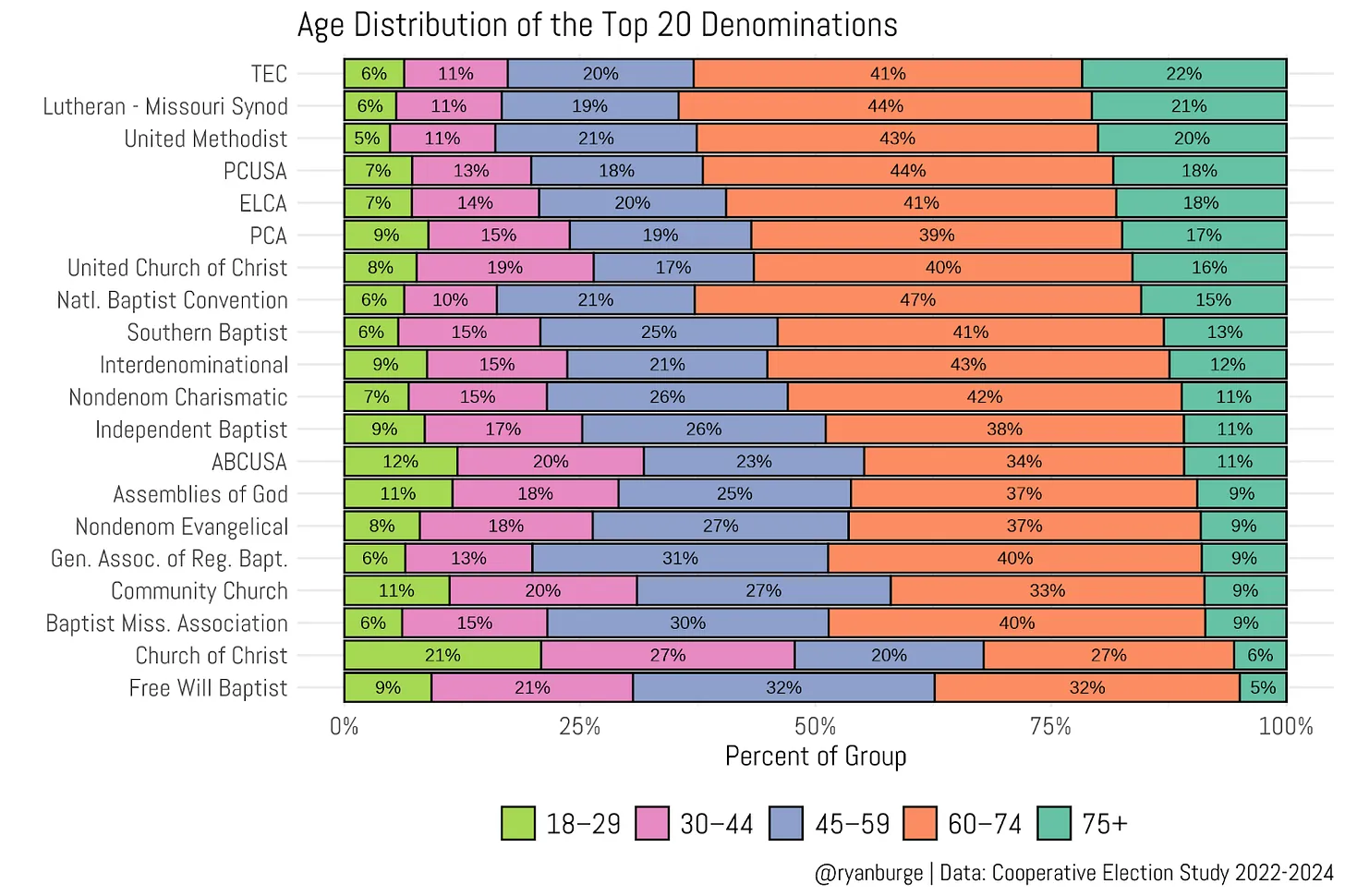
Look how few members in any of these denominations are young. Not one of the 20 denominations listed has more than 50% of its members under 44 years old. In the UMC, only 16% are 18-44.
Burge emphasizes this age range in his article because this is the age range of fertility, broadly speaking. That is, the rest of the folks in the group are not going to be adding to membership by giving birth to children.
He does not unpack this in his post, but another angle of this is the theology, views and values around life itself, and starting families (how soon and how big). The more progressive the denomination, the more likely it is that the fertility rate will be lower even within the age range of fertility.
21% of the membership of the UMC is between 45-59, which is more than 18-44 combined. And, at 43%, there are more than double the number of people who are 60-74 than 45-59. (And there are 8x as many 60-74 year olds as 18-29 year olds.) 63% of the UMC is 60 years and up.
This represents a demographic crisis.
I want to pause here. I doubt very many United Methodists read my work anymore. I suspect there are a lot of people who read this who are not fond of the UMC. And I think this kind of data brings a tremendous temptation to self-congratulation.
“See, this is why we left?”
And I suspect for most people reading this, you would be completely missing the point.
Is your tribe different?
Self-congratulations, posturing, or denial won’t accomplish anything positive.
I am thinking about this because this has been a topic of conversation among the staff at Asbury Church, where I serve.
So, to be as clear as I can be about the point of this post: This is not a post to celebrate the seeming demise of others.
The point is to be in touch with reality so we can ask the question I started with:
Where do we go from here?
Let’s start by stating the obvious:
If the denominations Burge lists do not figure out how to grow younger, they don’t have a future.
That is a descriptive statement, not a moral argument.
We are all mortal. I will die someday. And if no one comes behind me, the thing that I am part of will not exist anymore.
I am worried that older people will be offended by what I write. Please understand me. Age is not a moral issue. It is not immoral to grow old. It is just what happens.
But if an institution consists of primarily senior citizens and is no longer able to reach young people, then it is dying.
This is all the more difficult to talk about in a healthy way because our culture idolizes youth in ways that are damaging to young people and can invalidate the worth and value of older people. The older we are, the more likely we are to experience acutely the limitations of our bodies.
As we age, moving our bodies becomes more painful.
To young people who do not experience significant pain:
Take time to notice the literal physical pain some of the older members at your church endure to simply come to church. There are people who show heroic courage, strength, and grit by showing up. This will humble you and help you not take your own body for granted. Perhaps it will even encourage you to not take gathering with the faithful for worship for granted.
To older people:
I say to you with love, I know that talking about this can be uncomfortable. It is not at all my intent to signal that you are unimportant or lacking in value. Not at all! You are the reason we are here! My hope for you is that if you turn your hearts towards reaching the next generation (and many of you already have!), you will gain peace and joy knowing that reinforcements are coming and the mission you have given your life to will continue after your death.
This applies to me.
We are all moving towards the grave. We all ought to humble ourselves and learn from those who have gone before us. And we should all do all that we can to build up, strengthen, encourage, and bless those who are coming after us.
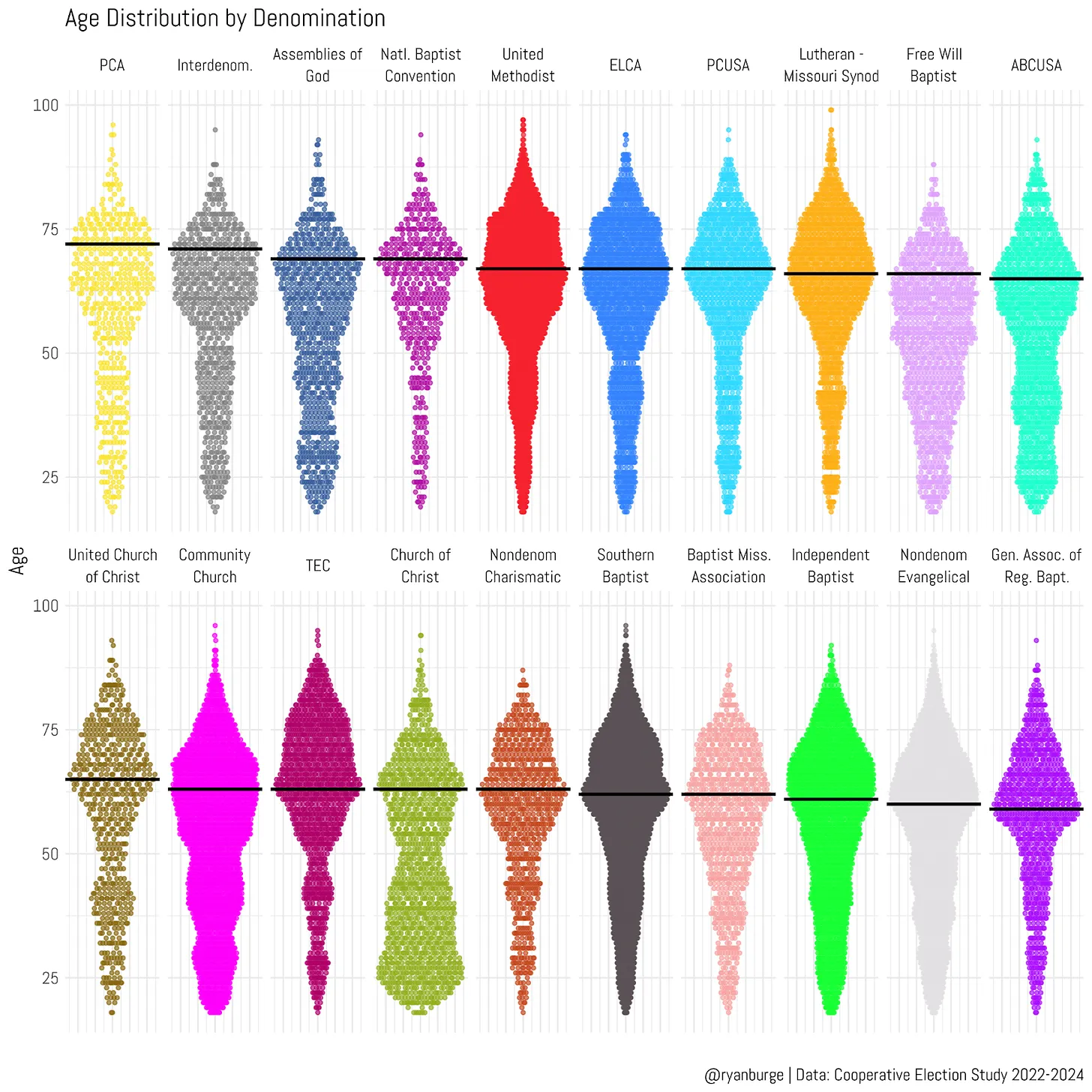
One of the reasons work like what Ryan Burge is doing is helpful and interesting is because it provides a more neutral way to talk about the future. It is hard to ignore or deny that a problem is coming when you look at the second image from Burge’s article.
There is, however, at least one obvious sign of hope for the future. Did you notice that there is one major exception? Look at the Church of Christ.
21% of the Church is 18-29. 27% are 30-44. This means that 48% of the Church of Christ is in the peak fertility range! It also means that the largest percentage in any one of the five age ranges is a tie for 30-44 and 60-74. So, there is a significant generational balance. It gets better. The third largest group is the youngest. Look at the Church of Christ in the second graph. You don’t want a long thin tail, as so many of the denominations included have.
You want, at a minimum, the people coming behind to be able to replace the people and resources of those who are ahead.
It took a lot of spadework to get to this point. Now, I want to share a few thoughts about this information. Fair warning, it may feel more discouraging before there is hope. But I am writing this post because I do feel hope for the future. I believe the Lord has already given us the way forward, if we would have the courage to take it.
My first thought comes from reading Aaron Renn’s Life in the Negative World and Christian Smith’s Why Religion Went Obsolete. These books are both crucial for thinking about evangelism and discipleship in the contemporary church.
I’ve mentioned Renn’s work here before. Renn argues that we live in “Negative World,” where elite culture is opposed to the core claims and commitments of the gospel. I think he is right. (I wrote a review of Life in the Negative World here.)
Rev. Andrew Forrest, the Senior Pastor at Asbury Church where I work, has written a book that show how to avoid being passive and victims in Negative World and move forward. Hint: Forrest gives away the core concept in his book’s brilliant title: Love Goes First. (I wrote a review of Love Goes First here.)
You should read all three of these books. The church desperately needs leaders who are doing the deep work to think about the times in which we live and who refuse to settle for running plays that worked in the 1950s but simply do not work today.
Here is how reading and thinking about these things came through in reading Ryan Burge’s post:
The work before the church is going to be extremely, nearly impossibly, difficult.
There is so much that could be said here. I’ll say three quick things to illustrate how hard this is going to be.
First, the Baby Boomer Generation is literally a one-of-a-kind event. The really wide parts of the second image represent this generation. There are just less people at each age behind the Baby Boomers. So that is the first demographic reality that makes this extremely difficult.
Second, over the past thirty years the dominant culture has shifted dramatically. In the years immediately following World War II, there was cultural pressure to be a member of a Christian church in the United States. Sometime in the 1990s that shifted to neutral, neither positive nor negative. And in the mid-2010s that shifted further to negative cultural pressure. So, when the Baby Boomer Generation was around my age, there were cultural incentives, or social pressures on people to go to church. Today, with this major loss of members coming in the next 10-15 years, there are negative incentives, negative social pressure on people becoming followers of Jesus.
Put simply: It is harder to “make” a convert today than it was fifty years ago.
Third, the institutions that represent these groups are sick and dying. In other words, they are not in a place to lead a resurgence or a renewal. They might have been able to do that back when I was in seminary when professors at the mainline liberal seminary I attended talked about the coming “death tsunami” that was headed for the UMC.
One of the things we talk about all the time at Asbury Church is how hard it is going to be going forward. We are looking for others who share a sense of urgency about figuring out how to lead and move forward “for such a time as this.” Figuring out how to reach people my age and younger is urgent and has to be the top priority for every church or they will not have a future.
As I was looking at Burge’s charts in a staff meeting at Asbury, someone brought the focus back to the Church of Christ: “Why are they different?”
I don’t know much about the Church of Christ. But I do know that sociologists have found that there is something of a law of church growth in the United States. I first came across this in the fantastic book The Churching of America, 1776-2005 by Roger Finke and Rodney Stark.
Here is the law of church growth in the United States:
High expectation, high demand churches grow. Low expectation, low demand churches decline.
I am sure that the Church of Christ, especially compared to the other denominations Burge includes, is a high expectation and high demand church.
I spent a decade trying to get United Methodists to move away from sloppy nonsense like “open hearts, open minds, open doors.”
Methodism has grown when it has had clear expectations of its members and enforced them. It has declined when it has not.
The Methodist Episcopal Church grew from the smallest Protestant denomination in the U.S. to the largest by far from 1776 to 1850. (See The Churching of America for details.) And during this time, you were required to attend a weekly small group meeting to remain a member. If you missed more than three times in a quarter, you were removed from membership. There was a document that outlined the lifestyle expectations for members in terms of sins to be avoided, concrete actions that expressed love of neighbor, and insisted on a disciplined practice of the means of grace (practices like Bible reading, prayer, worship, holy communion, and fasting).
This is not the only way early Methodism was a high expectation, high demand church. Read my book Doctrine, Spirit, and Discipline: A History of the Wesleyan Tradition in the United States for a detailed account.
Today, in many churches you can join a church by standing up for a few moments during a worship service and making a few vows. And you won’t be removed from membership even if you don’t keep any of the vows you made.
As I’ve thought about where we are and where we are going, it is just so obvious: This is going to be really difficult.
In Negative World, there are no longer any incentives for people to come to a church that is more a social club than a place that is focused on Jesus Christ and helping people meet him and give their lives to him as not only savior, but Lord of their lives.
There are a variety of ways you can miss the mark in terms of high expectation and high demand. Cults, for example, are high expectation and high demand. They provide a clear sense of belonging and identity. But they do not make disciples of Jesus Christ.
You can also miss the mark by jettisoning any attempt to be Christian and simply be an activist organization. Many college students and young adults are finding meaning and identity in protest and advocacy that is cult-like in terms of the demands it makes and the all-encompassing sense of belonging and identity it gives (or demands).
When Methodism was at its best, it was a high expectation and high demand church. It was focused on the gospel and was built to ensure that no one lost sight of growing in concrete practical discipleship to Jesus Christ.
You did not have to be a member of Methodism.
But you could not be a member of Methodism in name only.
John Wesley and those who carried on his work from one generation to the next into at least the mid-nineteenth century were marked by a commitment to basic doctrine, spirit, and discipline.
Here is how John Wesley put it in the last years of his life:
I am not afraid that the people called Methodists should ever cease to exist either in Europe or America. But I am afraid lest they should only exist as a dead sect, having the form of religion without the power. And this undoubtedly will be the case unless they hold fast both the doctrine, spirit, and discipline with which they first set out. (J. Wesley, “Thoughts Upon Methodism”)
I wrote a 400-page book about what this meant and how true it has been in the history of the Wesleyan tradition in the United States.
And I have never been more convinced that this is true than I am today.
One of the things that consistently amazes me about people at my church is their desire to grow. They want to be faithful. And they are eager to be led. It is so encouraging.
In Negative World, this will only become truer.
People who come to our churches will want to know if Jesus is real and if he can make a difference in their lives. When they come to faith, they will want to learn how to follow Jesus. Nominal Christianity doesn’t make sense anymore, especially to younger people.
So, where do we go from here?
We must become churches that are serious about discipleship and formation.
The bad news is: This will not be easy. In part because the truth is that many of our churches have not been most concerned about discipleship and formation. This means that in addition to the work of building, we also have work to reform, redirect, and change.
The good news is Jesus is real. Everyone knows the Great Commission from Matthew 28. We may need to especially remember the very last sentence of Matthew’s Gospel: “And behold, I am with you always, to the end of the age.”
We are not alone. We have never been alone.
Church leaders, we’ve got our work cut out for us.
Let’s get to it.


 Kevin M. Watson