A Helpful Perspective on Jeremiah Wright

Tags

,

I received a link to this article in an email today. One of the things that I thought was interesting is that it was a part of Christianity Today’s daily email, but it was written by Jason Byassee, who is assistant editor of the Christian Century. Byassee reminds evangelicals that Jeremiah Wright is evangelicals’ brother in Christ. The article is also honest about the ways that Wright’s recent actions have further damaged Obama’s efforts to secure the Presidential nomination of the Democratic Party. I found it to be thought provoking and worth the read, and I commend it to you.

Red Letter Christians by Tony Campolo

Tags

, ,

Tony Campolo has never seemed to be someone to shy away from controversial issues. It came as no surprise, then, that he dealt with “Hot-Button Issues” like gay rights, abortion, and immigration in his latest book Red Letter Christians: A Citizen’s Guide to Faith and Politics. Campolo’s book comes out along with several other recent publications (see my previous review of Jim Wallis’ The Great Awakening) that deal with faith and politics just in time for Christians to digest before they cast their votes in the 2008 Presidential election.

Campolo argues for a biblical approach to politics that goes deeper than mere party loyalties. He writes, “In reality, conservatives and liberals need each other: Conservatives maintain many lines that should never be crossed, while liberals destroy many lines that should never have existed… On some issues, Red Letter Christians are conservative and on others we are liberal. Neither end of the political spectrum has a corner on the will of God” (36-37). Campolo does not just hope to elevate the dialogue beyond seeing the world through red or blue glasses. He argues that “instead of using power to mold public policies, [Christians] should endeavor to speak with authority to those in power” (37).

Before Campolo argues for a specific understanding of politics, he argues for a particular understanding of what it means to be a Christian. Based on the title of the book, Campolo argues that “red letter Christians” are “committed to living out the things that Jesus taught” (22). In other words, the words spoken by Jesus in the Gospels, which are printed in red letters in many versions of the Bible, are lifted up as of particular importance for those who claim to be followers of Christ. This book, as a result, seeks to craft a particular approach to politics that is always faithful to the teachings of Jesus as revealed in the four Gospels.

This approach leads Campolo to articulate a fresh approach to politics that avoids many of the traps that Christians from the far right and far left have fallen into. In fact, Red Letter Christians articulates an approach to politics that will at times delight conservatives and liberals. Of course, this also means that conservatives and liberals will also be frustrated at times by the recommendations that Campolo makes. Ultimately, Campolo asks us to judge his politics not by how well it fits within a Republican or Democrat platform, but by how faithfully it puts the teachings of Jesus into practice in the realm of politics.

I found myself challenged by this book from the very beginning. Campolo argues that in order for Christians to be respected by non-Christians within the political sphere, they must “first serve the needs of others in sacrificial ways, especially the poor and oppressed” (40). Serving the other sacrificially is in itself a pretty radical concept for the way modern politics works. Whether I was reading the issues Campolo discusses under the “Global Issues,” “The Hot-Button Issues,” “The Economic Issues,” or “The Government Issues” I was challenged to reexamine many of my previously held political convictions in light of the teachings of Jesus. One of the things I really like about Tony Campolo is that he often confuses the stereotypes about evangelical Christians. In one moment he criticizes the current President, but in the next he reminds the reader that the situation is often much more complicated than it is presented in a sixty second television spot. Sometimes imperfect people have to do the best that they can in very difficult situations. This is helpful for me to remember before I judge any politician’s decision without giving adequate consideration to the complexities and real difficulties they faced in coming to the decision they made.

In some ways, I finished the book feeling more confused about the ultimate practical consideration that I brought to this book when I began reading it: Who should I vote for in the upcoming Presidential election? There is not a candidate that we could vote for that would even come close to advocating the “Red Letter Party Platform” in its entirety. Ultimately, I see this book as an important contribution because it sets aside many of the previous assumptions of the religious right that did not seem to be coming from Scripture, and it returns to the teachings of Jesus as found in Scripture. It is to Tony Campolo’s credit that he seeks to be faithful to these teachings above all else — even when it is inconvenient.

General Conference, M.U.M., and the Quadrilateral

Tags

, , , ,

I receive quite a bit of emails from a caucus group in the Oklahoma Conference named Mainstream United Methodists. I have recently received several emails from them about a handout that they were planning to distribute at General Conference. I have been away from my office for two weeks due to the birth of my first child, so I just got an email with final details about the handout and distribution of it. In the email there was an attachment that had the first page of the handout. Out of curiosity I opened the attachment. The front page prompted me to track down the entire handout, which you can find on the MUM website here.

As someone interested in Wesley Studies and preparing to enter SMU’s PhD program in the History of the Christian tradition in the Fall, and as someone who is a pastor in the Oklahoma Annual Conference, I wanted to comment on a few things that I think are inaccurate or unhelpful about this handout. My intent in doing this is not to start a fight or be disrespectful, but simply to clarify some misunderstandings about John Wesley and his relationship to the quadrilateral. I also want to clarify upfront that I am not involved in any other caucus group. My interest is not in defending the Institute on Religion and Democracy, which the handout is very critical of. Rather, my concern is that in reacting to things that MUM does not like about IRD, they seem to misrepresent Wesley in the interest of scoring points against IRD.

The main piece of the handout that I take issue with is the article found on the front page in the center column under a very well known picture of John Wesley, “Wesley’s Quadrilateral Under Attack.” It is not all that long, so for the sake of clarity and fairness, I will quote it in its entirety:

Wesley’s Quadrilateral is the center piece of United Methodism. Found in the introduction of Wesley’s forty-four sermons, it has provided a balanced doctrinal perspective for over 200 years.
Scripture, Tradition, Experience and Reason are valuable tools that guide inquiring minds and open the doors of spiritual mysteries. How can a pilgrim of the Way negotiate the treacherous waters of 21st century faith without them? These four guidelines help extract Biblical and theological truths for Jesus’ followers.
A growing number of scholars and theologians of various backgrounds tuck these “helps” in their tool belts. For Methodists, the Quadrilateral is a common denominator. It’s part of who United Methodists are. 2004 General Conference “editors” moved scripture to first and foremost on the quadrilateral. The next attempt will be to move to Sola-Scriptura, “Scripture Alone.” This is AWAY from John Wesley’s instructions.
As a layperson in Oklahoma recently exclaimed:
“Do away with Wesley’s Quadrilateral?
How could you do that?
The Quadrilateral is Methodism!”

There are a number of problems with the arguments made in this statement. The first is found in the title itself. The Quadrilateral cannot accurately be called “Wesley’s” because the quadrilateral was not created by John Wesley. In fact, Wesley himself never used the term. This is a not controversial, but is a plain fact that all respected Wesley scholars recognize. The term quadrilateral was coined, in relation to contemporary United Methodism, by Albert Outler (1908-1989). In an article published in the Wesleyan Theological Journal titled, “The Wesleyan Quadrilateral – In John Wesley,” Outler wrote: “The term ‘quadrilateral’ does not occur in the Wesley corpus—and more than once, I have regretted having coined it for contemporary use, since it has been so widely misconstrued.”

Second, I think the first sentence of this article is a reach: “Wesley’s Quadrilateral is the center piece of United Methodism.” I confess to not having the time to research this fully, but I am fairly confident that this statement is not one that is found in the Book of Discipline. If there is a center piece of United Methodism, I would think it would be something more along the lines of the UMC’s mission to “make disciples of Jesus Christ.” Elevating the Quadrilateral to “center piece” status would seem to be on the verge of another form of fundamentalism that is not helpful to the current context of polarization and mistrust. This is not to say that Scripture, tradition, reason, and experience are not important norms for theological reflection. As a United Methodist pastor I think that they are absolutely important norms. However, I do not think the Quadrilateral should be lifted up as the center piece of Methodism. I think the Discipline highlights a preferable aim for Methodism “to summon people to experiencing the justifying and sanctifying grace of God and encourage people to grow in the knowledge and love of God through the personal and corporate disciplines of the Christian life” (45).

In the second sentence, we are told that the Quadrilateral is found in the introduction of Wesley’s forty-four sermons” and that “it has provided a balanced doctrinal perspective for over 200 years.” I am not sure what introduction is being referred to, but I am guessing it is the introduction that Outler wrote for his 1964 collection of Wesley’s works. The Quadrilateral is certainly not mentioned in the Preface that Wesley wrote for Sermons on Several Occasions. On the other hand, in that Preface Wesley did write, “I want to know one thing, the way to heaven – how to land safe on that happy shore. God himself has condescended to teach the way: for this very end he came from heaven. He hath written it down in a book. O give me that book! At any price give me the Book of God! I have it. Here is knowledge enough for me. Let me be homo unius libri [A man of one book]. Here then I am, far from the busy ways of men. I sit down alone: only God is here. In his presence I open, I read his Book; for this end, to find the way to heaven” (Bicentennial Edition, Vol. I, 105-106).

Skipping to the third paragraph, “2004 General Conference ‘editors’ moved scripture to first and foremost on the quadrilateral. The next attempt will be to move to Sola Scriptura, ‘Scripture Alone.’ This is AWAY from John Wesley’s instructions.” This statement makes it appear as if placing Scripture above tradition, reason, and experience is a recent innovation. The reality is that most Wesley scholars see this as accurately correcting a misperception that arose from Outler’s articulation of the Quadrilateral. In other words, what was being altered was not Wesley’s theology, but Outler’s articulation of Wesley’s theology — so that it would be more faithful to Wesley’s own writing.

In Wesley and the Quadrilateral: Renewing the Conversation Scott Jones (formerly a professor at Southern Methodist University, and currently Bishop of the Kansas Area) points out that Wesley called himself a man of one book and forty-one years later: “He uses the phrase again to talk about the beginning of Methodism and its continuing commitment to Scripture:

[Wesley’s own words follow] From the very beginning, from the time that four young men united together, each of them was homo unius libri – a man of one book. God taught them all to make his word a lantern unto their feet, and a light in all their paths. They had one, and only one rule of judgment, with regard to all their tempers, words and actions, namely, the oracles of God. They were one and all determined to be Bible-Christians. They were continually reproached for this very thing; some terming them in derision Bible-bigots; others, Bible-moths – feeding, they said, upon the Bible as moths do upon cloth. And indeed unto this day it is their constant endeavor to think and speak as the oracles of God.[End of Wesley’s words]

Any accurate understanding of Wesley’s view of the Bible must first start here, with a strong statement that Scripture alone is the authority for Christian faith and practice” (41).

I am proud to be a part of the Oklahoma Conference and I give thanks for the voices in our Conference, and throughout our denomination, who are calling for United Methodists to reclaim our Wesleyan heritage. Unfortunately, the information that MUM is propagating at General Conference relating to Wesley’s relationship to the Quadrilateral is misleading and inaccurate. I hope that future publications will be more carefully researched and nuanced.

Getting into the Swing of Things

There has been quite a bit going on in the Watson family.


Bethany lost a full pound in her first five days of life, which was a bit of a concern because she wasn’t a huge baby to begin with. We went back to the doctor for a weight check today and were very pleased to get the news that she had gained 10 ounces in 4 days. So, she seems to be doing very well.

In other news, when we got home from the hospital there was a copy of the Wesleyan Theological Journal waiting in the mailbox. I was excited to get a copy of the journal because my first academic article was published in this issue. The folks at the Wesleyan Theological Society have not put the papers online yet, but if you want to see the title page, you can check it out here.

My District Superintendent also announced here last week that Vera Walton will be the new pastor here in Lamont. Hearing that news was sobering because it made it really hit home that we are moving. But I was also glad because I have heard such good things about Rev. Walton. I believe that this church will be in very capable hands.

This Sunday is my last Sunday off. After that, it will be time for me to try to get back into a routine at church. I am also planning on posting more regularly. Specifically, look for book reviews of Tony Campolo’s Red Letter Christians, Shane Claiborne and Chris Haw’s Jesus for President, and Ron Sider’s The Scandal of Evangelical Politics.

Finally, as those of you who are United Methodist are aware, General Conference is going on as we speak. Check out Steve Rankin’s thoughts as he blogs his way through General Conference at The Rankin File.

I’m a Daddy!

Tags

Bethany Faith Watson

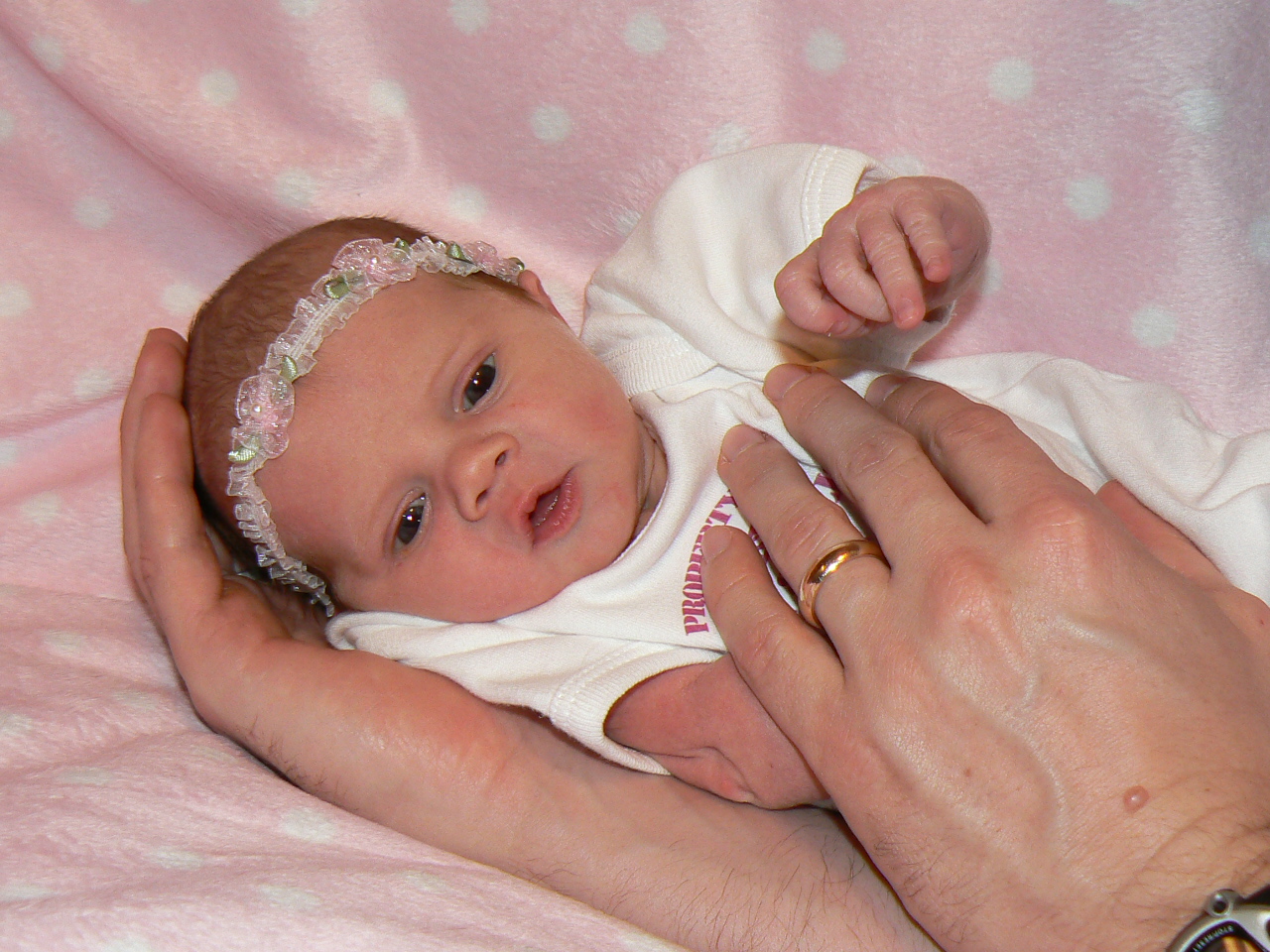
Bethany Faith Watson was born at 6:02 A.M. on April 16, 2008. She weighed in at 6 lbs 9 oz, and was 20 inches long. In her mommy and daddy’s eyes she is the most beautiful baby to ever live. Mom and baby are both doing very well, though all three of us are very sleepy! We deeply appreciate your thoughts and prayers. (Bethany is shown in what is currently her favorite position, hands up in the air next to her head… Touchdown!)

A Very Different Reading List…

Tags

I have not been doing a very good job of updating my reading list lately… With the baby on its way, I have been reading some books that are, well, different.

Here are some of the books that I have been reading:

The key word, in case you missed it, is baby!

Life Transitions

I am in the midst of what may be one of the craziest periods of my life. Those of you who follow this blog are aware that my wife and I are expecting our first child. The due date was April 9th, so we are eagerly awaiting her arrival at any minute. This is something that I am absolutely thrilled about and really looking forward to. It is also something that has kept us very busy, even in simply trying to get prepared. (Hence the decrease in frequency in posting.)

There is another transition that is not as important or significant as having your first child, but in any other season of my life would have center stage. After three wonderful years of ministry with the people of Lamont United Methodist Church, Melissa and I are leaving. I have been wrestling with and praying about a calling to return to academia. I applied to Southern Methodist University’s PhD program and was admitted. As a result, we will be moving to Dallas, TX in June and I will begin work on my PhD in the fall. I will be studying with Dr. Ted Campbell and Dr. Elaine Heath at SMU. My concentration will be the History of the Christian Tradition with an emphasis on Wesley Studies. My ultimate hope is to teach at the seminary level and pastor future pastors during their time in seminary.

It will be very difficult to leave Lamont. Melissa and I will really miss the wonderful people there. But I am also looking forward to beginning PhD work and immersing myself in Wesley Studies. I covet you prayers as we look to this new phase of our lives (both having a child and beginning a PhD).