• About Me

Kevin M. Watson

Kevin M. Watson

Category Archives: Uncategorized

John Wesley’s Sermon “Scriptural Christianity”: A Brief Summary

12 Tuesday May 2020

Posted by Kevin M. Watson in Uncategorized

≈ 30 Comments

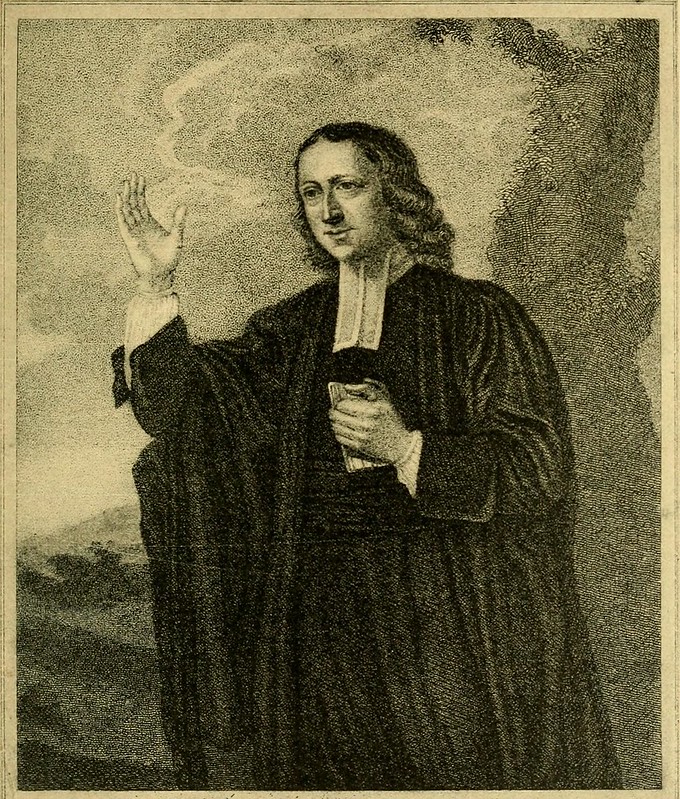
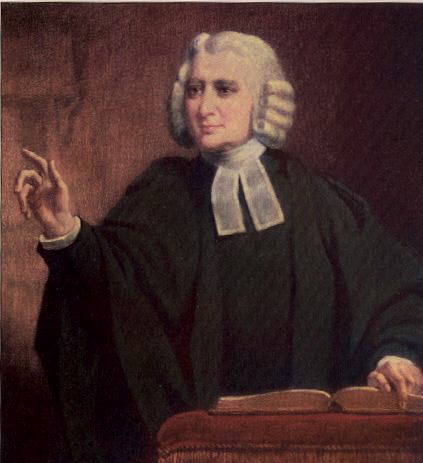
John Wesley


Background:

Did you know that many of John Wesley’s sermons are part of the formal doctrinal teaching of multiple Wesleyan/Methodist denominations? Wesley’s sermons have particular authority because these were the main way he taught Methodist doctrines and beliefs.

John Wesley preached the sermon “Scriptural Christianity” at St. Mary’s, Oxford University as the final sermon he preached before the university on August 24, 1744. In this sermon, Wesley bluntly confronts Oxford University with their failure to live according to the teaching of Scripture. When you read this sermon, you will likely not be surprised to find out that this was the last time Wesley was invited to preach at St. Mary’s.

This was the fourth and final sermon of the sermons the Wesleys preached at St. Mary’s. It was also the final sermon in the sermons included as a kind of preface to Wesley’s Sermons on Several Occasions. “Scriptural Christianity” is the fourth of the sermons in the Standard Sermons that are a key part of the formal doctrine of many Wesleyan/Methodist denominations.

In hopes of sparking interest in Wesley’s sermons and Methodism’s doctrinal heritage, here is my very short summary of “Scriptural Christianity.” I hope it will inspire you to read the sermon in its entirety yourself (check out the resources at the end of this post).


Key quote: 

May it not be one of the consequences of this that so many of you are a generation of triflers; triflers with God, with one another, and with your own souls? For how few of you spend, from one week to another, a single hour in private prayer? How few have any thought of God in the general tenor of your conversation? Who of you is in any degree acquainted with the work of his Spirit? His supernatural work in the souls of men? Can you bear, unless now and then in a church, any talk of the Holy Ghost? Would you not take it for granted if one began such a conversation that it was either ‘hypocrisy’ or ‘enthusiasm’? In the name of the Lord God Almighty I ask, What religion are you of? Even the talk of Christianity ye cannot, will not, bear! O my brethren! What a Christian city is this? ‘It is time for thee, Lord, to lay to thine hand!’….

Lord, save, or we perish! Take us out of the mire, that we sink not! O help us against these enemies! For vain is the help of man. Unto thee all things are possible. According to the greatness of thy power, preserve thou those that are appointed to die. And preserve us in the manner that seemest thee good; not as we will, but as thou wilt! [IV. 10-11]


One sentence summary:  

John Wesley confronts Oxford with the disconnect between scriptural Christianity and the nominally Christian lives of most people in Oxford.


Scripture passage for the sermon:

“And they were all filled with the Holy Ghost.” – Acts 4:31 (KJV)


Concise outline of “Scriptural Christianity”

  1. Wesley makes a comparison of Acts 4:13 to similar verses in Acts 2.
  2. In Acts 4:31, the place was shaken and they were filled with the Holy Ghost.
  3. They were filled with the Holy Ghost for a ‘more excellent purpose’ than the gifts of the Spirit.
  4. They were filled with the Holy Ghost to give them the mind which was in Christ, those holy fruits of the spirit which whosoever hath not ‘is none of his’; to fill them with ‘love, joy, peace, long-suffering, gentleness, goodness’; to endue them with faith, meekness and temperance; to enable them to crucify the flesh with its affections and lusts, its passions and desires; and, in consequence of that inward change to fulfill all outward righteousness.
  5. Without losing focus by arguing about the extraordinary gifts, let us focus on the ordinary fruits:
    1. As beginning to exist in individuals.
    2. As spreading from one to another.
    3. As covering the earth.
    4. Wesley will close with a plain practical application.

I. Let us consider Christianity in its rise, as beginning with individuals.

1. Suppose one heard Peter preach, repented, received faith and the witness of the Spirit.
2. He could not be afraid of any evil tidings.
3. His soul magnified the Lord and his spirit rejoiced in God his Savior.
4. The love of God was shed abroad in his heart by the Holy Ghost.
5. He loves his brother also.
6. Love is not puffed up, he is lowly of heart.
7. It was impossible for him knowlingly and designedly to do harm to any man.
8. He continued daily in all the ordinances of God and daily grew in grace.
9. It wasn’t enough to abstain from evil, his soul was athirst to do good.
10. Such was Christianity in its rise.

II.Let us take a view of Christianity spreading from one to another and growing.

1. It was the will of God that Christianity should spread from his first followers to others.
2. Lovers of mankind would be concerned for ‘the whole world lying in wickedness.’
3. Christians of old warned people to escape the damnation of hell.
4. They spoke to every person what was suited to their circumstance.
5. Their labors grew the church, but also grew the number of people who were offended.
6. The more Christianity spread, the more hurt was done to those who didn’t receive it.
7. Persecution arose in all of its forms.
8. Then the pillars of hell were shaken and the kingdom of God spread more and more.
9. As Christianity spread, how soon did the tares appear with the wheat! How soon did Satan find a seat, even in the temple of God!

III. Shall we not see greater things than these?

1. Can Satan cause the truth of God to fail? If not, Christianity will cover all the earth.
2. God has not cast away his people but is working so salvation can come to the Gentiles.
3. Suppose now the fullness of time to be come and the prophecies accomplished.
4. With righteousness or justice, mercy is also found.
5. No unkind or deceptive word would be heard.
6. When God reigns he will cause every heart to overflow with love and every mouth with praise.

IV. A plain practical application.

1. Where does this Christianity now exist? Where do the Christians live?
2. If you think I’m a fool, bear with me, do not prevent yourself from being blessed only because it comes through me.
3. Is this city a Christian city?
4. I am not talking about contested ideas, only the fundamental branches of our common Christianity.
5. Are you filled with the Holy Ghost?
6. To the teachers at Oxford: Are you filled with the Holy Ghost? Do you continually remind your students that the end of their studies is to know, love, and serve God?
7. I’m only speaking as if all under your care were intended to be Christians (not clergy).
8. Are those of us called to ministry patterns to the rest?
9. Do the youth have either the form or the power of Christian godliness?
10. Are not many of you a generation of triflers?
11. What is the chance that scriptural Christianity should again be the religion of this place? Lord, save, or we perish!


Resources:

Read “Scriptural Christianity” in its entirety.

Check out my brief summaries of the first three Standard Sermons:

“Salvation by Faith”

“The Almost Christian”

“Awake, Thou That Sleepest”

I highly recommend the critical edition of Wesley’s sermons, which has excellent references that show his reliance on Scripture throughout his preaching. There are four volumes if you want every known Wesley sermon. They aren’t cheap, but this is the most important publication by Abingdon since its release. Highly recommended!


Kevin M. Watson is a professor at Candler School of Theology, Emory University. He teaches, writes, and preaches to empower community, discipleship, and stewardship of our heritage. Click here to get future posts emailed to you. Affiliate links used in this post.

Cambridge Turquoise Reference Bible (KJV): Exceptional Quality and Craftsmanship

11 Monday May 2020

Posted by Kevin M. Watson in Uncategorized

≈ Leave a comment

The King James, or Authorized, Version of the Bible is widely regarded as the most influential book in the history of the English language. While it is less popular in some parts of contemporary Christianity, it continues to be the preferred translation for many Christians. The popularity of the KJV by contemporary Christians is seen by the variety of fine editions you can find in the King James Version today. Today’s review is the best KJV Bible I’ve seen to date.


Cover

Cambridge Turquoise Cover

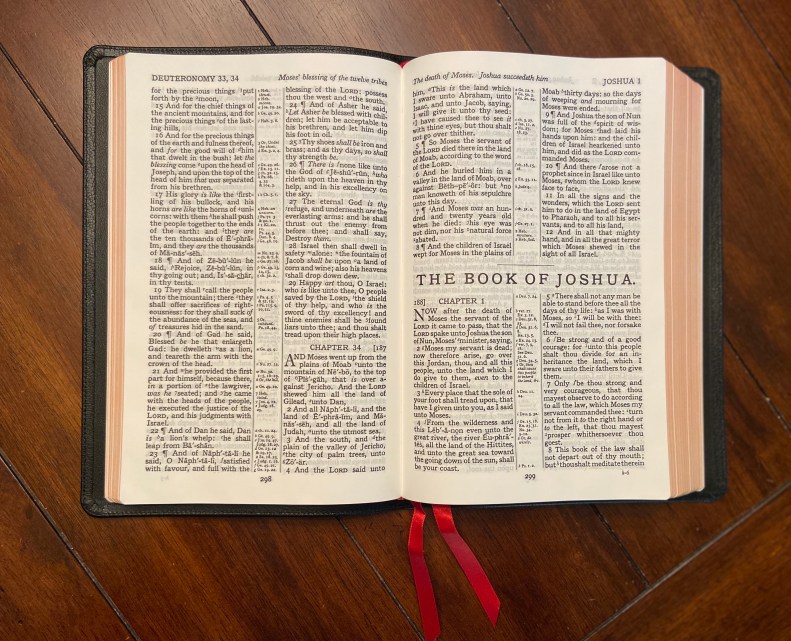
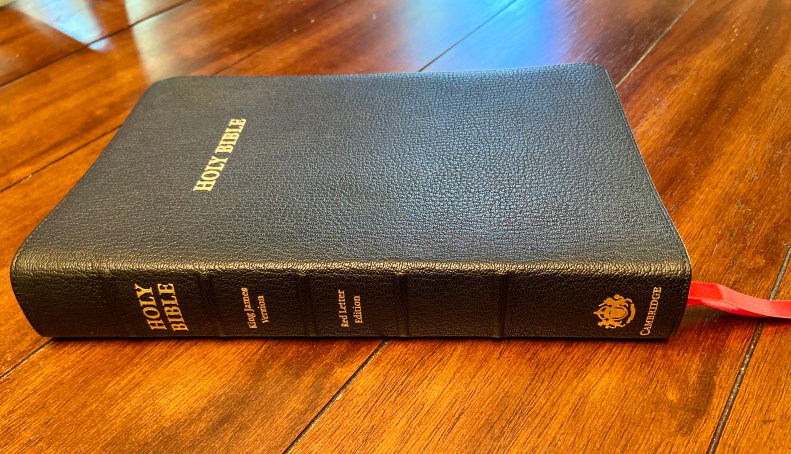
The Cambridge Turquoise Reference Bible is available in a black goatskin edge-lined binding and a black calf split paste-off binding. Edge-lined bindings are more durable and more expensive. I am reviewing the black goatskin in this review.

The goatskin on this Bible has a beautiful grain that has a lovely feel to it. This cover is closer to a matte than a glossy finish, which I love. The first impression of this cover is that it is the highest quality leather binding you can find on a Bible. The front cover has a simple gold-letter stamp of “HOLY BIBLE.”

The spine has gorgeous raised ribs. One of the unique features of a Cambridge KJV is that it has the Royal seal, as Cambridge University Press is the Queen’s printer. This adds a nice elegant touch that you cannot find on any other publisher of the KJV.

The goatskin cover and design are exceptional. Of all of the KJV Bibles I’ve had, this cover is by far my favorite.


Layout

Cambridge Turquoise Layout

The Turquoise Reference Edition is a double column Bible that has verse-by-verse layout. The advantage of this layout is that it is easy to scan the page for particular verses. This is particularly desirable when preaching or teaching, though it is largely a matter of preference. The disadvantage of this layout design is that it makes for a less immersive reading experience than a paragraph layout.

This Bible is a reference edition and has extensive references and notes from the translators in the center column of each page. The references are adequate for studying a passage and its connection to other parts of Scripture, which is essential for studying the Bible.

I found the system to initially be confusing and actually spent some time searching around online for an explanation of how the references are used, which I did not find in the Bible itself. Because the references are in the center column, I was confused about how to match up the keys in the text to the references. Here’s how they do it: The keys go from left to right across both columns. This keeps the center-column references close to where the keys occur in the text. I initially found this confusing because if you are scanning down one column of Scripture, the keys are not necessarily sequential. “A” might be in the left column and “b” and “c” might be in the right column. This ends up not being a real problem because most people would intuitively look for the reference in the center column and they would find the correct one. Nevertheless, I would have appreciated a short explanation of the system of references (which are identified with letters) and translator’s notes (which are identified with numbers) in the front matter of the Bible itself.

Cambridge Turquoise Layout

A pet-peeve of mine for fine Bibles is when new Books of the Bible are not given a fresh page. This a design choice that saves pages and thickness. But from my perspective, the payoff is marginal and does not offset the benefits of a cleaner layout. While this is ultimately a fairly minor concern, it is one of the very few criticisms I have of the Cambridge Turquoise Reference Bible.

At this stage, you may think that my general feeling of the layout of this Bible is strongly negative. That is not at all the case! The quality of the ink and paper, and the size of the font make this Bible easy to read. Physically, the Bible feels a bit taller and narrower than Bibles I would put in the same class. The cover is roughly 9 ¾” by 6 ½”. It may be that it seems taller than most Bibles because it is actually slightly narrower. Either way, I really like it. At 1 ½”, it is the perfect thickness for my taste.


Other Features

The Cambridge Turquoise Reference Edition includes both the original dedication and preface from the translators. Because of the history of the King James Version, I think every edition of the KJV ought to include both of these. Cambridge made a great choice here.

One feature I don’t remember seeing in other Bibles I’ve reviewed is that the chapters are numbered consecutively throughout the Bible. So, for example, next to chapter 1 of Jeremiah is “746]”. I would generally put this in the category of interesting trivia, but not necessarily something I would be likely to refer to much. (The design is subtle enough I didn’t even notice this immediately.)

The Bible also includes a presentation page and family records section. It includes a substantial concordance and maps in the back matter. There are two ribbon markers. And the Bible has Cambridge’s beautiful art gilt page edges.


Price

The goatskin retails for $320 and is available for $195.76 as of this writing. The cheapest it has been available on Amazon that I can find has been $172.15, about 7 months ago.

The calf split retails for $210. The price does not tend to change much on Amazon. It is $138.08 as of this writing and looks like it has been that price for 9 months. The cheapest it has been on Amazon that I can find was $137.26.


Conclusion

Cambridge Turquoise Spine

This Bible feels substantial both in the hand and laid open while reading. It possesses the supreme virtue of fine Bibles: It is of such excellent quality and craftmanship you want to hold it and interact with it. This is a great example of the attention to detail and premium materials from start to finish that are consistent hallmarks of Cambridge Bibles.


Kevin M. Watson is a professor at Candler School of Theology, Emory University. He teaches, writes, and preaches to empower community, discipleship, and stewardship of our heritage. Click here to get future posts emailed to you. Affiliate links used in this post. Cambridge provided a review copy of this Bible in exchange for an honest review.

Pandemic Perspectives: A Conversation on Spirit & Truth

08 Friday May 2020

Posted by Kevin M. Watson in Uncategorized

≈ 2 Comments

Spirit & Truth released a conversation with Scott Kisker, Matt Reynolds, and myself yesterday. This conversation was one of the highlights of my week. I hope you will check it out and that the conversation will bless you too.

The conversation centered around discipleship in a time of social distancing. We talked about the versatility of Wesleyan class meetings, as a way to meet virtually when necessary (though in person is ideal). One aspect of developing small group formation that seems particularly helpful right now is that small groups can fairly easily move from online to in person as required by conditions related to Covid-19. (Need help starting class meetings? Check out: How to Quickly and Easily Launch Online Class Meetings.)

The most interesting part of the conversation for me was when Scott argued that we should refer to this season as a famine and not a time of fasting. Scott argued that fasting is not the right way to think about this season. Rather, we are in the midst of a famine.

Scott’s main point was that we can choose to fast. We do not choose a famine. It is something that happens to us. And, as a result, it is not a spiritual discipline. I had not seen or heard anyone else make this distinction. It has really changed my thinking about this season.

We discussed several other aspects of Church history and whether we think there are historical precedents for Covid-19 and the church’s response.

I particularly enjoyed this conversation because Scott was one of my two most important mentors when I was in seminary. It is always humbling to me to be connected with him and get to work with him.

Matt asked Scott and I to do this together because we co-wrote a book a few years ago on the Wesley band meeting. The book discussed both the theology behind these groups and how to start band meetings today. If you want to know more about Wesleyan small group formation or think you might be ready for a band meeting, pick up a copy of The Band Meeting.

If you haven’t been following Spirit & Truth, I highly encourage you to do so. Matt Reynolds is on the cutting edge of contemporary evangelism that is helping people encounter Jesus and his love for them. And he is passionate about equipping local churches to spread the good news of Jesus in their communities. Matt Reynolds gives me hope for the future of the Wesleyan movement!

Kevin M. Watson is a professor at Candler School of Theology, Emory University. He teaches, writes, and preaches to empower community, discipleship, and stewardship of our heritage. Click here to get future posts emailed to you. Affiliate links used in this post.

Charles Wesley’s Sermon “Awake, Thou That Sleepest”: A Brief Summary

05 Tuesday May 2020

Posted by Kevin M. Watson in Uncategorized

≈ 33 Comments


Background:

The previous two posts have offered brief introductions to the first two sermons that are part of the formal doctrinal teaching of many Wesleyan/Methodist denominations. Did you know that one of these sermons was actually written and preached by Charles Wesley, who is best known for writing hymns like “Hark! the Herald Angels Sing” and “Christ the Lord Is Risen Today”?

Charles Wesley preached the sermon “Awake, Thou That Sleepest” at St. Mary’s, Oxford University as one of the University sermons on April 4, 1742. This is the only sermon Charles preached in St. Mary’s.

This was the third of four sermons the Wesleys preached at St. Mary’s that formed the beginning of Wesley’s Sermons on Several Occasions. “Awake, Thou That Sleepest” is the third in the Standard Sermons that are a key part of the formal doctrine of many Wesleyan/Methodist denominations. And it is the only one that was not written by John Wesley.

In hopes of sparking interest in these sermons and Methodism’s doctrinal heritage, here is my very short summary of “Awake, Thou That Sleepest.” I hope it will inspire you to read the sermon in its entirety yourself! (Check out the resources at the end of this post.)


Key quote: 

Awake, thou everlasting spirit, out of thy dream of worldly happiness. Did not God create thee for himself? Then thou canst not rest till thou restest in him. Return, thou wanderer. Fly back to thy ark. ‘This is not thy home.’ Think not of building tabernacles here. Thou art but ‘a stranger, a sojourner upon earth’; a creature of a day, but just launching out into an unchangeable state. Make haste; eternity is at hand. Eternity depends on this moment: an eternity of happiness, or an eternity of misery! [II.6]


One sentence summary:  

People, who by nature are asleep and separated from God, must wake up, put their faith in Jesus Christ, and be filled with the Holy Spirit.


Scripture passage for the sermon:

“Awake, thou that sleepest, and arise from the dead, and Christ shall give thee light.” Ephesians 5:14 (KJV)


Concise outline of “Awake, Thou That Sleepest”

I. Who is the sleeper Ephesians 5:14 speaks of?

1. By sleep is signified the natural state of man.
2. The poor unawakened sinner has no knowledge of himself.
3. Full of all disease, he thinks he is in perfect health.
4. Sleeper: a sinner satisfied in his sin, ignorant of his disease and only cure.
5. If he is not outwardly vicious, his sleep is usually deepest of all.
6. He has a form of godliness but denies the power thereof.
7. However highly esteemed among men such a Christian may be, he is an abomination to God.
8. He abides in death, though he doesn’t know it.
9. Before one can arise they must come to know they are dead to God and the things of God.
10. He does not have the spiritual senses necessary to discern spiritual good and evil.
11. Because he has no spiritual senses, he denies that they exist.
12. If you don’t have the witness of the Spirit, you need to be convinced you are unawakened.

II. Exhortation based on Ephesians 5:14

1. Know yourself, your true state. Judge yourself and you won’t be judged by the Lord.
2. Awake and cry out, ‘What must I do to be saved?’ And never rest till thou believest on the Lord Jesus, with a faith which is his gift, by the operation of his Spirit.
3. I am especially speaking to those who are unconcerned with this exhortation.
4. May the angel of the Lord wake you up!
5. Did God not create you for himself? Then you cannot rest until you rest in him.
6. In what state is your soul?
7. Are you a new creature?
8. Have you received the Holy Spirit?
9. If the question offends you, you aren’t a Christian and don’t really want to be one.
10. Have you received the Holy Spirit? A Christian is anointed with the Holy Ghost and with power. Christianity is participation in the divine nature, the life of God in the soul of man.
11. New creation is essential, inward change, spiritual birth, holiness.
12. Doing no harm and doing good will not save you.
13. Awake from spiritual death and come out from among the dead.

III. Explain the promise “and Christ shall give thee light” from Ephesians 5:14

1. If you awake, he has bound himself to give you light.
2. God is light, and will give himself to every awakened sinner who waits for him.
3. We are called to be a dwelling place for God through his Spirit.
4. The Spirit of Christ is that great gift of God which he has promised to us.
5. You may all be living witnesses of these things, of remission of sins and the gift of the Holy Ghost.
6. Eternal life is: to know the only true God, and Jesus Christ whom he hath sent. This experimental knowledge, and this alone, is true Christianity.
7. He is antichrist whosoever denies the inspiration of the Holy Ghost, or that the indwelling Spirit of God is the common privilege of all believers.
8. In ‘only’ denying the inspiration of the Holy Spirit you deny the whole Scriptures, the whole truth and promise and testimony of God.
9. Any who deny the inspiration of the Holy Spirit renounce the Church of England.
10. The wisdom of God was always ‘foolishness with men.’
11. Even among those who have kept themselves pure from those grosser abominations, how much love of the world and fear of man is to be found.
12. I wish I could except us from this, but we have not kept ourselves pure.
13. God has withheld judgment for now, but how much longer?
14. God, be glorified in our reformation, not our destruction.
15. It is high time for us to wake up!


Resources:

Read “Awake, Thou That Sleepest” in its entirety.

Want to know more about Charles Wesley? John R. Tyson’s Assist Me to Proclaim is an accessible biography of Charles Wesley.

Check out my short summary of the first two Wesleyan Standard Sermons “Salvation by Faith” and “The Almost Christian.”

I highly recommend the critical edition of Wesley’s sermons, which has excellent references that show his reliance on Scripture throughout his preaching. There are four volumes if you want every known Wesley sermon. They aren’t cheap, but this is the most important publication by Abingdon since its release. Highly recommended!


Kevin M. Watson is a professor at Candler School of Theology, Emory University. He teaches, writes, and preaches to empower community, discipleship, and stewardship of our heritage. Click here to get future posts emailed to you. Affiliate links used in this post.

My Thoughts on the Division of United Methodism

30 Thursday Apr 2020

Posted by Kevin M. Watson in Uncategorized

≈ Leave a comment


In early January, First Things contacted me and asked me to write a piece for them about the impending division of the UMC. This came right after the announcement of the “Protocol.” First Things wanted a piece that would be published just before the UMC General Conference.

It is hard to believe how much has changed since then. The General Conference has been postponed by more than a year. And Covid-19 has disrupted virtually every aspect of our lives.

Print publications work on a timeline that significantly limits their ability to respond to unexpected events. My article for First Things was in the very last stages of editing, for example, as Covid-19 began to cause massive disruption across the United States and it became unclear whether General Conference would meet as originally planned.

My article was published in print in May, 2020 and online a few weeks ago. While the timing made sense in January, it was far from ideal when it was actually published.

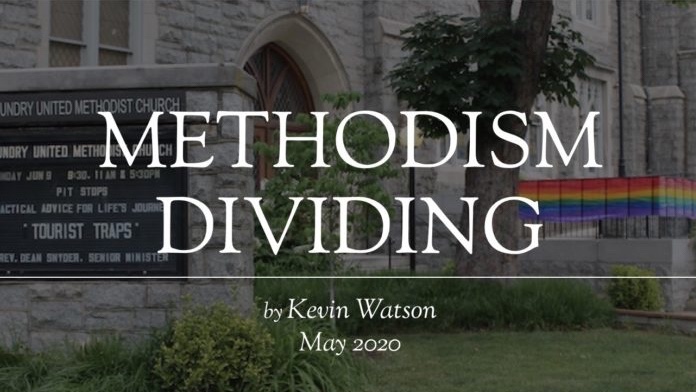
In “Methodism Dividing,” I put the United Methodist disagreement about same sex marriage and human sexuality in broader historical context. I particularly press on what I see as a common myth in United Methodism that we lead cultural change through our work for social justice.

In my experience there is a myth of social progress in three areas: slavery and racism, women’s ordination and leadership more broadly, and affirmation of same sex marriage. I argue that United Methodism, and its antecedents, did not lead these changes from a place of principled Christian conviction. Rather, the main branch of Methodism responded to changes in the surrounding dominant culture and followed in their wake. (I.e., the Methodist position on the first two changed after the dominant culture changed, rather than leading change in the dominant culture.)

This is why the worst moment of institutional racism in American Methodism was the formation of the Central Jurisdiction, which segregated all African-American Methodists into one Jurisdiction determined solely based on race, in the 1939 merger that created the Methodist Church. And it is why the Central Jurisdiction was not fully dissolved until the early 1970s, after major changes in the South came through the Civil Rights Movement.

Here’s another way this can be illustrated:  The position of United Methodists in a particular geographic area in the U.S. can generally be determined by the position of the dominant culture in the same area. There are of course exceptions, but this is a fairly sound and generally predictive principle. If the UMC is conservative in places that are generally conservative and liberal in places that are generally liberal, this suggests that United Methodism lacks a clear sense of identity and takes on the values of the dominant culture.

I often describe the UMC as a cultural chameleon. There are aspects of this that can be positive and helpful. There are also a variety of ways that this can be detrimental and damaging to a coherent Christian witness. I yearn for an expression of Methodism with a stronger grounding in its theological heritage and greater clarity of its own identity.

Regardless of where you are on the theological spectrum, all United Methodists need to give careful consideration to the relationship between church and society.

I think it is now inevitable that the UMC will divide. What is to be determined is how much fighting and bitterness there will be as division unfolds, and whether the church divides into a few new branches or fragments and splinters into many. Regardless of where we end up, there is room for all of us to be more firmly rooted in Christ.

You can see how I develop the historical argument in more details by checking out “Methodism Dividing” at First Things. My book Old or New School Methodism? The Fragmentation of a Theological Tradition provides an in-depth look at a particular moment of division in American Methodist theology.

Kevin M. Watson is a professor at Candler School of Theology, Emory University. He teaches, writes, and preaches to empower community, discipleship, and stewardship of our heritage. Click here to get future posts emailed to you. Affiliate links used in this post.


John Wesley’s Sermon “The Almost Christian” A Brief Summary

28 Tuesday Apr 2020

Posted by Kevin M. Watson in Uncategorized

≈ 45 Comments


Background:

Did you know that many of John Wesley’s sermons are part of the formal doctrinal teaching of multiple Wesleyan/Methodist denominations? Wesley’s sermons have particular authority because these were the main way he taught Methodist doctrines and beliefs.

John Wesley preached the sermon “The Almost Christian” at St. Mary’s, Oxford University as one of the University sermons on July 25, 1741. In this sermon, Wesley contrasted nominal (or almost) and real (or altogether) Christianity.

This was the second of four sermons Wesley preached at St. Mary’s that formed the beginning of Wesley’s Sermons on Several Occasions. “The Almost Christian” is the second of the sermons in the Standard Sermons that are a key part of the formal doctrine of many Wesleyan/Methodist denominations.

In hopes of sparking interest in Wesley’s sermons and Methodism’s doctrinal heritage, here is my very short summary of “The Almost Christian.” I hope it will inspire you to read the sermon in its entirety yourself (check out the resources at the end of this post).


Key quote: 

‘The right and true Christian faith is’ (to go on in the words of our own Church) ‘not only to believe that Holy Scripture and the articles of our faith are true, but also to have a sure trust and confidence to be saved from everlasting damnation by Christ’ – it is a ‘sure trust and confidence’ which a man hath in God ‘that by the merits of Christ his sins are forgiven, and he reconciled to the favour of God’ – ‘whereof doth follow a loving heart to obey his commandments.’

Now whosoever has this faith which ‘purifies the heart,’ by the power of God who dwelleth therein, from pride, anger, desire, ‘from all unrighteousness,’ ‘from all filthiness of flesh and spirit’; which fills it with love stronger than death both to God and to all mankind – love that doth the works of God, glorying to spend and to be spent for all men, and that endureth with joy, not only the reproach of Christ, the being mocked, despised, and hated of all men, but whatsoever the wisdom of God permits the malice of men or devils to inflict; whosoever has this faith, thus ‘working by love,’ is not almost only, but altogether a Christian. [II.5-6]


One sentence summary:  

While an almost Christian lives an outwardly Christian life in every way, an altogether Christian adds to this love for God and neighbor, and genuine faith (trust and confidence) in God’s love for them through the merits of Jesus Christ.


Scripture passage for the sermon:

“Almost thou persuadest me to be a Christian.” – Acts 26:28 (KJV)


Concise outline of “The Almost Christian”

First, what is implied in being almost a Christian

Secondly, what is implied in being altogether a Christian

I. What is implied in being almost a Christian?

1. Heathen honesty – they are concerned for justice
2. They are concerned for the truth
3. They expected love and assistance from one another
4. An almost Christian has a form of godliness – does nothing which the gospel forbids
5. And almost Christian avoids strife and contention and seeks to live peaceably with all men
6. An almost Christian does as much good to as many people as he possibly can
7. They use all of the means of grace at all opportunities
8. They use family and private prayer and are sincere
9. They are sincere in that all these actions come from more than merely a desire to avoid punishment, the loss of friends, or to gain money or reputation – these motivations make one a hypocrite and not even an almost Christian
10. An almost Christian has a real design to serve God and a hearty desire to do his will
11. What more than this can be implied in being altogether Christian?
12. Wesley testifies that he himself did all of the above and was only almost a Christian

II. What more than this is implied in being altogether Christian?

1. Love of God that engrosses the whole heart and fills the entire capacity of the soul. He is crucified to the desire of the flesh, desire of the eye, and the pride of life.
2. Love of neighbor
3. One more thing is needed to be an altogether Christian: faith
4. True faith brings forth repentance and love and all good works
5. Definition of faith: “The right and true Christian faith is not only to believe that Holy Scripture and the articles of our faith are true, but also to have a sure trust and confidence to be saved from everlasting damnation by Christ – it is a sure trust and confidence which a man hath in God that by the merits of Christ his sins are forgiven, and he reconciled to the favor of God – whereof doth follow a loving heart to obey his commandments.”
6. Whosoever has this faith is an altogether Christian
7. Who are the living witnesses of these things?
8. Are not many of you not even almost Christians?
9. Good designs and good desires do not make a Christian.
10. God knows that if anyone dies without this faith and love, it would be better for them if they had never been born.
11. May we all then experience what it is to be not almost only, but altogether Christian!


Resources:

Read “The Almost Christian” in its entirety.

Check out my short summary of Wesley’s sermon “Salvation by Faith.”

I highly recommend the critical edition of Wesley’s sermons, which has excellent references that show his reliance on Scripture throughout his preaching. There are four volumes if you want every known Wesley sermon. They aren’t cheap, but this is the most important publication by Abingdon since its release. Highly recommended!


Kevin M. Watson is a professor at Candler School of Theology, Emory University. He teaches, writes, and preaches to empower community, discipleship, and stewardship of our heritage. Click here to get future posts emailed to you. Affiliate links used in this post.
 

It Is Hard to Say I’m Sorry: An Appreciation of Bishop Mike Lowry

27 Monday Apr 2020

Posted by Kevin M. Watson in Uncategorized

≈ 3 Comments

Admitting that you made a mistake, especially publicly, is extremely difficult. I suspect it becomes more difficult the more visible your position of leadership is.

It is not hard to find examples of people making mistakes. But it is rare to see someone own a mistake and apologize for it. And this is exactly what Bishop Mike Lowry, the resident bishop of the Central Texas Conference of The United Methodist Church has done.


His apology is direct and unequivocal:

As your Bishop, I erred in my theological judgment by endorsing “online” communion. The fault is mine and mine alone. I apologize for so doing to the clergy and laity of the Central Texas Conference, and am writing about this because I believe both that confession is important and that my error needs to be corrected and perhaps debated. More importantly, we have a teaching moment and a significant opportunity to theologically learn together by wrestling with the deeper implications of “online” communion.


This is one of the most encouraging acts of both humility and courage that I have seen in quite some time. I want to publicly thank Bishop Lowry.


Lowry’s essay should be required reading for two reasons.

First, it is an excellent example of intellectual virtue. Bishop Lowry stayed with a difficult and complex topic, even after taking an initial position on it. He continued to pursue the truth and sought to understand what was at stake in permitting “online” communion as best as he could.

And once he became convinced that he was incorrect, he acknowledged this and did what was in his power to do to make it right. He explained the reason for his change of mind. He encouraged clergy who had celebrated communion virtually to consider ceasing the practice. But he also acknowledged that some might feel that a drastic change within the local church might do more harm than good and honored his initial statement.

This is an exceptional example of leadership.


Lowry’s essay is required reading, secondly, because it is a deeply thoughtful consideration of communion itself. Here is just one glimpse of what you will find in this essay:

The classic definition of the sacraments is “an outward and visible sign of an inward and spiritual grace.” The actual elements used in Holy Communion are to be consecrated by an ordained elder (or appointed licensed local pastor) who is physically present with the elements (bread and wine/juice). Such action ties together the three-part discipline of Word, Sacrament and Order for which elders are ordained.


This line in particular haunts me:

The way we have handled this issue, both individually and collectively as bishops, highlights the theological poverty of the UMC.

Bishop Lowry succinctly describes why the way permission for online communion has troubled me so much. The disagreement about whether the church can offer communion when it can’t be together in person shows just how fractured the UMC is.

The disagreement over whether communion can rightly be officiated online cuts across an entirely different fault line than the painfully visible disagreement about same sex marriage. The pushback I received to my writing about online communion on social media and elsewhere was fairly evenly split between those who agree with me about human sexuality and those who disagree with me.

This disagreement is visible within the Council of Bishops itself.


One final thing that makes Bishop Lowry’s mea culpa so remarkable: Lowry initially took a step away from the historic understanding of communion and on more careful consideration returned to it. For me, this is a reminder of the continued riches of the living faith of the Church of Jesus Christ.

Thank you Bishop Lowry! May your tribe increase. And may we all learn from your example.


Kevin M. Watson is a professor at Candler School of Theology, Emory University. He teaches, writes, and preaches to empower community, discipleship, and stewardship of our heritage. Click here to get future posts emailed to you.

Wesley One Volume Commentary: First Impressions

22 Wednesday Apr 2020

Posted by Kevin M. Watson in Uncategorized

≈ 2 Comments

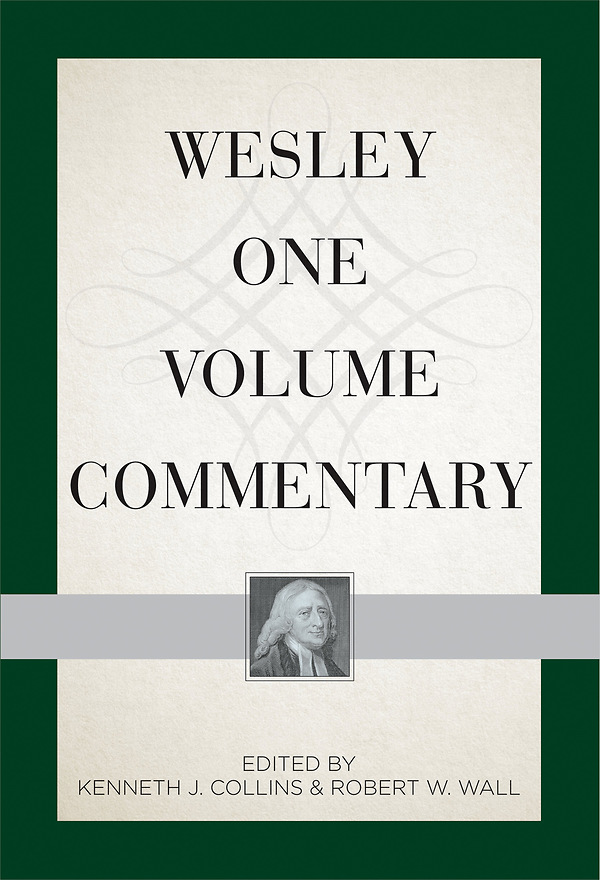
I ordered the new Wesley One Volume Commentary last week and was thrilled when it came in the mail. I remember a colleague mentioning working on commentary for one of the books for the volume a year or two ago, but otherwise didn’t know much about it. Here are my quick thoughts:


1. Kenneth J. Collins and Robert W. Wall are the editors.

This is a big positive.

Wall was a colleague and mentor during my time on the faculty at Seattle Pacific University. He gave a University lecture at SPU on John Wesley’s use of 1 John that is one of the best academic lectures I’ve ever heard.

Collins teaches historical theology and Wesley studies at Asbury Theological Seminary. He is one of the foremost and most prolific scholars of John Wesley currently teaching. I am frequently asked to recommend an accessible biography of John Wesley for laity and my recommendation is Collins’s A Real Christian: The Life of John Wesley.


2. The dedication is to Joel B. Green: “Faithful friend, respected colleague, and biblical scholar extraordinaire.”

It immediately struck me that Joel Green is the ideal person for such a dedication. This is a detail that may not mean much to the average person who buys the book, but it put a smile on my face. A lovely gesture.


3. “Introduction to a Wesleyan Theological Orientation” by Kenneth J. Collins is an excellent introduction to the topic.

While pastors and laity will benefit from a careful reading of the entire essay, the sections “How Sin Is Defined Is Crucial in Understanding the Liberties of Redemption” and “Regeneration Is Freedom from the Power of Sin” are especially helpful.


4. “Introduction to Wesleyan Biblical Interpretation” by Robert W. Wall is another excellent contribution.

Wall brilliantly sets up the purpose for this volume. Here is a succinct summary: “The purpose of the Wesley One Volume Commentary is to retrieve a ‘Wesleyan sense’ of scripture for the reader’s use in worship, catechesis, mission, and personal devotions” (xxii). The clear theological and ecclesial orientation of this volume is a major strength. Wall provides a robust introduction to Wesleyan biblical interpretation that is an important contribution.


5. The contributors come from a variety of Wesleyan/Methodist faith communities.

There are a number of United Methodist contributors, as one would expect and as there should be. The volume is strengthened by the intentional inclusion of scholars from (in alphabetical order): The African Methodist Episcopal Church, The Anglican Church in North America, The Church of God (Anderson), The Church of God (Cleveland), The Church of the Brethren, The Church of the Nazarene, The Episcopal Church, The Free Methodist Church, The Salvation Army, The Wesleyan Church, and The Wesleyan Church of Russia.


6. My first impression of the layout was underwhelming.

I like the design of the spine. I did not like the layout of the back cover as much. The interior layout did not make a positive first impression compared to comparable volumes. These things are subjective, so you may disagree with me.


Conclusion:

My first impression is this a book every Wesleyan/Methodist pastor should have in their library. I also think it will be useful for engaged laity, particularly those who teach Sunday School classes. This is a book I will be consulting regularly in personal study of Scripture and in preparation to preach and teach the Bible. I am grateful to Abingdon for publishing it and to all of the scholars who contributed to it.


Kevin M. Watson is a professor at Candler School of Theology, Emory University. He teaches, writes, and preaches to empower community, discipleship, and stewardship of our heritage. Click here to get future posts emailed to you. Affiliate links used in this post.
What Did John Wesley Mean by “Salvation by Faith”?

21 Tuesday Apr 2020

Posted by Kevin M. Watson in Uncategorized

≈ 38 Comments

What did John Wesley mean when he insisted that salvation is by faith? Wesley’s sermon “Salvation by Faith” is dedicated to this topic and remains a powerful teaching for Christian theology. This is my brief summary of the sermon.


Background:

Did you know that many of John Wesley’s sermons are part of the formal doctrinal teaching of multiple Wesleyan/Methodist denominations? Wesley’s sermons have particular authority because these were the main way he taught Methodist doctrines and beliefs.

John Wesley preached the sermon “Salvation by Faith” at St. Mary’s, Oxford University as one of the University sermons on June 11, 1738. The date of the sermon tells us that Wesley preached this sermon less than three weeks after his famous “heart-warming” experience at Aldersgate Street on May 24, 1738.

This sermon was included with four other sermons Wesley preached at St. Mary’s as the beginning of Wesley’s Sermons on Several Occasions. “Salvation by Faith” is the first of the sermons in the Standard Sermons that are a key part of the formal doctrine of many Wesleyan/Methodist denominations.

In hopes of sparking interest in Wesley’s sermons and Methodism’s doctrinal heritage, here is my very short summary of “Salvation by Faith.” I hope it will inspire you to read the sermon in its entirety yourself (check out the resources at the end of this post).


Key quote:

[Salvation by faith] is a sure confidence which a man hath in God, that through the merits of Christ his sins are forgiven, and he reconciled to the favour of God; and in consequence hereof a closing with him and cleaving to him as our ‘wisdom, righteousness, sanctification, and redemption or, in one word, our salvation. (I.5)


One sentence summary:

Salvation by faith is trust and confidence in the work of Jesus Christ to forgive us, reconcile us to God, and enable our growth in righteousness and true holiness.


Scripture passage for the sermon:

“By grace ye are saved through faith.” – Ephesians 2:8 (KJV)


Concise outline of “Justification by Faith”

1. Every good thing we receive from God is freely given by God and undeserved.
2. Sinful people cannot atone for their sins.
3. Grace is the source, faith the condition, of salvation.

I. What is the faith through which we are saved?

1. It is not barely the faith of a heathen.
2. It is not the faith of a devil.
3. It is not the faith the apostles had while Christ was still on earth.
4. It is faith in Christ that involves the head and the heart.
5. It acknowledges the necessity and merit of his death, and the power of his resurrection.

II. What is salvation by faith?

1. It is a present salvation. “Ye are saved through faith.”
2. You are saved from sin, both from the guilt and power of it.
3. First, from the guilt of all past sin.
4. They are saved from fear a. of the wrath of God and b. of falling away from the grace of God.
5. Through this faith they are saved from the power of sin as well as from the guilt of it.
6. People born of God no longer sin.
7. This then is the salvation which is through faith, even in the present world: a salvation from sin and the consequences of sin.

III.   Common Objections.

1. Objection: To preach salvation or justification by faith is to preach against holiness and good works. Answer: We speak of a faith that necessarily produces good works and all holiness.
2. Objection: Do we not make void the law through faith? Answer: We trust in Christ alone, use all ordinances, do the good works he appointed, and manifest holy tempers.
3. Objection: Does not preaching this faith lead to pride? Answer: It may accidentally. The key is to remain focused on salvation as sheer gift that is undeserved.
4. Objection: May not the speaking thus of the mercy of God encourage people in sin? Answer: It may, but the goodness of God will lead the sincere of heart to repent.
5. Objection: If a man cannot be saved by all that he can do, this will drive him to despair. Answer: It will drive them to despair of being saved by their own merit, which is necessary.
6. Objection: This is an uncomfortable doctrine. Answer: This is the only comfortable doctrine! (To all self-destroyed, self-condemned sinners.)
7. Objection: Salvation by faith only ought not to be preached as the first doctrine. Answer: There can be no other foundation than Jesus Christ and that salvation is by faith in him alone.
8. Conclusion: Never was maintaining this doctrine more important than today.
9. The adversary rages when salvation by faith is declared to the world because it alone overturns the foundations of his kingdom.


Resources:

Read “Salvation by Faith” in its entirety here. And then come back and share your one sentence summary of the sermon!

I highly recommend the critical edition of Wesley’s sermons, which has excellent references that show his reliance on Scripture throughout his preaching. There are four volumes if you want every known Wesley sermon. They aren’t cheap, but this is the most important publication by Abingdon since its release. Highly recommended!


Kevin M. Watson is a professor at Candler School of Theology, Emory University. He teaches, writes, and preaches to empower community, discipleship, and stewardship of our heritage. Click here to get future posts emailed to you. Affiliate links used in this post.
Easter Is a Season, Not a Sunday

16 Thursday Apr 2020

Posted by Kevin M. Watson in Uncategorized

≈ 2 Comments

For some of us it may feel like we missed our chance to celebrate Easter. But the reality is that Easter is just getting started.

Did you know that Easter is a season, not just one Sunday?


One of the most challenging aspects of the Covid-19 pandemic for the church was the growing likelihood, and eventual certainty, that most churches would not be open on the highest attended Sunday of the year.

There was a tension in online services between the words we spoke and the various ways in which these words were spoken.

I missed the opportunity to celebrate in person together. On the day the church expresses its boldest confidence in the life-changing reality of the gospel of Jesus Christ, we were not able to be together because the simple act of gathering together could reignite the invisible enemy stalking us.

I grieved not being able to gather with brothers and sisters in the faith at my church to celebrate the best news the world has ever heard: Jesus Christ, who was crucified, has been raised from the dead!

Christ is risen!

He is risen, indeed!

But these lines aren’t meant to be said by one person. They are a call and response.


This year is a good time to press into celebrating Easter as a season.

There is a meaningful theological rationale for understanding Easter as a season, not a Sunday. The church prepares for Easter by entering into a disciplined season of prayer and fasting for the 6 weeks of Lent.

The journey starts on Ash Wednesday. We are confronted with our mortality. And how many of us knew how relevant that would be this year?

If you count the days on a calendar from Ash Wednesday until the day before Easter, you will count 46 days. So, why is Lent said to be 40 days?

Every Sunday is a “little Easter.” The church gathers together every week to celebrate the life, death, and resurrection of Jesus. The reality of the resurrection is too awesome and radically world-changing to celebrate once a year. We celebrate Jesus’s triumph over sin and death itself in the resurrection every Sunday throughout the year.

Lent is 40 days because the Sundays in Lent are not fast days. They are days of celebration and rejoicing.


Why does any of that matter for a discussion of Easter?

It’s simple: The good news of Easter is too good to do justice to in one Sunday, much less one worship service. If we prepare and fast for 6 weeks, we must celebrate for longer, otherwise we would spend more time mourning or grieving our propensity to sin than we would spend rejoicing in God’s gift of salvation.

This year there are many things that are out of our control. When will we be able to meet together again? When we do, will we be able to shake hands or hug? What will the new normal be like, and how will it be different than what was normal just over a month ago?

In the midst of the unknown, the anxiety, and even the grief we are experiencing, this is the perfect time to practice a disciplined celebration of the resurrection of Jesus Christ.

Easter is a season, not a Sunday. May the Holy Spirit lift our hearts in praise and celebration from now until Pentecost. I don’t know if we will be able to join together in person this Easter. But we have 7 more weeks.

I am going to pray for the grace to celebrate well this Easter season. How will you celebrate?


Want to know more about the discipline of celebration? Check out the last chapter of Richard Foster’s classic The Celebration of Discipline. This is a book every Christian should read, highly recommended.

Kevin M. Watson is a professor at Candler School of Theology, Emory University. He teaches, writes, and preaches to empower community, discipleship, and stewardship of our heritage. Click here to get future posts emailed to you. Affiliate links used in this post.
← Older posts
Newer posts →

Blog at WordPress.com.

  • Subscribe Subscribed
    • Kevin M. Watson
    • Join 369 other subscribers
    • Already have a WordPress.com account? Log in now.
    • Kevin M. Watson
    • Subscribe Subscribed
    • Sign up
    • Log in
    • Report this content
    • View site in Reader
    • Manage subscriptions
    • Collapse this bar
 

Loading Comments...