• About Me

Kevin M. Watson

Kevin M. Watson

Category Archives: Ministry

UM Social Media Experiment: The Results

21 Wednesday Jan 2009

Posted by Kevin M. Watson in links, Ministry, Technology, Wesley

≈ 5 Comments

Today concludes the two week time line for the experiment in Methodist social media exposure. There were 759 views of the YouTube video promoting Reclaiming the Wesleyan Tradition: John Wesley’s Sermons for Today There were 44 hits to the video when I discovered it and posted it on the Methodist blogosphere. At the end of the first week there were 619 views. This means that the momentum slowed down significantly after the first week as there were 140 views in the second week. (On the other hand, that is still more than three times as many views as the video had in its first six months of existence.)

Blake Huggins was surprised at how well the experiment was going in a comment he left on my post about the experiment at one week. Henry Neufeld, on the other hand, was disappointed with the results.

I am not exactly sure what to make of the results. I think the experimented would have been more successful if the video that was circulated had not been promoting a book generally, and promoting a book I co-authored more particularly. I noticed comments on several blogs that expressed that they were disappointed to find at the end of the video that it was just promoting another book. (Though I was also surprised that so many people seemed to feel that United Methodists have so much information out there about their books. I have tended to feel the other way, that not very many people know about United Methodist publications outside of a very committed group.) I was also a bit disappointed that the views of the video decreased so rapidly in the second week.

On the other hand, I was surprised that more than 25 bloggers linked to the video in some way on their blog. And I do think it is significant that simply passing on a video was able to revive a video that was basically dead on YouTube. A change from 44 views in 6 months to 715 views in 2 weeks is a significant change. I think that this experiment does show that there exists a significant group of Methodists who are willing to work together in some capacity to raise awareness and get the word out. The big question is: Get the word out about what? Over the last few weeks I have found myself dreaming about the ways that the blogosphere could be used as a resource for helping to better get the Wesleyan message out there – not just to other Methodists, but more deeply into the emerging church and other places where meaningful conversations are happening about what it means to be a Christian, how to live faithfully, the meaning of life, etc.

As I indicated in the original post about this experiment, I will write a letter to the folks at Discipleship Resources and the General Board of Discipleship letting them know about the experiment and encouraging them to think about ways to use the internet as a means of communication and ways to work with Methodists who already have a presence and audience on the web. I will pass on any response that is appropriate to publicly communicate.

In the meantime, what are your thoughts about the experiment? Do you see anything more than this can point to or lead to?

An Experiment in Improving UM Social Media Exposure

07 Wednesday Jan 2009

Posted by Kevin M. Watson in links, Ministry, Technology

≈ 17 Comments

I would like to find out how much of an impact Methodist bloggers can have on spreading the word if we all join together. How big of an impact do you think we could have? To get an idea, and to hopefully gain some concrete evidence of how Methodist bloggers can help get the Methodist message out there, I invite you to participate in an experiment with me.

This past Saturday I posted a link to a YouTube video that I recently discovered promoting a book that I co-authored called Reclaiming the Wesleyan Tradition: John Wesley’s Sermons for TodayAfter posting the video, Gavin, at Hit the Back Button to Move Forward, posted about the video and his disappointment that it has not received more exposure. His post also stirred up some discussion about how United Methodism could do a much better job with getting our message across. Gavin also noted at one point how much the views from the video had gone up in a few days, just from he and I linking to it. (When I wrote my post there had been 44 views in over six months. As of this writing there have been 189 views!)

All of this has stuck in my mind over the last few days. I have been wondering if people at Discipleship Resources and other arms of United Methodism that are involved in publishing and communications understand what a resource they have in all of the Methodists who maintain great blogs. My guess is that they don’t realize the potential that exists for bloggers to be a serious avenue for getting the Methodist message out there.

Now let me say that while I would certainly like to see folks like Discipleship Resources and Abingdon have more success in selling books in mainstream venues like Barnes and Noble and Borders, this is about more than selling books. I believe that the Wesleyan tradition has an important contribution to make to the Church and to the world. Currently, I think that institutionally the United Methodist Church could be doing a better job communicating our message.

So, I would like to try an experiment to see what potential Methodist bloggers have to spread the word and get a message out there. I would like to see how much we can increase the views of the Reclaiming the Wesleyan Tradition YouTube video in two weeks. If you are willing to help here is what I would suggest: First, post the video on your blog. (The link is http://www.youtube.com/watch?v=1ISKTrScpzQ) Second, write a post that either links to this post or summarizes in your own words the experiment to see how much social capital Methodist bloggers have. Third, one week after posting the video write a follow-up post that reminds people about the video and the experiment.

If this experiment has significant results, I plan on trying to get in touch with the folks at Discipleship Resources and the GBOD to let them know the difference that plugging into the Methodist blogging world made. I would also suggest they create a forum from learning from you all about how they can better communicate through social media and the internet.

So, here is the video:

———————————————————————-

If you would like to save time, you can copy and paste this as the post: (you can also change any part of it that you would like to)

Kevin Watson at https://deeplycommitted.wordpress.com has started an experiment to see how much social capital Methodist bloggers have. This experiment was prompted by the feeling among some Methodist bloggers that United Methodism does not always do as good of a job as it could at getting the Wesleyan message out there, particularly on-line. So, he wants to see how many views a YouTube video can get if Methodist bloggers work together to promote it. The experiment is to see how many hits the video will receive in two weeks.

If you want to participate you can: First, watch the video below. Second, copy and paste this entire post into a new post on your blog and post it. Third, remind people about this experiment in one week.

Based on the results of the experiment, Kevin will get in touch with the folks at Discipleship Resources and let them know the ways in which Methodist bloggers are often an underused resource.

Here is a link to the video: http://www.youtube.com/watch?v=1ISKTrScpzQ

Is the Emerging Church Still a Conversation?

06 Tuesday Jan 2009

Posted by Kevin M. Watson in links, Ministry

≈ 4 Comments

For the last few months I have been wondering if the emerging movement is still a conversation. Many in the movement have preferred to call it the emerging conversation, rather than the emerging church. This question has particularly stuck in my mind since I asked someone who is a leader in the emerging “conversation” if they knew of anyone who had offered a substantive response to D. A. Carson’s Becoming Conversant with the Emerging Church: Understanding a Movement and Its ImplicationsThe answer I received was, “Most of us believe that book is so bad it doesn’t deserve a response.”

I was surprised by this answer, because I did not find Carson’s book to be offensive or intentionally trying to distort the emerging message. It may be that I don’t get it, but I felt that Carson was really trying to understand and interact with his best understanding of this movement and then make a meaningful response to it. Obviously there are going to be areas where D. A. Carson disagrees with key voices in the emerging church. For my part, Carson’s book left me sincerely interested in how people like Brian McLaren (who was not the person I was corresponding with) would respond to Carson’s concerns.

To be fair, I am raising this question based on a very short response I received from one person. It would be unfair to make this representative of an entire group of people. Moreover, Peter Rollins was recently as SMU and I had the chance to visit with him for about thirty minutes after he spoke in a New Testament calss. He was very gracious and in the time I spent with him I felt that he wanted to be part of an ongoing conversation. (While I do not agree with everything he says, both of his books are worth reading: How (Not) to Speak of Godand The Fidelity of Betrayal: Towards a Church Beyond BeliefHow (Not) to Speak of God has particularly been praised by folks within Emergent.)

To push things a bit farther: From my perspective, there does not seem to be all that much critical reflection on what is coming out of the emerging church. I have sometimes detected a bit of a defensive posture from folks in the emerging church, such as the appendix in Tony Jones’ The New Christians: Dispatches from the Emergent Frontier titled “A Response to Our Critics.” Of course, this is also an effort to do exactly what I am asking for – conversing with those who disagree with them. So, I am sure that the emerging church has received more than its fair share of uncharitable criticism. I am also sure that they have often done their best to respond to their critics. However, lately I have felt that there is a bit of an attitude that “those people just don’t get it” and therefore they are not worth talking to.
I write this because there has always been something that I can’t quite put my finger on about the emerging church that has attracted me. I think that there are many things that they get powerfully right. I also think their ability to get their message out and sell books in places like Barnes and Noble shows that they are meeting a real need that people have, particularly younger people – a demographic my own denomination currently has a very hard time connecting with. So I am a fan of the emerging church. I buy the new books that come out (although enough are coming out now that I can’t say I buy all of them). However, I also have some questions. Occasionally I think they get things completely wrong. I don’t think this makes them different from any other group. But because they are raising such important issues and are connecting with popular culture so well, I hope that they will not insulate themselves from constructive criticism or change. It seems to me that these were in many ways the very motives which raised up the emerging church to begin with – a desire to move the church closer to faithfulness and relevance in a changing culture.

What are your thoughts? Am I missing key venues where the conversation continues? I am interested in your perception of the current state of the emerging conversation.

Top 5 Things I Miss About Pastoring in a Local Church

18 Thursday Dec 2008

Posted by Kevin M. Watson in Ministry

≈ 2 Comments

Tags

local church, pastoring

Top 5 Things I Miss about Pastoring in a Local Church:

5. Teaching. I loved teaching Sunday School and seasonal studies. I enjoyed the give and take that came with small group gatherings where people were able to respond to my teaching and forced me to think more carefully and more deeply. It was through teaching in Lamont that my gifts for teaching were affirmed and where I began to gain confidence in my desire to teach at the seminary level. However, it was also in teaching in Lamont that I realized that I sometimes made things too easy, neat, or straightforward. I learned to learn from others and my time teaching in Lamont, I believe, made me a better teacher.

4. Presiding at the Eucharist. This would be closer to # 1, except that it took me a while to really become comfortable with the liturgy of the Communion service. Once I began to feel more at home in the movements and words of the Great Thanksgiving, I was able to better sense what God had done and continued to do for us through the Eucharist and through Christ’s life, death, and resurrection. I agree with Wesley that communion is the grand channel by which God delivers grace to us.

3. Christmas Eve Communion Service. Lamont did a wonderful job of preparing for Christmas Eve and had a beautiful sanctuary. I felt the peace of the Holy Spirit and the power of Christ’s coming each year during the Christmas Eve service. More people came to worship for that service than any other service of the year and I always left feeling like people had been given the opportunity to glimpse the fullness of the kingdom. It was a particularly special service because so many people’s families came home for Christmas, and more often than not my family was there too.

2. Preaching. I have not preached a sermon since my last sunday in Lamont. While some sermons took a lot more effort and energy than others, I always loved preaching. And I never ceased being amazed at how God was able to use my sermons in very different ways than I had imagined.

1. Being used by God to usher people into the Kingdom of God through the sacrament of baptism. One of my favorite mementos from my time as the pastor of Lamont United Methodist Church is the crinkled pages in my hymnal where I drops of water fell during baptisms. I can’t quite explain it, but each baptism was a holy moment for me.

The Church That Was Born Again

14 Sunday Dec 2008

Posted by Kevin M. Watson in Life, Ministry, Wesley

≈ 7 Comments

Tags

Eldbrooke, Rebirth, United Methodism

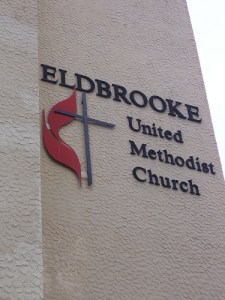
Eldbrooke UMC

Eldbrooke UMC

Elbrooke United Methodist Church no longer exists, at least not as a community of faith that continues to gather together to worship God and serve others. My internship in seminary was at Eldbrooke UMC, where I watched the church yoke itself to Metropolitan Memorial United Methodist Church. The following year it was closed. I graduated from seminary and moved to Oklahoma before Eldbrooke was closed, yet I occasionally heard pieces of news as Eldbrooke was closed and then put up for sale. My internship at Eldbrooke was difficult because I came to love the people at the church, yet the church was obviously not moving in a positive direction. Attendance was low, the building was in disrepair, and people seemed to be fighting just to stay above water.

I saw so much potential for the church, as it was located in a growing neighborhood of Northwest Washington, D.C., within a block of a metro stop. From a strategic standpoint, there seemed to be every reason why the church should be thriving, not dying. Yet, die it did.

I heard that the church would likely ultimately be sold to the highest bidder, which most people thought would mean that the church would be torn down. But due to the church being designated an historical landmark, and other circumstances, it was ultimately sold to another church. And that is how Eldbrooke United Methodist Church became The City Church DC.

I made this discovery when my brother and I walked to Eldbrooke, reminiscing, and noticed that the lights were on and people were in the parking lot. I introduced myself and explained that I had been an intern at this church and was in town for the weekend and asked if there was any way that I could take a quick look around inside. I discovered I was speaking to one of the lead pastors. She seemed genuinely glad to meet me and show me around. She gave me a thorough tour of the church, and introduced me to her husband, the other lead pastor.

I have to say that seeing concrete evidence that a group of people were investing in this church made my heart sing. They have remodeled the sanctuary and the area where we used to have our soup suppers after worship on Sunday morning. And the work continues.

What particularly impressed me was how charitable they were in their discussion of the church. When I introduced myself to the second lead pastor and told him I was currently working on a Ph.D. in church history he immediately responded, “Well, there is a lot of history in this place.” Michael and Heather provided a wonderful example to me of how to work towards unity in the Body of Christ. The City Church DC is nondenominational and, therefore, not United Methodist. But there was not hint of gloating or dismay or judgment of what is, to be honest, a failure of the United Methodist Church. They seemed to see themselves as simply stepping into the history of this church, leading to its next steps of faithfulness and obedience to how they understand God to be at work.

And so Eldbrooke United Methodist Church, which was put to rest a few years ago, was born again. Eldbrooke, which was dead, is now City Church, which is alive and growing. (Michael told me that since they began worshiping in February attendance has grown fro 65 to 130.) I suspect that some United Methodists in the D.C. area may not care much about The City Church DC, but whether United Methodists notice or not, the kingdom is coming. Jesus continues to draw people to himself and he sends them in love to others.

I think this is a great story in and of itself. Yet, it seems to me that there is something in this story that United Methodists can learn from. It should not escape our notice that a church is growing in literally the same location and even in the very same building. In some ways, it seems that the main thing that had to die for the church to live was the United Methodist affiliation of the church. While in some ways that may not be that big of a deal, as the wellness of “the Church” is far more important than the wellness of “The United Methodist Church.” In other ways, Eldbrooke’s legacy may be, more than anything, to question United Methodism. What was it about Eldbrooke UMC, the district that the Church was in, and the Baltimore Washington Conference that made it unable to survive, while it seems to be doing very well with a new start? Was there a failure of the connectional system? Was there a failure of imagination? Of nerve?

Part of Eldbrooke’s legacy may be in the questions that it asks of United Methodists. My sense is that if we are willing to take a hard look at churches like Eldbrooke United Methodist Church, we will find some things that are not easy to acknowledge. We will be led to repent of the ways in which our church has not been faithful to our Lord. Yet, if we are unwilling to acknowledge our mistakes and our sins, how can we expect to move forward? For my part, I lament that United Methodists were not able to resurrect a vibrant ministry in that place, but mostly I praise God that the Church is present and Christ is still being proclaimed at 4100 River Road NW in Washington D.C.

Acts 2 Young Adult Sunday School Class

06 Monday Oct 2008

Posted by Kevin M. Watson in Life, Ministry

≈ 1 Comment

Tags

Acts 2, Highland Park UMC, Sunday School

I began teaching a new Sunday School class at Highland Park United Methodist Church in Dallas, TX called Acts 2. The class was created to try to reach out to folks in their 20s and 30s. We welcome singles and couples. The class met for the first time yesterday morning with about 25 people showing up. About half of the folks were graduate students and the other half were young professionals. It also seemed like it worked out that about half were married and half were single.

In the class we hope to practice the kind of community that the early Church created as seen in Acts 2:42-47. So, we hope to devote ourselves to studying Scripture, fellowship, breaking bread, and prayer. We are especially focused on connecting head knowledge with heart knowledge during our time in class. We hope that we will learn not just information, but how to put our beliefs into practice. We are also focused on having an active fellowship outside of our time on Sunday morning. Some of the leaders in the class are already planning several activities. We hope this will be a place where young professionals and graduate students will be able to find a community that will help them become deeply committed Christians.

If you live in the Dallas area and are a young adult looking for this kind of community, we would love to have you join us. We meet at 9:30 am in room 256 in Highland Park UMC.

Q: Are Ye Able? A: No!

25 Thursday Sep 2008

Posted by Kevin M. Watson in Ministry

≈ 23 Comments

Tags

Are Ye Able

I was recently a part of a wonderful worship service. Unfortunately, it was interrupted by the hymn “Are Ye Able” (#530 in the United Methodist Hymnal). The hymn was sung in a setting where people should have been more aware of the theology that is being expressed by the hymn, but people seemed to be unaware of what they were singing.

Here is the first verse:

Are ye able, said the Master, to be
crucified with me? Yea, the sturdy dreamers
answered, to the death we follow thee.
Lord, we are able. Our spirits are thine. (etc.)

It gets worse in verse three:
Are ye able, when the shadows close
around you with the sod, to believe that spirit
triumphs, to commend your soul to God?
Lord, we are able…

As one of my seminary professors succinctly put it, this is heresy. Christians have long understood a basic part of the gospel message to be that we are not able to save ourselves, we are saved by God’s astonishing, undeserved grace. Jesus came to seek and to save the lost. So, the basic problem with this hymn is that every time the hymn asks “Are ye able?” the answer the hymns gives is “yes,” but it should be “No!” We are not able. But the good news is that God is able.

Frankly, the idea that when we die, we are able to commend our souls to God is nearly as far as we can get away from the Christian understanding of salvation by grace through faith. “It is the gift of God and not by works, so that no one can boast.”

The next time the United Methodist Church revises the Hymnal, I would be delighted to discover that this hymn was no longer included in our hymnal.

We are not able, it is not about us or our ability. May we quit singing songs that help us feel more comfortable in our own sufficiency.

Background on the Explanatory Notes (Part II)

04 Thursday Sep 2008

Posted by Kevin M. Watson in Book Review, Ministry, Wesley

≈ 1 Comment

Tags

Explanatory Notes, John Wesley

In my reading today, I came across more information about the Explanatory Notes:

During the previous decade, John had hoped the publication of his Bible commentary, Explanatory Notes Upon the New Testament, would provide doctrinal help for his preachers. The first edition, in 1755, had been prepared more hastily than Wesley had hoped. The second edition the following year was essentially a reprint, though with the errata incorporated. In 1760, however, he and Charles had embarked on a major revision of the work, further refining the biblical text and expanding the notes. They finished this new edition in 1762 and, combined with the collected Sermons on Several Occasions John had published (four volumes by 1760), it provided basic doctrinal guidelines for the preachers.

By the late summer of 1763, Wesley had firmly fixed these two resources as the measure of proper Methodist preaching. (Heitzenrater, Wesley and the People Called Methodists, 212-3)

Heitzenrater goes on to argue that the Model Deed, which controlled access to Methodist pulpits, stipulated that preachers must preach “‘no other doctrine than is contained in Mr. Wesley’s Notes Upon the New Testament, and four volumes of Sermons.’ By this stipulation, the Sermons and Notes became the doctrinal standards for the Methodist preachers.” (Heitzenrater 213)

If you are still reading, you will see that we are starting to get somewhere… The Explanatory Notes were part of the doctrinal standards of early Methodism because they were considered to be an important way of ensuring that the people who preached in Methodist pulpits were preaching a doctrine that Wesley would approve of. Thus, the Explanatory Notes were intended to play an important role in defining what was acceptable Methodist teaching.

This still leaves open for discussion the role that they do actually play today and the role that they should play today.

Background on the Explanatory Notes

03 Wednesday Sep 2008

Posted by Kevin M. Watson in Book Review, Ministry, Wesley

≈ 7 Comments

Tags

Explanatory Notes, John Wesley, United Methodist Church

In a previous post I mentioned that I am reading through John Wesley’s Explanatory Notes on the New Testament. Today, in re-reading Richard Heitzenrater’s Wesley and the People Called Methodists, I came across this passage:

The notes were largely a collation of material from John Heylyn’s Theological Lectures, John Guyse’s Practical Expositor, Philip Doddridge’s Family Expositor, and Johannes Bengel’s Gnomen Novi Testamenti. The latter was one of the first works of modern critical biblical scholarship, and Wesley adopted many of Bengel’s principles of textual criticism. Although the predominance of the material in the notes comes from these sources, Wesley wove them together in such an editorial way that he could own the combined whole. Having acknowledged his debt to these authors in the preface, Wesley chose not to document particular borrowings, as as not to ‘divert the mind of the reader from keeping close to the point in view’ (JWW, 14:235-39). (Heiztenrater, 188)

In a sense then, it would seem that one could argue that our doctrinal understanding of the New Testament comes from John Heylyn, John Guyse, Philip Doddridge, and Johannes Bengel as filtered and collated by Wesley. It is likely that I will not have time in the near future to learn more about these four men, but I would be very interested to explore this further at another time, as I do not know much about any of them, and only recognize Doddridge’s name.

The more I think about the Explanatory Notes and read them, the more surprised I am that they carry the weight of Doctrine for United Methodists. One could ask whether it is necessary to have a Doctrine for the interpretation of the New Testament, but perhaps more to the point, one could ask whether the Explanatory Notes continue to make a relevant contribution to the life of the United Methodist Church.

I would love to hear your thoughts on this.

The Methodist Method

02 Tuesday Sep 2008

Posted by Kevin M. Watson in links, Ministry

≈ 4 Comments

Tags

Methodist Method, United Methodist History

I am giving a lecture today for Dr. Ted Campbell’s United Methodist History course at Perkins School of Theology at Southern Methodist University. I will be lecturing on the early Methodist system of organization and the way in which the early Methodists “watched over one another in love.” The main emphasis of my lecture will be on the Society, Class, Band structure. This lecture will help students of United Methodist History understand early Methodist discipline in order to begin to discern whether it has any relevance for the contemporary United Methodist Church.

I have posted the outline that I distributed to the students in the documents section, in case you are interested. Click here to go directly to the outline.

← Older posts
Newer posts →

Blog at WordPress.com.

  • Subscribe Subscribed
    • Kevin M. Watson
    • Join 368 other subscribers
    • Already have a WordPress.com account? Log in now.
    • Kevin M. Watson
    • Subscribe Subscribed
    • Sign up
    • Log in
    • Report this content
    • View site in Reader
    • Manage subscriptions
    • Collapse this bar
 

Loading Comments...